What's inside
As an Amazon Associate I earn from qualifying purchases. This post may contain affiliate links at no extra cost to you.
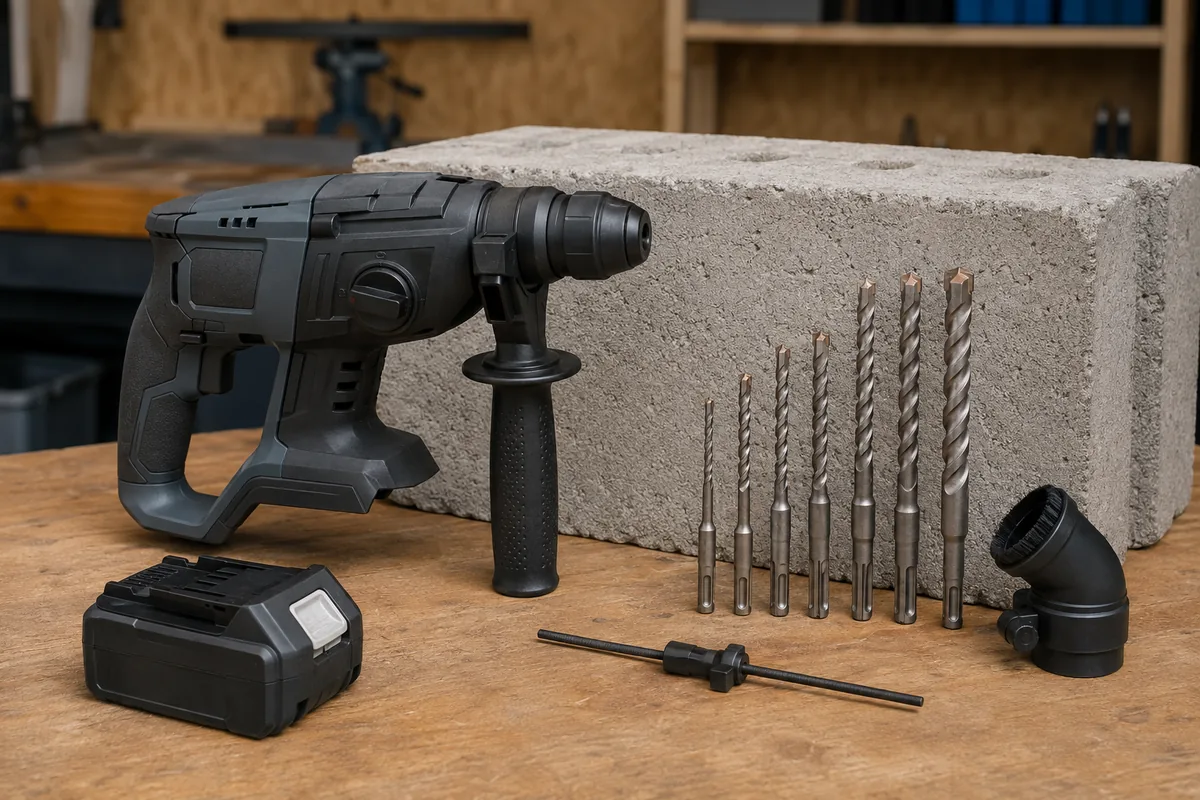
Installing a handful of Tapcon screws does not require the biggest cordless rotary hammer in the store. It does require the right tool: an SDS-Plus rotary hammer with a hammer-drill mode, a depth stop, and enough battery capacity to finish the holes without slowing down.
For most concrete fastening, a compact 18V or 20V SDS-Plus tool is the sweet spot. It drills 3/16-inch and 1/4-inch holes quickly, weighs less than a full-size hammer, and shares batteries with other cordless tools. A 12V model can work for occasional small holes, but it gives up speed and runtime. A larger SDS-Max rotary hammer is unnecessary for ordinary Tapcon installation.
As an Amazon Associate we earn from qualifying purchases at no extra cost to you.


What to look for in a cordless rotary hammer
Tapcon holes are small, but the concrete can be hard, aggregate-heavy, or reinforced. The important specification is not maximum drilling diameter. Look for impact energy around 1 to 2 joules, a no-load speed roughly between 900 and 1,500 rpm, and a hammer rate around 4,000 to 5,000 blows per minute. Those figures describe the compact SDS-Plus class well.
An SDS-Plus chuck is preferable to a standard three-jaw chuck because SDS bits load quickly and transmit impact efficiently. Use a tool with three modes: rotary hammer for concrete, rotation-only for ordinary drilling, and chisel-only for light demolition. The third mode is not necessary for Tapcons, but it makes the tool more useful for removing tile, scraping mortar, or chasing a small channel.
A depth stop is more valuable than a large maximum-capacity number. Set it so the hole is slightly deeper than the screw’s intended embedment. A common starting point is about 1/4 inch deeper than the required embedment, which leaves room for dust at the bottom. Confirm the dimensions printed on your Tapcon package, especially when using longer screws or drilling through a fixture.
Best cordless rotary hammer types for Tapcons
| Tool type | Best use | Advantages | Trade-offs |
|---|---|---|---|
| Compact 12V SDS-Plus | Occasional holes in block or softer concrete | Light, easy to handle, low battery cost | Slower in hard concrete; limited runtime |
| Compact 18V/20V SDS-Plus | Most Tapcon and light anchoring work | Best balance of speed, runtime, and size | More expensive than a basic drill |
| Heavy-duty 18V/20V SDS-Plus | Many holes, hard concrete, small demolition | Faster drilling and stronger sustained performance | Heavier; more tiring overhead |
| SDS-Max rotary hammer | Large holes and serious demolition | High impact energy and large-bit capacity | Overkill for Tapcons; expensive bits and batteries |
For most homeowners, the best purchase is a compact 18V or 20V SDS-Plus cordless rotary hammer. Buy a bare tool if you already own compatible batteries. A kit is often the better value when it includes a 4.0Ah or 5.0Ah battery and charger.
Battery platform and runtime
Battery compatibility should drive the decision more than small differences in published impact energy. If you already use a cordless drill, impact driver, saw, or light, staying on that platform avoids buying another charger and a separate battery family.
A 2.0Ah battery keeps the tool light and is adequate for a few holes. A 4.0Ah or 5.0Ah pack is a better match for repeated drilling, especially in cold weather or dense concrete. Expect the actual hole count to vary widely. A compact rotary hammer may drill dozens of small holes in normal block, but hard concrete, long holes, clogged flutes, and frequent repositioning can cut that number substantially.
High-output batteries can improve sustained performance on some platforms, but they also add weight. For six holes to mount a shelf, the difference is rarely worth buying a new battery. For a masonry-heavy workload, choose the 5.0Ah battery and charger kit available in your existing system.
How to drill Tapcon holes correctly
Use the carbide masonry bit size specified by the Tapcon manufacturer. Do not substitute a generic bit based only on the screw diameter. Tapcon screws commonly use 3/16-inch or 1/4-inch bits, but the correct bit depends on the fastener size and concrete material.
Mark the hole and check for wiring, plumbing, and embedded metal before drilling. Hold the rotary hammer square to the surface. Start slowly until the bit creates a shallow recess, then apply steady pressure. Let the hammer mechanism do the cutting; leaning heavily on the tool can stall it, overheat the motor, and wear the bit without making the hole faster.
Pull the bit out every few seconds on deeper holes to clear dust. A clogged hole can make the screw feel tight before it reaches full depth. It can also leave loose dust between the threads and concrete, reducing holding power. Vacuum the hole after drilling, or use a blow bulb if that is what the fastener instructions allow. Wear eye protection and hearing protection; concrete dust and rotary-hammer noise are not minor irritants.
Driving the screw and avoiding failures
Switch to a compatible driver bit and use the screw manufacturer’s recommended driving method. An impact driver can install Tapcons quickly, but it can also overdrive them. Stop when the fixture is snug. If the head spins past the surface, the threads may be stripped and the anchor’s holding power reduced.
The most common failure is a hole that is too small, too shallow, or full of dust. The second is drilling into a mortar joint or weak edge material when a stronger section of concrete was available. Keep holes away from edges by at least the distance specified for the fastener; if the concrete chips out, move the hole rather than forcing a larger screw into damaged material.
A cheaper compact rotary hammer is fine when you are installing a few 3/16-inch Tapcons in block, brick, or reasonably soft concrete. Spend more for a stronger 18V/20V model when you have dozens of holes, overhead work, dense aggregate, or other masonry jobs planned. If your work is limited to occasional small holes, a cordless SDS-Plus rotary hammer with a masonry bit set is a more useful package than a bare tool with no suitable bits.
Related guides
- Longest Lasting Lawn Mower Battery: AGM vs Lithium vs Flooded Lifespan and Cost per Season
- Duralast Gold Lawn Mower Battery Review: U1 Fit, CCA and When to Pay for AGM
- Greenworks Pro 80V 21-Inch Mower Review: Runtime Math, Push vs Self-Propelled and Yard Fit
- Bosch High Pressure Washer Gun Replacement: Fittings, Adapters and What Fits Your Model