What's inside
As an Amazon Associate I earn from qualifying purchases. This post may contain affiliate links at no extra cost to you.
For detailed cutouts, a cordless jigsaw and a cordless oscillating tool solve different problems. A jigsaw is the faster choice when you need to remove a complete section of wood, laminate, or plastic. An oscillating tool is slower, but it can start in the middle of a panel, trim flush against an obstruction, and make controlled notches with less risk of overcutting.
The right choice depends mainly on the material, the access you have, and whether the cut is a clean visible edge or a small opening that will later be covered. Battery platform compatibility matters too: the best tool is often the one that uses batteries and chargers you already own.
As an Amazon Associate we earn from qualifying purchases at no extra cost to you.



Where a cordless jigsaw wins
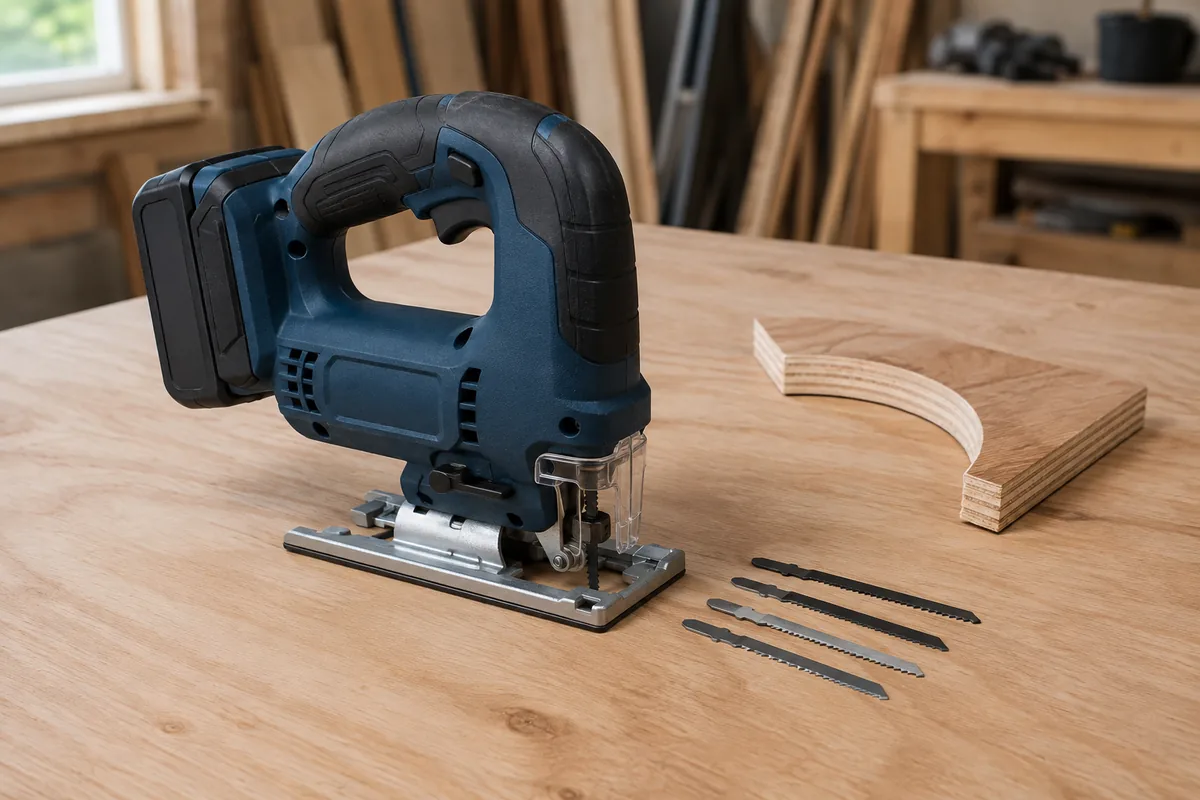
A jigsaw uses a narrow blade that moves up and down, usually with a selectable orbital action. It is designed to follow a line through sheet goods and boards. With the correct blade, it will cut plywood, solid wood, laminate, PVC, and thin metal.
For sink openings, curved shelf cutouts, electrical-box openings in thin panels, and large access holes, a jigsaw is normally the practical option. It cuts much faster than an oscillating tool and leaves a more consistent edge when the shoe is supported flat on the workpiece. A sharp fine-tooth blade can produce a reasonably clean cut in laminate; a coarse blade removes material quickly but is more likely to splinter.
Most jigsaws need a starter hole before making an interior cut. The hole must be wider than the blade, commonly about 3/8 inch (10 mm), and it needs to sit fully inside the waste area. If the hole is too close to the layout line, the blade can wander into the finished edge.
A jigsaw is less convenient when the panel is already installed against a wall or cabinet. The base needs room to sit flat, and the blade extends below the workpiece. It can also make a longer cut than intended if the blade catches, especially in thin material.
If most of your detailed cutouts are in wood or sheet goods, a cordless jigsaw bare tool is usually the better first purchase. Choose one that accepts common T-shank blades, has a variable-speed trigger, and offers a visible cut line. A light, compact model is often easier to control than a high-powered saw.
Where an oscillating tool wins
An oscillating multi-tool swings its blade through a small arc rather than making a full reciprocating stroke. It is not a fast sheet-cutting saw. Its advantage is control in tight spaces.
You can plunge-cut directly into drywall, plywood, flooring, plastic, or trim without drilling a starter hole. That is useful for cutting an outlet opening, trimming a door jamb, removing a damaged section of flooring, or making a notch around a pipe. A narrow bi-metal or carbide blade can also cut nails and screws that a jigsaw blade would simply hit and stop against.
The tool is easier to keep within a short layout line. You can stop at a corner, back out, and approach from another direction. Flush-cut blades let you trim a door casing or a row of shims without removing the surrounding material.
Its limitations are equally important. Blades are consumables, and quality plunge blades can cost several dollars each. Cutting a 12-inch opening in 3/4-inch plywood may take several minutes and can overheat a cheap blade. The tool also produces substantial vibration and noise. Holding it hard against the workpiece reduces control and can cause the blade to bend or burn the edge.
For repair work, installed materials, and short plunge cuts, compare cordless oscillating multi-tools with attention to vibration control, variable speed, and blade availability. A tool with a quick-change system is convenient, but the replacement blades still need to match the mount and the material.
Jigsaw versus oscillating tool
| Factor | Cordless jigsaw | Cordless oscillating tool |
|---|---|---|
| Best cut length | Long cuts and large openings | Short cuts, notches, and repairs |
| Interior cut | Usually needs a 3/8-inch starter hole | Plunge-cuts without a hole |
| Speed in 1/2-inch plywood | Fast; commonly seconds per foot, depending on blade | Slow; often minutes for a large opening |
| Edge quality | Good with support and the right blade | Controlled, but commonly rougher |
| Access | Needs room for the shoe and blade below | Works close to walls, trim, and installed fixtures |
| Hidden fasteners | Stops or damages the blade | Can cut some nails and screws with a bi-metal blade |
| Main failure mode | Blade wandering, splintering, or overcutting | Blade overheating, bending, or wearing out |
Battery platform and runtime
Neither tool normally needs a large battery for occasional cutouts. A compact 2.0Ah or 2.5Ah pack keeps the tool lighter and is enough for many trim or drywall jobs. A 4.0Ah or 5.0Ah pack makes more sense for repeated plywood cuts, thick hardwood, or demolition work, although it adds weight.
Use the same voltage platform as your drill and impact driver when possible. Buying a bare tool can save the cost of another charger and battery. If you are starting from zero, compare the cost of the kit rather than the tool alone. A cheaper tool from a new ecosystem may cost more after adding a charger and two batteries.
Runtime is affected more by blade condition and material than by the tool’s advertised voltage. A dull jigsaw blade forces the motor to work harder. A worn oscillating blade cuts slowly and creates heat. Keep a spare battery available for long jobs, but replace the blade before assuming the battery is the problem.
How to make cleaner cutouts
Mark the cut on painter’s tape when working on laminate, finished wood, or painted surfaces. Clamp the workpiece, support the waste so it cannot tear away at the end, and cut with the finished face oriented according to the blade’s tooth direction. On many jigsaws, that means placing the finished face down to reduce top-surface tear-out; verify with a test cut because blade designs vary.
For a jigsaw, use a fine-tooth blade, turn orbital action down or off for a visible edge, and let the blade feed at its own pace. For an oscillating tool, start at a moderate speed, keep the blade square, and make several shallow passes rather than forcing full depth immediately. A straightedge or plunge-cut guide helps prevent the blade from drifting.
When the cutout will be hidden by a plate, trim ring, or countertop fixture, precision matters less. In that situation, the cheaper option is often fine: an oscillating tool is a sensible buy for one or two small openings, while a jigsaw is unnecessary if you already have a drill and the cut will be covered. For repeated cabinet, flooring, or woodworking cutouts, the jigsaw’s speed quickly justifies its place in the cordless kit.
Which tool should you buy?
Buy the cordless jigsaw if your work involves curves, large openings, plywood, boards, or repeated cuts where speed and edge quality matter. Buy the oscillating tool if you mostly repair installed materials, need flush cuts, work around obstructions, or want plunge cuts without drilling.
If your budget allows only one tool and you already own a drill, the oscillating tool covers more repair situations. If you are building a woodworking-focused cordless setup, choose the jigsaw first. Many homeowners eventually keep both: the jigsaw removes the bulk of the material, while the oscillating tool handles the awkward corners and final fitting.
FAQ
Which tool should you buy?
Related guides
- Longest Lasting Lawn Mower Battery: AGM vs Lithium vs Flooded Lifespan and Cost per Season
- Duralast Gold Lawn Mower Battery Review: U1 Fit, CCA and When to Pay for AGM
- Greenworks Pro 80V 21-Inch Mower Review: Runtime Math, Push vs Self-Propelled and Yard Fit
- Bosch High Pressure Washer Gun Replacement: Fittings, Adapters and What Fits Your Model