What's inside
As an Amazon Associate I earn from qualifying purchases. This post may contain affiliate links at no extra cost to you.
Paint correction is one of the jobs where cordless tools are genuinely useful. You are not dragging a power cord across a freshly washed car, and you can work around bumpers, mirrors, and a driveway without hunting for an outlet. The trade-off is runtime: polishing consumes battery power quickly, especially with a long-throw dual-action (DA) machine or a rotary running at high speed.
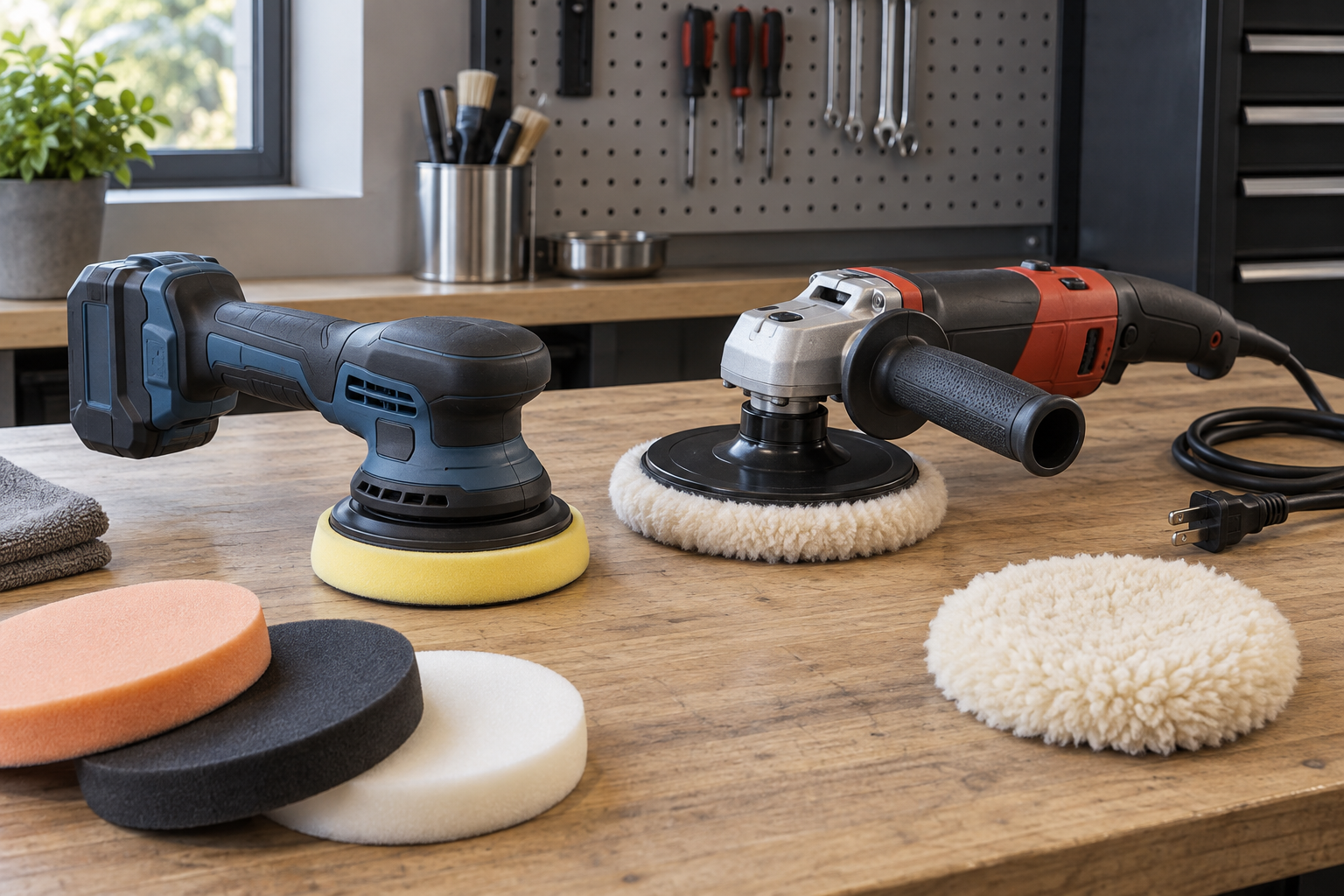
The best cordless polisher depends less on peak speed than on the type of correction you do. A dual-action polisher is the safer choice for most owners because its orbit reduces the chance of creating holograms or burning through clear coat. A rotary polisher cuts faster, but it concentrates heat and requires more control. For occasional swirl removal, choose a cordless DA. For heavy oxidation, wet-sanding marks, or professional production work, a rotary can make sense.
As an Amazon Associate we earn from qualifying purchases at no extra cost to you.


Choose the right polisher type
| Type | Best use | Main advantage | Main risk |
|---|---|---|---|
| Short-throw DA, 8–12 mm | Waxing, light swirls, finishing | Easy to control and usually efficient | Slow on deep defects |
| Long-throw DA, 15–21 mm | Faster correction on large panels | More correction per pass | Higher battery use and pad walking |
| Rotary | Heavy cutting and professional correction | Fastest material removal | Can create holograms or burn paint |
For a first machine, a 5-inch backing plate and a 12 mm DA is a sensible middle ground. It fits common 5- and 5.5-inch pads, handles curved panels better than a 6-inch plate, and is less tiring than a large long-throw machine. A 6-inch tool covers a hood or roof faster, but it is awkward around pillars, door handles, and tight bumper contours. Some machines accept interchangeable plates; that is useful, but check the manufacturer’s approved plate size rather than assuming every plate is safe.
The battery platform matters more than a small speed difference
A cordless polisher is a poor reason to buy into an entirely new battery system. If you already own several batteries, stay with that platform unless its tools are unsuitable. Milwaukee M18, DeWalt 20V Max, Makita 18V LXT, and Ryobi 18V all have broad cordless tool ranges and readily available replacement batteries. Flex 24V and other premium systems may offer strong performance, but their batteries and chargers cost more and provide fewer tool choices.
Use a high-capacity battery, generally 5.0 Ah or larger. A compact 2.0 Ah pack makes the tool lighter, but it may provide only a short working session under load. In practical terms, plan on roughly 15 to 30 minutes of active polishing from one pack, depending on speed, pressure, pad size, paint hardness, and battery capacity. That does not mean the battery lasts only 15 minutes in the driveway; you spend time wiping residue, changing pads, inspecting the panel, and moving around the vehicle.
A second battery is more useful than a faster charger if you are correcting an entire vehicle. Keep one pack on the tool and one charging. Expect a charger to need approximately 45 to 90 minutes for a large pack, depending on the battery and charger. Very fast chargers can help, but they may produce more heat and add cost. If your current ecosystem has only small batteries, compare the cost of two high-capacity packs and a charger before buying the tool.
For shoppers starting from zero, compare cordless dual-action polisher kits that include a battery and charger. Kit pricing is often substantially better than buying those parts separately. If you already own batteries, a bare tool is usually the cheaper option.
Features worth paying for
Variable speed is essential. A useful range is roughly 2,000 to 5,000 orbits per minute for a DA, or about 600 to 3,000 rpm for a rotary. Low speed helps spread compound and finish delicate areas; high speed improves cutting but also builds heat. A lock-on switch is convenient for long panels, while a trigger with a speed dial gives better control around edges.
Soft-start is another worthwhile feature. It prevents the pad from flinging polish when the tool starts. Electronic speed control helps maintain speed when you apply moderate pressure, but it cannot overcome excessive force. If the pad stops rotating on a DA, reduce pressure, flatten the tool, or use a smaller pad. Do not keep leaning on it; that creates heat without improving correction.
Look for a balanced grip, a rubberized head, and a battery position that does not make the tool top-heavy. A bare tool weighing around 5 to 6.5 pounds before the battery is manageable. Add a large battery and hold it at shoulder height for ten minutes, and the difference becomes obvious. A side handle is useful on a rotary and during heavy cutting, but many detailers prefer a compact head handle on a DA.
Dust protection and sealed switches matter in a garage environment, although no polisher should be sprayed with water. Cooling vents can pull in compound dust, so blow them out with clean, dry air after each job. Keep the battery away from direct sun and let a hot pack cool before charging.
Practical buying recommendations
For most DIY paint correction, buy a cordless 5-inch DA on the battery platform you already use, with at least two 5.0 Ah batteries. Pair it with a medium-cut foam or microfiber pad and a finishing foam pad. This setup is slower than a corded professional machine, but it is forgiving and versatile. Browse 5-inch cordless DA bare tools if you already own compatible packs.
A 15 mm or 21 mm long-throw DA is worthwhile when you regularly correct large vehicles and want fewer passes. It is not automatically better: the longer orbit can hop on curved panels, uses more battery, and may be excessive for a small hatchback. Choose it when speed matters more than compact handling.
Choose a cordless rotary only if you already understand pad angle, edge control, and heat management. Start around 800 to 1,000 rpm, keep the pad moving, and inspect the panel frequently. Stay away from sharp edges until you have experience. If your work is mainly wax application and light gloss improvement, a rotary is unnecessary expense and risk; a small DA or even a corded random-orbit polisher is the better value.
How to avoid the common failures
Wash and decontaminate the paint first, then test a small area. Use the least aggressive pad and compound combination that produces the result you need. Work an area of roughly 2 by 2 feet with overlapping passes, wipe it clean, and inspect under strong light. If the defect remains, make one more pass before moving to a more aggressive pad.
Do not chase every scratch. If a defect catches your fingernail, it may be through the clear coat and polishing will not remove it safely. Edges and body lines have less paint and can burn through quickly, particularly with a rotary or microfiber cutting pad. Keep the pad clean, change pads when they become saturated, and use several pads rather than forcing one dirty pad through the entire vehicle.
For a broader selection of compatible batteries and chargers, compare 5.0 Ah battery and charger kits for your existing platform. The best cordless polisher is the one you can balance comfortably, keep supplied with charged batteries, and control well enough to improve the paint without creating a new repair.
Related guides
- Longest Lasting Lawn Mower Battery: AGM vs Lithium vs Flooded Lifespan and Cost per Season
- Duralast Gold Lawn Mower Battery Review: U1 Fit, CCA and When to Pay for AGM
- Greenworks Pro 80V 21-Inch Mower Review: Runtime Math, Push vs Self-Propelled and Yard Fit
- Bosch High Pressure Washer Gun Replacement: Fittings, Adapters and What Fits Your Model