What's inside
As an Amazon Associate I earn from qualifying purchases. This post may contain affiliate links at no extra cost to you.
Best RIDGID Shop Vacs for Workshop Dust, Debris, and Wet Messes
The best RIDGID shop vac depends on what you collect: choose a compact 4–6-gallon model for occasional cleanup in a tight shop, a 9–12-gallon vac for general woodworking, or a 14–16-gallon model for long sessions and bulky debris. For fine sawdust, prioritize a compatible HEPA filter and a dust-collection setup; tank size and peak horsepower alone won’t determine how well a vac captures airborne dust.
RIDGID’s lineup spans compact wet/dry vacs and larger workshop models, but exact specifications can vary by model number and revision. The table below compares common capacity classes rather than promising that every model in a class has identical airflow or accessories. Check the current product label or manual before buying, especially for CFM, hose diameter, filter compatibility, and included attachments.
As an Amazon Associate we earn from qualifying purchases at no extra cost to you.
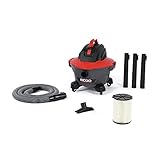


Compare RIDGID shop vac sizes for workshop use
| Tank class | Typical hose diameter | Practical airflow target | Best fit | Main trade-off |
|---|---|---|---|---|
| 4–6 gal | 1-7/8 in. on many compact setups; verify model | About 70–100 CFM | Small shops, benchtop tools, quick spills, car interiors | Fills quickly with chips; smaller hoses clog more easily |
| 9–12 gal | 1-7/8 or 2-1/2 in., depending on model and hose | About 100–150 CFM | General-purpose woodworking and mixed wet/dry cleanup | Needs floor space; airflow depends on the filter and hose setup |
| 14–16 gal | Often 2-1/2 in. for larger debris; confirm included hose | About 150–200 CFM for higher-capacity configurations | Frequent cleanup, larger debris, and longer work sessions | Bulky to store and move; a full tank is heavy |
Airflow figures are selection targets, not guaranteed specifications for every RIDGID model. CFM is affected by the test method, hose length, filter condition, and attachments; compare published figures on the exact models you’re considering.
Choose by the work you actually do
For a small shop or occasional cleanup: 4–6 gallons
A compact RIDGID shop vac makes sense if storage is limited or you mostly clean a workbench, handheld-tool area, vehicle, or small spill. It is easier to carry and tuck away than a large drum. The compromise is capacity: a few bags of planer shavings or a pile of routing chips can fill a small tank surprisingly fast. Empty it before the debris reaches the filter or float mechanism, rather than waiting for suction to fall off.
For most woodworking shops: 9–12 gallons
This middle size is usually the most useful all-rounder for a garage shop. It has room for ordinary floor cleanup without making every move a chore, and it can handle wet pickup when configured according to the manual. Look for a model with a 2-1/2-inch hose if you regularly collect larger chips; a narrower hose is easier to route around a bench but more prone to clogging on bulky waste.
For frequent cleanup or bulky debris: 14–16 gallons
Choose a larger tank when you work often, clean a large floor area, or don’t want to stop repeatedly to empty the vac. More capacity does not automatically mean better dust collection at a saw. A large tank can still perform poorly at a tool port if the hose is too long or narrow, the filter is loaded, or the tool’s dust outlet needs more airflow than the vacuum can deliver.
What CFM and hose diameter mean at the tool
CFM measures airflow, while sealed suction describes how forcefully a vacuum can lift water or debris when airflow is restricted. For woodworking, useful airflow through the whole setup matters more than a single headline number. A short, wide hose generally moves chips more freely; a smaller hose is lighter and easier to connect to portable tools, but can restrict airflow and plug with larger shavings.
- For fine dust at a sander: use a close-fitting adapter, keep the hose short, and avoid unnecessary bends.
- For a table saw or planer: check the tool’s dust-port size and collection requirements. A shop vac may be suitable for a small port or light-duty cleanup, while larger machines may need a dedicated dust collector.
- For floor debris and liquid: a wider hose and floor nozzle are more convenient than a narrow tool hose.
Adapters can make mismatched ports connect, but they do not restore airflow lost through a small hose or restrictive fitting. If suction seems weak, inspect the filter and hose for blockage before assuming the motor is failing.
Fine sawdust: HEPA filter compatibility matters
For sanding dust and other fine particles, verify that the exact RIDGID vac accepts the specific HEPA filter listed for that model. Compatibility is not universal across tank sizes or generations, and a standard cartridge filter should not be treated as a HEPA filter. A compatible filter is only one part of the system: a poorly seated filter, leaking hose connection, or open exhaust path can let dust escape.
For the best practical setup, use the correct HEPA-rated filter and a dust bag or collection bag that the manual specifies as compatible. Bags help contain debris during emptying and can keep the filter from loading as quickly. They are consumables, so include replacement costs in your ownership estimate. Do not use a bag or filter for wet pickup unless the product instructions explicitly allow it.
A quick setup and maintenance routine
- Match the filter to the job. Use the filter and bag arrangement prescribed for dry dust, and change configurations for wet pickup as directed by the manual.
- Check the seal. Seat the filter correctly and make sure the lid, hose, and tool adapter are secure; small leaks can undermine fine-dust capture.
- Keep the hose clear. Remove packed chips and check elbows or adapters when airflow drops.
- Empty before overfilling. A tank piled up to the filter can restrict airflow, while liquid pickup requires watching the float shutoff and emptying the tank promptly.
- Clean or replace filters correctly. Follow the filter’s care instructions. Some filters can be cleaned; others should be replaced rather than washed. Let a washable filter dry fully before reinstalling it.
The parts most likely to need attention are filters, bags, hose ends, and plastic fittings—not just the motor. Dragging a vac by its hose, storing it with a wet filter, or forcing oversized debris through a narrow hose can shorten the life of those components. Keep the hose supported when moving the unit and store the vac dry after wet pickup.
Bottom line
For a typical woodworking garage, start with a 9–12-gallon RIDGID model and choose the widest practical hose that fits your tools. Go smaller when portability and storage matter more than capacity; go up to 14–16 gallons for frequent cleanup and bulky waste. If fine sawdust is the priority, confirm model-specific HEPA-filter compatibility and use a sealed, well-maintained setup rather than relying on tank size or peak horsepower.