What's inside
As an Amazon Associate I earn from qualifying purchases. This post may contain affiliate links at no extra cost to you.
Best 220V Welder Outlets for Safe Workshop Installation
The best 220V welder outlet is the receptacle specified by your welder’s plug and installation manual, on a correctly sized circuit—not simply the outlet with the highest amp rating. For many portable welders, a NEMA 6-50R on a dedicated 50-amp, 240-volt branch circuit is common, but other machines use different plugs and requirements. Check the welder’s nameplate and manual before buying either an outlet or a plug adapter.
Choose by welder and installation
In North American workshops, “220V” commonly refers to nominal 240-volt single-phase service. A receptacle marked 250V is normally intended for this class of supply. The receptacle configuration identifies the plug pattern and grounding arrangement; it does not, by itself, establish that the circuit, wiring, or welder is safe at a particular current.
As an Amazon Associate we earn from qualifying purchases at no extra cost to you.

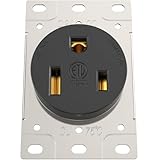


| Receptacle type | Typical rating and configuration | Good fit when | Check before choosing |
|---|---|---|---|
| NEMA 6-50R | 50A, 250V; two hot conductors and equipment ground | The welder has a matching 6-50P plug and its manual allows a 50A supply | Confirm breaker, conductor sizing, terminal range, and installation method |
| NEMA 6-30R | 30A, 250V; two hot conductors and equipment ground | A lower-input-current machine is supplied with a matching 6-30P plug | Do not use it for a machine whose plug or instructions require a 50A circuit |
| NEMA 14-50R | 50A, 125/250V; two hot conductors, neutral, and ground | The equipment specifically has a 14-50P plug or the installation calls for this configuration | A welder’s 6-50 plug is not interchangeable; an unused neutral does not make the plugs compatible |
| Hardwired connection | Set by the equipment instructions and local code | The welder is designed to be permanently connected rather than plugged in | Use the specified disconnect, wiring method, and overcurrent protection |
These are common North American configurations, not a universal list of suitable outlets. A receptacle’s face pattern is only one part of the selection. The circuit must also satisfy the welder’s input-current requirements, applicable electrical code, and the receptacle manufacturer’s conductor and temperature ratings.
Match amperage to the welder—not the output dial
A welder’s advertised welding output, such as 200A, is not the same as the input current drawn from the building circuit. Look for the input rating on the nameplate and in the manual. Manufacturers may state input amps, recommended breaker size, duty cycle, and a permitted range of supply voltage. Use those instructions to determine the branch circuit and receptacle.
Do not assume that putting a 30A receptacle on a 50A breaker is safe, or that installing a 50A outlet makes undersized wiring suitable. The breaker protects the branch-circuit conductors; the receptacle, conductors, breaker, and welder must be compatible as a system. Welders can also have specific code provisions for conductor and overcurrent sizing, so a generic online wire chart is not a substitute for the equipment instructions and local requirements.
Wire, distance, and installation details
Many 240V welder circuits use two ungrounded conductors and an equipment grounding conductor. A neutral is needed only when the equipment or receptacle configuration calls for one; it is not a substitute for ground. The correct conductor size depends on the welder, breaker, conductor material, insulation temperature rating, cable or raceway method, terminal ratings, ambient conditions, and local code.
Distance matters, too. A long run can increase voltage drop, particularly when the welder is drawing heavily. Have the installer account for the run length rather than automatically using the minimum conductor size from a short-run example. For a cord-connected welder, use a cord of the type and rating allowed by its manual, and keep it as short as practical. Do not use a household extension cord or a light-duty adapter to make an incompatible setup work.
For a fixed installation, a qualified electrician can verify the panel capacity, breaker compatibility, grounding and bonding, conductor routing, receptacle box, and required permits or inspections. This is especially important in older workshops, where the panel may have limited capacity or the existing wiring may not have an equipment ground. Turn off and verify power before any work; a 240V circuit can cause severe injury or fire.
Plug compatibility: avoid the adapter trap
Compare the exact NEMA designation on the welder’s plug with the receptacle listing. “Three-prong” or “four-prong” is not enough: different patterns can have different voltage, current, and grounding arrangements. A 6-50P plug, for example, does not fit a 14-50R, and changing the outlet face does not change the circuit’s capacity.
Adapters can conceal an undersized circuit or defeat intended protection. Use one only if the welder manufacturer explicitly permits that configuration and the adapter is rated for the full load and correctly wired. Never remove or defeat the grounding pin. If the plug and outlet do not match, ask the manufacturer or an electrician whether the circuit should be changed or whether a listed, properly rated solution is permitted.
Indoor, outdoor, and dusty workshop use
In a dry indoor shop, choose a listed receptacle and enclosure appropriate to the location, with a cover that protects the outlet when it is not in use. Near a garage door, washdown area, or outdoor welding station, moisture, dust, and metal debris can enter a poorly protected connection. Select an enclosure and cover rated for the actual exposure and follow local requirements for ground-fault protection and other location-specific safeguards.
Weather resistance does not mean a connection can be left exposed while in use. Keep the receptacle away from rain, standing water, grinding sparks, and hot work. A covered outdoor box should allow the plug and cord to be used in the manner its listing permits; do not force the cover shut or leave a connection lying on the ground.
Which setup makes sense?
| Your situation | Practical direction | Why |
|---|---|---|
| New welder, plug and manual specify 6-50 | Have a dedicated circuit and listed 6-50R installed to match the equipment requirements | A direct match avoids improvised adapters; the circuit still needs proper design |
| Small machine with a 6-30 plug | Use a correctly rated 6-30R circuit if allowed by the manual | A 50A outlet is not automatically an upgrade and may not provide the intended protection |
| Several welders with different plugs | Plan separate correctly rated circuits or manufacturer-approved connections | One “universal” receptacle cannot safely resolve different circuit requirements |
| Outdoor or damp work area | Use a suitable listed enclosure and location-appropriate protection, installed to code | Ingress protection and installation details matter as much as the receptacle pattern |
| Uncertain panel, wiring, or plug rating | Pause the purchase and have an electrician assess the system | Replacing only the receptacle can leave a hidden wiring or breaker hazard |
Buying checklist
- Read the welder’s nameplate and manual for input voltage, current, plug type, and circuit instructions.
- Match the receptacle pattern to the actual plug; do not shop by “220V” alone.
- Confirm the breaker, conductors, grounding, and receptacle are designed together for the installation.
- Check that the receptacle is listed and that its terminals accept the conductor material and size being used.
- Choose a suitable enclosure and cover for dust, moisture, and physical exposure.
- Have a qualified electrician review panel capacity and local permit or inspection requirements when installing a new circuit.
For many common plug-in welders, a properly installed 6-50R is the right choice—but only when the machine’s plug and electrical instructions call for it. The safest purchase is the receptacle that matches the welder and a verified circuit, not the one with the biggest number on its face.