What's inside
- Quick comparison of the picks
- Best overall: Milwaukee M12 FUEL stubby 3/8-inch (2562-20)
- Best compact: Milwaukee M12 FUEL subcompact 3/8-inch (3049-20)
- Best for tight spaces: Milwaukee M12 FUEL right-angle 3/8-inch (2564-20)
- Best for 1/2-inch sockets in tight spots: Milwaukee M12 FUEL right-angle 1/2-inch (2565-20)
- Best for DeWalt owners: DeWalt Xtreme 12V DCF902B
- How to choose a 12V impact wrench
- Ownership realities
- Which one fits your situation
- 12V or 18V impact wrench?
- Using an impact wrench safely and accurately
- Frequently Asked Questions
As an Amazon Associate I earn from qualifying purchases. This post may contain affiliate links at no extra cost to you.
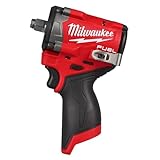
The best 12-volt impact wrench for most mechanics and woodworkers is the Milwaukee M12 FUEL 3/8-inch stubby impact wrench (2562-20), which Milwaukee rates at up to 550 ft-lbs of nut-busting torque in a tool that weighs about 2.2 pounds bare. If you want something smaller, the M12 FUEL 3/8-inch subcompact (3049-20) is lighter and shorter, and for tight spaces the right-angle models are the ones to look at. A 12V impact wrench is for automotive, equipment and general repair work where a larger 18V wrench would not fit.
Torque figures on impact wrenches come in two forms that are easy to confuse. “Fastening torque” is the torque the tool can reliably deliver when tightening, and “nut-busting torque” is the peak breakaway torque for loosening stuck fasteners. Both numbers are published by the maker, and they are what this guide compares. The figures below are from the Milwaukee product pages and independent review coverage, and the DeWalt entry is hedged because its numbers differ between sources.
As an Amazon Associate we earn from qualifying purchases at no extra cost to you.


Our Top Picks
Quick comparison of the picks
| Pick | Best for | Drive | Key specs (per maker’s sheets) | Price range |
|---|---|---|---|---|
| Milwaukee M12 FUEL stubby 2562-20 | Best overall | 3/8 in. | Up to 550 ft-lbs nut-busting, 0 to 3,000 RPM, about 2.2 lb bare | Mid to upper |
| Milwaukee M12 FUEL subcompact 3049-20 | Best compact | 3/8 in. | 225 ft-lbs nut-busting, 200 ft-lbs fastening, 0 to 3,400 RPM, about 1.6 lb bare | Mid to upper |
| Milwaukee M12 FUEL right-angle 2564-20 | Best for tight spaces | 3/8 in. | Up to 220 ft-lbs, head height about 2.2 in. | Mid to upper |
| Milwaukee M12 FUEL right-angle 2565-20 | Best for 1/2 in. sockets in tight spots | 1/2 in. | Right-angle 1/2 in. drive, sold in a set with the 3/8 in. | Mid to upper |
| DeWalt Xtreme 12V DCF902B | Best for DeWalt owners | 1/2 in. | Brushless, torque in the 200+ ft-lbs class (confirm on DeWalt’s sheet) | Mid-range |
Comparisons of 12V wrenches mostly cover Milwaukee. Makita and Bosch also sell 12V impact tools, but verified specification detail for those was thin, so they are not ranked here.
Best overall: Milwaukee M12 FUEL stubby 3/8-inch (2562-20)
The stubby is the best balance of power and size in the 12V class. Milwaukee quotes up to 550 ft-lbs of nut-busting torque, a speed of up to 3,000 RPM and a weight of about 2.2 pounds as a bare tool. That is enough torque to loosen many lug nuts that are not overtightened, remove suspension bolts and work on equipment such as lawn tractors and trailers. It is short enough to fit in a tool bag with the rest of an M12 kit.
The trade-off is that real-world torque on stubborn fasteners depends on the battery. A larger high-output battery gives more consistent performance than a small compact pack. And for stuck lug nuts on large trucks, an 18V wrench is the safer choice.
Best compact: Milwaukee M12 FUEL subcompact 3/8-inch (3049-20)
The 3049-20 is the lightest of the group, weighing about 1.6 pounds bare. It has 200 ft-lbs of fastening torque and 225 ft-lbs of nut-busting torque, with a speed up to 3,400 RPM. A friction ring holds sockets on securely. It’s very comfortable for repeated work in engine bays.
The trade-off is that it is a less powerful tool than the stubby, so it will struggle with rusted or over-torqued fasteners.
Best for tight spaces: Milwaukee M12 FUEL right-angle 3/8-inch (2564-20)
With a head profile of about 2.2 inches, the right-angle wrench reaches bolts that a straight tool cannot, such as those between a frame rail and a firewall. Milwaukee gives it up to 220 ft-lbs of torque.
The trade-off is lower torque than the stubby and a higher price per ft-lb. It is a specialist tool, not a first wrench.
Best for 1/2-inch sockets in tight spots: Milwaukee M12 FUEL right-angle 1/2-inch (2565-20)
This model is the 1/2-inch right-angle version and is sold in a set with the 3/8-inch right angle. It uses the larger drive size, which suits sockets and extensions that are more common for suspension and brake work.
The trade-off is price and overlap: if you only need one right-angle wrench, the 3/8-inch is usually enough.
Best for DeWalt owners: DeWalt Xtreme 12V DCF902B
DeWalt’s 12V Xtreme line includes a brushless 1/2-inch impact wrench designated DCF902B. Reader comments on one review cite 250 ft-lbs of fastening torque and 400 ft-lbs of breakaway torque, but these figures are not from DeWalt’s own sheet, so confirm them on DeWalt’s product page before you buy. It is a good option for DeWalt users who want a compact wrench that uses the same batteries as their Xtreme drill and impact driver.
The trade-off is that the Xtreme platform is smaller than Milwaukee’s M12 range.
How to choose a 12V impact wrench
Drive size
A 3/8-inch drive is the standard for 12V wrenches and fits most automotive sockets for fasteners up to about 19 mm. A 1/2-inch drive offers stronger sockets for lug nuts and suspension, but is bulkier.
Fastening versus nut-busting torque
For tightening, look at the fastening torque. For loosening, the nut-busting number is the one to check. A tool with 200 ft-lbs fastening and 225 ft-lbs nut-busting is a different tool from one rated 550 ft-lbs nut-busting. For most car work, 150 to 250 ft-lbs of fastening torque is enough.
Worked example: lug nuts
Most passenger cars specify lug nut torque between 80 and 100 ft-lbs. A wrench rated for 200 ft-lbs fastening can drive them on, but an impact wrench is not precise, so you should finish tightening with a torque wrench. For loosening, factory torque plus corrosion often means 120 to 150 ft-lbs of breakaway, which a 225 ft-lbs nut-busting tool usually handles, while a seized nut may need more than the subcompact can deliver. These are rule-of-thumb figures, not measured results.
Size and weight
The subcompact weighs about 1.6 pounds and the stubby about 2.2 pounds, both bare. Add about 0.5 pound for a compact battery and 0.8 pound for a larger one. Lighter tools reduce fatigue when working overhead.
Battery choice
A compact 2Ah pack stores 24 Wh, and a 4Ah pack 48 Wh. Larger packs sustain current better under heavy loads, so use the larger pack when breaking loose stubborn bolts.
Ownership realities
- Use impact-rated sockets: chrome sockets can crack under impact. Use black oxide impact sockets.
- Finish with a torque wrench: impact wrenches over-tighten easily, which can warp brake rotors or strip threads.
- Avoid long extensions: a long extension absorbs torque and reduces the tool’s effective power.
- Battery heat: hard use heats the pack. Let it cool before charging.
Which one fits your situation
| Situation | Pick |
|---|---|
| One 12V wrench for car and equipment work | Milwaukee 2562-20 |
| Engine bay work, light weight | Milwaukee 3049-20 |
| Bolts you cannot reach with a straight tool | Milwaukee 2564-20 or 2565-20 |
| Already own DeWalt Xtreme batteries | DeWalt DCF902B |
12V or 18V impact wrench?
A 12V wrench is the better tool when access and weight matter, but it has a lower ceiling. This table gives rough ranges to help decide, drawn from the maker figures above and typical 18V class specifications.
| Factor | 12V wrench | 18V wrench |
|---|---|---|
| Weight (bare) | About 1.6 to 2.2 lb | About 3 to 4 lb |
| Length | Short, fits engine bays | Longer, may not fit |
| Nut-busting torque | About 225 to 550 ft-lbs for Milwaukee FUEL | Often 1,000 ft-lbs or more |
| Best use | Interior, engine, bike and equipment repair | Lug nuts on trucks, rusted suspension bolts |
The practical advice is that a 12V wrench is a very good second wrench for tight places, and a poor only wrench if you regularly work on trucks or old, rusted vehicles.
Using an impact wrench safely and accurately
- Select an impact socket. Impact-rated sockets are thicker and made from a tougher alloy, so they do not shatter.
- Seat the socket fully. A partly seated socket can round off the fastener and slip.
- Start the fastener by hand. This prevents cross-threading, which an impact wrench makes worse.
- Use short bursts. When tightening, use short trigger pulls and stop as the impact sound speeds up. Over-tightening can stretch bolts.
- Finish with a torque wrench. For lug nuts, brake components and engine parts, torque to the specification.
- Wear eye protection. Rust and debris can fly off during loosening.
Frequently Asked Questions
Can a 12V impact wrench remove lug nuts?
Often yes, if they are not overtightened. A stubby with 550 ft-lbs nut-busting torque handles many, but a stuck nut on a truck may need an 18V or pneumatic wrench.
Is 3/8-inch or 1/2-inch better?
3/8-inch is lighter and more compact and fits most small-bolt work. 1/2-inch suits larger sockets and heavier fasteners.
What is the difference between fastening and nut-busting torque?
Fastening torque is what the tool can deliver when tightening. Nut-busting torque is the peak force for loosening stuck fasteners.
Do I need a FUEL model?
FUEL is Milwaukee’s brushless line. It delivers more torque and runtime than the older brushed models, and it is worth the extra cost for regular use.
Can I use a 12V impact wrench in woodworking?
Yes, for driving lag screws and hanger bolts, and for assembling workbenches. Use the appropriate hex or socket adapters.