What's inside
- What Does a Ryobi 1/2-Inch Impact Wrench Mean?
- Which Ryobi 1/2-Inch Impact Wrench Should You Choose?
- How to Check Ryobi 1/2-Inch Impact Wrench Battery Compatibility
- How to Use a Ryobi 1/2-Inch Impact Wrench Safely
- How Much Torque Do You Need?
- What Accessories Do You Need?
- Common Mistakes When Buying a Ryobi Impact Wrench
- Frequently Asked Questions
- Final Verdict
As an Amazon Associate I earn from qualifying purchases. This post may contain affiliate links at no extra cost to you.
A Ryobi 1/2-inch impact wrench is a useful cordless tool for removing lug nuts, loosening stubborn fasteners, and handling automotive maintenance. The right model depends on the fasteners you work with, the torque required, and whether you already own compatible Ryobi batteries.
The most important distinction is between the tool’s advertised breakaway torque and its tightening torque. A wrench may advertise a high breakaway figure without being suitable for tightening every fastener to a specified torque. For vehicle wheels and other critical joints, use a properly calibrated torque wrench to complete tightening according to the equipment manufacturer’s specifications.
Ryobi sells impact wrenches with different power levels and features, so check the complete model number before buying. A 1/2-inch drive describes the square anvil that accepts compatible sockets; it does not indicate the tool’s torque output or battery compatibility.
What Does a Ryobi 1/2-Inch Impact Wrench Mean?
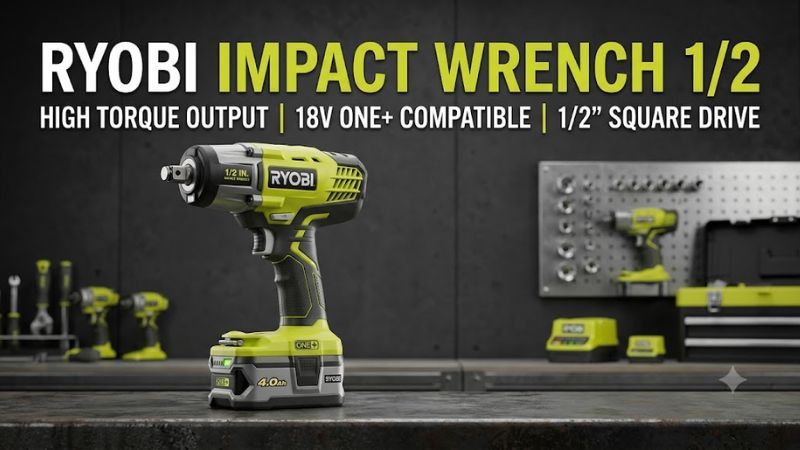
A 1/2-inch impact wrench uses a square drive designed for sockets with a matching 1/2-inch drive opening. It combines rotational force with repeated impacts to loosen or tighten threaded fasteners.
The 1/2-inch drive size is common for automotive maintenance because it accommodates many sockets used on passenger vehicles, light trucks, and other equipment. However, socket size, fastener size, and required torque are separate specifications.
| Feature | What it means | Why it matters |
| 1/2-inch drive | Size of the square socket attachment | Determines which drive-size sockets fit |
| Breakaway torque | Advertised ability to loosen a tightened fastener under specified conditions | Helps assess suitability for stubborn bolts |
| Tightening torque | Torque applied while tightening a fastener | Must be controlled for critical joints |
| RPM | Rotational speed | Affects how quickly the tool spins a fastener |
| IPM | Impacts per minute | Indicates impact frequency, not torque by itself |
| Battery voltage | Electrical platform the tool is designed for | Determines which battery family is compatible |
| Brushless motor | Motor design without conventional carbon brushes | Can improve efficiency and reduce brush maintenance |
These specifications should be considered together rather than using maximum torque as the only buying criterion.
Which Ryobi 1/2-Inch Impact Wrench Should You Choose?
For occasional vehicle maintenance, a standard 1/2-inch impact wrench may be sufficient. For rusted suspension fasteners, heavier automotive work, or frequent use, consider a higher-torque brushless model.
The following US-market models illustrate the differences. Specifications are manufacturer claims, not independent test results.
| Model | Best suited for | Manufacturer-rated torque | Main consideration |
| Ryobi PCL265B | General DIY and routine fastening | Up to 375 ft-lb fastening torque | Less torque headroom than the high-torque models |
| Ryobi P262 | General automotive maintenance | Up to 600 ft-lb breakaway; 450 ft-lb fastening | Brushless motor and four operating modes |
| Ryobi PBLIW25B | More demanding automotive work | Up to 650 ft-lb breakaway | Mid-torque design for demanding applications |
| Ryobi PBLIW01B | Heavy-duty fastening and stubborn fasteners | Up to 1,170 ft-lb breakaway; 700 ft-lb fastening | Higher output may be unnecessary for occasional DIY jobs |
Manufacturer specifications: Ryobi product documentation for the PCL265B, P262, PBLIW25B and PBLIW01B.
These torque figures are not directly interchangeable: the PCL265B figure is specified as fastening torque, while the other models list both fastening and breakaway torque. Do not rank tools by comparing one model’s breakaway rating with another model’s fastening rating.
1. Ryobi PCL265B: For General DIY
The PCL265B is an 18V ONE+ 1/2-inch impact wrench with a friction-ring anvil, variable-speed trigger and onboard LED worklight.
Its published specifications include:
- Up to 375 ft-lb of fastening torque.
- Variable speed from 0 to 2,700 RPM.
- Up to 3,100 impacts per minute.
- A 1/2-inch friction-ring anvil.
Choose it if: You want a cordless wrench for routine fastening and occasional automotive work, and its specified output suits your fasteners.
Consider another model if: You regularly encounter heavily corroded fasteners or need the additional torque capacity of a higher-output tool.
2. Ryobi P262: For Versatile Automotive Maintenance
The P262 is an 18V ONE+ HP brushless four-mode impact wrench. Ryobi specifies up to 600 ft-lb of breakaway torque and 450 ft-lb of fastening torque.
Its three speed settings and Auto Mode give the user more control over different fastening and removal tasks. The tool also has a friction-ring anvil, a die-cast gear case and three work lights.
Choose it if: You need one wrench for a range of automotive maintenance tasks and value adjustable operation rather than maximum torque alone.
Consider another model if: Your regular workload involves particularly stubborn fasteners that justify a higher-torque wrench, or you mainly perform light assembly work.
3. Ryobi PBLIW25B: For More Demanding Work
The PBLIW25B is an 18V ONE+ HP four-mode mid-torque impact wrench. Ryobi advertises up to 650 ft-lb of breakaway torque and describes it as suitable for automotive, mechanical and construction applications.
Its compact design, three speeds and Auto Mode may be useful when working around vehicle components where access and control matter.
Choose it if: You need more removal capability than a basic DIY wrench offers and prefer a mid-torque tool for varied work.
Consider another model if: You need the additional output of the high-torque PBLIW01B or do not require a powerful impact wrench for your usual jobs.
4. Ryobi PBLIW01B: For Heavy-Duty Fasteners
The PBLIW01B is an 18V ONE+ HP brushless four-mode high-torque impact wrench. Ryobi specifies up to 1,170 ft-lb of breakaway torque and 700 ft-lb of fastening torque.
It includes a 1/2-inch friction-ring anvil, three speeds, Auto Mode and tri-beam LED worklights.
Choose it if: Your workload regularly includes stubborn automotive or mechanical fasteners and the additional removal capability is useful.
Consider another model if: You mostly change wheels on a passenger car or perform occasional household repairs. A high-torque tool can add unnecessary cost and bulk, and its maximum output does not eliminate the need for correct tightening procedures.
How to Check Ryobi 1/2-Inch Impact Wrench Battery Compatibility
Most of the models discussed above belong to Ryobi’s US 18V ONE+ battery platform. However, check the exact tool and battery model before using them together.
A compatible battery must match the tool’s specified voltage platform and connection requirements. A battery from another Ryobi voltage family is not automatically compatible simply because it is made by Ryobi.
Follow these checks before purchasing or operating the wrench:
- Read the model number. Confirm the complete model identifier on the tool, packaging or manufacturer’s documentation.
- Check the battery platform. Verify that the battery is listed as compatible with that exact tool.
- Check what the package includes. A bare-tool package generally excludes the battery and charger, while a kit may include one or both. Confirm the specific package contents.
- Consider battery capacity. Amp-hours (Ah) indicate battery charge capacity, not torque. A higher-capacity compatible battery may provide more operating time, but actual runtime depends on the workload, battery condition and operating conditions.
- Use an approved charger. Follow the battery and charger instructions, including restrictions on charging temperature and handling damaged packs.
If you already own Ryobi 18V ONE+ tools, a bare-tool purchase may reduce duplication. If you are entering the platform for the first time, compare the full kit cost rather than looking only at the tool-only price.
How to Use a Ryobi 1/2-Inch Impact Wrench Safely
An impact wrench is designed to loosen and drive fasteners, but improper use can damage threads, fasteners, wheels or surrounding components. Follow the instructions for your exact model and use the correct socket for the job.
Step 1: Prepare the tool and work area
- Wear safety glasses and appropriate hearing protection.
- Secure the workpiece and keep bystanders clear.
- Remove the battery before inspecting the anvil or changing accessories.
- Check the tool, battery and socket for damage.
- Use impact-rated sockets rather than ordinary chrome hand-tool sockets.
For vehicle work, park on firm, level ground, secure the vehicle against movement and follow the vehicle manufacturer’s lifting and support instructions. Never rely on a jack alone when working underneath a vehicle.
Step 2: Select the correct socket
Choose a socket with the correct drive size, fastener size and profile. The socket must fit securely on the 1/2-inch anvil and must be rated for impact-wrench use.
Do not force an incorrectly sized socket onto a fastener. Avoid worn or cracked sockets, and ensure the socket is fully seated before operating the tool.
Step 3: Set the operating mode
If your Ryobi model has multiple speeds or Auto Mode, choose a setting appropriate for the task. Begin cautiously when the correct response of an unfamiliar fastener is uncertain.
Keep the socket aligned with the fastener and apply steady pressure. Avoid twisting the tool sideways, which can damage the fastener or cause the socket to slip.
Step 4: Loosen the fastener
Place the socket fully over the fastener and select the correct rotation direction. Apply controlled trigger pressure while maintaining alignment.
If the fastener does not move, stop rather than repeatedly applying impact without reassessing the situation. Corrosion, damaged threads, an incorrect socket or a fastener requiring a different procedure may be responsible.
Step 5: Tighten fasteners correctly
Use the impact wrench for initial fastening only when appropriate for the application. For wheel lug nuts and other critical fasteners, finish with a calibrated torque wrench set to the vehicle or equipment manufacturer’s specified torque.
Do not assume that a particular speed setting or a short trigger pull produces a repeatable tightening torque. Impact-wrench output varies with fastener condition, engagement time, battery state and other factors.
Step 6: Shut down and inspect
Release the trigger, wait for the tool to stop completely and remove the battery before inspecting or changing accessories. Check for unusual heat, vibration, damaged sockets or abnormal noises.
Stop using the wrench if the battery is damaged, the tool behaves abnormally or the anvil or housing shows signs of damage. Follow Ryobi’s instructions for service rather than dismantling the tool unnecessarily.
How Much Torque Do You Need?
The right torque capacity depends on the fasteners and working conditions, not simply the size of the vehicle or bolt.
| Application | What to consider |
| Furniture, brackets and general assembly | A high-torque impact wrench may be excessive; a drill-driver or impact driver may suit the fasteners better |
| Routine passenger-car maintenance | Consider a suitable mid-torque or standard 1/2-inch impact wrench |
| Corroded automotive fasteners | A higher breakaway-torque rating can be useful, but corrosion and access can still prevent removal |
| Suspension and heavier mechanical work | Check the service procedure, fastener requirements and tool access before choosing a wrench |
| Wheel lug nuts | Use the impact wrench cautiously for removal and suitable initial fastening; finish with a torque wrench to the specified value |
These are selection guidelines, not guarantees that a particular tool can remove every fastener in a category.
Breakaway torque versus fastening torque
Breakaway torque describes the tool’s advertised capability to loosen a fastener under specified conditions. Fastening torque describes its advertised tightening capability.
Neither number guarantees the torque delivered to a particular fastener in real use. The condition of the threads, corrosion, joint design, battery and duration of impact all influence the result.
For this reason, compare Ryobi models using the same type of torque rating and, where possible, comparable test conditions. Manufacturer specifications are useful for screening options, but they are not substitutes for independent comparative testing.
What Accessories Do You Need?
Before purchasing a Ryobi 1/2-inch impact wrench, account for the accessories required to use it properly.
- Impact-rated sockets: Choose the correct drive size and fastener profile. For wheel work, use sockets compatible with the wheel fasteners and designed for impact use.
- Torque wrench: Essential when a fastener must be tightened to a specified torque.
- Compatible battery and charger: Required if purchasing a bare tool without these items.
- Protective equipment: Safety glasses and hearing protection appropriate for the task.
- Vehicle support equipment: Use correctly rated lifting and support equipment when vehicle work requires lifting.
Extensions, adapters and universal joints can affect access and the behavior of the tool. Use only accessories rated for the application, and do not assume an adapter preserves the wrench’s advertised performance.
Common Mistakes When Buying a Ryobi Impact Wrench
Buying based only on the highest torque number
A higher rating does not automatically make a wrench the best choice. Consider the tool’s size, operating modes, fastener requirements and frequency of use.
Confusing a bare tool with a kit
The model suffix can distinguish a tool-only package from a kit. Verify the exact package contents rather than assuming a battery, charger or carrying case is included.
Assuming every Ryobi battery fits
Ryobi offers multiple battery platforms. Check the exact model and its approved battery requirements before purchasing or charging a battery for it.
Using the wrench as a torque wrench
An impact wrench does not provide the same controlled, verifiable tightening process as a calibrated torque wrench. This distinction is particularly important for wheels and other safety-critical joints.
Ignoring the socket rating
A socket that physically fits may still be unsuitable for impact use. Use the correct impact-rated accessory and inspect it for damage before each job.
Frequently Asked Questions
Is a Ryobi 1/2-inch impact wrench good for removing lug nuts?
Yes, a suitable Ryobi 1/2-inch impact wrench can remove many passenger-vehicle lug nuts, provided its output and the socket are appropriate for the fasteners. Rust, previous overtightening and other conditions can make removal more difficult. Always tighten lug nuts to the vehicle manufacturer’s specified torque with a calibrated torque wrench.
Which Ryobi 1/2-inch impact wrench has the most torque?
Among the four models covered here, the PBLIW01B has the highest published breakaway-torque rating at up to 1,170 ft-lb and a published fastening rating of up to 700 ft-lb. These are manufacturer specifications, not a guarantee of performance on every fastener.
Can I use my existing Ryobi 18V ONE+ battery?
You can use an existing battery when it is an approved match for the exact impact-wrench model. Confirm the platform and battery requirements in the manufacturer’s documentation instead of relying on the brand name or physical fit alone.
Should I buy a 1/2-inch or 3/8-inch Ryobi impact wrench?
Choose a 1/2-inch model when you need the corresponding socket drive and a tool suited to larger or more demanding fasteners. A 3/8-inch model may be more appropriate for smaller fasteners and tighter spaces. The drive size alone does not establish torque output, so compare the exact models and their intended applications.
Final Verdict
A Ryobi 1/2-inch impact wrench is worth considering if you need a cordless tool for automotive maintenance, mechanical work or demanding fastening jobs. The PCL265B is a candidate for general DIY use, the P262 and PBLIW25B offer mid-torque options, and the PBLIW01B is designed for users who need greater breakaway capability.
Before buying, confirm the exact model, compatible battery platform, package contents and torque specifications. Choose the least powerful model that reliably suits your actual workload, and keep a calibrated torque wrench available for critical tightening tasks.
For the most reliable purchase decision, compare the current manufacturer’s specifications and manual for your intended model before committing to a tool-only package or battery kit.