What's inside
As an Amazon Associate I earn from qualifying purchases. This post may contain affiliate links at no extra cost to you.
A Milwaukee 3/4 impact wrench is designed for demanding fastening and removal jobs involving large bolts, heavy equipment, commercial vehicles, and industrial machinery. The right model depends on how much torque your work requires, whether you need a standard or extended anvil, and whether you already own compatible Milwaukee M18 batteries.
The main models to understand are the M18 FUEL 2864-20, an established high-torque option, and the newer M18 FUEL 2964-20, which Milwaukee advertises with up to 1,800 ft-lb of fastening torque and 2,000 ft-lb of nut-busting torque. The extended-anvil 2969-20 targets applications that require additional reach. These are not interchangeable specifications: each model has its own performance ratings and intended use.
What Is a Milwaukee 3/4-Inch Impact Wrench?
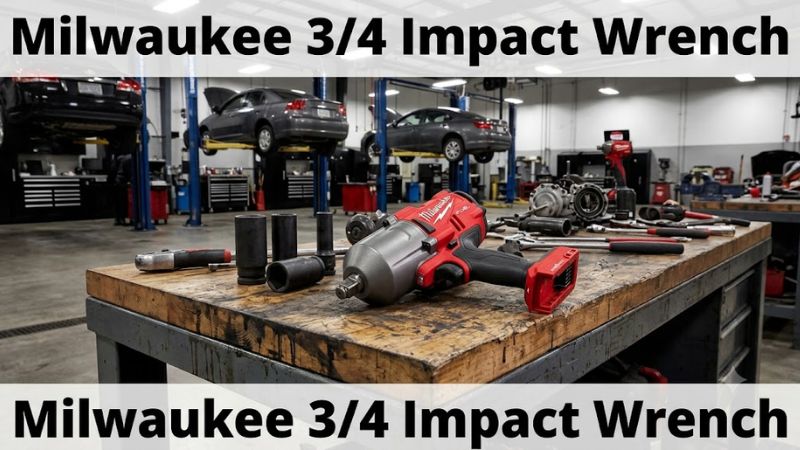
A 3/4-inch impact wrench uses a 3/4-inch square drive to accept compatible impact-rated sockets. Compared with many 1/2-inch impact wrenches, it is intended for larger fasteners and demanding work where a suitable socket and higher fastening capacity are important.
Common applications include:
- Heavy-equipment maintenance and industrial machinery.
- Commercial vehicle and fleet repairs.
- Large structural and mechanical fasteners.
- Agricultural equipment maintenance.
- Automotive work involving fasteners that exceed the practical capacity of smaller tools.
A larger drive does not automatically make a tool suitable for every large bolt. Fastener size, material, thread condition, required installation torque, access, and the correct socket all matter.
Milwaukee’s M18 FUEL 3/4-inch models are cordless tools, so they can be used without an air compressor or pneumatic hose. Their actual output and runtime depend on the model, battery, operating mode, fastener, and working conditions.
Milwaukee 3/4 Impact Wrench Models Compared
Milwaukee’s model numbers matter because tools that look similar can have significantly different torque ratings, anvil designs, and control features.
| Model | Drive and design | Advertised torque | Best suited to |
| 2864-20 | 3/4-inch square drive, friction ring, ONE-KEY | Up to 1,200 ft-lb fastening; 1,500 ft-lb nut-busting | Heavy-duty work with an established M18 platform |
| 2964-20 | 3/4-inch square drive, standard anvil, ONE-KEY | Up to 1,800 ft-lb fastening; 2,000 ft-lb nut-busting | Demanding general-purpose industrial and heavy-equipment work |
| 2969-20 | 3/4-inch square drive, 6-inch extended anvil, ONE-KEY | Up to 1,800 ft-lb fastening; 2,000 ft-lb nut-busting | Applications needing additional reach, particularly commercial tire service |
Torque figures are manufacturer-advertised maximums, not guaranteed results on every fastener. The models are not ranked using independent, directly comparable test results. Sources: Milwaukee Tool product information and announcement.
Milwaukee M18 FUEL 2864-20: An Established High-Torque Option
The 2864-20 is a brushless M18 FUEL impact wrench with a 3/4-inch friction-ring anvil and ONE-KEY connectivity. Milwaukee lists up to 1,200 ft-lb of fastening torque and 1,500 ft-lb of nut-busting torque. Its published product information also identifies a tool length of 8.59 inches and four customizable performance profiles.
Its friction ring supports quick socket changes. The compact design may be useful when working around machinery or vehicle components where access is limited, although the complete tool-and-battery assembly still needs enough clearance.
Choose it if: You want a high-torque M18 wrench for heavy-duty maintenance and can confirm that its output meets your actual workload.
Consider another model if: You need the higher advertised torque of the newer 2964-20 or require the additional reach of an extended-anvil wrench.
Milwaukee M18 FUEL 2964-20: Higher Advertised Torque
The 2964-20 raises the advertised maximums to 1,800 ft-lb of fastening torque and 2,000 ft-lb of nut-busting torque. Milwaukee also specifies a brushless motor, four-mode Custom Drive Control, ONE-KEY, and a battery-isolation system designed to manage vibration transmitted to the battery pack.
The difference between fastening and nut-busting torque is important. Fastening torque refers to the tool’s ability to tighten fasteners under the manufacturer’s specified test conditions. Nut-busting torque describes its ability to loosen fasteners under specified conditions. Neither figure should be treated as a precise torque setting for final bolt installation.
The 2964-20 is the more relevant model to investigate when your work regularly involves stubborn, large fasteners and you want the latest generation’s higher advertised output.
Choose it if: You need a heavy-duty 3/4-inch impact wrench for demanding industrial, fleet, or equipment maintenance.
Consider another model if: Your work mostly involves passenger vehicles, smaller fasteners, or confined spaces where a smaller-drive wrench is more practical.
Milwaukee M18 FUEL 2969-20: Extended Reach
The 2969-20 is the extended-anvil version of the newer high-torque design. Its 6-inch anvil is intended to help reach recessed fasteners and wheel assemblies that are difficult to access with a standard-length anvil. Milwaukee lists a bare-tool weight of 9.3 pounds and the same headline maximum torque figures as the 2964-20.
The additional reach can be valuable in commercial tire service, but it also changes the tool’s handling and overall balance. It is not automatically the better choice for general workshop use.
Choose it if: Recessed wheel nuts or other hard-to-reach fasteners are a regular part of your work.
Consider the standard 2964-20 if: You rarely need the extra reach and prefer a lighter bare tool.
How to Choose the Right Milwaukee 3/4 Impact Wrench
Before buying, focus on the job rather than the highest torque number. A tool that is more powerful than necessary may add cost and weight without improving your everyday work.
1. Match the torque to your workload
Consider the fasteners you routinely remove and install. Heavy-equipment maintenance may justify the newer 2964-20, while the 2864-20 may be sufficient for jobs within its performance range.
Do not use maximum nut-busting torque as a substitute for a specified tightening torque. For critical joints, use the impact wrench for initial fastening where appropriate and finish with a calibrated torque wrench according to the equipment manufacturer’s procedure.
2. Choose the correct anvil length
- Standard anvil: A practical choice for general workshop, industrial maintenance, and equipment repair.
- Extended anvil: Useful when recessed fasteners or wheel assemblies are difficult to reach.
The 2969-20’s 6-inch extended anvil is an application-specific advantage, not a universal performance upgrade.
3. Check battery and charger compatibility
The 2864-20, 2964-20, and 2969-20 belong to Milwaukee’s M18 platform. Milwaukee states that the newer 2964-20 and 2969-20 are compatible with M18 REDLITHIUM batteries and chargers.
Keep these points in mind:
- An M18 battery is not interchangeable with an M12 battery merely because both are made by Milwaukee.
- Battery capacity, expressed in amp-hours (Ah), affects stored energy and can influence runtime. It does not directly state the wrench’s torque.
- Milwaukee advertises the 2964-20’s ability to install up to 120 bolts measuring 1-1/4 inches with one REDLITHIUM FORGE XC8.0Ah battery. Treat this as a manufacturer claim for the specified application, not a universal runtime guarantee.
If you already own M18 batteries, check their condition and the demands of your workload before deciding whether a kit with additional batteries is worth the extra cost.
4. Decide whether ONE-KEY is useful
ONE-KEY provides tool-management and customization capabilities. On compatible models, it can support custom performance profiles and tool tracking. The 2964-20 also includes four-mode Custom Drive Control, AUTO-SHUTOFF, and Bolt Removal Mode.
These features are particularly relevant for professional shops managing multiple tools or repeating similar fastening tasks. Occasional users may place greater value on torque capacity, battery availability, and overall cost.
5. Compare the complete purchase cost
Milwaukee sells bare tools and kits separately. A bare tool generally does not include a battery or charger, so compare packages carefully.
Milwaukee’s US announcement listed the following prices for the newer models:
| Model or package | Announced US price |
| 2964-20 bare tool | $499 |
| 2964-22 kit | $849 |
| 2969-20 bare tool | $599 |
| 2969-22 kit | $949 |
These are prices from Milwaukee’s product announcement, not verified live checkout prices as of October 22, 2026. Confirm current availability, package contents, and pricing with an authorized seller before purchasing.
Safe Use of a Milwaukee 3/4-Inch Impact Wrench
A high-torque impact wrench can damage fasteners, sockets, wheel studs, and workpieces if used incorrectly. Follow the operator’s manual for the exact model.
- Inspect the tool and battery. Do not use a damaged battery pack, cracked socket, or tool with damaged components.
- Use impact-rated sockets. Confirm that the socket has the correct 3/4-inch drive, fits the fastener properly, and is rated for impact-wrench use. Ordinary chrome hand sockets may fracture under impact loads.
- Wear appropriate protection. Use safety glasses or goggles, hearing protection, and other PPE required by the work environment.
- Secure the workpiece. Keep hands clear of rotating components and ensure the vehicle or machinery cannot move unexpectedly. Follow the equipment manufacturer’s lifting and support procedures when working underneath a vehicle.
- Select a suitable operating mode. Start with a controlled setting where possible, and avoid prolonged impacting that could damage threads or components.
- Verify critical fastening torque. Use a calibrated torque wrench and the vehicle or equipment manufacturer’s specified procedure for final tightening. Do not assume an impact wrench’s advertised maximum torque or a selected electronic mode guarantees a precise final value.
- Remove the battery before changing accessories or performing maintenance. Stop work if the tool, battery, or socket shows signs of damage or abnormal operation.
For commercial wheels and other safety-critical fasteners, follow the applicable service procedure, including any specified tightening sequence, lubrication conditions, and torque requirements.
Milwaukee 3/4 Impact Wrench: Common Buying Mistakes
Buying based on nut-busting torque alone. A higher removal rating does not establish better fastening accuracy or prove that a tool is suitable for every fastener.
Assuming a 3/4-inch drive fits every large socket. The drive size must match, and the socket must also be impact-rated and appropriate for the fastener.
Ignoring the complete tool weight. Bare-tool specifications exclude the battery. A larger battery adds weight and changes balance, which matters during overhead or extended work.
Buying an extended-anvil model without needing the reach. The 2969-20 makes sense for specific access problems, but the standard 2964-20 is more versatile for many general heavy-duty jobs.
Assuming a bare tool is a complete kit. Check whether batteries, charger, and carrying case are included before comparing offers.
Frequently Asked Questions
Is the Milwaukee 3/4 impact wrench worth buying?
Yes, if you regularly service large fasteners and heavy equipment that justify a 3/4-inch drive. For ordinary passenger-car maintenance and smaller fasteners, a 1/2-inch model may be more practical and economical.
What is the most powerful Milwaukee 3/4 impact wrench?
The M18 FUEL 2964-20 and extended-anvil 2969-20 are advertised with up to 1,800 ft-lb of fastening torque and 2,000 ft-lb of nut-busting torque. These are manufacturer ratings; they should not be interpreted as guaranteed results under every working condition.
Can I use my existing Milwaukee M18 battery?
Yes, the 2864-20, 2964-20, and 2969-20 belong to the M18 battery platform. Confirm the exact tool and battery documentation, use a compatible M18 charger, and consider whether your current battery capacity is suitable for heavy-duty work.
Can a Milwaukee 3/4 impact wrench replace a torque wrench?
No, not for final tightening when a specified torque is required. An impact wrench is useful for removing fasteners and performing suitable fastening tasks, but its maximum advertised torque is not a precise measurement of the torque applied to an individual bolt. Use a calibrated torque wrench according to the equipment manufacturer’s procedure.
Final Verdict
The best Milwaukee 3/4 impact wrench depends on the fasteners, access requirements, and workload you face.
- Choose the 2864-20 if its advertised output meets your needs and you want an established M18 FUEL model with ONE-KEY.
- Choose the 2964-20 if you need the newer model’s higher advertised torque for demanding general-purpose heavy-duty work.
- Choose the 2969-20 if its 6-inch extended anvil provides a meaningful advantage for recessed fasteners or commercial tire service.
Before buying, confirm the exact model number, included accessories, battery requirements, warranty terms, and current price. Match the wrench to the actual job, and use a calibrated torque wrench whenever the final fastener torque must meet a specified value.