
What's inside
As an Amazon Associate I earn from qualifying purchases. This post may contain affiliate links at no extra cost to you.
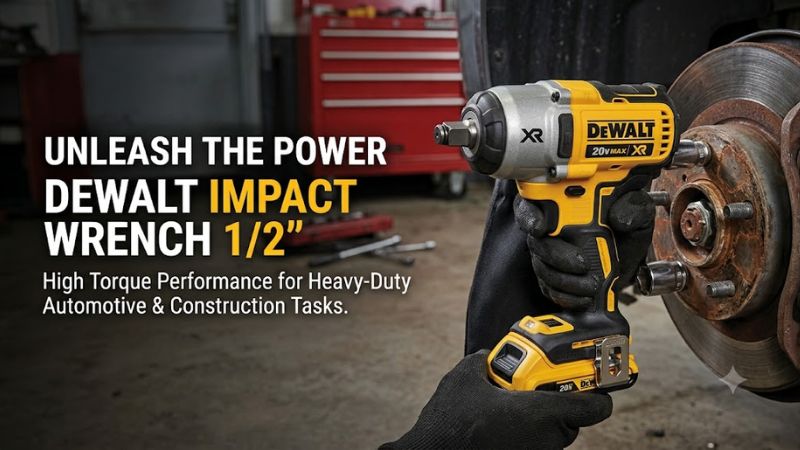
A 1/2 inch impact wrench is a power tool designed to loosen and tighten nuts and bolts, particularly fasteners that require substantial rotational force. Common applications include automotive wheel service, suspension repairs, equipment maintenance, and general mechanical work.
Choosing the right tool involves more than checking its advertised torque. You should also consider the type of work, power source, speed control, tool dimensions, socket compatibility, and the manufacturer’s operating instructions.
For occasional automotive maintenance, a cordless 1/2-inch impact wrench offers convenient portability. For frequent workshop use, consider the tool’s working capabilities, service requirements, ergonomics, and total ownership cost.
This guide explains how the tool works, which specifications matter, how to select the right type, and how to use it safely.
What Is a 1/2 Inch Impact Wrench?
A 1/2-inch impact wrench is a powered fastening tool with a square drive that accepts compatible 1/2-inch-drive sockets.
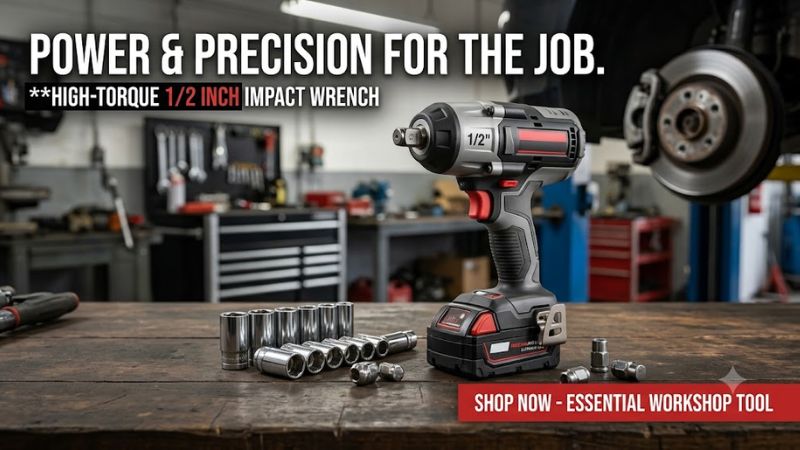
Inside the tool, a motor powers a hammer-and-anvil mechanism that delivers repeated rotational impacts. These impacts help loosen resistant fasteners and tighten threaded connections when an appropriate tool and operating procedure are used.
Unlike a conventional drill, which applies continuous rotational force, an impact wrench uses repeated impacts to help overcome resistance. An impact driver typically uses a hexagonal bit holder and is primarily intended for driving screws and compatible fasteners.
The 1/2-inch measurement refers to the square drive size, not the diameter of a bolt or the amount of torque the tool produces.
A 1/2-inch impact wrench can handle many automotive and mechanical tasks, but its suitability depends on the specific model, fastener condition, power supply, accessories, and manufacturer’s specifications.
What Is a 1/2 Inch Impact Wrench Used For?
Common applications include:
- Automotive wheel service: Removing wheel lug nuts and performing suitable wheel-service tasks.
- Suspension repairs: Loosening compatible suspension and chassis fasteners.
- Equipment maintenance: Servicing machinery and equipment with threaded fasteners.
- Workshop assembly: Performing repetitive fastening tasks where an impact wrench is appropriate.
- General mechanical repairs: Removing certain tight or corroded nuts and bolts.
An impact wrench is not suitable for every fastener. Small bolts, delicate assemblies, aluminum components, and precision joints can be damaged by excessive impact force.
For safety-critical fasteners, follow the relevant service procedure and use a suitable calibrated torque wrench for final tightening when required. Do not assume that an impact wrench’s trigger setting automatically produces the specified final torque.
How to Choose a 1/2 Inch Impact Wrench
The right tool depends on the workload, how frequently you use it, and whether you prioritize portability or workshop operation.
1. Understand torque ratings
Torque is one of the most important specifications, but manufacturers may publish several different figures.
| Torque specification | What it means | What to check |
| Fastening torque | A tightening-related rating under specified conditions | Whether it suits the intended fasteners and application |
| Breakaway or nut-busting torque | A rating associated with loosening fasteners under specified conditions | The manufacturer’s definition and test method |
| Maximum torque | A maximum or peak figure whose meaning varies by manufacturer | Whether it refers to tightening, loosening, or another measurement |
| Adjustable torque settings | Modes that change tool output or operating behavior | Whether the mode controls torque, speed, impact duration, or a combination |
Do not compare impact wrenches using only their largest advertised torque numbers. Manufacturers may use different testing procedures and definitions, so the figures may not be directly comparable.
For occasional automotive maintenance, choose a tool with documented capabilities suitable for your vehicle and intended fasteners. For frequent work involving stubborn or heavily corroded hardware, consider the demands of your regular workload rather than relying on a single peak figure.
More torque is not always better. Excessive impact force can damage threads, stretch bolts, deform components, or overtighten fasteners.
2. Choose the right power source
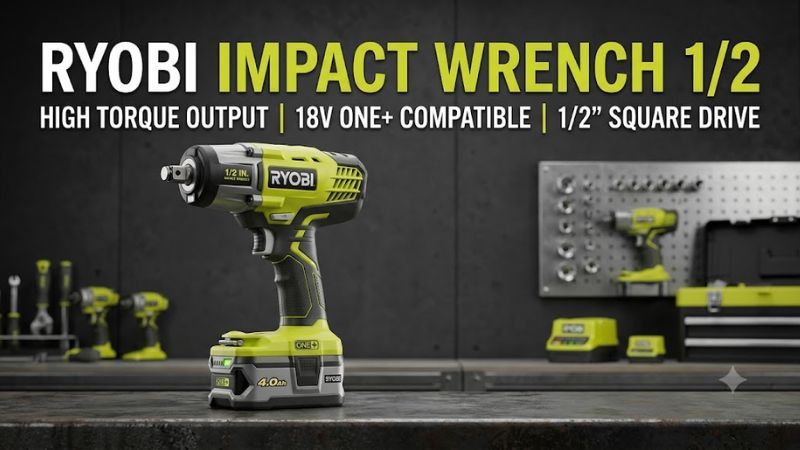
A 1/2-inch impact wrench may use a rechargeable battery, compressed air, or mains electricity, depending on the model.
| Power source | Advantages | Limitations | Suitable applications |
| Cordless battery | Portable and convenient without a power cord or air hose | Battery and charger costs; runtime depends on workload | Home garages, mobile mechanics, outdoor repairs |
| Pneumatic | No onboard battery; can suit established workshops | Requires an adequate compressor, hose, and compatible fittings | Automotive shops and fixed workshops |
| Corded electric | No battery changes during operation | Limited mobility and dependent on a compatible electrical supply | Suitable fixed work areas |
For cordless models, verify the exact battery platform, voltage, charger requirements, and included accessories. A bare-tool package generally does not include the battery and charger needed for operation.
For pneumatic models, check operating pressure and air consumption under load. Compressor tank capacity alone does not establish whether the system can maintain the airflow required by the tool. Hose dimensions, fittings, and pressure losses also matter.
For corded tools, confirm the rated voltage, frequency, plug, and regional electrical compatibility.
3. Check speed and impact rate
Manufacturers commonly publish two operating specifications:
- RPM (revolutions per minute): The rotational speed of the drive.
- IPM (impacts per minute): The number of impact blows delivered per minute under the specified conditions.
These figures describe different characteristics. A higher RPM does not automatically mean a tool will loosen stubborn fasteners more effectively, and a higher IPM rating does not independently establish greater torque.
Variable-speed triggers and selectable operating modes can help improve control when starting fasteners or working near delicate components. However, do not treat an electronic mode as a calibrated torque-control system unless the manufacturer explicitly documents that capability.
4. Consider size, weight, and access
Tool dimensions can make a significant difference when working inside wheel wells, engine bays, or confined machinery spaces.
Before purchasing, consider:
- Overall length and head dimensions.
- Weight with the battery installed.
- Grip shape, balance, and trigger control.
- Clearance around adjacent components with the intended socket fitted.
- Forward/reverse switch placement.
- Socket retention, such as a friction ring or pin detent.
A compact impact wrench may be easier to position in restricted spaces, but compact size does not guarantee sufficient torque for demanding fasteners. A larger tool may offer greater capability while being harder to maneuver.
For frequent professional use, ergonomics and manageable weight are important considerations alongside torque and speed.
5. Match the tool to your workload
| Intended job | What to prioritize | Main limitation |
| Occasional passenger-car maintenance | Portability, suitable torque capability, ease of control | Must follow the vehicle’s wheel-fastener procedure |
| Frequent automotive repair | Appropriate working torque, speed control, serviceability | Must be suitable for the toughest routine jobs |
| Restricted engine-bay or suspension access | Compact dimensions and compatible sockets | Clearance must be checked for the actual setup |
| Heavy machinery or stubborn fasteners | Documented capability and an adequate power supply | A 1/2-inch tool may be insufficient for some applications |
| Repetitive workshop fastening | Ergonomics, operating modes, maintenance requirements | Peak torque does not establish fastening consistency |
For demanding industrial or heavy-vehicle work, a larger drive size may be more appropriate. Do not assume that using an adapter makes a smaller impact wrench suitable for an application designed around a larger tool.
What Accessories Do You Need?
The drive size alone does not guarantee that an accessory is safe or compatible with your impact wrench.
Impact-rated sockets
Use sockets specifically designed for impact-wrench service. They are intended to withstand repeated impact loading, unlike ordinary hand sockets, which may crack or break during powered operation.
Before use, inspect sockets for cracks, deformation, excessive wear, and damaged drive openings. Replace damaged accessories rather than continuing to use them.
Extensions and adapters
Use extensions and adapters only when their ratings and intended applications are compatible with the tool. Their geometry and length can affect access, control, and the torque delivered to a fastener.
Do not assume that a standard chrome socket, universal joint, or drive adapter is suitable simply because it fits.
Batteries and chargers
For cordless models, use only batteries and chargers approved for the exact tool. Follow the manufacturer’s instructions for charging, storage, temperature limits, and inspection.
Do not use a battery that is visibly damaged, leaking, unusually swollen, or showing signs of overheating. Follow the manufacturer’s instructions for handling damaged batteries.
How to Use a 1/2 Inch Impact Wrench Safely
Correct operation helps reduce the risk of fastener damage, accessory failure, and injury. Read the manual for your specific tool before operating it.
Step 1: Prepare the work area
Wear appropriate eye protection and any additional PPE required by the tool manual and working conditions. Secure the vehicle or workpiece, maintain stable footing, and keep bystanders clear.
When working on a vehicle, use suitable lifting equipment and support methods. Never rely on a jack alone to support a vehicle while working underneath it.
Step 2: Inspect the tool and socket
Check the wrench, drive anvil, battery or air connection, and socket for visible damage.
Select the correct impact-rated socket and confirm that it fits the fastener securely. Disconnect the battery or air supply as directed by the manufacturer before changing accessories.
Step 3: Position the wrench correctly
Seat the socket fully on the fastener and align the tool with the fastener axis.
Maintain a firm grip and stable body position. Apply controlled trigger pressure where the tool design permits, and avoid forcing the socket onto a damaged or incorrectly sized fastener.
Step 4: Tighten according to the service procedure
Use the impact wrench only for the stages permitted by the relevant service instructions.
For wheel installation, follow the vehicle manufacturer’s specified tightening sequence and torque. Use a suitable calibrated torque wrench for final tightening when required.
Do not use maximum impact power to finish tightening wheel nuts. Excessive tightening can damage studs, threads, and wheel components.
Step 5: Shut down and inspect
Release the trigger and allow the tool to stop completely. Disconnect the power source before changing accessories or performing maintenance.
Inspect the tool and socket after use, then store them according to the manufacturer’s instructions.
Special precautions for automotive wheel nuts
A 1/2-inch impact wrench is commonly used for wheel service, but it is not a substitute for a torque wrench.
Required wheel-fastener torque varies by vehicle, wheel design, fastener type, and service requirements. Never apply a generic torque value to every vehicle.
For wheel installation:
- Check the vehicle’s service documentation for the specified torque and tightening sequence.
- Start the fasteners correctly to reduce the risk of cross-threading.
- Use the impact wrench for initial fastening only when the service procedure permits it.
- Complete final tightening using a calibrated torque wrench and the specified procedure.
- Follow any additional inspection or retightening instructions provided by the vehicle manufacturer.
Common Mistakes to Avoid
| Mistake | Why it matters | Better approach |
| Choosing a tool based only on maximum torque | Published figures may use different definitions and test methods | Compare documented specifications and intended workloads |
| Using ordinary hand sockets | They may not withstand repeated impact loading | Use compatible impact-rated sockets |
| Tightening every fastener with the same setting | Different joints have different requirements | Follow the applicable service procedure |
| Assuming batteries are interchangeable across a brand’s tools | Battery families and electrical requirements differ | Check exact model compatibility |
| Repeatedly impacting a fastener that will not move | Continued loading can damage the tool, accessory, or fastener | Stop and reassess the tool and fastener |
| Ignoring unusual noise, vibration, or heat | These may indicate damage or a fault | Stop using the tool and inspect it according to the manual |
| Using an unrated socket adapter | The accessory may be unsuitable for impact loading | Verify its rating and compatibility |
If a fastener remains stuck, do not assume that holding the trigger longer will solve the problem. Corrosion, damaged threads, inadequate power supply, poor socket engagement, or an unsuitable tool may be responsible.
Identify the cause before continuing.
Maintenance and Storage
Maintenance requirements differ between cordless, corded, and pneumatic impact wrenches.
For cordless models:
- Keep the tool and battery clean and free of accumulated debris.
- Inspect the battery housing and contacts for damage.
- Use the manufacturer’s approved charging equipment.
- Store the battery within the specified temperature and environmental limits.
- Follow the manual for cleaning, lubrication, and service.
For pneumatic models:
- Inspect hoses, fittings, and air connections for damage or leaks.
- Maintain the air supply and filtration or lubrication arrangements specified by the manufacturer.
- Use the recommended pneumatic-tool lubricant if the model requires it.
- Disconnect the air supply before changing accessories or performing maintenance.
For all models, stop using the tool if the drive mechanism is damaged, the trigger operates incorrectly, or unusual noise, vibration, or overheating develops. Seek qualified service when necessary.
Do not apply a universal lubrication schedule to every impact wrench. Follow the exact model’s maintenance instructions.
Frequently Asked Questions
1. Is a 1/2 inch impact wrench powerful enough for changing car tires?
Yes, many 1/2-inch impact wrenches are designed for passenger-vehicle wheel service, but suitability depends on the specific model and fastener condition. Follow the vehicle’s service procedure and use a calibrated torque wrench for final tightening when required.
2. What is the difference between a 1/2 inch impact wrench and an impact driver?
A 1/2-inch impact wrench uses a square drive primarily for compatible sockets and nut-and-bolt work. An impact driver typically uses a hexagonal bit holder and is mainly intended for screws and compatible driving accessories. Their drive interfaces and intended applications differ.
3. Can I use regular sockets on a 1/2 inch impact wrench?
No. Use sockets specifically rated for impact-wrench use and compatible with the tool and application. Ordinary hand sockets may crack or break under repeated impact loading.
4. Is a cordless or pneumatic 1/2 inch impact wrench better?
Neither is universally better. Cordless models suit mobile work and locations without compressed air, while pneumatic models can suit workshops with an adequate air system. Compare workload, power requirements, mobility, maintenance, and total ownership cost before choosing.
Final Verdict
A 1/2-inch impact wrench is a practical tool for many automotive repairs, wheel-service tasks, and general mechanical applications. Choosing the right one requires matching the tool’s documented capabilities to your workload, selecting a suitable power source, and using compatible impact-rated accessories.
For occasional home maintenance, portability and ease of control may matter more than maximum advertised output. For professional workshop use, consider operating demands, ergonomics, serviceability, and power-supply requirements.
Most importantly, use the impact wrench only for suitable operations and follow the correct fastening procedure whenever torque accuracy matters.
Write Your Review
No reviews yet. Be the first to share your experience!