
What's inside
- 1. Is There a DEWALT 1/2-Inch Impact Driver?
- 2. Popular DEWALT 1/2-Inch Impact Wrench Models
- 3. How to Choose the Right DEWALT 1/2-Inch Impact Wrench
- 4. Essential Accessories for a DEWALT 1/2-Inch Impact Wrench
- 5. How to Use a DEWALT 1/2-Inch Impact Wrench Safely
- 6. Common Mistakes to Avoid
- 7. Frequently Asked Questions
- Conclusion
As an Amazon Associate I earn from qualifying purchases. This post may contain affiliate links at no extra cost to you.
If you’re searching for a DEWALT 1/2-inch impact driver, you’re probably looking for a cordless tool that can handle stubborn bolts, automotive lug nuts, and demanding fastening jobs. However, there is an important distinction: DEWALT’s 1/2-inch square-drive tools are generally classified as impact wrenches, while its standard impact drivers typically use a 1/4-inch hex chuck.
Understanding this difference helps you select the right tool and avoid buying incompatible accessories. A 1/2-inch impact wrench is designed primarily for tightening and removing nuts and bolts with impact-rated sockets. A 1/4-inch impact driver is better suited to driving screws, installing fasteners, and handling general construction work.
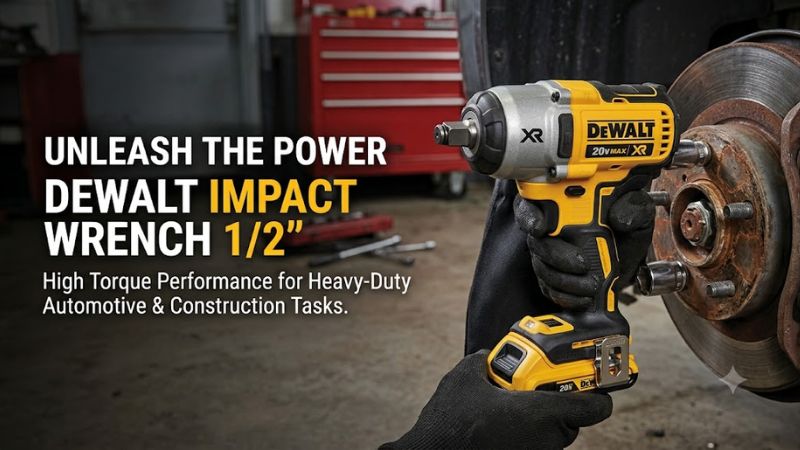
DEWALT offers several cordless 1/2-inch impact wrench models, including the compact DCF922, mid-torque DCF891, and high-torque DCF900. Each serves a different workload, so the best choice depends on the fasteners, materials, working conditions, and amount of torque required.
This guide explains how these tools differ, which specifications matter, how to choose compatible accessories, and how to operate a DEWALT impact wrench safely.
1. Is There a DEWALT 1/2-Inch Impact Driver?
DEWALT’s standard 1/2-inch square-drive cordless tools are impact wrenches rather than conventional impact drivers.
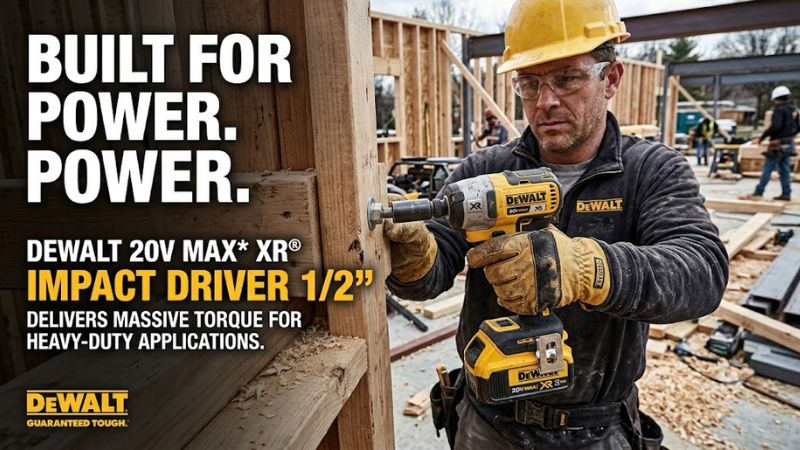
Although both tools use rotational impact mechanisms, their drive systems and intended applications are different.
| Feature | Impact Driver | 1/2-Inch Impact Wrench |
| Drive connection | 1/4-inch hex collet | 1/2-inch square anvil |
| Main accessories | Screwdriver bits | Impact-rated sockets |
| Primary applications | Driving screws and smaller fasteners | Tightening and removing nuts and bolts |
| Typical users | Carpenters, DIYers, installers | Mechanics, construction workers, maintenance technicians |
| Torque commonly advertised | Inch-pounds | Foot-pounds |
| Common applications | Decking, cabinetry, framing | Automotive repair, equipment maintenance, structural fastening |
An impact driver is generally more convenient for repetitive screw-driving tasks. Its quick-change hex chuck accepts compatible screwdriver bits and adapters.
A 1/2-inch impact wrench has a square-drive anvil that accepts sockets. Its larger drive connection and torque characteristics make it more suitable for applications involving larger threaded fasteners.
Neither tool is automatically appropriate for every fastening job. Always consider the fastener specification, tool capacity, and accessory compatibility.
2. Popular DEWALT 1/2-Inch Impact Wrench Models
DEWALT’s 20V MAX cordless impact wrench range includes compact, mid-torque, and high-torque options. Understanding their differences helps narrow down the right tool.
DEWALT DCF922: Compact 1/2-Inch Impact Wrench
The DEWALT DCF922 is a compact brushless impact wrench designed for users who need maneuverability without moving to a larger high-torque tool.
Its manufacturer-published specifications include:
| Specification | DCF922 |
| Battery platform | 20V MAX |
| Motor | Brushless |
| Drive size | 1/2-inch square |
| Maximum fastening torque | 300 ft-lb |
| Maximum breakaway torque | 450 ft-lb |
| Anvil | Detent pin |
| Operating modes | 4 |
| Package configuration | DCF922B bare tool |
The compact design is useful when working around vehicle components, machinery, and other restricted spaces. Its four-mode control system provides additional flexibility when adjusting operation to different fastening applications.
The detent-pin anvil helps retain compatible sockets during use. However, users should confirm that their sockets have the appropriate retention hole.
Best for: Routine automotive maintenance, equipment servicing, and fastening jobs where compact dimensions matter.
Limitation: Its advertised torque capacity is lower than that of DEWALT’s mid-torque and high-torque alternatives.
DEWALT DCF891: Mid-Torque 1/2-Inch Impact Wrench
The DCF891 is a brushless 20V MAX impact wrench intended for more demanding fastening work.
| Specification | DCF891 |
| Battery platform | 20V MAX |
| Motor | Brushless |
| Drive size | 1/2-inch square |
| Maximum fastening torque | 600 ft-lb |
| Maximum breakaway torque | 800 ft-lb |
| Maximum no-load speed | 2,000 RPM |
| Maximum impact rate | 3,250 IPM |
| Anvil | Hog ring |
| Weight | Approximately 3.7 lb without battery |
One useful feature is Precision Wrench control. This technology is designed to help reduce overtightening during fastening and limit fastener run-off during removal.
The hog-ring anvil also makes socket changes convenient for users who regularly switch between different socket sizes.
The DCF891 is a practical middle ground for users who perform regular automotive repairs, equipment maintenance, and heavier fastening tasks.
Best for: Users who need more torque capacity than a compact wrench provides but do not require a high-torque industrial model.
Limitation: Its larger output capability and dimensions may be unnecessary for light household projects.
DEWALT DCF900: High-Torque 1/2-Inch Impact Wrench
The DCF900 is designed for demanding applications requiring substantially higher advertised torque.
| Specification | DCF900 |
| Battery platform | 20V MAX |
| Motor | Brushless |
| Drive size | 1/2-inch square |
| Maximum fastening torque | 1,030 ft-lb |
| Maximum breakaway torque | 1,400 ft-lb |
| Operating modes | 4 |
| Anvil | Hog ring |
| Package configuration | DCF900B bare tool |
The DCF900 is appropriate for certain heavy automotive, construction, and industrial maintenance applications. Its higher torque capacity can help when working with larger or more resistant fasteners, provided the application is suitable for the tool.
However, maximum torque is not a recommended tightening target. Applying excessive force can damage threads, fasteners, or connected components.
Best for: Heavy-duty users who regularly encounter demanding fastening and removal applications.
Limitation: Its additional power can be unnecessary for routine light automotive work and smaller fasteners.
Quick Model Comparison
| Model | Fastening Torque | Breakaway Torque | Suitable Workload |
| DCF922 | 300 ft-lb | 450 ft-lb | Compact applications |
| DCF891 | 600 ft-lb | 800 ft-lb | Mid-torque fastening |
| DCF900 | 1,030 ft-lb | 1,400 ft-lb | High-torque applications |
These are manufacturer-advertised maximum figures, not directly comparable independent test results. Actual performance depends on battery condition, fastener characteristics, socket selection, and operating conditions.
3. How to Choose the Right DEWALT 1/2-Inch Impact Wrench
Choosing an impact wrench based only on its maximum torque rating can lead to unnecessary expense. Instead, consider your normal workload.
Match torque capacity to your applications
For occasional automotive maintenance and general equipment servicing, a compact model may provide sufficient capacity for suitable fasteners.
For regular automotive work, a mid-torque model offers more flexibility when dealing with demanding bolts and nuts.
For heavy equipment and larger fastening applications, a high-torque model may be more appropriate.
Remember that the required fastening torque must come from the vehicle, equipment, or fastener manufacturer’s specifications.
Consider the anvil design
DEWALT uses different socket-retention systems.
- Hog ring: Uses a retaining ring to hold the socket. It is convenient when changing sockets frequently.
- Detent pin: Uses a spring-loaded pin that engages a compatible socket retention hole.
Both systems use a 1/2-inch square drive, but socket retention arrangements differ. Check compatibility before purchasing replacement sockets or accessories.
Check battery requirements
The models discussed here belong to DEWALT’s 20V MAX battery platform.
The 20V MAX designation refers to maximum initial voltage measured without a workload; the nominal voltage of this lithium-ion system is 18V.
Before purchasing a battery, verify the exact tool and battery compatibility. Consider capacity, weight, and the amount of work performed between charging sessions.
A higher-capacity battery stores more energy but generally adds weight. It may be useful for extended workloads, although actual runtime varies with the application.
Also check whether the package includes a battery and charger. A model carrying the B suffix, such as DCF891B or DCF900B, is commonly sold as a bare tool.
4. Essential Accessories for a DEWALT 1/2-Inch Impact Wrench
An impact wrench requires accessories designed for powered impact applications.
Impact-rated sockets should be your first purchase. Ordinary chrome sockets intended for hand tools are not the correct choice unless specifically approved for impact use.
Useful accessories include:
| Accessory | Main Purpose |
| 1/2-inch impact sockets | Tightening and removing nuts and bolts |
| Impact extensions | Reaching recessed fasteners |
| Impact-rated universal joints | Accessing angled fasteners |
| Compatible battery | Supplying cordless power |
| Compatible charger | Charging the battery |
| Torque wrench | Verifying final tightening torque |
Before installing any accessory, check its drive size, impact rating, dimensions, and compatibility with the anvil.
Avoid unnecessary combinations of extensions and adapters. Additional connections can increase movement and reduce control.
Inspect sockets regularly for cracks, deformation, worn drive openings, and other damage. Replace defective accessories rather than continuing to use them.
5. How to Use a DEWALT 1/2-Inch Impact Wrench Safely
Correct operation involves inspecting the tool, selecting appropriate accessories, maintaining alignment, and verifying the final fastening result.
Step 1: Prepare the work area
Work on a stable surface with adequate lighting and ventilation.
Secure the workpiece before operating the tool. Remove loose objects that could interfere with the socket or work area.
Wear safety glasses and hearing protection. Use appropriate protective equipment for the material and environment. If working around dust, sparks, or other hazards, follow the relevant workplace safety requirements.
Step 2: Inspect the impact wrench
Before installing the battery, inspect the housing, trigger, selector, anvil, and battery connection.
Look for cracks, damaged components, loose parts, or excessive wear.
Do not operate a tool with a damaged anvil, malfunctioning trigger, or defective battery. Consult an authorized service provider when a safety-related fault is suspected.
Step 3: Install the battery
Make sure the tool is switched off before attaching the battery.
Align a compatible DEWALT 20V MAX battery with the battery rails and slide it into place until it locks.
Check that the battery is secure. Never force a battery that does not fit.
Step 4: Attach the correct socket
Choose a 1/2-inch impact-rated socket that matches the fastener.
For a hog-ring anvil, push the socket onto the square drive until it is securely retained.
For a detent-pin anvil, align the socket’s retention hole with the pin.
Gently check socket retention before operating the tool.
Step 5: Select the operating mode
Choose an appropriate speed or control mode based on the fastener and application.
Start with a lower setting when practical. Use the variable-speed trigger to maintain control and avoid unnecessary impacts.
Do not assume that a particular mode delivers a precise fastening torque. Impact wrench torque output is affected by several operating variables.
Step 6: Position the tool correctly
Place the socket squarely over the nut or bolt head.
Keep the impact wrench aligned with the fastener to reduce side loading and socket slippage.
Maintain a secure grip and keep your hands away from the rotating anvil and socket.
Step 7: Operate the wrench
Press the trigger gradually and allow the impact mechanism to work.
Release the trigger when the required operation is complete.
If a fastener does not move, stop and inspect the socket engagement, rotation direction, and fastener condition. Do not keep applying uncontrolled force to a seized fastener.
Step 8: Verify the fastening result
For applications with specified tightening torque, use a properly calibrated torque wrench according to the manufacturer’s procedure.
This is particularly important for automotive wheel lug nuts.
An impact wrench’s advertised maximum torque does not represent a calibrated measurement of the torque applied to an individual fastener.
Follow the specified tightening sequence and torque value. Do not assume that a fastener is correctly tightened simply because the impact wrench has stopped rotating.
Step 9: Shut down and store the tool
Release the trigger and remove the battery before changing accessories or performing maintenance.
Allow hot sockets to cool before handling them.
Clean exterior dust and debris, inspect the tool for damage, and store the battery and wrench in a suitable dry location.
6. Common Mistakes to Avoid
Several mistakes can reduce fastening accuracy and increase the risk of damage.
Using ordinary sockets: Use impact-rated sockets designed for powered impact applications.
Overtightening fasteners: Maximum impact wrench torque is not a target for routine tightening. Use the specified torque and a torque wrench where required.
Ignoring battery compatibility: Verify the exact battery platform and supported packs rather than assuming all DEWALT batteries are interchangeable.
Using the wrong tool for drilling: An impact wrench is not a substitute for a standard drill or 1/4-inch impact driver.
Ignoring socket wear: Cracked or damaged sockets can fail under impact loading. Inspect accessories before use.
Applying excessive force to seized bolts: Stop if the fastener does not respond normally. Investigate corrosion, thread damage, or mechanical obstruction instead of continuing uncontrolled operation.
7. Frequently Asked Questions
Is a DEWALT 1/2-inch impact driver actually an impact wrench?
Yes, the commonly available DEWALT 1/2-inch square-drive cordless models are classified as impact wrenches. Standard DEWALT impact drivers generally use a 1/4-inch hex chuck for screwdriver bits.
Can a DEWALT 1/2-inch impact wrench remove car lug nuts?
Yes, an appropriately rated 1/2-inch impact wrench can remove many vehicle lug nuts. However, seized or heavily corroded fasteners may require additional procedures. Always follow the vehicle manufacturer’s instructions and use a calibrated torque wrench for final tightening.
What is the difference between the DEWALT DCF891 and DCF900?
The DCF891 is a mid-torque model rated at up to 600 ft-lb fastening torque and 800 ft-lb breakaway torque. The DCF900 is a high-torque model rated at up to 1,030 ft-lb fastening torque and 1,400 ft-lb breakaway torque.
What sockets fit a DEWALT 1/2-inch impact wrench?
A DEWALT 1/2-inch impact wrench accepts compatible 1/2-inch square-drive impact sockets. Select the correct socket size and check the retention system, impact rating, and accessory condition before use.
Conclusion
A DEWALT 1/2-inch impact driver is more accurately described as a DEWALT 1/2-inch impact wrench. Understanding this distinction makes it easier to select the right cordless tool, accessories, and battery platform.
The DCF922 is a compact option for suitable lighter applications, the DCF891 provides greater capacity for regular demanding fastening work, and the DCF900 is designed for higher-torque applications.
Before choosing a model, evaluate your workload, required fastening torque, battery needs, and socket compatibility. For any application requiring a specific final tightening torque, always follow the equipment manufacturer’s instructions and verify the result with an appropriate torque wrench.


Write Your Review
No reviews yet. Be the first to share your experience!