
What's inside
- Quick Verdict
- Ryobi 2300 PSI Pressure Washer Specifications
- Ryobi 2300 PSI Pressure Washer Price: How Much Should You Pay?
- Cleaning Performance: What Can the Ryobi RY142300 Handle?
- Key Features and Included Accessories
- Pros and Cons
- Warranty, Maintenance, and Safety
- Ryobi 2300 PSI vs. Newer Electric Pressure Washers
- Who Should Buy the Ryobi 2300 PSI Pressure Washer?
- Frequently Asked Questions
- Final Verdict
As an Amazon Associate I earn from qualifying purchases. This post may contain affiliate links at no extra cost to you.
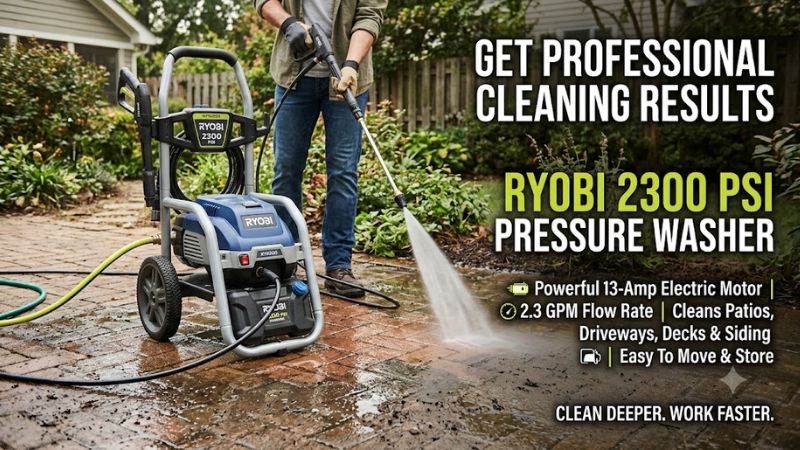
The RYOBI 2300 PSI Brushless Electric Pressure Washer (RY142300) is a corded electric pressure washer designed for homeowners who need more cleaning capability than a basic entry-level unit without the fuel, engine maintenance, and exhaust associated with gas-powered equipment.
Its main specifications are a maximum advertised pressure of 2,300 PSI, a maximum flow rate of 1.2 gallons per minute (GPM), and a 13-amp brushless electric motor. It also includes a turbo nozzle, an onboard detergent tank, a 25-foot high-pressure hose, and large wheels for moving the machine around a property.
Our verdict: The Ryobi RY142300 is worth considering for residential cleaning if you find a complete, properly functioning unit at a reasonable price. However, it is a discontinued model, so availability, warranty coverage, and the condition of used or remaining-stock units matter as much as the advertised specifications.
This review focuses on the North American RY142300 family, including the RY142300VNM variant listed on Ryobi’s official website. It does not assume that every similarly named Ryobi pressure washer has the same specifications or accessories.
Quick Verdict
Best for
Homeowners cleaning patios, outdoor furniture, suitable siding, vehicles, and moderately dirty hard surfaces.
Main advantage
A brushless motor, useful included accessories, and a relatively high advertised pressure rating for a residential electric washer.
Main drawback
Its roughly 50-pound weight, limited flow rate, and discontinued status.
Buying advice
Compare the asking price with current electric pressure washers and verify the exact model, condition, and warranty before paying.
The strongest reason to consider the RY142300 is its combination of residential cleaning capability and convenient onboard storage. Its biggest limitation is that 2,300 PSI does not automatically translate into fast cleaning on every surface: water flow, nozzle selection, dirt buildup, and working technique also affect results.
Ryobi 2300 PSI Pressure Washer Specifications
The model to look for is RY142300, with RY142300VNM appearing as a specific variant on Ryobi’s official product page. Ryobi currently labels the VNM product discontinued.
| Specification | Verified details |
| Product | RYOBI 2300 PSI Brushless Electric Pressure Washer |
| Model family | RY142300 |
| Listed variant | RY142300VNM |
| Power source | Corded electric |
| Motor | Brushless |
| Maximum advertised pressure | 2,300 PSI |
| Maximum advertised flow | 1.2 GPM |
| Electrical input | 120 V AC, 60 Hz, 13 A |
| High-pressure hose | 25 ft |
| Power cord | Approximately 35 ft |
| Detergent system | Onboard tank with automatic soap injection |
| Included nozzles | Three nozzle types, including a turbo nozzle and a low-pressure soap nozzle |
| Weight | Approximately 49–51 lb in published product and independent-review information |
| Warranty | Original manual states 3 years for personal, family, or household use; commercial or rental use has a different term |
| Current product status | Listed as discontinued by Ryobi |
Note: The weight figures come from different published sources and may reflect different configurations or measurement methods. Check the specific unit’s label and documentation before treating either number as its exact shipping or operating weight.
What do 2,300 PSI and 1.2 GPM mean?
PSI measures water pressure, while GPM measures how much water the machine delivers per minute. Both influence cleaning, but they do different jobs.
- 2,300 PSI maximum: Indicates the advertised peak pressure rating, not a promise that the machine maintains this pressure under every operating condition.
- 1.2 GPM maximum: Describes the advertised maximum flow rate. Relatively modest flow can make rinsing large surfaces slower than with a machine that delivers substantially more water.
- Brushless motor: Avoids the motor’s conventional brush-wear mechanism, but does not guarantee that the pump, seals, hose, or other components will last indefinitely.
An independent TechGearLab test measured approximately 1,975 PSI and 1.1 GPM for the RY142300. Those are results from that reviewer’s test conditions, not replacement specifications for every unit.
The practical takeaway is that the RY142300 is best evaluated as a capable residential electric pressure washer—not as a direct equivalent to a high-flow commercial machine.
Ryobi 2300 PSI Pressure Washer Price: How Much Should You Pay?
Price is one of the most important considerations because this model is discontinued.
TechGearLab listed the RY142300 at $329 in its November 26, 2019 review. That is a historical list price, not a verified current retail price.
As of October 26, 2026, the available manufacturer information identifies the RY142300VNM as discontinued. I could not verify a current, generally available new-unit price for the exact model, so assigning it a present-day dollar value would be misleading.
What makes a price reasonable?
Rather than judging the washer by its old list price, evaluate the actual package being offered.
| Purchase condition | What to consider |
| New, unopened remaining stock | Confirm the model number, included accessories, seller return policy, and whether the manufacturer warranty applies. |
| Open-box unit | Check for missing nozzles, hose damage, detergent-system issues, and signs of previous water exposure or use. |
| Used unit | Test the pump under load, inspect leaks and connections, and verify the electrical safety features. |
| Unit sold without accessories | Account for the cost and availability of compatible replacement parts before comparing prices. |
Buying recommendation: Compare the asking price with Ryobi’s currently listed electric pressure washers and other equivalent corded models. A newer model with a full warranty may be a better purchase than an older RY142300 offered at a premium simply because it is harder to find.
The price comparison should use the same market, package condition, included accessories, and warranty assumptions. Do not compare a bare machine with a complete kit as if they were identical offers.
Cleaning Performance: What Can the Ryobi RY142300 Handle?
The RY142300 is intended for residential outdoor cleaning, but its effectiveness depends on the surface, the type of contamination, and the nozzle being used.
TechGearLab’s independent testing found that the washer performed well relative to other electric models in its test group, although gas-powered models generally delivered stronger overall performance. The review also identified the unit’s weight and noise as disadvantages.
1. Patios, walkways, and suitable concrete
The turbo nozzle is useful for appropriate hard surfaces where concentrated cleaning action helps remove stubborn dirt. However, the rotating jet can damage paint, soft masonry, deteriorated concrete, or vulnerable surface coatings if used too close or for too long in one place.
For larger patios and driveways, the modest 1.2 GPM maximum flow is a consideration. Removing heavy buildup across a large area can take time, especially when compared with equipment delivering more water per minute.
Use a surface-cleaner attachment only when its connections, pressure rating, and compatibility match the washer. Follow the accessory manufacturer’s instructions.
2. Cars, trucks, and recreational vehicles
The washer can be useful for rinsing road grime and cleaning vehicle exteriors when an appropriate nozzle, safe distance, and suitable detergent are used.
However, maximum pressure is not the best setting for every vehicle surface. Start cautiously and avoid directing a concentrated jet at tires, seals, electrical connectors, damaged paint, or delicate trim.
For routine vehicle washing, a suitable wider spray pattern is generally more appropriate than a turbo nozzle. Confirm the nozzle included with the specific unit and its intended use before starting.
3. Siding, fences, and outdoor furniture
The RY142300 can handle many routine exterior-cleaning jobs, provided the surface tolerates pressure washing.
For siding, wood, painted surfaces, and outdoor furniture:
- Start with a wider spray pattern and a greater distance.
- Test a small, inconspicuous area first.
- Avoid forcing water behind siding, into vents, or into electrical fixtures.
- Follow the surface manufacturer’s cleaning recommendations.
- Use only compatible pressure-washer detergents.
Older wood, peeling paint, soft plastics, and weathered finishes may be damaged even when a pressure washer is operating normally.
4. Stubborn stains and heavy-duty jobs
The RY142300 is less suitable when a project requires sustained high water volume, frequent all-day operation, or specialized commercial cleaning performance.
Its advertised pressure figure alone cannot establish how quickly it will remove oil, deeply embedded grime, or other difficult contaminants. Some stains require an appropriate cleaning chemical, dwell time, surface preparation, or a different cleaning method.
If heavy-duty work is your primary need, compare machines using both flow rate and pressure, alongside independent performance evidence and manufacturer-approved duty conditions.
Key Features and Included Accessories
The RY142300’s design emphasizes convenience for homeowners who want a corded electric washer that can be moved around a driveway or yard.
Brushless motor and electric operation
The brushless motor is one of the model’s defining features. Electric operation also avoids gasoline, engine oil, and exhaust emissions at the point of use.
That does not make the washer maintenance-free. The pump, water connections, seals, hose, detergent system, and electrical components still require appropriate inspection and care.
Turbo nozzle and quick-connect wand
Ryobi advertises the included turbo nozzle as delivering up to 50% faster cleaning. Treat this as a manufacturer claim rather than a guarantee that every cleaning task will be completed 50% faster. The result depends on the surface, contamination, technique, and comparison method.
The quick-connect system makes switching compatible nozzles easier. Inspect each nozzle and connection for damage, and never attach an accessory that is not rated for the operating pressure and compatible with the washer.
Onboard detergent tank
The integrated tank allows detergent to be applied without a separate tank on the ground. The original manual describes an automatic soap-injection system that works with the designated low-pressure soap nozzle.
The trade-off is that an integrated tank offers less flexibility than a separate detergent system for some users. Use only detergents approved for pressure washers, and follow the manual’s dilution and rinsing instructions.
Wheels, hose, and cord storage
The hand-truck-style frame and large wheels make the unit easier to roll than to carry. Its approximately 50-pound weight is still significant if you need to lift it into a vehicle, carry it upstairs, or store it on a shelf.
The 25-foot high-pressure hose provides useful working reach, while the approximately 35-foot power cord helps position the washer near a suitable outlet. The shorter practical reach of the hose or cord, together with the garden hose and wand, will determine how much of an area you can clean without repositioning the machine.
Pros and Cons
| Advantages | Limitations |
| Advertised maximum pressure of 2,300 PSI | Maximum flow of 1.2 GPM limits water delivery for larger jobs |
| Brushless electric motor | Requires a suitable electrical supply and water connection |
| Turbo nozzle included | Concentrated spray can damage vulnerable surfaces |
| Onboard detergent tank | Detergent application depends on the appropriate nozzle and setup |
| 25-foot high-pressure hose | Hose length may require moving the machine around larger areas |
| Large wheels and integrated storage | Approximately 50 lb makes lifting inconvenient |
| Strong historical independent-review results among electric models | The exact model is discontinued |
The main strengths are the feature set and residential cleaning capability. The main drawbacks are the weight, limited flow, and uncertainty surrounding present-day availability and support.
Warranty, Maintenance, and Safety
The original RY142300 operator’s manual specifies a three-year warranty for personal, family, or household use and a different warranty period for commercial or rental use. That historical warranty statement should not be treated as confirmation that a particular used or remaining-stock unit qualifies for coverage today. Confirm eligibility with Ryobi and the seller.
Before purchasing, ask whether the original receipt is available, whether the unit was previously registered, and whether the seller’s return policy covers defects.
Essential operating precautions
The RY142300 combines high-pressure water with mains electricity. Follow the exact operator’s manual rather than relying solely on general pressure-washer advice.
- Electrical safety: Inspect the power cord, plug, and ground-fault circuit interrupter (GFCI) before use. Test and reset the GFCI according to the manual. Keep electrical connections protected from water.
- Extension cords: Ryobi’s quick-reference guide states that an extension cord is not recommended. Use a properly located outlet and follow the manual’s electrical requirements rather than improvising a long extension-cord arrangement.
- Pressure safety: Never point the spray at people or animals. High-pressure water can cause serious injection injuries even when the external wound looks small.
- Surface protection: Keep the spray away from vulnerable finishes, seals, electrical equipment, and areas where water intrusion could cause damage.
- Maintenance: Disconnect power before carrying out permitted maintenance. Inspect hoses, fittings, nozzles, and the detergent system, and follow Ryobi’s instructions for storage and pump protection.
Stop using the washer if its cord, GFCI, hose, or pressure connections are damaged, or if it develops abnormal leakage or operation. Do not bypass safety devices or attempt repairs on energized equipment.
Ryobi 2300 PSI vs. Newer Electric Pressure Washers
Because the RY142300 is discontinued, comparing it with currently listed Ryobi alternatives is more useful than relying exclusively on its old price.
Ryobi’s official product page currently lists other electric models, including the RY142500 at 2,500 PSI and 1.2 GPM, the RY143011 at 3,000 PSI and 1.1 GPM, and the RY142022 at 2,000 PSI and 1.2 GPM. These are distinct models, not interchangeable variants of the RY142300.
| Model | Advertised pressure | Advertised flow | Who should consider it |
| RY142300 | 2,300 PSI | 1.2 GPM | Buyers who find a complete, fairly priced unit |
| RY142500 | 2,500 PSI | 1.2 GPM | Buyers comparing a currently listed brushless model |
| RY143011 | 3,000 PSI | 1.1 GPM | Buyers prioritizing a higher advertised pressure rating |
| RY142022 | 2,000 PSI | 1.2 GPM | Buyers considering a lower-pressure electric option |
These are manufacturer-advertised maximum ratings, not independently verified, directly comparable performance measurements. Higher PSI alone does not establish faster cleaning or better results.
The RY142500 is a sensible starting point for comparison because it offers a similar advertised flow rate and a higher pressure rating. The RY143011 may appeal to buyers who prioritize the higher pressure figure, but its lower advertised flow means it should not automatically be assumed to clean faster.
Before choosing a newer unit, compare its current price, included nozzles, hose, detergent setup, warranty, and actual cleaning requirements.
Who Should Buy the Ryobi 2300 PSI Pressure Washer?
Buy it if:
- You want a corded electric washer for regular residential cleaning.
- Your main jobs include patios, suitable concrete, vehicles, and outdoor furniture.
- You value the included turbo nozzle, onboard detergent tank, and integrated storage.
- You can find the exact model in good condition at a competitive price.
- You have a suitable outdoor water supply and electrical outlet.
Skip it if:
- You need a lightweight machine for frequent lifting or transport.
- You regularly clean large areas and need higher water flow.
- You need a currently supported model with straightforward warranty eligibility.
- You intend to use it for demanding commercial work without confirming that its specifications and operating conditions are appropriate.
- The seller charges more than a comparable newer washer with a better warranty or accessory package.
Overall recommendation: Buy the RY142300 only when the price, condition, and package make sense compared with current alternatives. Its specifications and independent test results make it a credible residential washer, but its discontinued status means it is not an automatic best buy.
Frequently Asked Questions
Is the Ryobi 2300 PSI pressure washer discontinued?
Yes. Ryobi’s official product page marks the RY142300VNM 2300 PSI Brushless Electric Pressure Washer as discontinued. Availability of remaining stock or used units can vary.
How much does the Ryobi RY142300 cost?
The exact current price could not be verified. TechGearLab listed it at $329 in November 2019, but that historical figure is not a current market valuation. Compare the actual offer with newer electric washers and confirm whether the package is complete.
Can the Ryobi 2300 PSI pressure washer clean a driveway?
Yes, it can clean suitable concrete driveways and patios, although the time required depends on the area, dirt buildup, and technique. Its turbo nozzle can help with stubborn grime, but excessive pressure or staying too close to one spot can damage concrete, coatings, and adjacent materials.
Is the Ryobi 2300 PSI pressure washer worth buying used?
It can be, provided the pump works correctly, there are no leaks, the electrical safety features function, and the hose and accessories are in good condition. Test it under load when possible, check the seller’s return policy, and confirm whether any warranty coverage remains. Avoid a questionable unit simply because its advertised pressure rating looks attractive.
Final Verdict
The Ryobi RY142300 remains a reasonable option for homeowners who want a relatively capable electric pressure washer with an included turbo nozzle, detergent tank, and convenient storage. Its 2,300 PSI maximum rating and 1.2 GPM maximum flow suit a range of residential jobs, while independent testing supports its standing as a competitive electric model for its generation.
Its weaknesses are equally important: it is relatively heavy, its flow rate is limited for larger cleaning projects, and Ryobi lists the VNM variant as discontinued.
For most buyers shopping today, the best approach is to compare the RY142300 with currently listed models before purchasing. If you find a complete, well-maintained unit at a good price, it can still be worth considering. If the price is close to that of a newer washer with a current warranty, the newer model is generally the more practical choice.
Related guides
- How to Use a Husqvarna 3200 PSI Pressure Washer: Setup, Cleaning, and Troubleshooting
- DEWALT 4000 PSI Pressure Washer Review: Price, Specs, and Is It Worth Buying?
- Electric Pressure Washer 3000 PSI: How to Choose and Use One
- Briggs and Stratton Pressure Washer: How to Use, Maintain, and Troubleshoot It
Write Your Review
No reviews yet. Be the first to share your experience!