What's inside
- Best pressure washers for home use at a glance
- 1. RYOBI RY142500 — Best overall for home use
- 2. Greenworks Pro GPW3002A — Best for demanding electric cleaning
- 3. Sun Joe SPX3000 — Best value-oriented option
- 4. DEWALT DWPW2400 — Best for mobile electric cleaning
- 5. Kärcher K1700 — Best for compact, lighter-duty cleaning
- 6. Westinghouse WPX3200 — Best gas pressure washer for larger properties
- How to choose the best pressure washer for your home
- Pressure washer safety tips for homeowners
- Frequently asked questions
- Final verdict: Which pressure washer should you buy?
As an Amazon Associate I earn from qualifying purchases. This post may contain affiliate links at no extra cost to you.
The best pressure washer for home use for most homeowners is the RYOBI RY142500 2500 PSI Brushless Electric Pressure Washer. It offers a useful combination of cleaning pressure, electric convenience, and included accessories for routine jobs such as washing patio furniture, fences, outdoor steps, and small driveways.
Best pressure washers for home use at a glance
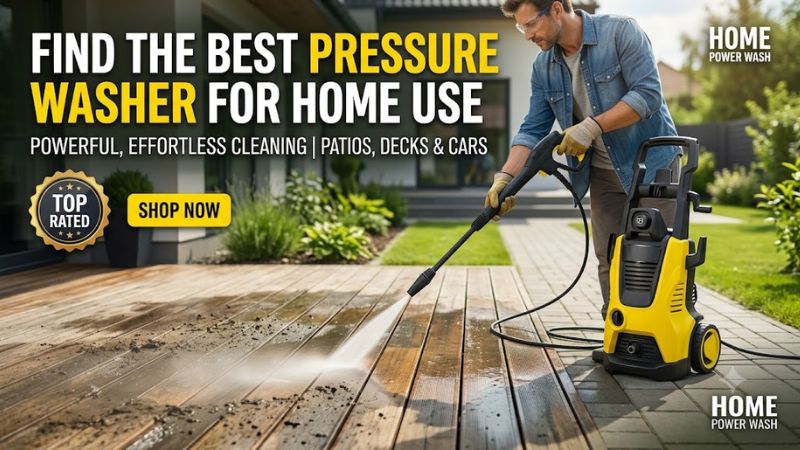
| Product | Best for | Advertised pressure and flow | Power source | Main limitation |
| RYOBI RY142500 | Best overall for typical home cleaning | 2,500 PSI; 1.2 GPM | Corded electric | Limited flow for large concrete areas |
| Greenworks Pro GPW3002A | Demanding electric cleaning | 3,000 PSI maximum; 1.1 GPM at 3,000 PSI | Corded electric | Requires a suitable electrical outlet |
| Sun Joe SPX3000 | Value-oriented residential cleaning | 2,030 PSI maximum; 1.76 GPM maximum | Corded electric | Exact package specifications require confirmation |
| DEWALT DWPW2400 | Mobile electric cleaning | 2,400 PSI maximum; 1.1 GPM | Corded electric | Relatively modest water flow |
| Kärcher K1700 | Compact, lighter-duty jobs | 1,700 PSI maximum; 1.2 GPM maximum | Corded electric | Less suited to heavy grime over large areas |
| Westinghouse WPX3200 | Large driveways and properties | 3,200 PSI rated; 2.5 GPM rated | Gasoline | Requires fuel, engine maintenance, and exhaust precautions |
Important: Maximum pressure and maximum flow are not necessarily delivered simultaneously. For example, Greenworks lists 2.0 GPM at 100 PSI and 1.1 GPM at 3,000 PSI for the GPW3002A. Compare operating specifications under equivalent conditions whenever possible.
1. RYOBI RY142500 — Best overall for home use
The RYOBI RY142500 is a strong choice for homeowners who want one electric pressure washer for a range of routine outdoor cleaning jobs. Its brushless motor, 2,500 PSI maximum pressure, and 1.2 GPM flow rating make it suitable for many residential surfaces, provided the correct nozzle and technique are used.
Key specifications
| Specification | Details |
| Power source | Corded electric |
| Electrical supply | 120V, 60Hz |
| Motor | 13-amp brushless motor |
| Maximum pressure | 2,500 PSI |
| Listed flow rate | 1.2 GPM |
| High-pressure hose | 25 feet |
| Power cord | 35 feet, with GFCI protection |
| Included accessories | Trigger handle, metal wand, 15-degree nozzle, turbo nozzle, and soap nozzle |
| Listed weight | 43.36 lb |
| Warranty | 3-year limited warranty |
Why it stands out
The brushless motor and aluminum axial-cam pump are useful features for a homeowner looking for a capable electric machine. Its onboard storage also helps keep the hose, cord, and accessories organized between jobs.
The included nozzles provide different cleaning options. The soap nozzle supports detergent application, while the turbo nozzle can help remove stubborn dirt from suitable durable surfaces. Neither should be used indiscriminately on delicate materials.
Limitations
Its 1.2 GPM flow rate is relatively modest for extensive concrete cleaning. A large driveway may take longer to wash than it would with a higher-flow machine. The unit is also less convenient when the work area is far from a suitable electrical outlet.
Buy if: You want a versatile electric pressure washer for regular household cleaning.
Skip if: You routinely clean large concrete areas and need higher water flow to cover them efficiently.
2. Greenworks Pro GPW3002A — Best for demanding electric cleaning
The Greenworks Pro GPW3002A is worth considering if you want a higher-output electric pressure washer without the fuel and engine maintenance associated with gas models. Its advertised maximum pressure is 3,000 PSI, but its flow rating changes significantly depending on operating pressure.
Key specifications
| Specification | Details |
| Power source | Corded electric |
| Motor | 14-amp brushless motor |
| Maximum pressure | 3,000 PSI |
| Flow at 3,000 PSI | 1.1 GPM |
| Flow at 100 PSI | 2.0 GPM |
| High-pressure hose | 25 feet |
| Power cord | 35 feet with inline GFCI |
| Included nozzles | 15-degree, 25-degree, 40-degree, soap, and turbo |
| Listed warranty | 3-year limited tool warranty |
Why it stands out
The brushless motor and multiple nozzle options give homeowners flexibility across several outdoor cleaning tasks. Its higher maximum-pressure rating makes it a candidate for tougher dirt on suitable surfaces, while electric operation avoids gasoline storage and engine oil changes.
However, pressure alone does not determine cleaning speed. Water flow, nozzle design, dirt type, and the size of the work area also matter.
Limitations
The 3,000 PSI headline rating should not be interpreted as continuous delivery at 2.0 GPM. The machine also needs an appropriate electrical connection, and its cord limits placement.
Buy if: You regularly clean outdoor surfaces and prefer a higher-output electric washer.
Skip if: You mostly wash cars or patio furniture and do not need the additional capability.
3. Sun Joe SPX3000 — Best value-oriented option
The Sun Joe SPX3000 is a familiar residential electric pressure washer that may appeal to homeowners seeking an affordable machine for occasional cleaning. Commonly published specifications list 2,030 PSI maximum pressure and 1.76 GPM maximum flow.
Because exact packages and specifications can vary, verify the model identifier and included accessories before purchasing.
Key specifications
| Specification | Details |
| Power source | Corded electric |
| Commonly listed maximum pressure | 2,030 PSI |
| Commonly listed maximum flow | 1.76 GPM |
| Included accessories | Confirm against the exact package |
| Warranty | Confirm current terms for the exact model and market |
Why it stands out
For moderate household workloads, a value-oriented electric washer can be sufficient for outdoor furniture, steps, small patios, and vehicle washing when used with appropriate settings and accessories.
Electric operation reduces the routine maintenance associated with gasoline engines. The SPX3000 is worth comparing with similarly priced models if its package includes the accessories you need.
Limitations
Maximum PSI and maximum GPM are separate ratings, so they do not establish the machine’s simultaneous operating output. Current pricing, warranty coverage, and package contents should be confirmed rather than assumed.
Buy if: You find a competitively priced package with clearly documented specifications and suitable accessories.
Skip if: You need verified high-flow performance for large paved areas or cannot confirm the exact package details.
4. DEWALT DWPW2400 — Best for mobile electric cleaning
The DEWALT DWPW2400 is a wheeled electric pressure washer designed for homeowners who want to move their equipment between cleaning areas without handling a heavy machine by hand. Its 2,400 PSI maximum rating and included nozzle selection suit a variety of routine outdoor tasks.
Key specifications
| Specification | Details |
| Power source | Corded electric |
| Listed voltage | 110V |
| Maximum pressure | 2,400 PSI |
| Listed flow rate | 1.1 GPM |
| High-pressure hose | 25 feet |
| Power cord | 35 feet |
| Included nozzles | Turbo, 15-degree, 25-degree, 40-degree, and soap |
| Warranty | 3-year limited warranty |
Why it stands out
The pneumatic wheels help when moving the washer over outdoor surfaces, while onboard storage keeps accessories together. The included nozzle options provide flexibility for different cleaning tasks.
For typical residential jobs, the combination of electric power and a wheeled frame can be more convenient than a larger gas machine.
Limitations
At 1.1 GPM, the DWPW2400 is not a high-flow option for cleaning extensive driveways. Its electrical cord and water supply also restrict where it can operate.
Buy if: You want a mobile electric washer with several included nozzle options.
Skip if: Your main priority is finishing large concrete surfaces as quickly as possible.
5. Kärcher K1700 — Best for compact, lighter-duty cleaning
The Kärcher K1700 is suited to homeowners who prioritize easy handling and storage over maximum cleaning output. Its lower pressure rating makes it a practical candidate for routine cleaning, provided the machine is matched to the surface and the manufacturer’s instructions.
Key specifications
| Specification | Details |
| Power source | Corded electric |
| Maximum pressure | 1,700 PSI |
| Maximum flow | 1.2 GPM |
| Listed weight without accessories | 20.7 lb |
| High-pressure hose | 20 feet |
| Detergent tank | 0.5 gallon |
| Included nozzles | Three, including a turbo nozzle |
| Warranty | 3-year limited warranty |
Why it stands out
The listed weight is lower than that of many larger residential pressure washers, which can make the K1700 easier to move and store. Its detergent tank and included nozzles support common household cleaning tasks without requiring a gas engine.
The machine is best considered for moderate cleaning around smaller properties rather than heavy-duty work over large areas.
Limitations
The lower pressure rating makes it less suitable for stubborn grime spread across extensive concrete surfaces. Replacement hoses and attachments must also match the applicable connector specifications and manufacturer compatibility requirements.
Buy if: You need a manageable electric washer for occasional cleaning and have limited storage space.
Skip if: You regularly tackle heavily soiled driveways or want higher cleaning throughput.
6. Westinghouse WPX3200 — Best gas pressure washer for larger properties
The Westinghouse WPX3200 is the gas-powered choice in this roundup for homeowners who need higher water flow and freedom from an electrical cord. Its rated 3,200 PSI and 2.5 GPM make it worth considering for larger outdoor cleaning workloads.
Key specifications
| Specification | Details |
| Power source | Gasoline |
| Engine | 212cc, four-stroke OHV |
| Rated pressure | 3,200 PSI |
| Rated flow | 2.5 GPM |
| High-pressure hose | 25 feet |
| Included nozzle tips | 0-degree, 15-degree, 25-degree, 40-degree, and soap |
| Listed dry weight | 63 lb |
| Warranty | 3-year residential limited warranty |
Why it stands out
Its rated water flow is higher than that of the electric models covered here, which can help when cleaning extensive concrete areas. The gasoline engine also makes it suitable for locations where access to a convenient electrical outlet is limited.
For homeowners with large driveways or substantial outdoor hardscaping, the additional flow may be more valuable than simply choosing the highest advertised PSI.
Limitations
The WPX3200 is heavier and requires fuel, engine maintenance, and more attention to noise and exhaust. Gasoline-powered pressure washers must be operated outdoors, away from doors, windows, and air intakes, to reduce carbon monoxide exposure.
The included 0-degree nozzle can concentrate the water jet enough to damage surfaces or cause injury. It should not be treated as the default nozzle for household cleaning.
Buy if: You have a large property and regularly clean extensive outdoor surfaces.
Skip if: You mainly wash vehicles, patio furniture, or small patios and prefer lower maintenance requirements.
How to choose the best pressure washer for your home
The right machine depends on the surfaces you clean, the size of the area, and how frequently you use it. A higher PSI rating does not automatically mean a washer will finish every job faster.
Match pressure and water flow to the task
PSI measures water pressure, while GPM measures water volume delivered per minute. Both matter, but they describe different characteristics.
| Cleaning task | What to prioritize | Practical guidance |
| Cars and outdoor furniture | Controlled pressure and suitable nozzles | Use a broad spray pattern and avoid directing the jet at delicate finishes |
| Vinyl siding and fences | Appropriate pressure and cleaning solution | Follow the surface manufacturer’s cleaning instructions |
| Wood decks | Gentle, controlled cleaning | Test an inconspicuous area to avoid damaging wood fibers or coatings |
| Concrete driveways | Adequate flow and suitable accessories | Consider a compatible surface-cleaner attachment for broad, flat areas |
| Heavily soiled patios | Appropriate pressure, flow, and detergent | Let compatible cleaning products assist rather than relying on pressure alone |
Always follow the pressure washer manual and the surface manufacturer’s guidance. Even a lower-powered washer can damage paint, wood, mortar, seals, or other vulnerable materials if the nozzle is too aggressive or too close.
Choose electric or gas power
Electric pressure washers are generally the more convenient choice for routine household cleaning. They avoid gasoline storage and combustion-engine maintenance, making them suitable for patios, furniture, vehicles, and smaller driveways. They do, however, require a suitable electrical supply and careful cord management.
Gas pressure washers are better suited to larger properties and workloads where higher water flow or freedom from an electrical cord matters. They require fuel, engine maintenance, and precautions against exhaust exposure. Never operate a gasoline-powered washer inside a home, garage, or other enclosed or partially enclosed space.
Check the included accessories
Before buying, confirm that the package includes the equipment you need:
- Spray nozzles: Check which spray patterns are included and which are appropriate for your surfaces.
- Surface cleaner: A compatible surface cleaner can help cover broad concrete areas more evenly than a narrow spray.
- Detergent system: Determine whether the washer has an onboard tank or requires a separate compatible attachment.
- Hose length: A longer hose can reduce how often you need to move the machine, provided it is approved for that model and pressure.
- Replacement parts: Check whether compatible hoses, seals, nozzles, and service components are available.
Do not assume an accessory will fit simply because it has the same nominal diameter. Connector type, thread, pressure rating, and manufacturer compatibility all matter.
Compare the total ownership cost
The lowest-priced machine is not always the best value. Consider the initial purchase price, required accessories, replacement components, and maintenance supplies.
A small electric washer may be sufficient if you clean a patio a few times each year. If you regularly clean a large driveway, a higher-flow machine or compatible surface cleaner may justify a larger initial investment.
Pressure washer safety tips for homeowners
Pressure washers can cause serious injection injuries, eye injuries, electrical shock, and property damage. Safe operation requires following the manufacturer’s instructions and using the machine within its intended limits.
- Wear appropriate eye protection, protective footwear, and any additional personal protective equipment specified in the manual.
- Use the electrical supply and GFCI protection specified by the manufacturer. Keep electrical connections away from standing water and runoff.
- Never point the spray gun at people or animals. Never use your hand to check for a leak in a pressurized hose or fitting.
- Start with a less aggressive nozzle and a greater distance from the surface. Adjust cautiously according to the material and the manufacturer’s instructions.
- Never operate a gasoline-powered pressure washer indoors or in an enclosed or partially enclosed area. Carbon monoxide can accumulate to dangerous levels.
- Shut down the washer and release pressure according to the manual before changing accessories, inspecting connections, or performing maintenance.
A high-pressure injection injury requires immediate medical attention, even if the wound appears small. The initial appearance of the injury does not reliably indicate its severity.
Frequently asked questions
1. What PSI pressure washer is best for home use?
A pressure washer with an advertised maximum rating of roughly 1,700–2,500 PSI can handle many residential jobs, depending on its water flow, nozzle, and intended application. Delicate surfaces may need substantially gentler cleaning, while extensive concrete cleaning may benefit from greater water flow.
2. Is an electric or gas pressure washer better for home use?
An electric pressure washer is generally more convenient for routine home cleaning because it avoids gasoline and combustion-engine maintenance. A gas model is worth considering for larger properties or frequent heavy-duty cleaning where higher water flow is useful.
3. Can I use a pressure washer to clean my driveway?
Yes, provided the machine and accessories are suitable for the driveway’s condition and material. A compatible surface cleaner can improve coverage across broad, flat areas. Use caution around cracks, damaged concrete, joints, coatings, and nearby landscaping.
4. What should I look for in a pressure washer for cars?
Choose a pressure washer with controllable cleaning intensity, a suitable broad-pattern nozzle, and a compatible vehicle detergent system. Keep the spray away from sensitive seals, tires, cameras, and electrical components, and follow the vehicle manufacturer’s washing recommendations.
Final verdict: Which pressure washer should you buy?
For most homeowners, the RYOBI RY142500 is the best overall starting point because it combines useful residential cleaning capability with electric operation and a practical accessory package.
Choose the Greenworks Pro GPW3002A if you want a higher-output electric option, the Kärcher K1700 if compact storage and lighter-duty cleaning are priorities, or the Westinghouse WPX3200 if your property and workload justify a gas-powered washer with higher water flow.
Before purchasing, confirm the exact model, current price, included accessories, warranty, and power requirements. Match the machine to the surfaces you clean rather than choosing solely by the largest PSI number on the box.
Related guides
- DEWALT 3300 PSI Pressure Washer Review: Specs, Price, and Is It Worth Buying?
- Sun Joe Electric Pressure Washer: How to Choose, Use, and Troubleshoot One
- Greenworks 1800 PSI Pressure Washer Review: Price, Specs, and Is It Worth Buying?
- DEWALT 4400 PSI Pressure Washer Review: Price, Specs, and Is It Worth Buying?