What's inside
- Ryobi 3300 PSI Pressure Washer: Quick Verdict
- Ryobi RY80589
- Ryobi 3300 PSI Pressure Washer Specifications
- Price and Value: Is the Ryobi 3300 PSI Worth $399?
- Cleaning Performance: What Can It Handle?
- Design, Handling, and Maintenance
- Safety Features and Important Precautions
- Pros and Cons of the Ryobi 3300 PSI Pressure Washer
- Ryobi 3300 PSI vs. an Electric Pressure Washer
- Who Should Buy the Ryobi 3300 PSI Pressure Washer?
- Frequently Asked Questions
As an Amazon Associate I earn from qualifying purchases. This post may contain affiliate links at no extra cost to you.
The Ryobi 3300 PSI pressure washer is worth considering if you need a gas-powered machine for demanding residential cleaning, including concrete driveways, walkways, and other outdoor surfaces. However, 3300 PSI alone does not tell you how quickly a pressure washer will clean. Water flow, nozzle selection, the surface being cleaned, and the exact model also matter.
There are several Ryobi pressure washers rated at 3300 PSI, and their specifications are not identical. This review focuses on the Ryobi RY80589, which Ryobi lists with a 212cc gasoline engine, a maximum advertised pressure of 3300 PSI, a flow rate of 2.4 gallons per minute (GPM), and a listed price of $399 in the US market as checked on October 20, 2026. A separate model, the RY803325A, is listed by Home Depot with 2.5 GPM and a different engine specification.
The bottom line: the RY80589 is a reasonable candidate for homeowners who want substantial cleaning capacity without moving into a larger commercial machine. It is less appealing if you need a quiet, low-maintenance electric washer or only clean cars and delicate outdoor furniture.
Ryobi 3300 PSI Pressure Washer: Quick Verdict
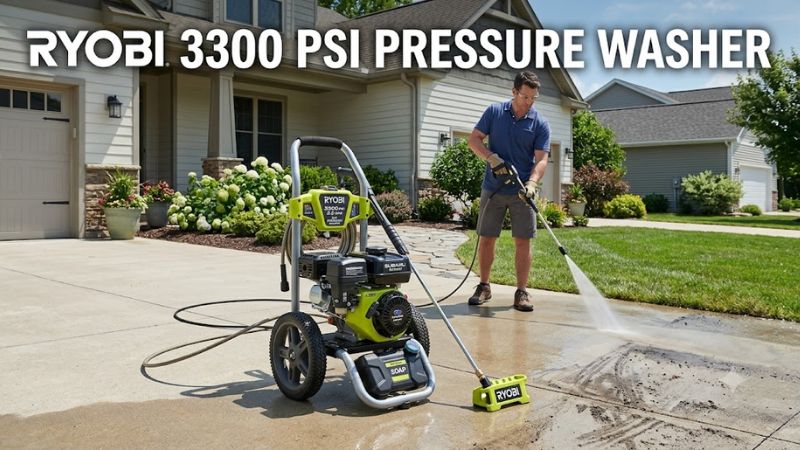
Ryobi RY80589
Gas-powered pressure washer · US model
Maximum advertised pressure
3,300 PSI
Advertised flow rate
2.4 GPM
Best for
Driveways, walkways, outdoor hard surfaces, and larger residential cleaning jobs.
Main drawbacks
Gas-engine maintenance, operating noise, fuel storage, and the risk of surface damage from excessive pressure.
Listed price
$399
US manufacturer listing; price and availability may change.
Specifications and price: Ryobi’s official RY80589 product listing. The pressure and flow figures are manufacturer ratings, not independent performance measurements.
Recommendation: Consider this model if you regularly clean large outdoor areas and prefer a gas engine. For occasional car washing, small patios, and lighter maintenance, a lower-pressure electric washer may be a more practical purchase.
Ryobi 3300 PSI Pressure Washer Specifications
The RY80589 is a gasoline-powered, cold-water pressure washer designed for substantial outdoor cleaning. Its advertised pressure and flow rate place it in a useful range for homeowners who need more capacity than many compact electric washers provide.
| Specification | Ryobi RY80589 |
| Power source | Gasoline |
| Engine displacement | 212cc |
| Maximum advertised pressure | 3,300 PSI |
| Advertised flow rate | 2.4 GPM |
| Pump type | Aluminum axial cam |
| High-pressure hose | 35 feet |
| Wheel size | 12 inches |
| Listed weight | 59 lb |
| Fuel tank capacity | 0.95 gallon |
| Warranty | 3-year limited warranty listed by manufacturer |
| Listed US price | $399 |
| Research date | October 20, 2026 |
Specifications are based on Ryobi’s published product information. The 59 lb figure is the listed machine weight; verify the applicable manual for operating and transport details.
What do 3300 PSI and 2.4 GPM mean?
PSI measures pressure, or the force per unit area exerted by the water. GPM measures the volume of water delivered each minute.
These numbers describe different aspects of cleaning performance:
- 3,300 PSI: Indicates the advertised maximum pressure capability. It is not a promise that every nozzle or operating condition delivers 3,300 PSI continuously at the surface.
- 2.4 GPM: Indicates the advertised flow rate. Higher flow can help rinse away loosened dirt and move debris from a cleaned area.
- Combined effect: Pressure helps loosen stubborn deposits, while water flow helps carry away the material. Nozzle design and distance from the surface also affect results.
Do not assume this machine will remove every stain quickly just because it carries a 3,300 PSI rating. Embedded oil, old coatings, mineral deposits, and biological growth may require different cleaning methods or detergents.
Price and Value: Is the Ryobi 3300 PSI Worth $399?
At the manufacturer’s listed price of $399, the RY80589 is worth considering if you have enough recurring outdoor cleaning work to justify a gasoline-powered machine. It is a less compelling purchase if you will use it only once or twice a year.
US price check: October 20, 2026. Prices, stock, and warranty terms can change.
A second model to check before buying
One important buying detail is that the Ryobi 3300 PSI name covers multiple models.
| Detail | RY80589 | RY803325A |
| Advertised pressure | 3,300 PSI | 3,300 PSI |
| Advertised flow | 2.4 GPM | 2.5 GPM |
| Engine | 212cc | Honda GCV200, 201cc |
| Hose | 35 ft | 50 ft |
| Listed US price | $399 | $529 |
| Warranty information | 3-year limited warranty | 3-year limited washer warranty; 2-year engine warranty |
Sources: Ryobi’s product listing and Home Depot’s listing for the RY803325A.
The RY803325A costs $130 more at the observed prices, but it also lists a longer hose and a different engine. That difference may be worthwhile if you frequently clean large areas and value the additional reach. It does not automatically mean the more expensive model cleans better in every situation.
Check the model number on the machine and packaging before comparing offers. Do not use the specifications, included accessories, or warranty for one model to evaluate another.
What is included with the RY80589?
Ryobi’s published listing identifies the following package contents:
- RY80589 pressure washer
- Trigger handle
- Metal spray wand
- 35-foot non-marring high-pressure hose
- Quarter-inch quick-connect nozzle set, including soap, 25-degree, 40-degree, and extended-reach second-story nozzles
- Engine lubricant
- Operator’s manual
Confirm the box contents with the seller before purchase, especially for clearance stock, used machines, or packages with different model suffixes. The machine’s listed price should not be assumed to include separately sold accessories.
Cleaning Performance: What Can It Handle?
The RY80589’s specifications make it a plausible choice for larger residential jobs. However, the manufacturer ratings alone do not establish an independent cleaning speed or prove superiority over competing pressure washers.
Concrete driveways and walkways
Concrete is one of the more suitable applications for a gas-powered washer in this class, provided the concrete is in good condition and the operator chooses an appropriate nozzle and working distance.
It can be useful for removing loose dirt, surface grime, and some weather-related buildup. Stubborn oil stains may need a compatible degreaser and additional treatment rather than simply increasing pressure.
Use caution on cracked, deteriorating, previously repaired, or decorative concrete. A concentrated jet can erode weak material, damage joints, and leave visible cleaning marks. A compatible surface-cleaner attachment may produce a more uniform finish over large flat areas.
Siding and exterior walls
The machine can be used for some exterior cleaning, but its maximum pressure should not be applied indiscriminately to siding.
Use a suitable low-pressure approach, keep water away from vulnerable seams and openings, and follow the siding manufacturer’s cleaning instructions. High-pressure spray can force water behind cladding, damage finishes, or break fragile components.
For a two-story house, the extended-reach nozzle may help reach higher areas. It does not eliminate the need to protect windows, electrical equipment, vents, and other vulnerable surfaces.
Cars, trucks, and outdoor furniture
For vehicle paint, soft trim, screens, and delicate furniture, the RY80589 may offer more pressure than necessary.
Use an appropriate nozzle and keep a safe distance, following the vehicle or surface manufacturer’s guidance. Never direct a concentrated jet toward tires, seals, electrical connectors, or damaged paint. A lower-pressure electric model may be easier to manage for routine car washing.
Old paint and preparation work
Ryobi identifies exterior paint preparation among the intended applications of its 3300 PSI product family. However, removing paint with pressurized water creates additional hazards.
Older coatings may contain lead or other hazardous substances. Before disturbing an existing coating, determine what it contains and follow the applicable safety and waste-handling requirements. Do not assume a pressure washer is the right removal method for every painted surface.
Design, Handling, and Maintenance
The RY80589 combines a gasoline engine, an axial-cam pump, a wheeled frame, and a high-pressure hose. These features suit outdoor work where mobility and independence from an electrical outlet are useful.
Portability and reach
At a listed 59 lb, this is not a lightweight washer. Its wheels help with movement over suitable ground, but lifting it into a vehicle or carrying it over steps may require extra care.
The 35-foot hose provides useful reach around a driveway or patio, although the RY803325A’s 50-foot hose may be more convenient for larger properties.
Gas-engine ownership costs
A gasoline pressure washer requires more routine attention than a typical electric washer. Ownership involves fuel, engine-oil maintenance, storage precautions, and preparation for periods when the machine will not be used.
Follow the exact operator’s manual for fuel, lubricant, starting, pump care, and storage. The manual for the RY803300H, for example, warns against E15 and E85 fuel and specifies unleaded gasoline with no more than 10% ethanol. Do not automatically apply another model’s manual to the RY80589; check the correct manual for your unit.
Noise and exhaust
The gasoline engine produces exhaust and operating noise. Run the machine outdoors, away from doors, windows, and air intakes, and never operate it inside a home, garage, shed, or other enclosed or partially enclosed area. Carbon monoxide can accumulate to dangerous levels even when a door is open.
If a quieter setup is important or you need to clean inside a space, choose a suitable alternative rather than running a gasoline pressure washer indoors.
Safety Features and Important Precautions
A 3,300 PSI pressure washer can cause serious injuries and property damage when used incorrectly. The pressure rating should be treated as a capability that requires control, not a target for every cleaning task.
Before using the RY80589:
- Read the operator’s manual for the exact model.
- Connect the water supply and ensure water is flowing correctly before starting the pump, following the manufacturer’s startup procedure.
- Wear appropriate eye protection, sturdy footwear, and other protective equipment specified by the manual.
- Inspect the hose, fittings, spray gun, and wand for damage before operation.
- Never point the spray at people or animals, and never use your hand to check for a suspected high-pressure leak.
- Shut down the engine and release pressure according to the manual before changing nozzles or disconnecting components.
- Keep the exhaust away from enclosed or partially enclosed spaces.
- Use only compatible, pressure-rated hoses, fittings, and accessories.
High-pressure water can penetrate skin and cause serious injection injuries. Seek immediate medical attention if an injection injury occurs, even if the wound initially appears minor.
For additional safety guidance, follow the warnings in the RY80589 operator’s manual rather than relying on a generic pressure-washer procedure.
Pros and Cons of the Ryobi 3300 PSI Pressure Washer
Pros
- Substantial advertised cleaning capacity: The 3,300 PSI maximum rating and 2.4 GPM flow rate suit a range of demanding residential cleaning jobs.
- Gas-powered operation: No electrical outlet is required to power the machine.
- Useful hose reach: The included 35-foot hose provides flexibility around driveways and patios.
- Extended-reach nozzle: The manufacturer includes a nozzle intended to help with second-story cleaning.
- Wheeled design: The 12-inch wheels assist movement across suitable outdoor surfaces.
- Published price: The manufacturer’s $399 listing provides a clear starting point for budgeting.
Cons
- Gas-engine maintenance: Fuel, oil, storage, and seasonal care add work and cost.
- Noise and exhaust: It is less suitable for noise-sensitive neighborhoods and enclosed environments.
- Potentially excessive pressure: Delicate surfaces require careful nozzle selection and technique.
- Weight: At a listed 59 lb, transport and lifting require more effort than with many compact electric models.
- Model confusion: Other Ryobi 3300 PSI washers have different flow rates, engines, hoses, and prices.
- Limited independent evidence: The manufacturer’s specifications do not establish real-world cleaning speed, long-term durability, or comparative performance.
Ryobi 3300 PSI vs. an Electric Pressure Washer
A gas-powered machine is not automatically the better choice simply because its advertised PSI is higher. The best option depends on the size of the cleaning area, how often you work, and whether you need to operate away from an electrical outlet.
| Buying consideration | Ryobi RY80589 gas washer | Electric pressure washer |
| Larger outdoor jobs | A reasonable candidate | Depends on the model’s pressure and flow |
| Electrical outlet needed | No | Yes |
| Engine maintenance | Required | No gasoline engine maintenance |
| Operating noise and exhaust | Higher; produces exhaust | Usually quieter; no engine exhaust at the machine |
| Routine car washing | Can work with careful pressure control | Often sufficient and easier to manage |
| Ownership cost | Includes fuel and engine upkeep | Includes electricity and any model-specific maintenance |
| Best reason to choose | Recurring, demanding outdoor cleaning | Convenience and lighter-duty household cleaning |
Compare the actual pressure, flow rate, accessories, and warranty of any electric alternative. Do not compare PSI ratings alone.
Who Should Buy the Ryobi 3300 PSI Pressure Washer?
Buy the RY80589 if:
- You regularly clean a large driveway, concrete paths, or outdoor hard surfaces.
- You want a gasoline-powered washer without depending on an electrical outlet.
- You are comfortable maintaining a small gasoline engine.
- You can safely store and operate the machine outdoors.
- The $399 listed price fits your budget and the included hose and nozzles meet your needs.
Skip it if:
- You mainly wash cars, bicycles, or delicate outdoor furniture.
- You need a quiet machine for frequent residential use.
- You do not want to manage gasoline, oil, engine maintenance, or winter storage.
- You need a lighter unit that is easy to lift and carry.
- You expect the maximum PSI rating alone to remove every type of stain.
What to check before purchasing
Use this short checklist before committing to a model:
- Confirm that the machine is the RY80589, not another Ryobi 3300 PSI model.
- Verify the current price and whether the package is new, complete, and covered by the stated warranty.
- Confirm the hose length, nozzle set, and included accessories.
- Check local availability of compatible replacement parts and service.
- Compare the total ownership cost with an electric washer or a more expensive gas model.
- Read the correct operator’s manual and confirm that the machine is appropriate for your planned surfaces.
Frequently Asked Questions
1. How much does the Ryobi 3300 PSI pressure washer cost?
The Ryobi RY80589 was listed at $399 in the US market when checked on October 20, 2026. Another model, the RY803325A, was listed at $529 by Home Depot. These prices apply to the identified models and can change with stock, promotions, and retailer policies.
2. Is a Ryobi 3300 PSI pressure washer good for driveways?
Yes, a Ryobi 3300 PSI model can be suitable for many residential driveway-cleaning jobs, especially on sound concrete. Results depend on the flow rate, nozzle, surface condition, and type of dirt. A compatible surface cleaner can help achieve a more even finish on large areas.
3. Can you use the Ryobi 3300 PSI pressure washer on a car?
Yes, but use caution because maximum-pressure spray can damage paint, trim, seals, or tires. Choose a suitable spray pattern and working distance, and follow the vehicle manufacturer’s cleaning guidance. For routine car washing, a lower-pressure electric washer may be easier to control.
4. What is the difference between the Ryobi RY80589 and RY803325A?
Both advertise 3,300 PSI, but the RY80589 is listed at 2.4 GPM with a 212cc engine and a 35-foot hose, while the RY803325A is listed at 2.5 GPM with a Honda GCV200 201cc engine and a 50-foot hose. Their observed prices also differ: $399 and $529, respectively. Confirm the exact model and package before purchasing.
Final Verdict: Is the Ryobi 3300 PSI Pressure Washer Worth Buying?
The Ryobi RY80589 is worth considering for homeowners who regularly clean driveways, walkways, and other outdoor surfaces and want the flexibility of a gasoline-powered pressure washer. Its advertised 3,300 PSI, 2.4 GPM flow rate, 35-foot hose, and included nozzle set make it a practical candidate for substantial residential work.
At the observed $399 price, its value depends on how often you will use it and whether you need gas-powered capacity. Its maintenance requirements, noise, exhaust, and weight make it less attractive for occasional light-duty cleaning.
Before buying, compare it with the RY803325A and verify current pricing, package contents, warranty terms, and service availability. Choose based on the exact model and the work you need to do, not the 3,300 PSI label alone.
Related guides
- DEWALT 3300 PSI Pressure Washer Review: Specs, Price, and Is It Worth Buying?
- Sun Joe Electric Pressure Washer: How to Choose, Use, and Troubleshoot One
- Greenworks 1800 PSI Pressure Washer Review: Price, Specs, and Is It Worth Buying?
- DEWALT 4400 PSI Pressure Washer Review: Price, Specs, and Is It Worth Buying?