
What's inside
- 1. What Is a Milwaukee 3/8 Impact Wrench?
- 2. Which Milwaukee 3/8 Impact Wrench Should You Choose?
- 3. Choosing the Right Sockets for a Milwaukee 3/8 Impact Wrench
- 4. How to Use a Milwaukee 3/8 Impact Wrench
- 5. Milwaukee 3/8 Impact Wrench Safety Tips
- 6. Common Milwaukee 3/8 Impact Wrench Problems
- 7. How to Maintain a Milwaukee 3/8 Impact Wrench
- Frequently Asked Questions
- Final Verdict
As an Amazon Associate I earn from qualifying purchases. This post may contain affiliate links at no extra cost to you.
A Milwaukee 3/8 impact wrench is a practical cordless tool for automotive repairs, equipment maintenance, and mechanical assembly. Its compact square-drive design makes it useful when working around engine components, brackets, and other confined spaces. However, Milwaukee offers several 3/8-inch impact wrench models with different power levels, battery platforms, and intended applications.
Choosing the right model involves more than comparing advertised torque numbers. You should understand the difference between fastening torque and nut-busting torque, check battery compatibility, select impact-rated sockets, and learn how to control the tool without damaging fasteners.
This guide explains how Milwaukee 3/8 impact wrenches work, how to choose between popular models, and how to operate and maintain them safely.
1. What Is a Milwaukee 3/8 Impact Wrench?
A Milwaukee 3/8 impact wrench is a cordless fastening tool that combines rotational force with repeated mechanical impacts. It is designed to loosen and tighten threaded fasteners more effectively than many conventional hand tools.
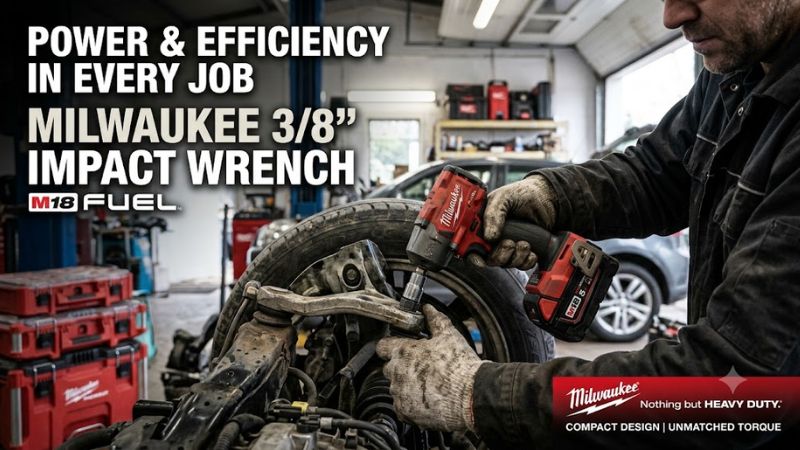
The 3/8-inch measurement refers to the square-drive anvil that connects the wrench to a socket. It does not indicate the maximum bolt diameter or the tool’s torque output.
Common applications include:
- Removing automotive nuts and bolts.
- Performing engine and suspension maintenance.
- Working on lawn equipment and small machinery.
- Assembling metal equipment and workshop fixtures.
- Removing stubborn fasteners when the tool has sufficient capacity.
- Handling repetitive fastening jobs in confined spaces.
A 3/8-inch impact wrench offers a useful balance between socket size, accessibility, and mechanical capability. However, it is not automatically suitable for every automotive or industrial fastener.
How does an impact wrench work?
Inside the tool, an electric motor drives a rotating mechanism that delivers repeated impacts to the output anvil. These impacts help loosen resistant fasteners without requiring the user to apply continuous manual force.
Three specifications help explain its operation:
- RPM: Revolutions per minute, indicating rotational speed.
- IPM: Impacts per minute, indicating how frequently the mechanism delivers impacts.
- Torque: Rotational force applied to the fastener.
Higher RPM does not automatically mean greater torque, and a higher impact rate does not guarantee faster removal in every situation.
2. Which Milwaukee 3/8 Impact Wrench Should You Choose?
Milwaukee has several 3/8-inch impact wrenches across its M12 and M18 cordless platforms. Three relevant models illustrate the differences between compact and higher-capacity options.
| Model | Platform | Advertised nut-busting torque | Best application |
| M12 FUEL Stubby 2562-20 | M12, 12V | Up to 550 ft-lbs | Compact access and demanding removal |
| M18 FUEL Compact 2854-20 | M18, 18V | Up to 250 ft-lbs | General compact mechanical work |
| M18 FUEL Mid-Torque 2960-20 | M18, 18V | Up to 600 ft-lbs | More demanding fastener removal |
These figures represent manufacturer-advertised nut-busting torque, not equivalent tightening-torque measurements. They should not be interpreted as directly comparable independent performance tests.
Milwaukee M12 FUEL Stubby 2562-20
The 2562-20 is a compact 12V M12 FUEL impact wrench with a 3/8-inch friction-ring anvil and POWERSTATE brushless motor.
Its published specifications include:
- Up to 550 ft-lbs of nut-busting torque.
- Maximum no-load speed of 3,000 RPM.
- Maximum impact rate of 3,300 IPM.
- Four DRIVE CONTROL modes.
- Tri-LED work lighting.
- Compatibility with M12 REDLITHIUM batteries.
Its main attraction is its compact battery platform combined with substantial advertised removal capability. It is worth considering for automotive technicians and DIY users who frequently work in restricted spaces.
Milwaukee M18 FUEL Compact 2854-20
The 2854-20 is an 18V compact impact wrench featuring a 3/8-inch friction-ring anvil.
Its specifications include:
- Up to 250 ft-lbs of nut-busting torque.
- A compact 4.8-inch tool length.
- POWERSTATE brushless motor.
- Four-mode DRIVE CONTROL.
- Tri-LED lighting.
- Automatic shut-off and bolt-removal control.
This model is appropriate for users who want a compact M18 tool for routine automotive and mechanical work. Its shorter body can be useful around brackets, engine components, and other obstacles.
The 2854-20 bare-tool package does not include a battery or charger, so account for those costs when planning a purchase.
Milwaukee M18 FUEL Mid-Torque 2960-20
The 2960-20 belongs to Milwaukee’s M18 mid-torque category. It uses a 3/8-inch friction-ring anvil and is advertised with up to 600 ft-lbs of nut-busting torque.
Its features include:
- POWERSTATE brushless motor.
- Four-mode DRIVE CONTROL.
- Tri-LED lighting.
- Automatic shut-off.
- Bolt-removal control.
- M18 battery compatibility.
This model is worth considering for users who regularly encounter more demanding fasteners. However, additional power does not eliminate the need for correct socket selection and final torque verification.
M12 versus M18: Which platform is better?
Choose M12 when compact dimensions and compatibility with existing M12 equipment are priorities.
Choose M18 when you already own M18 batteries or need a specific M18 model for your workload.
Do not select a wrench based on voltage alone. Compare the exact model specifications, dimensions, advertised torque figures, battery requirements, and application.
3. Choosing the Right Sockets for a Milwaukee 3/8 Impact Wrench
A Milwaukee 3/8 impact wrench needs sockets with a matching 3/8-inch square-drive connection.
However, the square-drive measurement is different from the socket’s hex opening. For example, a 3/8-inch-drive impact socket may have a 10mm, 13mm, 17mm, or 19mm opening.
Choose sockets according to these characteristics:
| Feature | What to check |
| Drive size | 3/8-inch square drive |
| Construction | Impact-rated material |
| Opening | Correct metric or SAE size |
| Depth | Shallow or deep, depending on access |
| Retention | Compatible with the tool’s friction ring |
| Condition | No cracks or excessive wear |
Deep versus shallow impact sockets
Shallow sockets are useful for fasteners with limited clearance and relatively short exposed threads.
Deep sockets provide additional depth when working with long threaded studs or recessed nuts.
The correct choice depends on the fastener and surrounding components. Avoid forcing a socket into a restricted space if it cannot sit squarely on the fastener.
Friction-ring socket retention
Many Milwaukee 3/8 impact wrenches use friction-ring retention. The ring helps hold the socket on the anvil while allowing relatively quick changes.
Inspect the ring regularly. A worn retaining mechanism may allow the socket to fall off during operation.
Do not use an incompatible socket or attempt to modify the retention system.
4. How to Use a Milwaukee 3/8 Impact Wrench
Correct operation starts with a suitable battery, socket, and work area. The following procedure applies to typical fastening and removal tasks, but the exact operator’s manual takes priority for model-specific instructions.
Step 1: Prepare the tool and work area
Before installing the battery, inspect the impact wrench for visible damage.
Check the anvil, housing, trigger, selector, and battery contacts. Make sure the work area is stable, well-lit, and free from unnecessary obstructions.
For automotive work, secure the vehicle using appropriate lifting equipment and rated supports. Never work underneath a vehicle supported only by a jack.
Wear safety glasses and hearing protection when required by the operating environment.
Step 2: Install a compatible battery
Use an M12 battery for an M12 wrench or an M18 battery for an M18 wrench.
Check that the battery is properly seated and that its casing is not cracked, swollen, or damaged.
Never assume that batteries are interchangeable between voltage platforms.
Step 3: Attach an impact-rated socket
Remove the battery before changing accessories.
Select a socket with a 3/8-inch square drive and the correct opening for the fastener. Push it onto the anvil until the retaining mechanism engages.
Pull gently on the socket to confirm that it is secured.
Do not use ordinary chrome hand sockets. They are not designed for repeated impact loading and may crack or break.
Step 4: Select the correct rotation direction
Most Milwaukee impact wrenches have a forward/reverse selector.
- Forward is normally used for tightening.
- Reverse is normally used for loosening.
- Center lock, where provided, prevents accidental activation.
Release the trigger and wait for the motor to stop before changing direction.
Step 5: Select the appropriate speed mode
Models with DRIVE CONTROL provide different speed and impact settings.
For the 2562-20, the published settings are:
| Mode | Maximum RPM | Maximum IPM |
| 1 | 930 | 1,500 |
| 2 | 2,100 | 3,000 |
| 3 | 3,000 | 3,300 |
| 4 | 1,300 | 3,300 |
Start with a lower setting when working with smaller fasteners or when greater control is needed.
Higher settings may be appropriate for resistant fasteners when the application permits. Automatic modes are model-specific and should not replace a calibrated torque wrench.
Step 6: Position the socket correctly
Place the socket completely over the nut or bolt head.
Keep the wrench aligned with the fastener. Avoid operating at an angle because the socket may slip, damage the fastener, or place additional stress on the anvil.
Maintain a stable grip and balanced stance.
Step 7: Remove or tighten the fastener
For removal:
- Select reverse.
- Confirm that the socket is fully engaged.
- Apply controlled trigger pressure.
- Allow the impact mechanism to loosen the fastener.
- Release the trigger when the fastener breaks free.
For installation:
- Select forward.
- Inspect the threads for damage.
- Start the fastener by hand to reduce cross-threading risk.
- Use the wrench with controlled trigger pressure.
- Stop before the specified final torque is reached.
- Complete tightening with a calibrated torque wrench.
Avoid prolonged impacting. Excessive operation can damage threads, stretch bolts, or deform the workpiece.
Step 8: Verify and shut down
Check the fastener after operation. For critical assemblies, confirm the specified tightening torque using an appropriate calibrated torque wrench.
Release the trigger, wait for the motor to stop, and place the selector in its center-lock position where provided.
Remove the battery before storage, cleaning, or inspection.
5. Milwaukee 3/8 Impact Wrench Safety Tips
Impact wrenches produce substantial mechanical force. Incorrect operation can cause socket failure, unexpected tool movement, or fastener damage.
Follow these precautions:
- Wear suitable eye protection and hearing protection when required.
- Keep hands away from the rotating anvil and socket.
- Never hold a loose socket while the tool is operating.
- Keep the wrench aligned with the fastener.
- Do not use damaged or incompatible accessories.
- Avoid excessive tightening.
- Check for hidden electrical wiring before working on equipment.
- Stop immediately if the tool produces smoke, unusual grinding, or abnormal vibration.
For battery safety, use the correct charger and avoid exposing battery packs to excessive heat, moisture, crushing, or puncture.
6. Common Milwaukee 3/8 Impact Wrench Problems
Some operating problems can be resolved through basic external checks.
| Problem | Possible cause | Recommended action |
| Tool does not start | Discharged battery | Charge and reinstall a compatible battery |
| Tool stops unexpectedly | Battery protection or overheating | Release the trigger and allow cooling |
| Socket falls off | Worn friction ring | Inspect the retention mechanism |
| Bolt will not loosen | Corrosion or insufficient tool capacity | Check the fastener and tool suitability |
| Tool runs slowly | Low battery or incorrect mode | Check charge and settings |
| Unusual vibration | Damaged socket or mechanical fault | Stop operation and inspect |
What if the tool has no power?
Check the battery charge, seating, and visible contacts first.
If the tool remains unresponsive with a known-good compatible battery, professional service may be necessary.
What if the wrench cannot remove a bolt?
Confirm the rotation direction, socket fit, and selected mode.
The fastener may be severely corroded, cross-threaded, or mechanically locked. A higher-capacity wrench or an alternative removal procedure may be required.
Do not apply uncontrolled force or use improvised extensions.
7. How to Maintain a Milwaukee 3/8 Impact Wrench
Regular inspection helps identify wear before it affects tool operation.
| Component | Maintenance check |
| Anvil | Inspect for deformation and excessive wear |
| Friction ring | Check socket retention |
| Housing | Look for cracks or loose components |
| Battery | Inspect for swelling and physical damage |
| Contacts | Check for visible contamination |
| Trigger | Confirm normal operation |
| Sockets | Replace cracked or deformed accessories |
Clean the exterior using a dry cloth after removing the battery. Avoid directing liquids into the housing or using aggressive solvents.
Store the wrench in a dry location within the manufacturer’s specified storage conditions. Keep batteries away from excessive heat and moisture.
If the tool develops unusual grinding, burning smells, persistent overheating, or abnormal trigger behavior, stop using it and arrange qualified service.
Frequently Asked Questions
1. What is a Milwaukee 3/8 impact wrench used for?
A Milwaukee 3/8 impact wrench is used for loosening and tightening nuts and bolts in automotive maintenance, mechanical assembly, and equipment repair. Its compact square drive is useful when working in confined spaces.
2. Can a Milwaukee 3/8 impact wrench remove lug nuts?
Yes, certain models can remove some vehicle lug nuts, depending on fastener condition and required breakaway force. Always use an appropriate impact-rated socket and a calibrated torque wrench for final installation.
3. Can you use regular sockets on a Milwaukee 3/8 impact wrench?
No, ordinary chrome hand sockets should not be used for impact operation. Choose impact-rated 3/8-inch-drive sockets designed to withstand repeated mechanical loading.
4. What is the difference between Milwaukee M12 and M18 3/8 impact wrenches?
M12 models use Milwaukee’s 12V battery platform, while M18 models use its 18V platform. Their dimensions, specifications, and intended applications differ, so choose according to your workload and existing battery collection.
Final Verdict
A Milwaukee 3/8 impact wrench is a practical addition to an automotive workshop or DIY tool collection when compact access and cordless fastening capability are important.
The M12 FUEL Stubby 2562-20 is worth considering for compact applications, the M18 FUEL Compact 2854-20 offers a useful option for routine mechanical work, and the M18 FUEL Mid-Torque 2960-20 provides greater advertised nut-busting capability for more demanding removal tasks.
Before choosing, compare the exact model, battery platform, socket requirements, and intended workload. Use impact-rated accessories, avoid excessive impacting, and verify critical fastening torque with a calibrated torque wrench.
Write Your Review
No reviews yet. Be the first to share your experience!