What's inside
As an Amazon Associate I earn from qualifying purchases. This post may contain affiliate links at no extra cost to you.
Your first cordless tool purchase is also a battery-system decision. The tool may cost less than the batteries and charger you add later, and most brands do not let you use one brand’s pack on another brand’s tools. Compare the platform before buying the drill, saw, or impact driver—not after you have accumulated several packs.
As an Amazon Associate we earn from qualifying purchases at no extra cost to you.


Start with the tools you will actually use
Write down the next two or three tools you expect to buy, not every tool you might want someday. A homeowner who needs a drill, an occasional trim saw, and a yard tool has different needs from someone using an impact driver and circular saw every day. Check whether each tool is available on the same battery platform, and compare the tool’s bare-tool price with the price of a kit that includes a battery and charger.
For infrequent jobs, a kit with one battery may be enough. If you plan to use two tools in one session, a second battery avoids waiting for a recharge. A cordless drill kit with two batteries can be a better starting point than buying a bare tool and assembling the charging setup separately.
Understand voltage and amp-hours
For typical household work, 12-volt tools are compact and light; 18-volt or 20-volt-max tools are generally better suited to larger drills, circular saws, and other demanding tasks. “20-volt max” and “18-volt” commonly describe the same nominal battery class, measured or marketed differently. They are not directly interchangeable across brands.
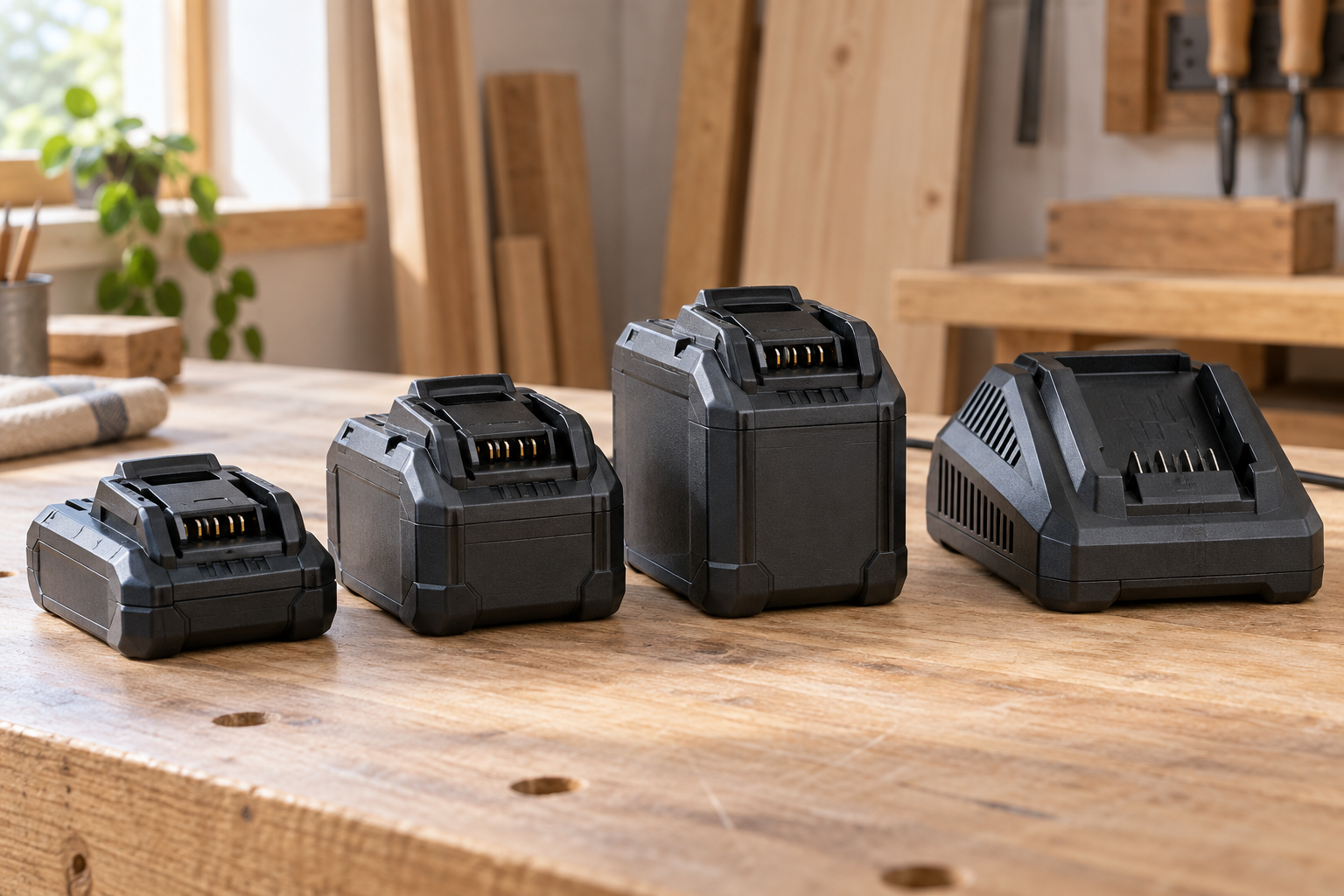
Amp-hours (Ah) indicate battery capacity, not a guarantee of runtime. A 2Ah pack is lighter and often more comfortable in a drill used overhead. A 5Ah pack can run longer, but adds weight and may feel awkward on a compact tool. Under a heavy load, runtime also depends on the tool, material, battery design, and how aggressively you work. Sawing thick lumber continuously will drain a pack much faster than driving occasional screws.
High-output batteries can improve performance on some tools, but are not automatically the best choice for every job. A large pack on a light-duty drill can make a manageable tool tiring; a small pack on a saw may trigger frequent stops or protection cutoffs.
Compare platform costs and trade-offs
Prices and included batteries change, so compare current kits and bare tools rather than relying on a brand’s advertised discount. The table below describes common buying patterns, not fixed rules for every product in a platform.
| Platform type | Often suits | Trade-off to check |
|---|---|---|
| Compact 12V | Assembly, small repairs, overhead work | Fewer options for demanding saws or larger tools |
| Mainstream 18V/20V | General home use and many workshop jobs | Battery prices and tool range vary by brand |
| Higher-power 36V/40V class | Some larger outdoor tools and heavy-duty tasks | More weight, higher pack cost, and possible gaps in small-tool selection |
Do not choose based on the largest catalog alone. Check that the platform has the specific tools you need, plus practical items such as a second charger or replacement batteries. If you need a circular saw for occasional cuts, a lower-cost platform may be perfectly adequate. If the tool will see regular heavy use, compare its cutting performance, battery options, and warranty support rather than buying on kit price alone.
Check compatibility carefully
Even within one brand, batteries may fit only certain tool families or generations. Some manufacturers offer compact and high-power lines with different connections; a battery that slides onto one tool may not work on another. Read the compatibility notes for the exact battery and tool before ordering. Do not assume a third-party adapter makes an unsupported combination safe or reliable: it can cause poor connections, protection faults, or warranty disputes.
Also distinguish battery capacity from charger speed. A slow charger may be fine if you charge overnight. For back-to-back work, check the manufacturer’s stated charge time for the pack you plan to use. A charger advertised as “fast” may still take a meaningful amount of time with a large-capacity battery, and charge times can vary with temperature and pack condition.
Price the whole kit
Compare the cost of the first tool, at least one useful battery, and a charger. Then estimate what the next bare tool and an additional battery will cost. A low-priced starter kit can be good value, but a deal with a tiny battery may be frustrating on a saw. Conversely, paying extra for a large battery is wasteful if you mostly drive screws in short bursts.
For a drill-and-driver setup, look at drill and impact-driver combo kits. They can save money when you need both tools, but are poor value if one will sit unused. If your work involves cutting, compare the bare-tool price of a cordless circular saw against a kit that includes a suitable battery. Check the recommended battery size in the tool’s specifications.
Avoid common buying mistakes
Do not buy into a platform because one discounted tool looks irresistible. A cheap bare tool is not cheap if the needed battery and charger cost more than expected. Do not buy the biggest battery for every task: added weight can make a drill less comfortable, while a compact pack may overheat or cut out under a demanding load. And do not treat adapters, used packs with unknown history, or unverified batteries as guaranteed savings. Poor contact, damaged cells, or missing protections can turn a bargain into downtime—or a safety problem.
Before checkout, confirm the exact battery family, included pack capacity, charger compatibility, tool warranty, and availability of the next tool you are likely to buy. If the platform covers your real needs and the starter kit includes a practical battery, the cheaper option may be the sensible one. Pay more when you can point to a concrete benefit—such as lower tool weight, better performance on repeated heavy cuts, or a tool you know you will need—not simply a bigger catalog or a higher voltage printed on the box.
Related guides
- Longest Lasting Lawn Mower Battery: AGM vs Lithium vs Flooded Lifespan and Cost per Season
- Duralast Gold Lawn Mower Battery Review: U1 Fit, CCA and When to Pay for AGM
- Greenworks Pro 80V 21-Inch Mower Review: Runtime Math, Push vs Self-Propelled and Yard Fit
- Bosch High Pressure Washer Gun Replacement: Fittings, Adapters and What Fits Your Model