
What's inside
- What Is a Harbor Freight Oscillating Tool?
- Harbor Freight Oscillating Tool Models: Warrior vs. Bauer vs. Hercules
- Harbor Freight Oscillating Tool Comparison
- Corded vs. Cordless: Which Harbor Freight Oscillating Tool Should You Choose?
- What Can You Do With a Harbor Freight Oscillating Tool?
- Harbor Freight Oscillating Tool Blade Compatibility
- How to Use a Harbor Freight Oscillating Tool Safely
- Common Mistakes When Buying a Harbor Freight Oscillating Tool
- Frequently Asked Questions
- Final Thoughts: Which Harbor Freight Oscillating Tool Should You Choose?
As an Amazon Associate I earn from qualifying purchases. This post may contain affiliate links at no extra cost to you.
A Harbor Freight oscillating tool can handle a surprising range of home improvement and repair jobs, from trimming door jambs and cutting drywall to removing old caulk, scraping adhesive, and sanding tight corners. However, Harbor Freight sells oscillating multi-tools under three different brands: Warrior, Bauer, and Hercules.
The right choice depends on how frequently you use the tool, whether you prefer corded or cordless power, and how much control you need when working with different materials. A low-cost Warrior model may be sufficient for occasional repairs, while Bauer and Hercules offer options for more frequent DIY work and demanding applications.
This guide explains the differences between Harbor Freight oscillating tools, their power options, blade compatibility, practical applications, and the features worth checking before purchasing. It also covers common mistakes that can affect cutting performance and tool life.
What Is a Harbor Freight Oscillating Tool?
A Harbor Freight oscillating tool is a handheld power tool that moves an attached accessory through a small, rapid back-and-forth angular motion. Unlike a circular saw or angle grinder, it does not continuously rotate a blade or disc.
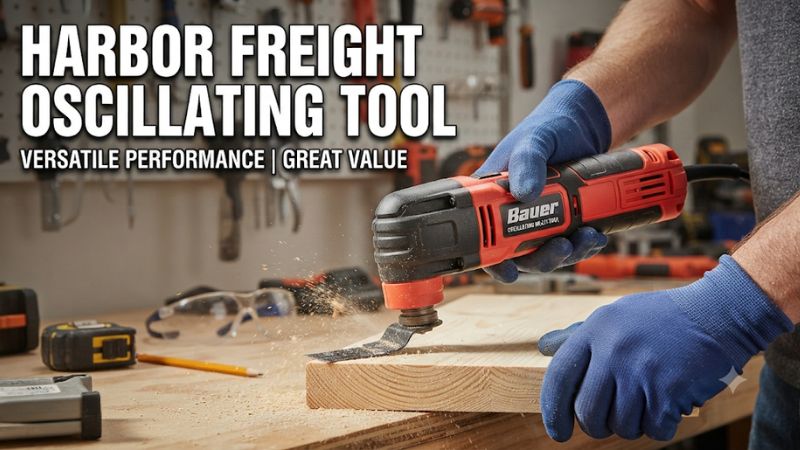
This controlled oscillation allows the tool to perform detailed work in locations where larger power tools may be difficult to position.
Depending on the installed accessory, an oscillating multi-tool can:
-
Cut wood, plastic, drywall, and certain metal materials.
-
Trim door casings and baseboards during flooring installation.
-
Remove old grout with an appropriate grout-removal accessory.
-
Scrape paint, adhesive, and construction residue.
-
Sand corners, edges, and other restricted areas.
-
Make plunge cuts without drilling a separate starting hole when the blade and material permit it.
The tool’s usefulness comes primarily from accessory versatility rather than raw cutting capacity. It is designed for controlled, localized work, not for replacing a circular saw, reciprocating saw, or dedicated floor sander.
Harbor Freight currently offers three principal oscillating tool brands:
-
Warrior: Entry-level options for occasional household repairs.
-
Bauer: Midrange tools for regular DIY projects.
-
Hercules: Higher-positioned tools for more frequent and demanding use.
These are Harbor Freight’s own product lines, so buyers should compare their actual specifications and configurations rather than assuming they share the same performance characteristics.
Harbor Freight Oscillating Tool Models: Warrior vs. Bauer vs. Hercules
Choosing between these three brands is easier when you consider the type of work you expect to perform. Motor specifications, accessory-changing systems, battery platforms, and vibration control can all affect the experience.
1. Warrior: Best for Occasional Home Repairs
WARRIOR 2 Amp Variable-Speed Oscillating Multi-Tool – SKU 57808
The Warrior 2 Amp model is an entry-level corded option for homeowners who need an oscillating tool for occasional repairs and smaller projects.
Its main specifications include:
-
2-amp motor.
-
Six speed settings.
-
Maximum speed of 20,000 oscillations per minute (OPM).
-
120V AC power.
-
Approximately 3.03 lb tool weight.
-
Six-foot power cord.
-
Die-cast aluminum gear housing.
The six-speed adjustment gives users some control when switching between cutting, sanding, and scraping accessories. Its compact design also makes it useful for localized work around cabinets, trim, and flooring.
One important consideration is that the Warrior model uses a more basic accessory-changing arrangement than the quick-change Bauer and Hercules options. Check the exact model’s manual before purchasing replacement accessories or attempting a blade change.
Advantages:
-
Affordable entry point into oscillating tools.
-
Variable-speed operation.
-
Suitable for occasional household projects.
-
Corded power avoids battery runtime limitations.
Limitations:
-
Lower motor amperage than the corded Bauer and Hercules models discussed below.
-
Requires access to a suitable electrical outlet.
-
Accessories are sold separately.
-
Less convenient for frequent accessory changes.
Buy if: You occasionally cut trim, remove adhesive, sand small areas, or perform basic home repairs.
Skip if: You expect to use the tool frequently for renovation work or need cordless mobility.
2. Bauer: Best for Regular DIY Projects
BAUER 3 Amp Variable-Speed Oscillating Multi-Tool – SKU 59163
Bauer occupies the middle of Harbor Freight’s oscillating tool lineup. Its 3 Amp corded model provides a useful combination of variable speed, a quick-change accessory system, and a compact grip.
Its published specifications include:
-
3-amp motor.
-
120V AC power.
-
Six-speed variable adjustment.
-
Speed range of 11,000–20,000 OPM.
-
Tool-free universal quick-change accessory system.
-
Approximately 3.5 lb tool weight.
-
Eight-foot power cord.
The quick-change mechanism is particularly useful when a project requires switching between a cutting blade, sanding pad, and scraper. You can change accessories without repeatedly stopping to work with a separate mounting key.
Bauer also offers cordless oscillating multi-tools in its 20V platform. This is worth considering if you already own compatible Bauer 20V batteries and chargers.
For users who regularly work on flooring, cabinetry, drywall repairs, and trim installation, Bauer offers a practical middle ground. However, its corded 3 Amp rating should not be interpreted as a direct measurement of cutting speed or usable output power.
Advantages:
-
Higher motor amperage than the Warrior 2 Amp model.
-
Convenient tool-free accessory changes.
-
Six-speed adjustment for different materials.
-
Available in both corded and cordless configurations.
-
Rubberized grip designed to improve handling.
Limitations:
-
The corded version restricts movement.
-
Accessories are sold separately.
-
The cordless tool requires a compatible battery and charger.
-
It is not a substitute for a dedicated high-capacity cutting tool.
Buy if: You regularly complete DIY renovations and want convenient accessory changes without moving into a more expensive tool category.
Skip if: You need a specialized cutting tool for continuous heavy-duty production work.
3. Hercules: Best for More Demanding DIY Work
Hercules offers both corded and cordless oscillating multi-tools. Its higher-positioned models are designed for users who want additional performance features and more comfortable operation during frequent use.
Two configurations are worth understanding.
Hercules 3.5 Amp Variable-Speed Oscillating Multi-Tool – SKU 59510
This corded model uses a 3.5-amp motor and is intended for cutting, sanding, and scraping applications. It provides continuous electrical power without requiring battery changes or recharging.
Hercules 20V Brushless Cordless Oscillating Multi-Tool – SKU 57319
The cordless model provides a different set of advantages:
-
20V lithium-ion battery platform.
-
Brushless motor.
-
Variable speed from 8,000 to 19,000 OPM.
-
Six-speed adjustment.
-
3.1-degree oscillation range.
-
Keyless blade-changing mechanism.
-
Integrated LED work light.
-
Published bare-tool weight of approximately 2.6 lb.
-
Tool-only configuration; battery and charger sold separately.
The brushless motor eliminates the carbon brushes used in conventional brushed motors. Harbor Freight also advertises longer runtime compared with its brushed Hercules product, although actual runtime depends on battery capacity, material, accessory, and workload.
The tool’s vibration-control design is another consideration for users who frequently perform detailed cutting or sanding. Reduced vibration can improve comfort, but it does not eliminate fatigue or the need for proper handling.
Advantages:
-
Brushless cordless option.
-
Variable-speed control.
-
Integrated LED illumination on the cordless model.
-
Keyless accessory changes.
-
Cordless mobility with a compatible 20V battery.
-
Five-year limited warranty for qualifying Hercules 20V brushless tools.
Limitations:
-
The cordless version is sold without a battery and charger.
-
Battery and charger costs increase the initial investment if you are new to the platform.
-
The corded model still requires access to an electrical outlet.
-
Higher positioning does not make the tool suitable for every heavy-duty cutting application.
Buy if: You frequently perform renovation, installation, and repair work and value cordless convenience or additional handling features.
Skip if: You only need an inexpensive tool for occasional small repairs.
Harbor Freight Oscillating Tool Comparison
The following table summarizes the principal models and configurations discussed above.
| Model | Power | Speed | Best For |
|---|---|---|---|
| Warrior 57808 | 2 Amp, 120V corded | Up to 20,000 OPM | Occasional repairs |
| Bauer 59163 | 3 Amp, 120V corded | 11,000–20,000 OPM | Regular DIY projects |
| Hercules 59510 | 3.5 Amp corded | Variable speed | Frequent corded use |
| Hercules 57319 | 20V brushless cordless | 8,000–19,000 OPM | Mobile renovation work |
These specifications describe different configurations, not a controlled performance comparison. In particular, amperage on a corded tool and battery voltage on a cordless tool cannot be compared directly to determine which model cuts faster.
If you already own a compatible battery platform, that may be more important to your purchasing decision than the advertised motor specification.
Corded vs. Cordless: Which Harbor Freight Oscillating Tool Should You Choose?
Harbor Freight offers both power configurations, and each has practical advantages.
Corded Oscillating Tools
Corded models are useful when you work near electrical outlets or perform projects that involve extended periods of cutting and sanding.
Their main advantage is continuous access to electrical power. You do not have to stop because a battery has discharged.
However, the power cord can become inconvenient when working inside cabinets, under sinks, around vehicles, or in other restricted locations.
Corded models are worth considering for:
-
Workshop projects.
-
Repeated trim cutting.
-
Extended sanding sessions.
-
Home renovation near accessible outlets.
Before purchasing, verify the tool’s voltage and plug requirements. The US corded models discussed here are rated for 120V AC operation and should not be assumed compatible with Vietnam’s electrical supply without checking the exact tool’s rating and an appropriate electrical solution.
Cordless Oscillating Tools
Cordless models are useful when portability matters more than uninterrupted operation.
They are particularly convenient for:
-
Working in different rooms.
-
Repairing door frames.
-
Cutting flooring near walls.
-
Working in garages and outdoor locations.
-
Making adjustments in areas where extension cords are inconvenient.
The main consideration is battery compatibility.
For example, the Hercules 20V cordless model requires a compatible Hercules 20V battery and charger. Its tool-only package does not include either component.
Do not assume a Bauer 20V battery will work in a Hercules 20V tool simply because both platforms use the same nominal voltage. Battery compatibility must be confirmed for the exact tool and battery system.
If you already own several compatible batteries, purchasing another bare tool can make financial sense. Otherwise, compare the complete cost of the tool, battery, charger, and required accessories.
What Can You Do With a Harbor Freight Oscillating Tool?
The tool becomes considerably more useful when paired with the correct accessory.
Cutting Wood and Trim
A wood-cutting blade can help trim door jambs, cut baseboards, and create localized openings.
For example, when installing new flooring, you may need to remove a small section of door casing so the flooring can slide underneath. An oscillating tool can make this adjustment without removing the entire door frame.
Choose a blade intended for the material and use controlled movements rather than forcing the tool through the cut.
Cutting Drywall
A suitable drywall accessory can help create openings for electrical boxes and other installation work.
Before cutting, verify that the area is clear of wiring, plumbing, and other concealed services. Never assume a wall cavity is empty simply because the cutting area looks unobstructed.
Removing Adhesive and Caulk
Scraper attachments can help remove old adhesive, sealant, and residue from renovation surfaces.
Use an accessory appropriate for the surface. An aggressive scraper may damage softer materials, flooring finishes, or painted surfaces.
Sanding Corners and Edges
A triangular sanding pad allows access to corners and narrow areas that are difficult to reach with a conventional orbital sander.
Use the appropriate abrasive grit for the material and finish. Avoid excessive pressure, which can create uneven sanding marks and unnecessary heat.
Removing Grout
Specialized grout-removal accessories can help remove grout from tile joints.
This application requires extra care because an incorrect accessory or excessive cutting depth can chip tiles or damage the underlying substrate. Follow the accessory manufacturer’s instructions and work gradually.
Harbor Freight Oscillating Tool Blade Compatibility
Blade compatibility is one of the most important things to check before purchasing accessories.
Harbor Freight states that its Universal Fit oscillating blades are compatible with its oscillating multi-tools. However, its tools are not compatible with Starlock-style blades.
This distinction matters because oscillating accessories use different mounting systems. A blade that looks physically similar may not attach correctly to your tool.
Before buying replacement accessories, check the following:
| Accessory consideration | What to verify |
|---|---|
| Mounting system | Confirm Universal Fit compatibility |
| Blade material | Match the blade to wood, metal, drywall, or another material |
| Blade width | Choose a suitable width for the cutting area |
| Accessory condition | Check for damaged teeth, cracks, or deformation |
| Manufacturer instructions | Confirm the accessory is approved for your tool |
Common accessories include:
-
Bi-metal blades: For suitable wood and metal cutting applications.
-
Wood-cutting blades: For trimming and plunge cuts in wood.
-
Scraper blades: For removing adhesive and other surface materials.
-
Sanding pads: For finishing corners and edges.
-
Grout-removal blades: For appropriate tile and grout applications.
Do not force an incompatible blade onto the mounting system. Also, never assume that all universal-style accessories from different manufacturers are interchangeable without checking their specifications.
How to Use a Harbor Freight Oscillating Tool Safely
An oscillating multi-tool is relatively compact, but its rapidly moving accessories can still cause serious injuries.
Follow these precautions before starting a project.
1. Select the Correct Accessory
Identify the material you intend to cut, sand, or scrape. Choose an accessory specifically designed for that application.
Check its mounting compatibility and condition before installation.
2. Disconnect the Power Source
Before changing an accessory, turn off the tool and unplug a corded model.
For cordless models, switch off the tool and remove the battery before performing accessory changes or adjustments.
Wait until the accessory has stopped moving completely.
3. Wear Appropriate Protective Equipment
Use safety glasses or suitable eye protection whenever operating the tool.
Depending on the material and workload, additional protection may include:
-
Hearing protection.
-
A suitable dust mask or respirator.
-
Work clothing that does not hang loosely.
-
Appropriate gloves when handling sharp accessories or materials while the tool is disconnected.
Dust extraction or suitable ventilation is important when cutting or sanding materials that generate airborne particles.
4. Secure the Workpiece
Use clamps or another appropriate securing method to prevent the material from shifting.
Keep both hands positioned safely and maintain a stable stance. Never hold a small workpiece close to the moving blade.
5. Start With Controlled Pressure
Allow the oscillating accessory to perform the work. Applying excessive pressure can reduce cutting efficiency, increase heat, accelerate accessory wear, and make the tool harder to control.
Harbor Freight specifically recommends lighter pressure for its oscillating tools. Some cordless models also incorporate overload protection that can shut the tool down under excessive loading.
If this happens, switch the tool off, remove it from the workpiece, and restart with lighter pressure.
6. Inspect the Tool After Use
Switch off the tool and disconnect its power source before cleaning or inspecting it.
Check for damaged accessories, unusual looseness, blocked ventilation openings, and visible cord or battery damage.
Do not continue using a tool with damaged electrical components, a malfunctioning switch, or an accessory mounting mechanism that cannot securely retain the blade.
Common Mistakes When Buying a Harbor Freight Oscillating Tool
Even an inexpensive oscillating tool can become a poor purchase if its capabilities do not match the project.
Watch out for these common mistakes:
Buying based only on motor amperage: A higher amperage rating does not automatically guarantee faster cutting. Blade quality, oscillation speed, cutting angle, material, and tool design also influence performance.
Ignoring accessory compatibility: Check the mounting system before purchasing a large collection of replacement blades. Harbor Freight’s Universal Fit accessories are not Starlock-compatible.
Choosing cordless without considering battery costs: A bare-tool package may appear inexpensive, but the battery and charger can increase the total purchase cost.
Using the wrong blade for the material: A wood-cutting blade is not automatically appropriate for metal, tile, or other materials. Select the correct accessory.
Applying too much pressure: An oscillating tool is designed for controlled cutting and surface work. Forcing the blade can increase heat and wear without improving the result.
Expecting it to replace larger saws: An oscillating tool is excellent for localized cuts and restricted spaces, but it is generally inefficient for long, repetitive cuts through large pieces of material.
Frequently Asked Questions
Is the Harbor Freight oscillating tool worth buying?
Yes, a Harbor Freight oscillating tool can be a practical purchase for DIY users who need localized cutting, sanding, and scraping capabilities. The best value depends on the model, accessory requirements, and frequency of use.
Do Dremel blades fit Harbor Freight oscillating tools?
Not necessarily. Compatibility depends on the accessory’s mounting system, not simply the brand. Harbor Freight identifies its Universal Fit blades as compatible with its oscillating tools and states that its tools do not support Starlock-style blades. Check the exact accessory before purchasing.
Is Bauer or Hercules better for an oscillating tool?
Bauer is positioned for regular DIY use, while Hercules offers higher-positioned options with additional features such as brushless motor technology on its 20V cordless model. Choose based on workload, battery ownership, accessory-changing preferences, and budget rather than brand name alone.
Can a Harbor Freight oscillating tool cut metal?
Yes, an appropriate metal-cutting accessory can cut certain metal materials. However, the blade must be rated for the material and application. Secure the workpiece, wear suitable eye protection, and follow the accessory manufacturer’s instructions. Do not assume every oscillating blade can cut metal.
Final Thoughts: Which Harbor Freight Oscillating Tool Should You Choose?
A Harbor Freight oscillating tool can be a useful addition to a home workshop, particularly when you regularly work in corners, tight spaces, or areas where larger cutting tools are difficult to control.
The Warrior 2 Amp model is a reasonable starting point for occasional household repairs. The Bauer 3 Amp model offers a more convenient accessory-changing system and is suited to regular DIY projects. Hercules provides additional options for users who want a more feature-rich tool, particularly its 20V brushless cordless configuration.
Before making a purchase, consider three things: how frequently you will use the tool, whether corded or cordless operation better suits your workspace, and which accessories your projects require.
Most importantly, check the exact model number, battery requirements, and blade mounting compatibility. Choosing the right configuration from the beginning can save money and make future renovation and repair projects considerably easier.
Related guides
More from Amazon
Programs that pair well with the guide above. Offers and eligibility are set by Amazon and may change.
A free business account with business pricing and bulk-buying tools for work, shop or home office.
Create a business accountFree shipping on eligible items, Prime Video and more. Eligible new members can start with a free trial.
Start a Prime free trialAudiobooks and podcasts to listen to on the go. Eligible new members can start with a free trial.
Try Audible freeAd-free music streaming. Eligible new subscribers can start with a free trial.
Try Music Unlimited freeAs an Amazon Associate we earn from qualifying purchases.

Write Your Review
No reviews yet. Be the first to share your experience!