
What's inside
As an Amazon Associate I earn from qualifying purchases. This post may contain affiliate links at no extra cost to you.
The short answer
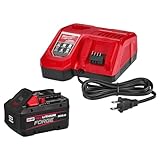
Milwaukee M18 Forge batteries are designed to deliver high power in a smaller, lighter package than comparable M18 High Output batteries. That can matter on demanding tools such as large grinders, circular saws and high-demand vacuums. But Forge is not an automatic runtime upgrade: capacity, tool load, temperature and battery size all affect how long a pack runs.
For a buyer, the useful distinction is this: Forge is aimed at getting strong output from a compact pack, while High Output remains a sensible choice when you want a familiar high-capacity battery at a lower price. Check the exact amp-hour rating and physical size before comparing prices. “Forge” and “High Output” are product families, not direct capacity equivalents.
As an Amazon Associate we earn from qualifying purchases at no extra cost to you.



What the labels mean in practice
High Output batteries use Milwaukee’s higher-output cell design for M18 tools that draw more current than ordinary compact tools. They come in several capacities, so a small High Output pack and a large one will differ substantially in weight and runtime.
Forge batteries are also high-output M18 packs, with a newer design focused on delivering power in a more compact format and managing heat. Milwaukee has described Forge packs as providing power comparable to larger High Output options in certain applications. That is a manufacturer claim, not a guarantee that every Forge battery will run every tool as long as a larger pack. Tool electronics, workload and battery temperature all matter.
Both families fit the M18 platform, but not every pack is the best match for every tool. A compact pack is easier to handle overhead; a larger pack can be more comfortable when the tool sits on the ground and needs longer between swaps.
Forge vs High Output at a glance
| Factor | M18 Forge | M18 High Output |
|---|---|---|
| Main advantage | High power in a more compact design | Established high-output option, with multiple capacity choices |
| Runtime | Depends on the pack’s amp-hour rating and workload; compact size does not mean longer runtime by itself | Higher-capacity versions can run longer, with added size and weight |
| Best fit | High-demand work where pack size and tool handling matter | Longer sessions where carrying a larger pack is acceptable |
| Heat and recovery | Designed for high output and improved thermal management; still needs sensible charging and cooling | Also built for demanding tools; hot packs may need time to cool before charging |
| Value | Worth considering when compact power solves a real problem | Often the better buy when discounted or when you need capacity more than compactness |
Power delivery: where the difference shows
Battery voltage alone does not tell you how well a pack will handle a heavy cut or a stalled blade. Under a high load, the pack and tool must deliver substantial current. A battery that heats up or reaches its limits can cause a tool to slow, shut down or pause until conditions improve.
That makes the Forge format appealing on tools where you notice bogging or frequent thermal interruptions, especially if you do not want the bulk of a larger battery. A more compact pack can also improve balance on a saw or grinder. But no battery can compensate for a dull blade, a wheel that is wrong for the material, or forcing the tool through a cut. Those conditions raise load and heat regardless of battery family.
High Output is not a low-power fallback. It is a legitimate choice for demanding M18 equipment, particularly in a larger capacity. If your tool runs well and you are not experiencing slowdowns or excessive heat, replacing a working High Output pack with Forge may produce little practical improvement.
Runtime: compare capacity, not just the name
Amp-hours are a useful starting point for comparing runtime within a battery platform: all else equal, a higher-capacity pack can supply energy for longer. In real work, runtime is not a simple promise. A circular saw cutting thick lumber continuously consumes far more power than an impact driver fastening intermittently. Cold weather, worn batteries and repeated heavy starts also change results.
Compare packs with similar capacity ratings and consider the weight you will carry. If you are choosing between a compact Forge pack and a larger High Output pack, the larger battery may last longer even if Forge has an advantage in power delivery per size. If the job involves frequent short cuts, changing batteries can be less troublesome than carrying a heavy pack all day.
For a long shift with few breaks, a higher-capacity pack is often the practical choice. For overhead fastening, trim work or a tool that feels unbalanced with a large battery, the smaller pack may save fatigue. Browse M18 Forge batteries by capacity rather than assuming every pack in the family offers the same runtime.
Charging, heat and common failure modes
Heavy use creates heat in both the tool and battery. A pack may stop delivering power when it gets too hot, and a charger may delay charging until the battery cools. That pause is a protection feature, not necessarily a fault. Forcing a hot pack into repeated heavy work can mean more shutdowns and longer waits.
Keep batteries out of direct sun in a hot vehicle, and let a warm pack cool in a dry, ventilated place before charging. Avoid charging a pack that is wet, visibly damaged or unusually hot. If a battery repeatedly cuts out under a load that another compatible pack handles, check the tool, contacts and battery condition; worn cells or a failing tool can mimic a platform limitation.
Faster charging helps only if your workflow benefits from it. If one battery is cooling while another runs the tool, a second pack may be more useful than paying extra for a charger you do not need. Compare compatible M18 chargers against the charger already in your kit, including charge time and whether it supports the batteries you plan to use.
Which one should you buy?
Choose Forge when you regularly use high-demand tools, want a more compact pack, or have a clear handling problem with larger batteries. It is most persuasive when reduced bulk and strong output matter more than getting the longest possible run per charge. If you are buying into the format, compare the pack size and price with the High Output alternative at the same capacity where available.
Choose High Output when you need longer runtime, already own one that works well, or find a larger-capacity pack at a meaningful discount. For moderate tools and intermittent use, the cheaper option is often entirely adequate. There is little reason to pay a premium based only on the Forge label if your current battery does not bog down, overheat or make the tool awkward to handle.
Before ordering, verify that the battery is an M18 pack, check its amp-hour rating and dimensions, and consider the tool’s balance with the battery installed. A good match is the pack that delivers enough runtime and power without making the tool tiring to use—not necessarily the newest or most expensive one.
FAQ
Which one should you buy?
Related guides
- Longest Lasting Lawn Mower Battery: AGM vs Lithium vs Flooded Lifespan and Cost per Season
- Duralast Gold Lawn Mower Battery Review: U1 Fit, CCA and When to Pay for AGM
- Greenworks Pro 80V 21-Inch Mower Review: Runtime Math, Push vs Self-Propelled and Yard Fit
- Bosch High Pressure Washer Gun Replacement: Fittings, Adapters and What Fits Your Model