
Key takeaways
- Compare the best tool belts by pocket count, belt width and materials, from a premium leather rig to canvas pouches for framing and electrical work.
What's inside
- Quick answer
- 1. Occidental Leather 9850 Adjust-to-Fit FatLip Tool Bag Set
- 2. CLC Custom Leathercraft 1614 ComfortLift Framers Combo System
- 3. CLC Custom Leathercraft 1509 Zippered Electrician Tool Pouch
- 4. McGuire-Nicholas 688 Carpenter Pouch
- 5. Dickies 57000 8-Pocket Padded Tool Belt Pouch
- How to choose
- Who should skip
- FAQ
- Final verdict
As an Amazon Associate I earn from qualifying purchases. This post may contain affiliate links at no extra cost to you.
A tool belt earns its keep when the tools you reach for most sit in the same place every time, the fastener pouch stays open while you work one-handed, and the loaded rig does not saw into your hips by midday. The five rigs below cover the main ways belts are built: a premium leather-and-nylon framing set with deep bags, a five-piece suspension system that moves weight onto the shoulders, a zippered electrician pouch with a shoulder strap, a suede carpenter pouch that rides on a belt you already own, and a compact canvas pouch on its own padded belt for painters and light trade work.
They differ most in pocket count, bag depth, belt width, and how the load is carried, so the right pick depends on your trade and on how much you carry at once. A framer hauling nails and a framing hammer all day needs deep, open bags and real hip support. An electrician running service calls needs smaller, divided pockets and a cover that keeps tools in place between stops. Match the rig to the load first, then worry about material.
As an Amazon Associate, we earn from qualifying purchases.
Quick answer
For a premium framing rig, the Occidental Leather 9850 pairs 24 pockets and holders with 10-inch-deep bags and an adjust-to-fit belt. The CLC 1614 ComfortLift suits framers who want suspension straps sharing the load across 20 pockets. Electricians get a zippered 21-pocket pouch in the CLC 1509. The McGuire-Nicholas 688 is a suede pouch for a belt you own, and the Dickies 57000 is the budget canvas option.
1. Occidental Leather 9850 Adjust-to-Fit FatLip Tool Bag Set

The 9850 is the premium pick for production carpenters who carry a full framing load every day. Its main bags run a full 10 inches deep with leather-reinforced bottoms, and the wide bag mouths are built to stay open so a handful of nails or a tape measure drops in without looking down. The set combines top-grain leather tool holders with industrial nylon bags, which keeps the weight lower than an all-leather rig while the parts that take abrasion stay leather. The belt section telescopes to fit a range of waist sizes rather than relying on a single row of holes, and built-in attachment points accept the maker suspension system if you later want shoulder support.
Specs
– Pockets and holders: 24
– Main bag depth: 10 in
– Fit: adjustable for pant waist 31 to 41 in
– Construction: top-grain leather holders with nylon bags, leather-reinforced bag bottoms and mouths
– Extras: built-in suspender attachment points; made in the USA
– Model: 9850
2. CLC Custom Leathercraft 1614 ComfortLift Framers Combo System

The 1614 is a five-piece combo system built around a suspension harness, so part of the load rides on your shoulders instead of hanging entirely from your waist. That matters on long framing days when the pouches hold fasteners, a hammer, a square, and layout tools at once. The layout totals 20 pockets across the pouches, with large main bags for fasteners and smaller sleeves for the hand tools a framer cycles through. As a mid-range system it gives up the leather construction of the premium pick in exchange for the harness and a lighter synthetic build that shrugs off rain and site dust.
Specs
– Pockets: 20
– Pieces: 5-piece combo system
– Support: ComfortLift suspension harness with padded shoulder straps
– Layout: large fastener bags plus divided tool pouches
– Model: 1614
– UPC: 084298161407
3. CLC Custom Leathercraft 1509 Zippered Electrician Tool Pouch

The 1509 takes a different approach: it is a single 21-pocket pouch for electricians, worn on a belt or carried by its padded shoulder strap between calls. A zippered fold-down cover closes over the pockets, which keeps strippers, drivers, and a meter from spilling in the van or the gang box. Inside, the pockets are sized for hand tools rather than bulk fasteners, and a steel hammer loop rides on the side. An ergonomic rubber handle and an airmesh padded back panel make it comfortable to grab and go, which suits service work where the rig goes on and off a dozen times a day.
Specs
– Pockets: 21
– Material: polyester with ballistic binding
– Closure: zippered fold-down cover
– Carry options: belt wear or adjustable padded shoulder strap; ergonomic rubber handle
– Extras: steel hammer loop; airmesh padded back panel
– Model: 1509
4. McGuire-Nicholas 688 Carpenter Pouch
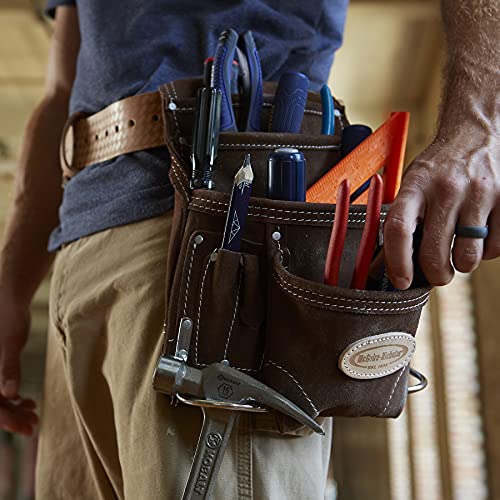
The 688 is a traditional suede leather carpenter pouch with 10 pockets, made to slide onto a work belt you already own through its belt-loop back. Suede is the classic pouch material for a reason: it is light, it flexes instead of fighting your hip when you crouch, and the pockets break in around the tools you carry most. The layout gives you open pockets for nails and screws plus room for a tape, a square, and pencils. Because it is a pouch only, the total spend stays in budget territory if your belt and hammer loop are already sorted, and it works just as well as a second pouch added to a larger rig.
Specs
– Pockets: 10
– Material: suede leather
– Attachment: belt loop, fits a separate work belt
– Color: brown
– Model: 688
– UPC: 019374954284
5. Dickies 57000 8-Pocket Padded Tool Belt Pouch
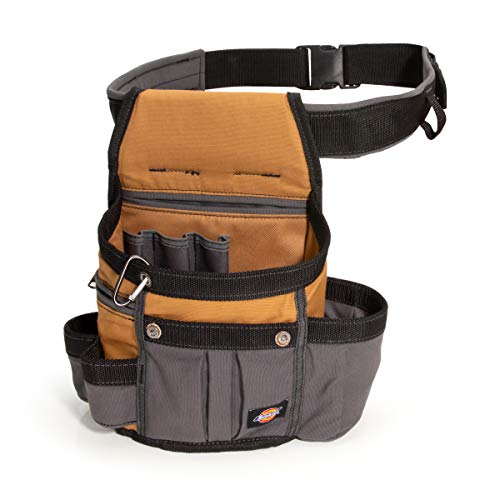
The 57000 is the budget pick: an 8-pocket canvas pouch that arrives on its own adjustable 3-inch padded web belt, so there is nothing else to buy. The padded belt is wider than the plain webbing on most low-cost aprons, which keeps a light load of painters tools, a drill driver, or trim carpentry gear from digging in. Canvas keeps the weight down and washes clean after paint and drywall work. Eight pockets will not swallow a framing load, but for punch-list work, painting, and weekend projects it covers the essentials: hand tools up front, fasteners in the open pockets, and a tape within reach.
Specs
– Pockets: 8
– Material: canvas
– Belt: adjustable 3-inch padded web belt included
– Fit: one size, adjustable
– Model: 57000
– UPC: 099198570006
How to choose
Count pockets against your actual load. Pocket counts only help if the pockets match the work. Framers need two deep, open fastener bags more than they need many small sleeves. Electricians need the opposite: lots of narrow, divided pockets that keep individual drivers and pliers separated. If you mostly carry five or six items, an 8 or 10-pocket pouch is easier to work from than a 24-pocket rig with empty bags flapping.
Decide how the weight should ride. A loaded framing rig can carry more than your hips want by the afternoon. Suspension straps and yoke-style harnesses move part of that load to your shoulders, and a wide padded belt spreads what remains. If you climb ladders or work overhead often, keep the rig lighter and closer to the body instead.
Match bag depth to fasteners. Deep bags, around 10 inches, hold a working supply of nails or screws and let you grab a handful without looking. Shallow pouches suit hand tools and are easier to keep organized, but they spill more easily when you bend.
Pick the material for your conditions. Leather holders and reinforced bottoms handle abrasion from lumber, concrete, and metal framing, and they hold their shape under load. Synthetic and canvas rigs weigh less, tolerate wet weather better, and usually land in the budget or mid-range tiers. Suede sits between the two: light and flexible, but it absorbs water and needs drying time after a soaked day.
Check the fit range before anything else. Belts size differently: some adjust across a wide waist range with a telescoping section, others rely on a buckle and holes over your work clothes. Measure over the layers you actually wear on site, including a jacket in cold weather, and confirm the rig range covers that number with room to spare.
Who should skip
Skip the big framing rigs if your work is mostly bench-based or one-room remodels where a tool bag on the floor stays within reach; a belt you rarely wear just adds bulk. Skip pouch-only options like the McGuire-Nicholas 688 if you do not already own a sturdy work belt, since the belt is a separate purchase. Skip the zippered electrician pouch for framing work: the divided pockets are too small for bulk fasteners, and the cover slows down the constant in-and-out rhythm of nailing. And skip canvas if your days involve dragging the rig across concrete or rebar daily; the reinforced leather-bottom bags will outlast it by a wide margin.
FAQ
How many pockets does a framer actually need?
Most framers work well with two deep fastener bags plus holders for a hammer, tape, square, and a few layout tools, which lands around 18 to 24 pockets and holders in total. More pockets than that usually means carrying tools the job does not need.
Are suspenders worth adding to a tool belt?
For heavy loads carried all day, yes: straps move part of the weight from your hips to your shoulders and keep the belt from sliding down as fasteners shift the balance. For light loads or short tasks, a wide padded belt alone is simpler and less restrictive.
Can a pouch-only rig work with any belt?
A belt-loop pouch like the McGuire-Nicholas 688 fits most standard work belts, but check the loop height against your belt width before ordering. A very wide belt may not pass through a loop cut for a narrower one.
How should a leather rig be cared for?
Brush off dust, let the leather dry at room temperature after wet days rather than applying direct heat, and work in a leather conditioner when the surface looks dry. Storing the rig hanging keeps the bags from creasing flat.
Final verdict
For daily framing, the Occidental Leather 9850 is the strongest all-round rig here: deep open bags, leather where abrasion hits, and a belt that adjusts across a wide range. Framers who feel the load in their hips should look at the CLC 1614 and its suspension harness. Electricians are best served by the zippered CLC 1509, while the McGuire-Nicholas 688 and Dickies 57000 cover the budget end in two different ways: a suede pouch for a belt you own, and a complete canvas belt-and-pouch set ready to wear.
Related guides
More from Amazon
Programs that pair well with the guide above. Offers and eligibility are set by Amazon and may change.
A free business account with business pricing and bulk-buying tools for work, shop or home office.
Create a business accountFree shipping on eligible items, Prime Video and more. Eligible new members can start with a free trial.
Start a Prime free trialAudiobooks and podcasts to listen to on the go. Eligible new members can start with a free trial.
Try Audible freeAd-free music streaming. Eligible new subscribers can start with a free trial.
Try Music Unlimited freeAs an Amazon Associate we earn from qualifying purchases.


Write Your Review
No reviews yet. Be the first to share your experience!