
Key takeaways
- Five manual crimping tools compared for insulated terminals, ferrules and open-barrel connectors, with wire ranges, die types and ratchet action explained.
What's inside
As an Amazon Associate I earn from qualifying purchases. This post may contain affiliate links at no extra cost to you.
- Top Pick: iCrimp SN-28B Dupont Crimping Tool
- Runner-up: Wirefy Crimping Tool for Insulated Connectors
- Also consider: Klein Tools 1005 Crimping and Cutting Tool
A loose crimp is a quiet failure. The wire looks seated, the terminal looks closed, and the connection works until vibration, heat, or a tug pulls it apart. A good manual crimper removes that uncertainty by shaping the terminal barrel around the conductor with even, repeatable force, so the joint holds through years of service in a panel, a vehicle, or a control cabinet.
The five tools below cover the work most workshops and home electrical jobs actually involve: insulated ring, spade, and butt terminals; small open-barrel pins for electronics; and wire ferrules for terminal blocks. Every one is a hand tool with no battery or charger, and each fills a different slot, from a first crimper to a professional-grade precision tool. Cordless hydraulic lug crimpers and plumbing press tools are a different purchase and are not covered here.
As an Amazon Associate, we earn from qualifying purchases.
Quick answer
For most insulated-terminal work, the Klein 3005CR ratcheting crimper is the safest single buy, with three color-coded cavities and a full-cycle ratchet. The iCrimp SN-28B is the budget pick for small open-barrel electronics pins, and the Knipex 97 52 36 is the premium choice for calibrated, repeatable insulated-terminal crimps.
iCrimp SN-28B Dupont Crimping Tool

The SN-28B is the tool for small open-barrel pins, the kind found in DuPont housings, JST connectors, and board headers. Its four nests cover AWG 28 to 18 wire, and the dual-wing dies fold the conductor wings and the insulation wings in one squeeze. That matters because a pin crimped with pliers or a generic die often looks finished while the wire sits loose inside the barrel.
The ratchet holds the pin in place while both hands are free to position the wire, which is the difference between a clean crimp and a fumbled one on pins this small. A release lever opens the jaws if a pin seats wrong, so a mistake does not mean a ruined terminal. At 190 mm long and 0.4 kg, it is light enough for bench electronics work without hand fatigue.
Buy this one for Arduino wiring, 3D printer harnesses, RC servos, and control boards. Do not buy it for insulated ring or spade terminals: the nests are sized for open-barrel pins, and an insulated terminal will not seat correctly in them.
Specs
– Crimping range: AWG 28–18 (0.1–1.0 mm²)
– Connector types: DuPont 2.54 mm, JST XH 2.5 mm, JST VH 3.96 mm, KF2510
– Mechanism: Ratcheting, full-cycle, with release lever
– Die: Dual-wing, four nests
– Length: 190 mm
– Weight: 0.4 kg
– UPC: 656664948785
Wirefy Crimping Tool for Insulated Connectors
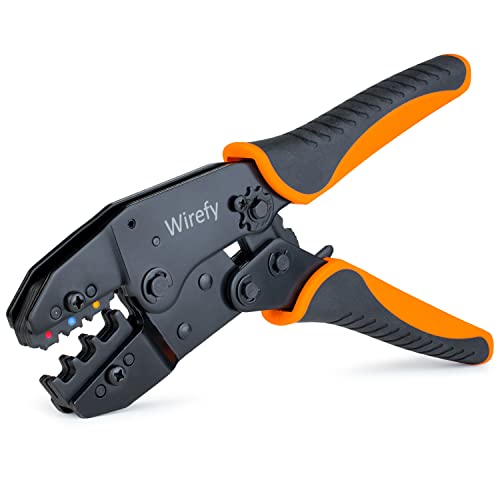
The Wirefy is a straightforward ratcheting crimper for insulated nylon terminals from AWG 22 to 10. The ratchet will not release until the handles complete the full stroke, which takes the guesswork out of the squeeze: every crimp gets the same compression, whether it is the first of the day or the fiftieth. That consistency is the main reason to choose a ratcheting tool over a plier-style one for repetitive terminal work.
The handles are 6 inches long and the tool weighs 540 g, so it sits in the middle of the pack for size and heft. The listed range covers the red, blue, and yellow insulated terminals used in automotive wiring, appliance repair, and general shop electrical work. Note that the listing describes the tool for insulated nylon connectors; a few roundups describe it more broadly as covering non-insulated terminals as well, and this article follows the listing.
For a home workshop crimping insulated terminals a few times a month, this is the value pick: a full-cycle ratchet with nothing extra to learn.
Specs
– Crimping range: AWG 22–10
– Connector types: Insulated nylon terminals
– Mechanism: Ratcheting, full-cycle
– Model: Wirefy-CRMP-01
– Dimensions: 11.42 x 4.69 in
– Handle length: 6 in
– Weight: 540 g
Klein Tools 1005 Crimping and Cutting Tool

The Klein 1005 is a plier-style tool, and that is its appeal. There is no ratchet to set or release: squeeze, and the die closes on the terminal. For an experienced electrician working in a crowded box, that direct feel is worth more than a ratchet, because the tapered nose reaches into tight spaces where a bulkier ratcheting frame will not fit.
It crimps both insulated and non-insulated terminals from AWG 10 to 22, so one tool covers a mixed terminal drawer. A specially hardened cutter in the nose trims wire without reaching for a separate tool, and the hot-riveted joint keeps the action smooth with no handle wobble. The plastic-dipped red handles are shaped for a natural grip, and the tool is made in the USA.
The trade-off is control: without a ratchet, the quality of each crimp depends on the hand behind it. Beginners will get more consistent results from a ratcheting tool. For a pro who already knows how a good crimp feels, the 1005 is the tool that lives in the pouch.
Specs
– Crimping range: AWG 10–22, insulated and non-insulated terminals
– Cutting capacity: AWG 10–22 wire
– Nose: Tapered, for confined spaces
– Joint: Hot-riveted
– Handle finish: Plastic-dipped, red
– Length: 9.6 in (24.4 cm)
– Weight: 12.8 oz (363 g)
Klein Tools 3005CR Ratcheting Crimper

The 3005CR is the most foolproof tool in this lineup for insulated terminals. Three color-coded cavities cover 22–16 AWG in red, 16–14 AWG in blue, and 12–10 AWG in yellow, so matching the die to the terminal is a matter of reading the color. The built-in ratchet ensures a full-cycle crimp every time, and a dial adjusts the force applied to the crimp.
An adjustable compound action puts more crimping power into each squeeze than a straight plier-style tool, which helps on the heavier 12–10 AWG yellow terminals. The cavity design gives a consistent crimp from either side of the tool, and the dual-material molded grips stay comfortable through a long batch of terminations.
Two things to know before buying. The handles are not insulated for protection against electrical shock, so de-energize the circuit before working on it. And the bundle listing that pairs this crimper with the Klein 11061 wire stripper is a different listing; the code in the reference table below is for the crimper on its own.
Specs
– Crimping range: AWG 10–22 stranded, insulated terminals
– Cavities: 3, color-coded (22–16 red, 16–14 blue, 12–10 yellow)
– Mechanism: Full-cycle ratchet, adjustable compound action, force dial
– Handle: Dual-material molded grips, red and black
– Length: 9 in
– Weight: 1.3 lb (0.6 kg)
– UPC: 092644344008
Knipex 97 52 36 PreciForce Crimping Pliers

The PreciForce 97 52 36 is the precision instrument of the group. It crimps insulated terminals, plug connectors, and butt connectors from 0.5 to 6.0 mm², about AWG 20 to 10, across three crimping positions. The crimping pressure is set precisely and calibrated at the factory, and it can be re-adjusted, so the tool delivers the same compression on the hundredth crimp as on the first.
A toggle lever multiplies hand force while keeping the tool compact at 220 mm, and the integral lock with a self-releasing mechanism holds the crimp until the cycle completes. The body is chrome vanadium electric steel, oil-hardened, with a burnished finish and multi-component grips. The die is fixed and not exchangeable, so buy this tool for the insulated-connector range it is built around, not as a catch-all.
For panel builders who crimp insulated terminals all day, the calibrated pressure and toggle lever justify the premium tier.
Specs
– Crimping range: 0.5–6.0 mm² (AWG 20–10)
– Connector types: Insulated terminals, plug connectors, butt connectors
– Crimping positions: 3
– Mechanism: Toggle lever, factory-calibrated pressure, unlockable ratchet
– Material: Chrome vanadium electric steel, oil-hardened
– Length: 220 mm
– Weight: 487 g
How to choose
Begin with the terminal, not the tool. Insulated ring, spade, and butt terminals need a die with color-coded nests sized for the insulation; open-barrel pins need dual-wing dies that fold the conductor and insulation wings separately; wire ferrules need a square or trapezoidal ferrule die. A tool built for one family will make a poor crimp on another, no matter how well it is made.
Match the wire range next. Check the smallest and largest wire you actually crimp, and confirm both sit inside the tool’s listed range. A tool rated to 10 AWG will not make a sound crimp on a 6 AWG lug, and a tool built for heavy cable will crush a 22 AWG pin.
Decide between a ratchet and a plier-style tool. A full-cycle ratchet releases only when the stroke completes, which protects a beginner from half-finished crimps and keeps a long batch consistent. A plier-style tool like the Klein 1005 gives direct feel and a slimmer nose for tight boxes, and suits hands that already know how a good crimp feels.
Finally, check the connector maker’s instructions. Some terminal makers specify the die profile and the inspection criteria for their connectors. Where a maker specifies a tool or die combination, follow it: a crimp that looks tight can still have poor electrical contact if the die is wrong or the cycle did not complete.
Who should skip
Skip this lineup if your work is mostly large battery cable lugs. Those need a hydraulic crimper, manual or cordless, with dies sized for heavy conductors; none of the five tools here covers that range. The live guide on this site for cordless hydraulic lug crimpers covers that purchase instead.
Skip it too for production-line volumes of hundreds of terminals a day, where a cordless terminal crimper earns its keep on hand fatigue and cycle time.
Plumbing work is out of scope as well. PEX crimp rings and press fittings use different tools entirely, and an electrical crimper will not make a sound plumbing joint. And if you need one tool for every connector family, no single hand crimper covers insulated terminals, open-barrel pins, ferrules, and lugs at once; buy for the connections you make most, then add a second tool for the rest.
FAQ
What is the difference between a ratcheting crimper and a plier-style crimper?
A ratcheting crimper locks through the stroke and releases only when the cycle completes, so every crimp gets the same compression. A plier-style crimper closes in direct proportion to hand force, which gives more feel and a slimmer nose but depends on the user to finish each squeeze.
Can one crimper handle both insulated terminals and open-barrel pins?
No. Insulated terminals need nests sized for the insulation sleeve, while open-barrel pins need dual-wing dies that fold the conductor and insulation wings separately. A tool built for one family will make a poor crimp on the other, so match the die to the terminal type.
Do I need a different tool for wire ferrules?
Yes, for best results. Ferrules need a square or trapezoidal die that compresses the sleeve evenly around the strands. A general terminal crimper can crush a ferrule out of shape, which defeats the purpose of fitting it into a terminal block.
How do I know a crimp is sound?
Check the connector maker’s criteria first: the conductor should be fully seated, the insulation support should not cut into the wire, and the barrel should not be split or badly deformed. A pull test can catch an obviously weak connection, but it is not a substitute for the specified process where the job requires one.
Final verdict
For most workshops, the Klein 3005CR is the tool to buy first: three color-coded cavities, a full-cycle ratchet, and a force dial cover the insulated terminals most jobs involve. Add the iCrimp SN-28B if electronics pins are part of your work, and the Klein 1005 if you want a slim plier-style tool for crowded boxes. The Wirefy is the sensible value pick for occasional insulated-terminal work, and the Knipex 97 52 36 is the premium choice when calibrated, repeatable crimps are the job itself.
Related guides
More from Amazon
Programs that pair well with the guide above. Offers and eligibility are set by Amazon and may change.
A free business account with business pricing and bulk-buying tools for work, shop or home office.
Create a business accountFree shipping on eligible items, Prime Video and more. Eligible new members can start with a free trial.
Start a Prime free trialAudiobooks and podcasts to listen to on the go. Eligible new members can start with a free trial.
Try Audible freeAd-free music streaming. Eligible new subscribers can start with a free trial.
Try Music Unlimited freeAs an Amazon Associate we earn from qualifying purchases.


Write Your Review
No reviews yet. Be the first to share your experience!