
Key takeaways
- Twin stack compressors trade footprint for steadier air. Compare CFM at 90 PSI, oil-lube and oil-free pumps, noise and weight for jobsite air tools and crews.
What's inside
As an Amazon Associate I earn from qualifying purchases. This post may contain affiliate links at no extra cost to you.
Buying a twin stack compressor is really a decision about airflow per pound. The two stacked tanks buy you reserve air for a second nailer or a longer burst from a die grinder, but the pumps behind those tanks range from a cast-iron, oil-lubricated unit built for framing crews to featherweight oil-free pumps that top out near two CFM. Pick the wrong end of that range and you either lug unnecessary iron up stairs or listen to a small pump cycle itself to death feeding a framing gun.


This guide is for trim carpenters working inside finished homes, small framing and roofing crews, and remodelers who carry one compressor between rooms all day. Every model below was chosen from its Amazon product title and listing details: tank size, delivered CFM at 90 PSI, maximum pressure, pump type, noise rating and weight, so the comparison rests on published numbers rather than marketing labels.
Quick Picks
As an Amazon Associate we earn from qualifying purchases.
| Product | Best for | Key spec from title |
|---|---|---|
| Makita MAC2400 | Two-nailer framing and roofing work | 4.2 CFM at 90 PSI from a 4.2 gallon twin-stack |
| California Air Tools 4620AC | Indoor jobs where two tools share one quiet pump | 2.0 HP oil-free, 70 dB, 4.6 gallon aluminum tank |
| Campbell Hausfeld DC040500 | Solo remodelers carrying a compressor room to room | 38 lb twin stack, 68 dB, 125 max PSI |
| California Air Tools CAT-4610AC | Finish work inside occupied homes | 60 dB, 4.6 gallon aluminum twin tank, oil-free |
How to Choose
Start with CFM at 90 PSI, not tank size
Tank gallons tell you how much air sits in reserve; CFM at 90 PSI tells you how fast the pump replaces it, and replacement speed is what keeps a tool working. A framing nailer firing steadily, a roofing gun on a tear-off, or any rotary tool like a die grinder will drain a 4.6 gallon tank in well under a minute of continuous use. The Makita in this guide delivers 4.2 CFM at 90 PSI, roughly double the 2.2 CFM of the two lightweight models, which is why it can feed two nailers while the smaller pumps suit one intermittent tool. Match the CFM figure to your hungriest tool first, then let tank size settle run time between cycles.
Decide between an oil-lubricated and an oil-free pump
An oil-lubricated cast-iron pump, like the Makita’s Big Bore design, is the traditional jobsite answer: it tolerates long duty cycles and rough handling, and in return asks for oil checks, level storage so the oil stays where it belongs, and a little more weight. Oil-free pumps remove that maintenance entirely and start happily in cold weather and on uneven ground, which is why both California Air Tools models and the Campbell Hausfeld use them. The trade is service life and noise character. California Air Tools rates its oil-free dual piston pump at a life cycle beyond 3,000 hours, while a comparable budget pump may be rated far lower, so read the pump description rather than assuming all oil-free pumps are equal.
Weigh the noise rating against where you actually work
The four compressors here span 60 to 79 decibels, and that spread matters more than it looks on paper because decibels are logarithmic: the 79 dB Makita is plainly louder beside a ladder than the 60 dB CAT-4610AC across a finished living room. If your work is punch-list and finish carpentry in occupied homes, a rating at or below 70 dB keeps conversation possible and clients calm. If the compressor lives on a slab outside a framed house, noise drops down the priority list and airflow should take its place. One caution: brands measure at different distances, Makita quotes its figure at three feet, so treat ratings as a ranking guide rather than laboratory truth.
Check weight, tank material and couplers before checkout
Twin stack compressors in this class weigh between 38 and 77 pounds, and that difference decides whether one person carries the unit or two people plan around it. Aluminum tanks, used by both California Air Tools models, cut weight and cannot rust from the inside when condensate sits over a weekend. Steel tanks are cheaper to build and shrug off dents. Also count the couplers: the Campbell Hausfeld carries a dual coupler so two users can run light tools at once, while single-coupler machines need a splitter that adds leak points. Finally, note the amp draw, which runs from 8.5 to 14 amps across these picks, because a 14-amp compressor sharing a circuit with a saw and lights will find the breaker.
The 4 Best Options
Makita MAC2400
The MAC2400 is the pick for crews whose tools actually consume air: a framing nailer paired with a finish gun, or a roofing nailer worked hard through a morning. Its oil-lubricated Big Bore pump delivers 4.2 CFM at 90 PSI, the strongest figure in this guide, and the cast-iron cylinder is built for the dust, drops and cold starts of open framing. The 4.2 gallon twin-stack tank holds 130 PSI, so recovery cycles are short and widely spaced. You pay for that output in mass and upkeep, but for two-person crews the arithmetic favors airflow over portability almost every time.
Specs
- Twin-stack tank: 4.2 gallons, steel
- Maximum pressure: 130 PSI
- Air delivery: 4.2 CFM at 90 PSI, 4.8 CFM at 40 PSI
- Motor: 2.5 HP, 12.3 amps, 115V
- Pump: oil-lubricated, cast-iron cylinder
- Noise: 79 dBA at 3 feet
- Weight: 77 lb
Best for: framing, roofing and siding crews running two nailers from one compressor.
Watch out for: at 77 lb it is a two-hand, plan-ahead carry, and the oil level needs checking like any oil-lubricated pump.
ASIN: B0001Q2VPK
California Air Tools 4620AC
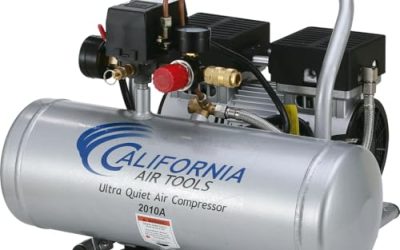
The 4620AC suits interior crews who need real airflow without the soundtrack of a traditional jobsite compressor. The 2.0 HP motor turns at only 1,680 RPM, which is how this unit holds its noise to 70 dB while the oil-free dual piston pump feeds the 4.6 gallon aluminum twin tank. Amazon lists its air flow capacity at 6.4 CFM, the highest headline figure here, and the Easy Start Valve unloads the pump at startup so cold mornings and long cords are less likely to stall it. At about 67 pounds it is still a deliberate carry, but it splits the difference between the Makita’s output and a true lightweight better than anything else in this guide.
Specs
- Twin tank: 4.6 gallons, aluminum
- Motor: 2.0 HP, 110V, 14 amp draw
- Air flow capacity: 6.4 CFM as listed
- Pump: oil-free dual piston, rated beyond 3,000 hours
- Noise: 70 dB
- Weight: 67.2 lb
- Dimensions: 20.7 x 18 x 21 inches
Best for: two-person interior trim and flooring crews working in finished, occupied spaces.
Watch out for: the 14 amp draw is the highest here, so give it a circuit of its own, and confirm the current seller before ordering since featured-offer availability on this listing fluctuates.
ASIN: B005SOD08M
Campbell Hausfeld DC040500
At 38 pounds, the DC040500 is the twin stack you grab for a day of moving between rooms: hanging doors upstairs, baseboard in a condo, punch work across three floors. The oil-free pump needs no oil checks and no level surface fuss, and the 68 dBA rating is low enough to run in a client’s home without shouting over it. Output is modest at 2.2 CFM at 90 PSI, which comfortably runs a finish or brad nailer and short bursts from a framing gun, and the dual coupler lets a helper run a second light tool. It is a one-person tool for one-person work, and judged that way it is well matched.
Specs
- Twin stack tank: 4.6 gallons
- Maximum pressure: 125 PSI
- Air delivery: 2.2 CFM at 90 PSI, 3.2 CFM at 40 PSI
- Motor: 1 HP
- Pump: oil-free, maintenance-free
- Noise: 68 dBA
- Couplers: dual coupler for two users
- Weight: 38 lb
Best for: solo remodelers and trim carpenters who carry the compressor to the work, room by room.
Watch out for: 2.2 CFM at 90 PSI will not keep up with sustained framing, roofing or rotary tools, so size up if your tools fire continuously.
ASIN: B06X6J1XZJ
California Air Tools CAT-4610AC

The CAT-4610AC is built around one number: 60 decibels, the quietest rating in this guide, achieved with a 1.0 HP motor running at 1,680 RPM and an oil-free dual piston pump. The 4.6 gallon aluminum twin tank keeps the whole unit at 45.5 pounds and immune to internal rust, and the modest 8.5 amp draw is gentle on older home circuits and small generators. Air delivery is 2.2 CFM, which suits brad and finish nailers, staplers and inflation rather than framing work. For cabinet installers and finish carpenters whose compressor sits in the same room as the client, that trade of output for quiet is usually the right one.
Specs
- Twin tank: 4.6 gallons, aluminum
- Maximum pressure: 120 PSI
- Air delivery: 2.2 CFM
- Motor: 1.0 HP, 110V, 8.5 amps
- Pump: oil-free dual piston, rated beyond 3,000 hours
- Noise: 60 dB
- Weight: 45.5 lb
- Dimensions: 19.1 x 16.7 x 19.7 inches
Best for: finish carpentry, cabinet installation and punch work inside occupied homes.
Watch out for: the low CFM ceiling shows quickly with hungry tools, and this listing often sells through third-party sellers, so check who is fulfilling the order.
ASIN: B01G75OUO8
Which One Fits Your Situation
A two-person framing crew sharing one compressor
Choose the Makita MAC2400. It is the only unit here whose 4.2 CFM at 90 PSI keeps two framing or roofing nailers cycling without the pump running continuously, and its cast-iron oil-lubricated pump is the design that tolerates that duty. The weight penalty matters least to a crew that sets the compressor once and works around it all day.
Remodeling inside an occupied home
Choose the California Air Tools 4620AC if two of you work at once, since it pairs the strongest listed airflow with a 70 dB rating the household can live with. Working alone in finished rooms, step down to the CAT-4610AC at 60 dB and trade airflow for a machine nobody in the house will complain about.
One carpenter, three floors, no elevator
Choose the Campbell Hausfeld DC040500. At 38 pounds it is the only compressor in this guide you will carry up stairs repeatedly without dreading it, and its dual coupler still lets a helper tack trim while you fit the next piece. Its 2.2 CFM output matches brad, finish and stapling work, which is most of what stair-climbing jobs involve.
A small shop that occasionally goes mobile
Choose the California Air Tools 4620AC and leave it on the shop floor most days. The aluminum tank shrugs off condensate between uses, the oil-free pump asks for nothing between projects, and the airflow covers shop nailers and blow guns. When a job does leave the shop, 67 pounds is manageable for occasional moves in a way a daily carry is not.
Common Mistakes
- Buying on tank gallons alone, then discovering the pump delivers half the CFM your framing nailer needs at 90 PSI.
- Running a compressor on a long, thin extension cord, which drops voltage, slows recovery and overheats the motor.
- Never draining the tank, so condensate rusts a steel tank from inside and shortens its life.
- Assuming every oil-free pump is built alike, when listed pump life ratings vary from a few hundred hours to several thousand.
- Sharing one loaded circuit between a high-draw compressor, a saw and site lighting until the breaker ends the argument.
Frequently Asked Questions
Can a twin stack compressor run two nailers at the same time?
Yes, provided the pump’s CFM at 90 PSI exceeds what both tools consume. The Makita MAC2400 at 4.2 CFM handles two framing or finish nailers comfortably, and the Campbell Hausfeld even ships with a dual coupler. The lighter 2.2 CFM models can share air between two intermittent tools, but sustained firing from both will outrun the pump.
Is an oil-lubricated or oil-free pump better for jobsite work?
Oil-lubricated cast-iron pumps like the Makita’s suit heavy daily duty and long service, at the cost of oil checks and extra weight. Oil-free pumps need no oil, start easily in the cold and tolerate slopes, which is why the quiet models here use them. For intermittent finish work, oil-free is simpler; for all-day framing, oil-lubricated still earns its upkeep.
How much difference is there between 60 dB and 79 dB in practice?
A lot, because the decibel scale is logarithmic rather than linear. A 60 dB compressor permits normal conversation beside it and is realistic inside a furnished home. At 79 dB you are raising your voice and the client’s patience wears thin. Ratings are measured at different distances between brands, so use them to rank machines rather than as exact predictions.
What else should I check before running one on a generator or shared circuit?
Add up the amp draw first: these picks range from 8.5 to 14 amps, and a 14-amp compressor leaves little room on a standard 15-amp circuit for anything else. Startup surge is the hard moment, so models with an easy-start or unloader valve behave better on generators. When in doubt, give the compressor its own circuit and keep cords short and heavy.
Related guides
More from Amazon
Programs that pair well with the guide above. Offers and eligibility are set by Amazon and may change.
A free business account with business pricing and bulk-buying tools for work, shop or home office.
Create a business accountFree shipping on eligible items, Prime Video and more. Eligible new members can start with a free trial.
Start a Prime free trialAudiobooks and podcasts to listen to on the go. Eligible new members can start with a free trial.
Try Audible freeAd-free music streaming. Eligible new subscribers can start with a free trial.
Try Music Unlimited freeAs an Amazon Associate we earn from qualifying purchases.


Write Your Review
No reviews yet. Be the first to share your experience!