Our Top Picks
 DEWALT 20V MAX XR Brushless Cordless 7-1/4 in.STANDARD15.35 x 9.4 x 9.6 inches9.88 PoundsCheck on Amazon
 Cordless Drill Impact Driver Brushless Power Tool ComboSmall5.5 x 2 x 8 inches2.1 poundsCheck on Amazon


What's inside
- The buying order at a glance
- 1. Circular saw: the tool the whole deck waits on
- 2. Impact driver: the tool that saves your wrists and your weekend
- 3. Miter saw: repeatability, not necessity
- 4. Cordless drill: the quiet partner to your impact
- 5. Reciprocating saw: demo and the cuts nothing else can reach
- 6 and 7. Concrete anchors and detail work
- What to skip
- Choosing a battery platform before you choose tools
- Deck building power tools FAQ
- Related Guides
- The buying order at a glance
- 1. Circular saw: the tool the whole deck waits on
- 2. Impact driver: the tool that saves your wrists and your weekend
- 3. Miter saw: repeatability, not necessity
- 4. Cordless drill: the quiet partner to your impact
- 5. Reciprocating saw: demo and the cuts nothing else can reach
- 6 and 7. Concrete anchors and detail work
- What to skip
- Choosing a battery platform before you choose tools
- Deck building power tools FAQ
- Related Guides
As an Amazon Associate I earn from qualifying purchases. This post may contain affiliate links at no extra cost to you.
Most deck builds do not stall because someone bought the wrong brand. They stall because the tool that would have saved four hours was bought fourth instead of first. That is the real problem with picking the best power tools for deck building: the shopping lists you find are sorted by price or by whatever the writer had lying around, not by which tool unlocks the next stage of the job.
So this list is ordered by purchase sequence. Number one is the tool that turns a pile of lumber into a frame. Number two is the one that stops you from hand-driving 500 fasteners. By the time you reach the bottom, you are into nice-to-haves that only pay off if you are building more than one deck. Each entry says what job it unlocks and, where relevant, what to skip.
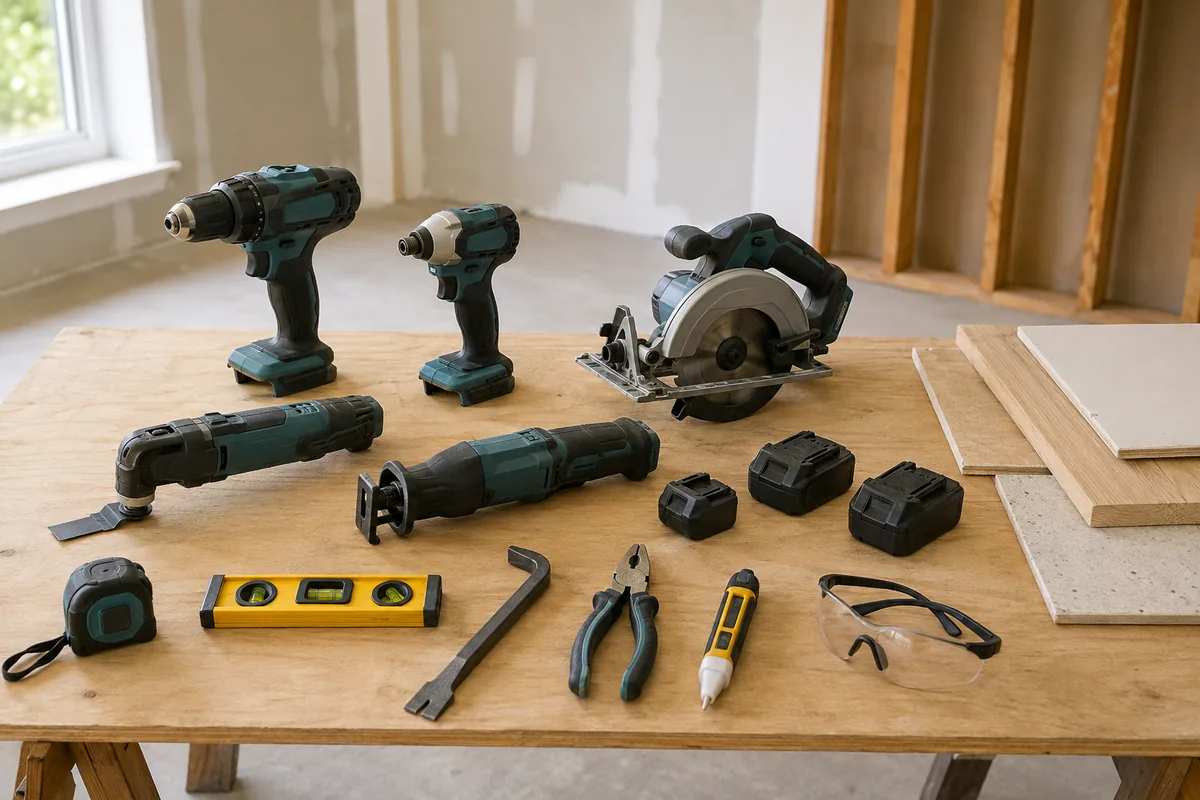
The buying order at a glance
Read this as a sequence, not a menu. If your budget runs out at row four, you can still build a deck.
| Buy order | Tool | Job it unlocks | Buy later? |
|---|
| Buy order | Tool | Job it unlocks | Can you rent it? |
|---|---|---|---|
| 1 | Circular saw (cordless or corded) | Cutting joists, decking, stair stringers | No, own this |
| 2 | Impact driver | Driving structural screws and deck fasteners | No, own this |
| 3 | Miter saw (10 or 12 in sliding) | Repeatable square and angle cuts on decking | Yes, but you will want it |
| 4 | Cordless drill (paired with the impact) | Pilot holes, ledger bolts, hardware | No, own this |
| 5 | Reciprocating saw | Demo, notching, cutting posts in place | Yes |
| 6 | Rotary hammer or hammer drill | Ledger anchors into concrete or block | Yes, rent for one day |
| 7 | Router or oscillating tool | Post notches, hidden fastener cleanup, trim | Only if fussy detail work |
1. Circular saw: the tool the whole deck waits on
Nothing happens until lumber gets shorter. A circular saw cuts joists to length, rips decking to fit the last course, notches posts, and cuts stair stringers, which is a job a miter saw physically cannot do. If you own exactly one power tool for this project, it is this one.
The real decision is cordless versus corded, and for deck work cordless has genuinely won. You are working across a footprint bigger than any extension cord wants to be, often over an open frame where a cord is a trip hazard. A brushless 7-1/4 inch cordless saw on a large-format battery will get through pressure-treated framing all day. Rear-handle (worm-drive style) models give better sightlines and more grunt in wet PT lumber; sidewinders are lighter and easier overhead.
Skip the 6-1/2 inch compact saws for this job. They look appealing on price, but the shallower depth of cut fights you on 4×4 and 6×6 posts, and you end up flipping stock and chasing the kerf.
Cordless 7-1/4 in. brushless circular saw
Prioritize blade capacity and battery platform over headline power claims. A 7-1/4 inch blade with a full-depth cut handles 4x lumber in one pass, and a saw that shares batteries with your impact driver saves you from owning two chargers. Framing blades with 24 teeth are the right call for wet pressure-treated stock; save the fine-tooth blades for finish decking.
2. Impact driver: the tool that saves your wrists and your weekend
A mid-size deck can eat several hundred to well over a thousand fasteners. Structural screws for ledger and rim connections, deck screws or hidden clips for the surface, and lag-style fasteners for railing posts. A drill/driver can technically do it. It will also cam out, strip heads, and heat up while you fight it.
An impact driver delivers rotational hammer blows, so torque arrives in bursts instead of twisting the tool out of your hand. It drives long structural screws without pre-drilling in most softwood, and modern brushless units on the DeWalt XR, Milwaukee FUEL, and Makita LXT platforms have enough control at low speed that you can stop flush instead of sinking screws through the decking.
Two things matter more than the spec sheet. First, buy a second battery. Fastening is the most battery-hungry part of the build. Second, buy quality impact-rated bits in the exact size your fasteners use, and buy more than one. Cheap bits round off, then round off your screw heads.
- ✔ Drives long structural screws without pilot holes in most softwood
- ✔ Far less wrist strain and cam-out than a drill/driver
- ✔ Compact head reaches between joists and blocking
- ✔ Batteries are usually shared with the rest of your kit
- ✘ Poor at precise pilot holes, so you still want a drill
- ✘ Loud enough that hearing protection is not optional
- ✘ Easy to overdrive fasteners until you learn the trigger
3. Miter saw: repeatability, not necessity
Placed third because it is the biggest quality jump per dollar after the first two, but it is not what gets you started. A miter saw’s value on a deck is repeatability. Set a stop block, cut forty joists to identical length, and your frame goes together square. Cut those same forty by eye with a circular saw and you will spend the difference chasing gaps at the rim.
Size guidance: a 10 inch sliding compound saw crosscuts standard decking and 2×8 or 2×10 joists comfortably. A 12 inch slider adds capacity for wide boards and steeper compound angles on railings, and it costs and weighs more. Non-sliding 10 inch saws struggle with wider decking boards, which is exactly the cut you make most often.
If you are building one deck and never touching a miter saw again, rent it. If you suspect there is a fence, a pergola, or interior trim in your future, buy it. Add a portable stand or build a pair of sawhorses with outfeed support before your first cut, because an unsupported 16 foot board will pull the saw off the table.
4. Cordless drill: the quiet partner to your impact
Buy the drill as a kit with the impact driver if you can. It does the jobs the impact is bad at: accurate pilot holes for railing hardware, countersinks, driving ledger bolts with a socket adapter where you need controlled torque instead of hammer blows, and running a large auger or hole saw when you need to pass wiring for post cap lights.
A standard 1/2 inch chuck brushless model is plenty. Hammer drill function is a bonus, not a reason to upgrade, and it is not a substitute for the concrete work described below.
5. Reciprocating saw: demo and the cuts nothing else can reach
If you are replacing an old deck, this moves up the list dramatically. A recip saw with a demolition blade cuts through old decking, nails, and fasteners without you caring what it hits. On new builds it earns its place cutting installed posts to height, trimming joist ends in place after the frame is up, and getting into notches where no other saw fits.
Blade choice matters more than the saw. Keep a bi-metal demo blade for nail-embedded wood, a coarse wood blade for fast rough cuts, and a fine metal blade for the odd bolt. Orbital action and tool-free blade change are the two features worth paying for.
Cordless reciprocating saw with orbital action
Look for variable speed, tool-free blade changes, and a pivoting shoe. On the same battery platform as your circular saw, this is the cheapest way to add real demolition capability. Compact one-handed models are handy overhead but slower through nail-embedded lumber, so pick full-size if you are tearing out an existing deck.
6 and 7. Concrete anchors and detail work
A rotary hammer belongs on the list only if your ledger board attaches to concrete, block, or brick foundation, or if you are setting anchors in an existing slab. When that is the job, no ordinary hammer drill will make it pleasant. This is the single best rental candidate on the whole list: you need it for a few hours, and a mid-size SDS-Plus rotary hammer with the right bit diameter will drill clean anchor holes faster than a hammer drill does in three times the time.
A compact router or an oscillating multi-tool sits last. The router cleans post notches and rounds over exposed edges so nobody catches a splinter on the railing cap. The oscillating tool makes flush cuts, trims hidden fastener clips, and gets into corners after the fact. Both are genuinely useful, neither is required to finish a deck.
What to skip
Skip the framing nailer for the frame itself. Most current residential code guidance and hardware manufacturer instructions call for specific structural screws or joist hanger nails in specific hole patterns. A framing nailer with the wrong fastener in a joist hanger is a failed inspection. Nailers earn their keep on fence pickets and skirting, not connectors.
Skip the table saw unless you already own one. Rips on a deck are few and mostly happen in place, where a circular saw with a straightedge or an edge guide does it better and does not require you to wrestle a 16 foot board across a small table.
Skip pneumatic tools and a compressor for a one-deck project. The hose, the noise, and the setup time do not pay back when cordless fastening is this good.
Skip the 20-piece combo kit that bundles four tools you will never use to hit a headline price. You are better off buying three good tools on one battery platform than seven mediocre ones.
Skip cheap unbranded batteries. They are the most common cause of a tool that seems to have lost power, and they are the worst place to save money on a jobsite where everything is damp.
Choosing a battery platform before you choose tools
The most expensive mistake on this list is not a bad tool. It is buying four tools across three battery systems. Pick one 18V or 20V-max platform and stay in it: DeWalt XR, Milwaukee FUEL, Makita LXT, and Ryobi’s HP line all have every tool named above, and all of them will build a deck. Higher-voltage systems exist and hit harder on the circular saw, but they add weight and cost that a residential deck does not require.
Practical battery math: two large-capacity packs plus a fast charger will keep one person working continuously. Add a third if two people are driving fasteners at the same time.
Cordless combo kit: drill and impact driver
The two-tool brushless combo is where most people should commit to a platform. It typically bundles two batteries and a charger, which is most of the cost of buying either tool separately, and it locks you into a system where the circular saw and recip saw are bare-tool purchases later. Confirm both tools in the kit are brushless before buying, because mixed kits are common.
Deck building power tools FAQ
Can I build a deck with just a circular saw and an impact driver? Yes, and plenty of decks have been. You will spend more time measuring and marking each cut, and your joist lengths will vary slightly more than they would with a miter saw and a stop block. Use a speed square as a saw guide on every crosscut and check the frame for square with diagonal measurements before you deck it.
Do I need a special saw blade for pressure-treated lumber? Not special, but the right one. A 24-tooth framing blade cuts wet pressure-treated stock without bogging or gumming, which is what happens when you use a 60-tooth finish blade. Keep a higher-tooth-count blade for composite decking, where a clean cut edge shows.
Should I rent or buy the miter saw? Rent if this is a one-time project and you have nowhere to store it. Buy if you expect any future framing, fencing, or trim work, because a miter saw is the tool people regret renting twice. Rental makes the most sense for the rotary hammer, which most homeowners will genuinely never need again.
Build the list from the top. One good circular saw, one impact driver, two batteries, and the correct blades and bits will get a deck framed and decked. Everything after that buys you speed and repeatability, which matter more the second time you do this than the first.
Check prices on Amazon →