Our Top Picks

What's inside
- 1. A table saw or track saw, because square parts come first
- 2. Random orbit sander, because finish quality is visible from across the room
- 3. Cordless drill/driver, then a compact router
- 4. Thickness planer, the tool that changes what wood you can afford
- 5. Miter saw and a joiner, in that order, and only when the work demands it
- What to skip when building out the best power tools for furniture making
- Frequently asked questions
- Related Guides
- 1. A table saw or track saw, because square parts come first
- 2. Random orbit sander, because finish quality is visible from across the room
- 3. Cordless drill/driver, then a compact router
- 4. Thickness planer, the tool that changes what wood you can afford
- 5. Miter saw and a joiner, in that order, and only when the work demands it
- What to skip when building out the best power tools for furniture making
- Frequently asked questions
- Related Guides
As an Amazon Associate I earn from qualifying purchases. This post may contain affiliate links at no extra cost to you.
Most people buy furniture tools in the wrong order. They start with the tool that looks like furniture making, usually a router or a fancy miter saw, then spend two years wondering why nothing fits together. The problem is not skill. It is that furniture is an assembly of flat, square, consistently sized parts, and no amount of clamping pressure fixes stock that is cupped and out of square. That is why this list of the best power tools for furniture making is ordered by what to buy first, not by price and not by what is exciting.
Each entry below states the job it unlocks. If a tool does not unlock a new class of work, it is a convenience purchase and it goes later in the queue. I have also included a what-to-skip section, because the fastest way to build a real shop is to not buy three specific tools everyone tells you to buy.
As an Amazon Associate we earn from qualifying purchases at no extra cost to you.


| Buy order | Tool | Job it unlocks | Rough budget tier |
|---|---|---|---|
| 1 | Table saw or track saw | Straight, repeatable, square cuts | Mid to high |
| 2 | Random orbit sander | Finish-ready surfaces | Entry |
| 3 | Cordless drill/driver set | Joinery prep and assembly | Entry to mid |
| 4 | Compact router | Joinery, edges, templates | Entry to mid |
| 5 | Thickness planer | Consistent stock thickness | Mid |
| 6 | Miter saw | Fast rough crosscuts and trim | Entry to mid |
| 7 | Domino, biscuit or dowel joiner | Fast repeatable alignment | High |
1. A table saw or track saw, because square parts come first
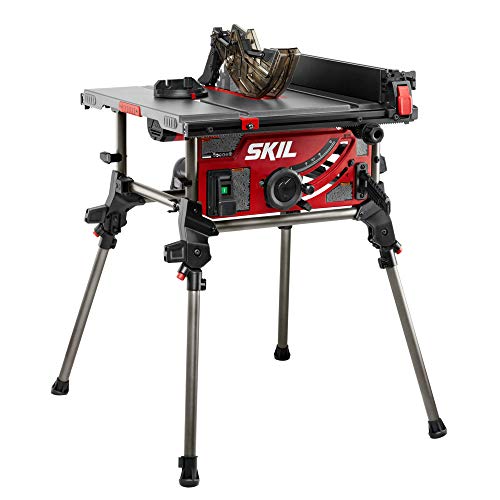
This is the whole argument. Furniture is parts that meet at 90 degrees, and your first purchase should be whatever gives you a dead-straight reference edge and repeatable width. A contractor or jobsite table saw with a decent fence does this all day for narrow parts. A track saw does it better for sheet goods and long panels, and it does it in a small space without a 4×8 outfeed area.
Pick based on what you plan to build. Case goods from plywood, meaning bookshelves, cabinets, built-ins, wardrobes: buy the track saw first. Solid wood furniture with lots of narrow rails, stiles, legs and aprons: buy the table saw first. If you truly build both, the table saw is the more general machine, but budget for a crosscut sled early because the stock miter gauge on affordable saws is the weak point.
What actually matters on a table saw in this price range is fence squareness and how well it locks, blade arbor runout, and whether the top is flat. Horsepower is rarely the limiting factor for furniture-scale parts. On a track saw, look at track deflection, riving knife or anti-kickback behavior, and whether tracks from the same brand join without a step.
Jobsite and Contractor Table Saws
Look for a rack-and-pinion fence, a cast or well-supported top, and a stand you can actually move. Skip the cheapest bench-top saws with stamped fences that flex when you lock them, because a fence you cannot trust means every part needs hand-fitting later. If your shop is a garage bay you park in, weigh a rolling stand as a real feature rather than a nice-to-have.
2. Random orbit sander, because finish quality is visible from across the room
Second place goes to the least glamorous tool here. Joinery mistakes hide inside a case. Sanding mistakes sit on the top of the table where guests put their coffee. A 5-inch random orbit sander with hook-and-loop discs is the cheapest large jump in the perceived quality of everything you build.
Corded is still the sane default for sanding because runtime matters more than mobility, and dust extraction matters more than either. Pair the sander with a shop vac and a hose adapter, not the little onboard bag. If you already own a cordless platform, a brushless cordless sander is genuinely good now, just plan on two batteries for a table top.
The other reason this ranks so high: it makes hand tools optional. Without a decent sander, you need scrapers and planes to get a surface ready for finish. With one, you can get to a clean, uniform surface with a grit progression and patience.
3. Cordless drill/driver, then a compact router
A two-tool cordless kit with a drill and an impact driver covers assembly, pocket screws, hardware, drawer slides and hinges. Buy into one battery platform and stay there. The mainstream lines all work: DeWalt XR, Milwaukee FUEL, Makita LXT, Ryobi ONE+ if budget is the constraint and you do not mind the tradeoffs in ergonomics. The platform decision matters more than the specific kit, since you will buy four to eight more tools on those batteries.
Then the router, which is where furniture making gets interesting. A compact 1-plus-horsepower router with fixed and plunge bases unlocks dados, grooves for panels and drawer bottoms, rabbets, roundovers, chamfers, hinge mortises, template work and flush trimming. It is the single most versatile tool in the shop and the one most likely to hurt you, so buy quality bits, take shallow passes, and learn feed direction before you turn it on.
A full-size router in a table is a later upgrade, not a first router. Get comfortable handheld first.
- ✔ One battery platform means every future purchase is cheaper
- ✔ Compact router covers joinery, edge profiles and templates in one tool
- ✔ Drill and impact driver together stop you from swapping bits constantly
- ✔ Router templates make repeatable parts without buying a second machine
- ✘ Cheap router bits burn and chatter and will ruin good stock
- ✘ Compact routers struggle with large panel-raising or big profile bits
- ✘ Cordless routers eat batteries fast on long cuts
- ✘ Impact drivers overdrive screws in softwood if you do not learn the trigger
4. Thickness planer, the tool that changes what wood you can afford
Here is the honest ranking argument for the planer sitting at number five rather than number one. A planer does not make your first projects possible, but it changes your material economics permanently. Surfaced four-sides lumber from a big-box store costs a large premium and comes in a narrow range of species and thicknesses. Rough lumber from a hardwood dealer is cheaper per board foot, comes in real thicknesses, and comes in species you cannot buy retail.
A 12 or 13-inch benchtop planer with a helical or segmented cutterhead is the sweet spot for furniture. Helical heads cost more up front, run quieter, and handle figured wood with less tearout. Straight-knife machines work fine and knives are cheap, they are just louder and fussier on curly stock.
The catch nobody mentions in buying guides: a planer makes boards a consistent thickness, not flat. You need one flat reference face first, which comes from a jointer, a router sled, hand planes, or a planer sled. Plan for that step or you will produce beautifully uniform bananas.
Benchtop Thickness Planers
Buy the widest one your budget and bench allow, and strongly consider a helical cutterhead if you plan to work walnut, maple or anything figured. Two-speed feed is worth having for finish passes. Budget for a dust collection hose too, since a planer produces more chips per minute than any other tool in a small shop and a shop vac alone will clog.
5. Miter saw and a joiner, in that order, and only when the work demands it
A sliding compound miter saw is fast and convenient. It is not a precision furniture tool out of the box, and a table saw with a sled will beat it on square crosscuts. So it ranks here as a workflow accelerator: excellent for breaking down long boards, cutting trim, and repetitive angled parts with a stop block. If you build a lot of chairs, frames, or anything with lots of angles, move it up your list.
Loose-tenon joiners, biscuit joiners and dowel jigs solve alignment, not strength. A biscuit or dowel keeps a glue-up from sliding around and registers parts where you want them. A loose-tenon machine like the Festool Domino line genuinely does add strength and speed, and it is genuinely expensive. Buy it when you are building enough furniture that hours saved matter more than the price. Until then, dowels and pocket screws build real furniture that lasts.
What to skip when building out the best power tools for furniture making
Three purchases eat beginner budgets and deliver almost nothing:
Skip the oscillating multi-tool as a woodworking purchase. It is a remodeling and repair tool. It cuts nail-embedded trim, opens drywall, and flush-cuts dowels in a pinch. It does not do a single furniture job better than a tool already on this list.
Skip the benchtop jointer under about 6 inches. Narrow beds and short infeed mean you cannot flatten the wide boards furniture actually needs, and you will end up ripping and re-gluing to work around it. Either save for a real jointer or flatten with a router sled or planer sled, which costs almost nothing.
Skip the giant drill/driver combo kit with six tools. The bundled circular saw, reciprocating saw and work light are usually the brand’s entry-level models, and the sander in those kits is rarely one you would choose on its own. Buy the two-tool kit and pick each additional tool deliberately.
Two more spending traps: an air compressor and brad nailer bought before you own a router (a cordless brad nailer later is the better move), and a drum sander bought before you have a planer. Both are real tools with real uses, just far down the queue.
Compact Routers with Plunge and Fixed Bases
A compact router kit with both bases plus a set of quality carbide straight bits and a roundover will handle the majority of furniture joinery and edge work. Look for soft start, variable speed, and a base with a clear sub-base so you can see your line. Pair it with a simple shop-made straightedge jig before you spend money on commercial guides.
Frequently asked questions
Can I build real furniture with only a track saw, drill and router? Yes, and this is the most common modern small-shop setup. That trio handles sheet goods, solid wood joinery, and assembly. You will be limited on stock thickness and on ripping narrow parts efficiently, and you will lean on a hand plane or sander for surfacing. Add the sander and you can build finished case goods, tables and beds.
Cordless or corded for furniture work? Cordless for drills, impact drivers, brad nailers and circular saws, where mobility is the point. Corded for planers, table saws and heavy routing, where sustained power and runtime matter and the tool never moves anyway. Sanders and track saws go either way, so decide based on whether you already own the battery platform.
How much should I plan to spend to build furniture properly? Prices shift constantly, so think in tiers rather than exact numbers. The first three tools on this list, bought in solid mid-range versions, form a functional furniture shop. The planer roughly doubles that outlay and pays itself back in lumber savings if you build regularly. Everything after that is speed and comfort, not capability, so add it as specific projects demand.
Buy in this order and each tool immediately unlocks work you could not do before. Buy in the exciting order and you accumulate a shop that cannot produce a flat, square panel. Start with the tool that makes parts accurate, add the one that makes them look finished, and let actual projects tell you what comes next.
Check prices on Amazon →