What's inside
As an Amazon Associate I earn from qualifying purchases. This post may contain affiliate links at no extra cost to you.
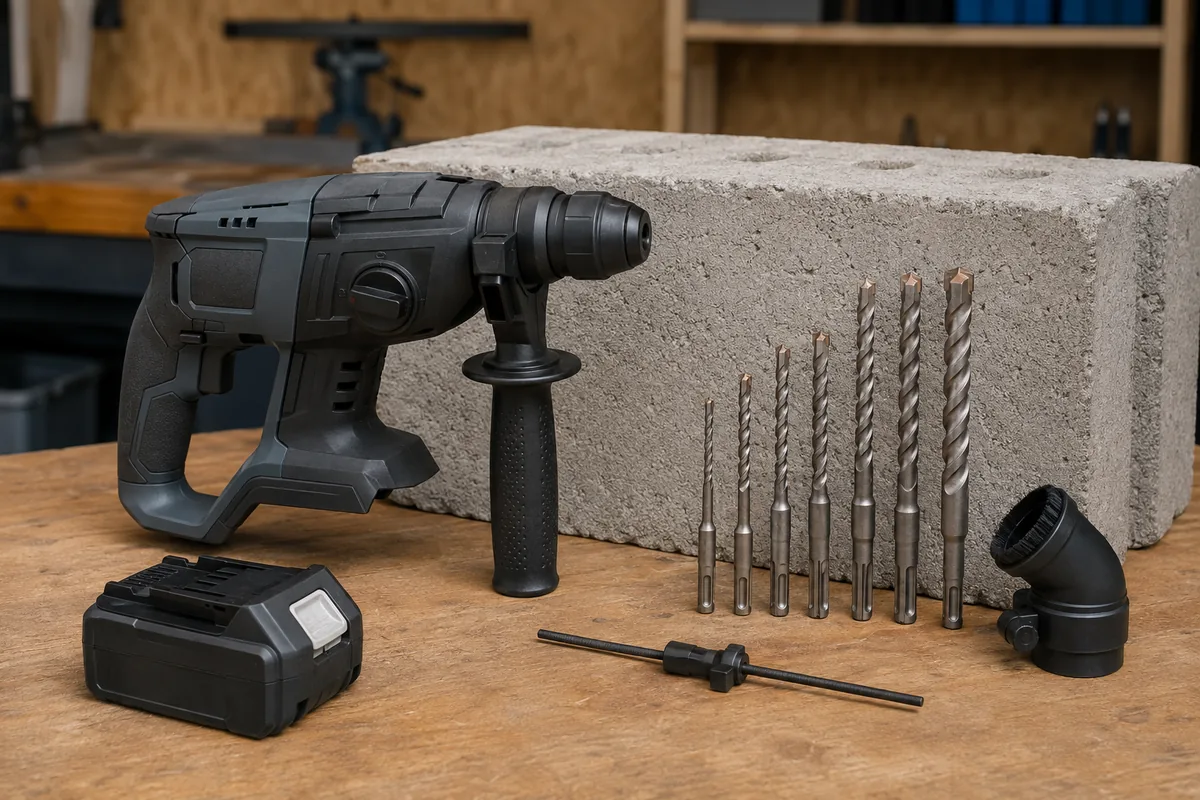
Overhead anchor holes are harder on a cordless rotary hammer than the same holes in a wall. The tool’s weight stays above your shoulders, dust falls toward your face, and a long drilling session can drain a battery quickly. For typical concrete anchor work, a compact SDS-plus hammer is usually the right balance: lighter and easier to control than an SDS-max tool, but much more effective than a drill with a hammer setting.
As an Amazon Associate we earn from qualifying purchases at no extra cost to you.


Choose the right class of rotary hammer
For common holes from about 1/4 to 1/2 inch in concrete, look first at cordless SDS-plus models. Their SDS-plus bits are widely available, and many tools in this class weigh roughly 5 to 8 pounds bare. Add a battery and bit, and the setup may weigh 7 to 10 pounds. That difference matters when you are holding the tool overhead for a row of anchors.
Check the manufacturer’s maximum drilling diameter, but do not treat it as a recommendation for continuous overhead work. A tool rated for a 1-inch hole may make one; repeated large holes will be slower, harder on the operator, and tougher on the battery. For larger holes or frequent heavy drilling, a corded tool or an SDS-max rotary hammer may be more suitable, though neither is an easy overhead choice.
A hammer drill is not a substitute for a rotary hammer in hard concrete. Hammer drills rely on rapid, short impacts and need the operator to push firmly. Rotary hammers use a separate impact mechanism and generally advance masonry bits more effectively with less downward force. That reduces fatigue, but it does not make overhead drilling effortless.
What to compare before buying
| Feature | Why it matters overhead | What to look for |
|---|---|---|
| Tool and battery weight | More weight increases shoulder and arm fatigue. | Compare complete-tool weight, not bare-tool weight alone. |
| Battery platform | A compatible battery you already own can cut the cost of entry. | Use a battery with enough capacity for the work, while accounting for its added weight. |
| Vibration control | Vibration adds fatigue during repeated holes. | Look for an effective anti-vibration handle and a comfortable grip. |
| Dust control | Overhead dust can enter eyes and lungs or obscure the hole. | Consider an integrated dust extractor or a compatible shroud and vacuum. |
| Depth stop and clutch | Consistent depth helps anchors seat properly; a clutch can reduce reaction if a bit binds. | Choose controls that are easy to set and use with gloves. |
Match the tool to your battery platform
If you already own cordless tools, staying within that battery ecosystem is often the practical choice. A bare tool can be a good deal when your batteries and charger are compatible; buying a new platform just for occasional anchor holes may not be. Confirm compatibility by voltage and battery series, since not every pack in a brand’s lineup fits every tool.
Battery capacity is a trade-off, not a free upgrade. A larger pack can help when drilling many holes, but it adds weight at the worst possible place: on a tool held above your head. For a short installation, a smaller compatible pack may be easier to manage. For a long run of holes in dense concrete, a larger pack or a spare may prevent interruptions. Cold batteries, worn packs, oversized bits, and hard aggregate can all reduce runtime.
Compare the cordless SDS-plus rotary hammers sold as bare tools if you already have a compatible platform. If you need batteries and a charger too, compare kit pricing rather than assuming the bare tool is the cheapest route.
Plan for dust and safe positioning
Concrete dust is not just a nuisance. Drilling can produce respirable silica, which is harmful when inhaled. Use a suitable dust-control method, such as a compatible extraction attachment connected to a suitable vacuum, and follow the tool and site safety instructions. Wear eye protection and appropriate respiratory protection; overhead work makes both especially important. Keep dust out of the motor’s air intake and do not blow it toward other people.
Mark the required depth and use the depth stop where available. A hole that is too shallow may prevent the anchor from seating; one that is too deep may weaken the installation or run into an obstruction. Check for embedded services before drilling, keep both hands on the tool, and maintain a stable stance. Do not drill from an unstable ladder while trying to manage a heavy tool overhead.
For occasional work, a compatible dust shroud and vacuum may be enough. If you drill overhead regularly, compare rotary hammers with compatible dust extraction. Extraction adds cost, bulk, and sometimes weight, but can improve visibility and reduce cleanup.
Use the right bit and avoid common failures
Use a sharp masonry bit with the correct SDS shank, diameter, and length for the anchor. A worn or low-quality bit can drill slowly, wander, and heat up, pushing you to lean harder on the tool. Excessive pressure is tiring and does not compensate for a dull bit. Let the hammer mechanism work, keep the bit aligned, and withdraw it periodically if dust is packing into the hole.
Common trouble signs are slow progress, a hot bit, repeated battery cutouts, or the tool twisting suddenly. Stop if the bit binds, remove the battery before inspecting or changing accessories, and check for reinforcement or an obstruction rather than forcing it. A side handle helps control the tool, but it cannot prevent every bind.
Which option makes sense?
For a homeowner drilling a few small anchor holes, a lighter SDS-plus tool—or even a rented rotary hammer—may be the sensible choice. A cheaper tool is fine when the holes are small, the concrete is not unusually hard, and the work is infrequent. You do not need a premium heavy-duty model to install a handful of anchors.
For repeated overhead work, prioritize manageable complete-tool weight, low vibration, a useful depth stop, and dust control over the highest advertised impact energy. A professional drilling into dense concrete every day may justify a more robust tool and an extra battery. If you are comparing compact options, start with compact cordless SDS-plus rotary hammers, then check the complete weight with the battery you will actually use.
FAQ
Which option makes sense?
Related guides
- Longest Lasting Lawn Mower Battery: AGM vs Lithium vs Flooded Lifespan and Cost per Season
- Duralast Gold Lawn Mower Battery Review: U1 Fit, CCA and When to Pay for AGM
- Greenworks Pro 80V 21-Inch Mower Review: Runtime Math, Push vs Self-Propelled and Yard Fit
- Bosch High Pressure Washer Gun Replacement: Fittings, Adapters and What Fits Your Model