Our Top Picks
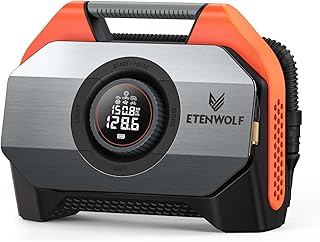
 ETENWOLF VORTEX S6 Tire Inflator Portable Air Compressor19200 Mah11.8 x 5.5 x 9.45 inches6 PoundsCheck on Amazon

What's inside
As an Amazon Associate I earn from qualifying purchases. This post may contain affiliate links at no extra cost to you.
Most people buy an air compressor for home use twice. The first one is a cheap pancake unit grabbed on sale, and it works fine for tires and a brad nailer. Then they try to run a die grinder or blow out a sprinkler system, and the tank empties in twelve seconds while the motor screams. The second purchase is the one they should have made in the first place.
The fix is not buying the biggest compressor you can afford. It is matching tank size and, more importantly, CFM delivered at 90 PSI to the tools you plan to run. This ranking is ordered by what to buy first for a typical home shop or garage, not by price. Each entry states the job it unlocks and who should skip it.
As an Amazon Associate we earn from qualifying purchases at no extra cost to you.




| Type | Typical tank | Best for | Skip if |
|---|
| Type | Typical tank | What it unlocks | Skip it if |
|---|
| Category | Tank range | Jobs it unlocks | Not enough for |
|---|---|---|---|
| Cordless / tire inflator | None | Tires, bike, sports balls, air mattress | Any air tool |
| Pancake or hot dog | 1 to 6 gallons | Brad nailer, finish nailer, staples, blow gun | Framing all day, sanders |
| Twin-stack / wheelbarrow | 4 to 10 gallons | Framing nailer, roofing, light impact wrench | Continuous grinding |
| Portable vertical | 15 to 30 gallons | Impact wrench, ratchet, short paint jobs | Full-time sanding |
| Stationary single-stage | 60 to 80 gallons | DA sander, spray guns, media blasting, plumbing air | Production body work |
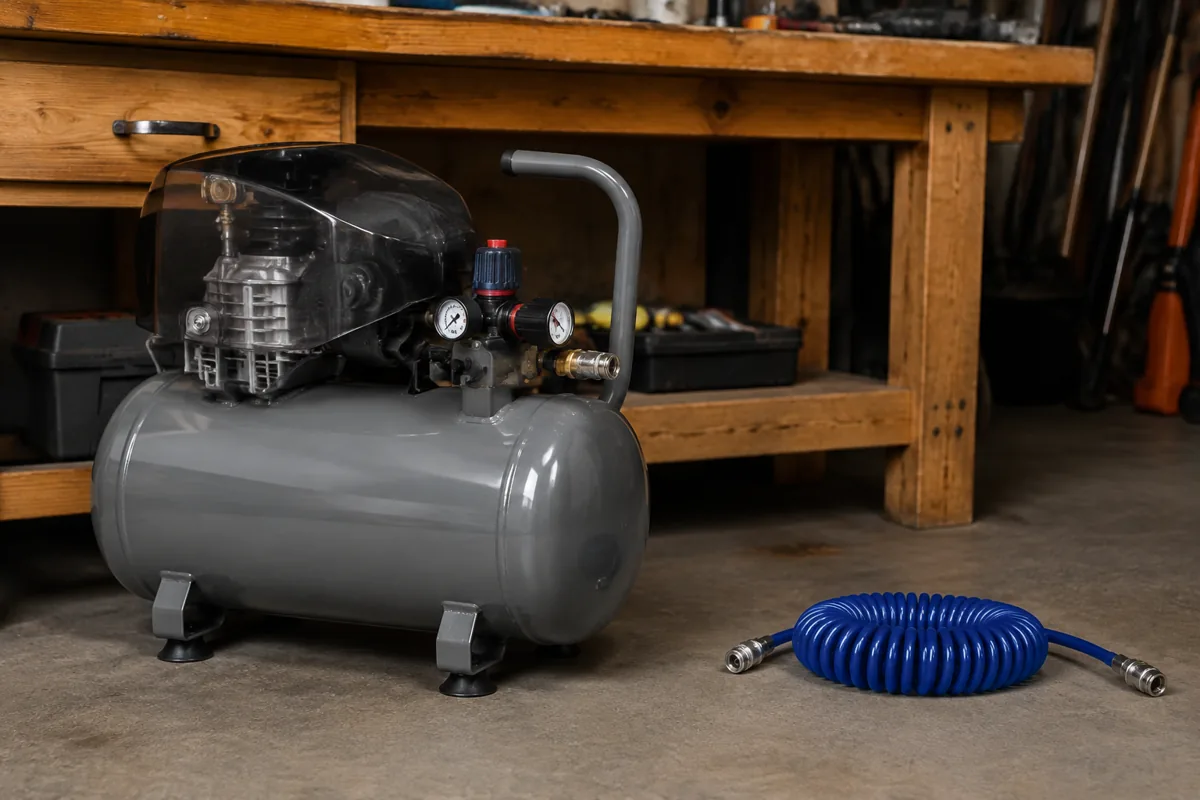
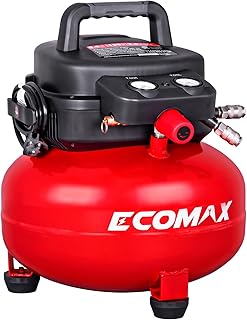
1. Start here: a small pancake air compressor for home use
If you own no compressor at all, this is the first purchase, and for a large share of homeowners it is the only one needed. A 6 gallon pancake or hot dog unit in the 1 to 2 CFM range covers trim nailing, baseboard, crown molding, cabinet installs, upholstery staples, tire top-offs, and blowing sawdust off a bench. That is the bulk of what happens in a home shop.
The job it unlocks is finish carpentry. A brad nailer fires a fastener in a fraction of a second and consumes almost no air, so a small tank keeps up easily even during fast trim work. Buy an oil-free model with a cast aluminum pump, look for a stated 2.0 CFM or better at 90 PSI, and pay attention to noise. Modern low-noise units in the 70 to 80 decibel range are worth the small premium because you will actually use them indoors instead of dreading the racket.
What to look for beyond specs: two regulated outlets so two people can nail at once, a roll cage that protects the gauges, and a drain valve you can reach without flipping the whole unit over. Cheap drain valves buried under the tank are the single biggest reason home compressors rust out from the inside.
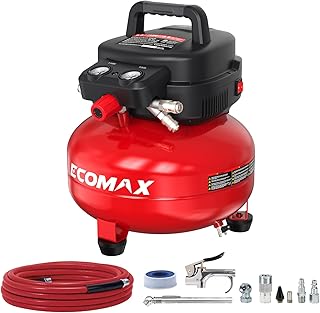
6-Gallon Pancake Compressor (Quiet, Oil-Free)
This is the default first compressor for a homeowner. Filter for oil-free, at least 2.0 CFM at 90 PSI, and a noise rating under 80 dB. Skip the very cheapest listings with no CFM figure published at all, because that omission is almost always hiding a weak pump.
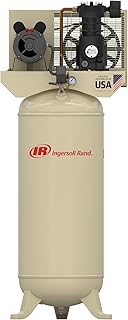
2. Next: a portable vertical tank in the 20 to 30 gallon range
This is the upgrade almost everyone eventually wants, and it is second on the list because it unlocks automotive work. An impact wrench is the gateway tool. A half-inch impact draws roughly 4 to 5 CFM in real use, which is more than double what a pancake delivers. With a 20 to 30 gallon vertical and a pump rated around 5 CFM at 90 PSI, you can break loose lug nuts, run an air ratchet under the dash, and use a cutoff wheel in short bursts.
Vertical tanks matter in a home garage for a reason that has nothing to do with performance: floor space. A 30 gallon vertical occupies about two square feet in a corner. The same capacity in a horizontal wheelbarrow layout eats a walkway. Look for a cast iron pump if the price gap is small, because cast iron pumps run cooler, last longer, and can be rebuilt.
Where people get burned here is duty cycle. Many mid-size consumer compressors are rated for roughly 50 percent duty cycle, meaning the motor is designed to run half the time. Feed a continuous-draw tool into one and the pump overheats, the thermal overload trips, and you stand around waiting. Read the duty cycle before you read the price.
- ✔ Runs impact wrenches, ratchets, and blow guns comfortably
- ✔ Vertical footprint fits a garage corner
- ✔ Cast iron pump options are rebuildable
- ✔ Enough recovery for short spray or sanding sessions
- ✘ Heavy and awkward to move even with wheels
- ✘ Most consumer units are around 50 percent duty cycle
- ✘ Often needs a dedicated 120V circuit or a 240V outlet
- ✘ Still not enough air for continuous DA sanding
20-30 Gallon Vertical Air Compressor
The sweet spot for a two-car garage. Prioritize CFM at 90 PSI over tank gallons, confirm the voltage matches an outlet you already have, and check whether the pump is oil-lubricated cast iron. Expect to add a water separator and a 50-foot rubber hose.
3. Only if you spray or sand: a 60 gallon stationary
Third on the list, and third for a reason. A 60 to 80 gallon stationary two-stage or heavy single-stage compressor is a genuinely different machine. It unlocks the tools that never stop drinking air: dual-action sanders at 8 to 12 CFM, HVLP spray guns, media blast cabinets, and long plumbing or framing sessions where the pump never gets a break.
The catch is infrastructure. These need a 240V circuit, usually 30 amps, run by an electrician if you do not have one. They are 300-plus pounds, they do not move once placed, and they are loud enough that neighbors notice. Buy one only if you have identified a specific tool you cannot run today. If your honest answer is that you might refinish a car someday, buy the 30 gallon and rent a bigger unit for the weekend you actually do it.
Two features separate good stationary units from mediocre ones: a genuine two-stage pump, which compresses air twice for higher pressure and cooler operation, and a properly sized aftercooler or moisture management setup. Water in the lines ruins paint jobs and rusts tanks.
What to skip
Skip oil-free compressors above about 30 gallons. Oil-free is a fine tradeoff on a small portable where you want zero maintenance and light weight. Scaled up, oil-free pumps run hot, wear faster, and are painfully loud. At that size the maintenance of checking oil twice a year is not a burden.
Skip any listing that advertises horsepower but not CFM. Peak or developed horsepower figures on consumer compressors are close to meaningless. CFM delivered at 90 PSI is the only number that predicts whether your tool will work. If a seller hides it, assume the worst.
Skip tiny tanks paired with big claims. A 3 gallon tank cannot run a framing nailer through a whole deck build no matter what the box art shows. The pump has to refill constantly and you will spend the day waiting.
Skip the cheap PVC air line kits. PVC pipe is not rated for compressed air. It becomes brittle and can shatter into fragments. Use black iron, copper, or a purpose-built aluminum air line system if you plumb a shop.
Skip cordless inflators as a compressor substitute. The battery inflators in the DeWalt XR, Milwaukee FUEL, and Makita LXT ecosystems are excellent for tires and sports gear, and worth owning if you already have the batteries. They cannot run a nailer. They are a different tool wearing a similar name.
Accessories that change the experience more than the compressor does
Hose choice matters more than most people expect. Cheap PVC hose stiffens in a cold garage and fights you constantly. Rubber or hybrid polymer hose in 3/8 inch stays flexible and, critically, delivers more air than 1/4 inch over any distance. If you are running an impact wrench off 50 feet of quarter-inch hose, the hose is your bottleneck, not the pump.
Add a water separator and a decent regulator at the outlet. Compressed air is warm and wet, and every tank makes condensation. A five dollar habit of draining the tank after each session doubles the life of the machine. For anything with an oiled motor, an inline lubricator or a few drops in the tool inlet before use prevents the slow death that kills most air tools.
Finally, buy a decent set of couplers and standardize on one type. Mixing industrial, automotive, and ARO fittings across a shop guarantees the moment where the tool you need does not connect to the hose you have.
Air Tool Starter Kit and Hybrid Hose
A 50-foot 3/8 inch hybrid hose plus a water separator and matched quick couplers upgrades a mediocre compressor more than spending extra on the tank did. Standardize on one coupler style across every tool you own.
Frequently asked questions
What size air compressor do I need for a home garage? For trim nailing and tires, 6 gallons is genuinely enough. For automotive work with an impact wrench, target 20 to 30 gallons with roughly 5 CFM at 90 PSI. Only go to 60 gallons if you intend to spray paint or run a DA sander regularly.
Is CFM or tank size more important? CFM. Tank size only buys you time before the pump has to catch up. A large tank with a weak pump lets you work in short bursts and then stall out, while a strong pump with a modest tank keeps going. Match CFM to the highest-demand tool you own, then add about 30 percent headroom.
Do I need 240V power for a home compressor? Not for anything up to roughly 30 gallons, which typically runs on a standard 120V circuit, though it may want that circuit to itself. Stationary units in the 60 gallon class almost always require a dedicated 240V line, and that wiring cost should be part of your budget from the start.
Buy in order. Pancake first, vertical when a specific tool demands it, stationary only when you have a concrete reason. Most home shops never need step three, and the ones that do already know it.
Check prices on Amazon →