Our Top Picks
 CRAFTSMAN 6 Gallon 150 PSI Oil-Free Pancake AirMedium15.8 x 16.4 x 17 inches30.8 poundsCheck on Amazon

What's inside
- 1. The 6-gallon pancake: buy this first if you own a brad nailer
- 2. The twin stack: buy this if a framing nailer is in your future
- 3. The single-stage vertical: the honest ceiling for the best air compressor under 300
- 4. The quiet trim compressor: a specialist, not a first buy
- What to skip
- Setup details that decide whether you like the tool
- FAQ
- Related Guides
- 1. The 6-gallon pancake: buy this first if you own a brad nailer
- 2. The twin stack: buy this if a framing nailer is in your future
- 3. The single-stage vertical: the honest ceiling for the best air compressor under 300
- 4. The quiet trim compressor: a specialist, not a first buy
- What to skip
- Setup details that decide whether you like the tool
- FAQ
- Related Guides
As an Amazon Associate I earn from qualifying purchases. This post may contain affiliate links at no extra cost to you.
Most people shopping for the best air compressor under 300 dollars end up buying on tank size alone, then discover their impact wrench stalls after two lug nuts. Tank gallons are the least important number on the box. What matters is CFM at 90 PSI, because that single figure decides whether a tool runs continuously or in frustrating three-second bursts while you stand there listening to the motor catch up.
This list is ordered by what to buy first, not by price. Each placement is tied to the specific job it unlocks. If you only ever shoot trim nails, the cheapest pancake on this page is the correct answer and spending more is waste. If you want to break rusted bolts loose with an air impact, no pancake compressor on earth will do it and you need to jump straight to the twin-stack or single-stage vertical tier. Read the job column, not the gallon count.
As an Amazon Associate we earn from qualifying purchases at no extra cost to you.



| Compressor type | Typical CFM at 90 PSI | Job it unlocks | Buy it if |
|---|
| Compressor type | Typical CFM @ 90 PSI | Job it unlocks | Realistic budget | |
|---|---|---|---|---|
| 6 gal pancake | 2.0 – | 2.6 | Brad, finish, narrow crown staples | Well under 300 |
| 4.5 gal twin stack | 3.0 – | 4.0 | Framing nailer, roofing, light blowgun | Mid 200s |
| 8-10 gal single stage vertical | 4.0 – | 5.2 | Continuous framing, tire duty, small ratchets | Top of the 300 range |
| 1 gal quiet trim unit | 1.0 – | 2.0 | Indoor trim work, cabinet install | Low, but limited |
| 20 gal plus | 5.0+ | Impact wrenches, DA sanders, spray | Above 300, plan for it |
1. The 6-gallon pancake: buy this first if you own a brad nailer
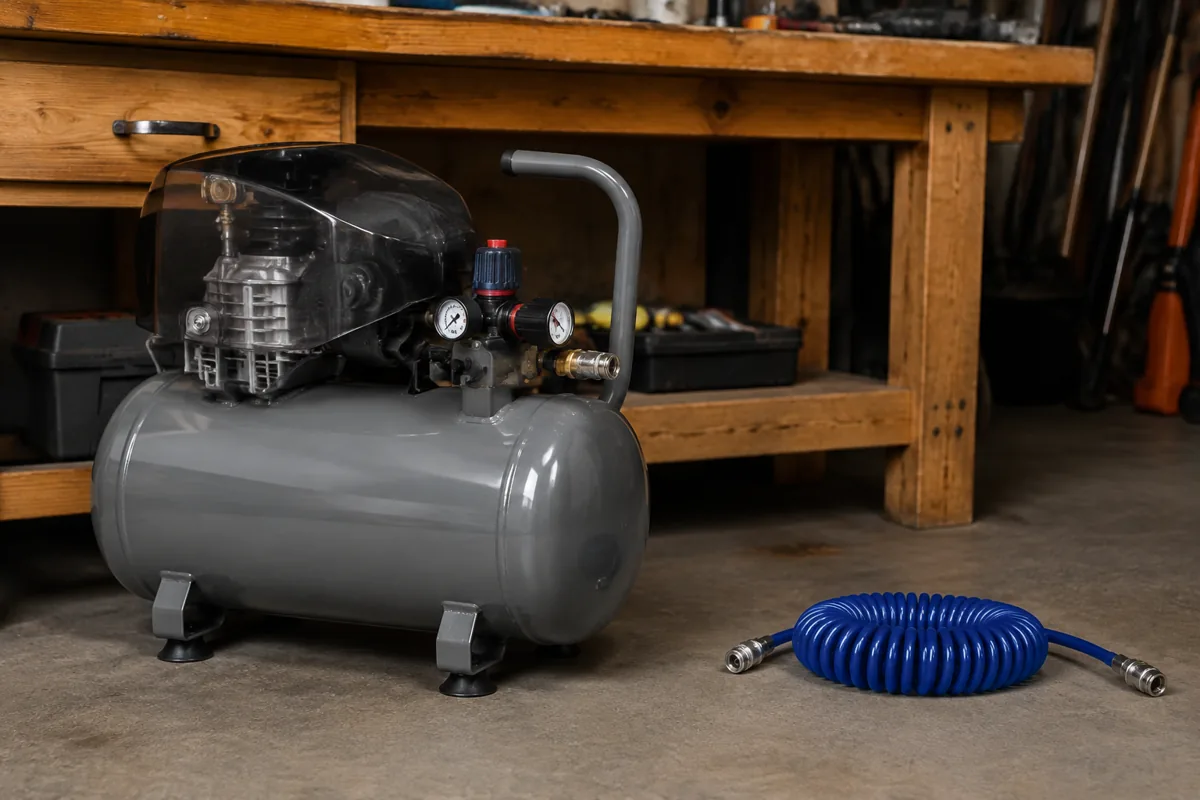
This is first on the list because it solves the most common problem for the most people at the lowest cost. A 6-gallon pancake with roughly 2.6 SCFM at 90 PSI runs a brad nailer, a 16-gauge finish nailer, a narrow crown stapler, and a pin nailer without ever making you wait. Baseboard, door casing, shoe molding, crown, cabinet face frames, picture frame assembly. That is the entire job list for maybe eighty percent of home shop owners, and it is fully covered here.
The reason it earns the top slot rather than a bigger machine is duty cycle math. Trim nailers use a tiny puff of air per shot. Even a modest pancake refills faster than you can move the ladder. Buying a 20-gallon vertical to shoot baseboard is like buying a dump truck to haul groceries. You will also carry a pancake up stairs with one hand, which matters more than you think on day two of a trim job.
What to look for: an oil-free pump so you never check oil, a regulator with two quick-connect couplers, and a rubber-footed base. Oil-free pumps are louder and wear out sooner than oil-lubricated ones, but in this price tier the tradeoff is correct because the machine will spend most of its life sitting still.
6-Gallon Pancake Air Compressor
The default correct answer for finish carpentry and general household air. Filter your search for 150 PSI max tank pressure and at least 2.6 SCFM at 90 PSI, then pick whichever known brand is cheapest that week. Do not pay extra for gallons you will not use. Skip this tier entirely if an air impact wrench is on your list.
2. The twin stack: buy this if a framing nailer is in your future
A framing nailer changes the requirement completely. It fires a 3-inch nail and consumes several times the air volume of a brad nailer, and framing work means firing continuously rather than one nail every thirty seconds. A pancake will keep up for a wall or two, then fall behind and leave you sinking nails halfway.
Twin-stack units in the 4 to 4.5 gallon range typically deliver 3 to 4 CFM at 90 PSI, which is the practical floor for continuous framing. They stay reasonably portable, the narrow footprint fits between studs and behind a truck seat, and the taller pressure headroom means fewer stalls. Deck framing, shed builds, subfloor, sheathing, fence work.
Honest limitation: a twin stack still will not run an air-hungry tool like a dual-action sander or an air impact wrench. Those need volume no small tank can sustain. What a twin stack does well is intermittent high-demand work, and framing is exactly that.
- ✔ Real CFM for framing and roofing nailers
- ✔ Narrow footprint fits truck beds and tight rooms
- ✔ Faster recovery than a pancake under load
- ✔ Still one-hand portable for most adults
- ✘ Louder than trim-focused quiet units
- ✘ Overkill and wasted money for brad nailing only
- ✘ Cannot sustain sanders, grinders, or impact wrenches
- ✘ Small tanks cycle the motor often, which shortens pump life
3. The single-stage vertical: the honest ceiling for the best air compressor under 300
Around 8 to 10 gallons in a vertical or wheeled hot dog configuration is where the budget starts to run out, and it is also where the machine becomes genuinely useful for automotive work. Expect somewhere in the 4 to 5.2 CFM range at 90 PSI. That unlocks tire inflation without waiting, blowgun cleanup, air ratchets, small die grinders in short bursts, and framing without any hesitation at all.
Vertical tanks take up less floor space than horizontal ones, which is the real argument for them in a one-car garage. The tradeoff is portability. Once you are in this tier you are rolling the compressor, not carrying it, and some of these units are awkward on stairs or a truck gate. If the compressor will live in one corner of the garage with a hose reel on the wall, that is a non-issue and this is the smartest buy on the page.
Consider oil-lubricated pumps in this tier if you find one in budget. They run quieter, last considerably longer, and tolerate longer run times. The cost is checking a sight glass and occasionally changing oil, plus keeping the unit level. For a stationary garage compressor that is an easy trade.
8-10 Gallon Vertical Air Compressor
The pick if you want one compressor that covers carpentry and light automotive without a second purchase later. Compare on CFM at 90 PSI first, then noise rating in decibels, then tank size last. Verify the plug requirement is standard 120V household before ordering.
4. The quiet trim compressor: a specialist, not a first buy
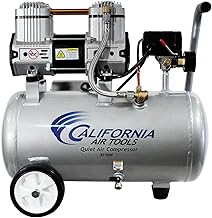
Low-decibel compressors in the 1 to 2 gallon range use slower induction motors and typically run around 60 to 70 dB instead of the 80-plus of a standard oil-free pancake. That difference is enormous when you are working inside an occupied house, in a finished basement, in an apartment, or anywhere a sleeping child or an annoyed client is involved.
It ranks fourth because the air output is genuinely small. Pin nailer, brad nailer, small finish nailer, and that is close to the whole list. It is a second compressor for a working trim carpenter, or a first compressor for someone whose entire hobby is cabinet and furniture work. Anyone hoping this will also air up truck tires quickly will be disappointed.
What to skip
Skip anything advertised only in “peak HP” or “max PSI” with no CFM at 90 PSI listed. Peak horsepower is a marketing figure derived from a stalled motor. If the manufacturer hides delivered air volume, assume it is bad.
Skip cordless battery-powered compressors as your only shop compressor. The convenience is real for tire top-offs at the curb, and battery platforms like DeWalt XR, Milwaukee FUEL, and Makita LXT all offer inflators worth owning for that. But they do not deliver sustained CFM for nailers, and pairing one with batteries costs more than a corded pancake that outperforms it.
Skip 20-gallon-plus units in this budget. A big tank paired with a weak pump is the classic budget trap. You get slow initial fill, a motor that runs forever, and no more usable CFM than a good 8-gallon. Volume comes from the pump, not the tank. If you truly need impact wrench or sander performance, save past 300 rather than buying a large tank with a small pump.
Skip the bundled hose and accessory kits when the compressor alone is meaningfully cheaper. Included recoil hoses are usually short and stiff. A 50-foot rubber or hybrid hose bought separately is a real upgrade and will outlast the compressor.
Setup details that decide whether you like the tool
Drain the tank after every use. Compressed air condenses water, water rusts steel from the inside, and a rusted tank is the most common way these machines die. The petcock is under the tank and takes ten seconds.
Replace the factory couplers with a matched set in one style, either industrial or automotive, across every tool and hose you own. Mixed coupler styles are the single most annoying problem in a home shop and cost only a few dollars to eliminate.
Set the regulator to the tool’s spec, not to maximum. Most trim nailers want roughly 70 to 90 PSI and framing nailers a bit more. Running everything at tank pressure sinks nails too deep and beats up the tool. And use a 3/8-inch hose rather than 1/4-inch for anything beyond trim nailing, because a narrow hose throttles CFM before it reaches the tool.
FAQ
Can I run an air impact wrench on a compressor under 300 dollars? Realistically, no, not continuously. Most 1/2-inch air impacts want 4 to 5 CFM sustained, and short-burst use on an 8 to 10 gallon unit will work for a lug nut or two before the tank drops and you wait. If breaking bolts is the main job, a cordless high-torque impact wrench is the better spend at this budget.
Is oil-free or oil-lubricated better? Oil-free is lighter, needs no maintenance, and is right for a compressor that gets carried and used occasionally. Oil-lubricated runs quieter, tolerates longer run times, and lasts significantly longer, which makes it the better choice for a stationary garage unit. Neither is universally better.
How many gallons do I actually need? For trim nailing, 1 to 6 gallons. For framing, 4 gallons with adequate CFM beats 10 gallons with weak CFM. For tires and light automotive, 8 gallons and up. Always compare CFM at 90 PSI first and treat tank size as a tiebreaker.
Buy for the job you will actually do this year. A pancake for trim, a twin stack if framing is coming, an 8 to 10 gallon vertical if the compressor lives in the garage and touches cars. Anything past that means saving beyond this budget rather than compromising on pump quality.
Check prices on Amazon →