What's inside
- Quick Comparison: Best Cordless Weed Eaters
- 1. EGO POWER+ ST1623T — Best Battery Powered Weed Eater for Most Homeowners
- 2. Husqvarna 525iLST — Best for Large Yards and Professional Maintenance
- 3. DEWALT DCST972 — Best for Attachment Versatility
- 4. Milwaukee M18 FUEL Dual-Battery String Trimmer 3006 — Best for Heavy-Duty Cutting
- 5. Greenworks Commercial ST161 — Best for High-Output Professional Work
- 6. ECHO DSRM-2600 — Best Professional Trimmer for Balance and Handling
- How We Chose the Best Battery Powered Weed Eaters
- How to Choose the Right Cordless Weed Eater
- Frequently Asked Questions
- Final Verdict
As an Amazon Associate I earn from qualifying purchases. This post may contain affiliate links at no extra cost to you.
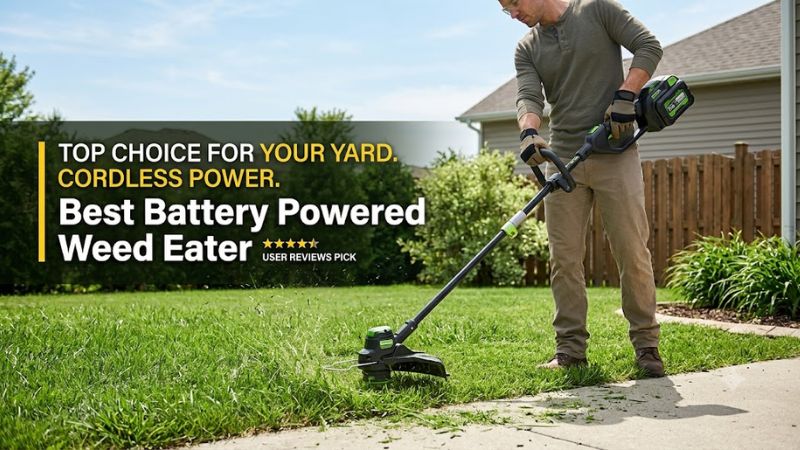
The best battery powered weed eater for most homeowners is a cordless string trimmer that balances cutting power, manageable weight, battery runtime, and convenient line feeding. The right choice depends on your yard size, the thickness of your weeds, and whether you already own compatible batteries.
The EGO POWER+ ST1623T is a strong all-around option for residential use because it combines a 16-inch cutting swath, a brushless motor, automatic line feeding, and simplified spool reloading. For larger properties and frequent maintenance, the Husqvarna 525iLST offers an 18.1-inch cutting width and three speed settings. The DEWALT DCST972 is another option for users who want an attachment-capable trimmer.
This guide focuses on cordless, battery-powered string trimmers intended for the US market. It distinguishes manufacturer specifications from independent performance results and explains when batteries and chargers must be purchased separately.
Quick Comparison: Best Cordless Weed Eaters
| Product | Best For | Key Specifications | Battery Compatibility | Main Limitation |
| EGO POWER+ ST1623T | Best overall for homeowners | 56V platform, 16-inch swath, brushless motor, LINE IQ and POWERLOAD | EGO 56V ARC Lithium | Premium purchase compared with basic homeowner models |
| Husqvarna 525iLST | Large yards and professional maintenance | 18.1-inch swath, brushless motor, three speed settings | Husqvarna BLi-X battery system | Battery and charger sold separately on tool-only configuration |
| DEWALT DCST972 | Attachment versatility | 60V MAX, adjustable 15- or 17-inch swath, brushless motor | Compatible DEWALT FLEXVOLT batteries | Battery and charger sold separately on tool-only configuration |
| Milwaukee M18 FUEL 3006 | Heavy-duty cutting | Dual-battery design, 17-inch swath, supports up to 0.105-inch line | Two compatible M18 batteries | Heavy and expensive |
| Greenworks Commercial ST161 | High-output professional work | 82V platform, 17-inch swath, brushless motor | Greenworks Commercial 82V system | Premium equipment with substantial operating weight |
| ECHO DSRM-2600 | Professional trimming and handling | 56V platform, 17-inch swath, three speed settings | ECHO 56V eFORCE battery system | Premium pricing and limited suitability for the heaviest brush |
Specifications and package contents depend on the exact model and regional configuration. Prices are omitted because consistent, current US retail prices for all six models could not be verified.
1. EGO POWER+ ST1623T — Best Battery Powered Weed Eater for Most Homeowners
Best for: Regular lawn maintenance, edging, and trimming around landscaping.
The EGO POWER+ ST1623T is a strong all-around choice for homeowners who want a wide cutting path and less manual work when loading trimmer line. Its 16-inch cutting swath is suitable for routine yard maintenance, while LINE IQ automatically feeds line during trimming and POWERLOAD simplifies reloading the spool.
Key Specifications
- Battery platform: EGO 56V ARC Lithium.
- Cutting swath: 16 inches.
- Motor: Brushless.
- Line management: LINE IQ automatic feeding and POWERLOAD reloading.
- Kit configuration: The ST1623T catalog configuration includes a 4.0Ah battery and 320W charger.
- Alternative configuration: The ST1620T is a separate model configuration without a battery and charger.
Why It Stands Out
Automatic line feeding reduces the need to bump the head against the ground to advance line. POWERLOAD addresses another common maintenance task by simplifying the process of winding fresh line onto the spool.
The brushless motor is also suitable for a frequently used cordless yard tool. If you already own compatible EGO outdoor equipment, sharing the battery platform may reduce the cost of adding another tool.
Main Limitation
This model may not provide the best value if you only trim a small strip of grass or already own batteries from another brand. Its 16-inch cutting swath is practical for routine maintenance but does not establish that it will outperform larger professional trimmers in dense vegetation.
Buy if: You want a homeowner-friendly trimmer with convenient line management and plan to use other compatible EGO tools.
Skip if: You need a low-cost trimmer for occasional touch-ups or would have to buy an entirely new battery system.
2. Husqvarna 525iLST — Best for Large Yards and Professional Maintenance
Best for: Frequent trimming, larger properties, and landscaping crews.
The Husqvarna 525iLST is a professional-grade cordless trimmer with an 18.1-inch cutting width, a brushless E-TORQ motor, and three selectable speed settings. It suits users who regularly maintain large areas and want to adjust output to match the vegetation.
Key Specifications
- Battery platform: Husqvarna BLi-X.
- Listed battery voltage: 40V.
- Cutting width: 18.1 inches.
- Motor: Brushless E-TORQ.
- Maximum output-shaft speed: 7,200 rpm.
- Weight: 8.82 lb without battery, according to Husqvarna.
- Included equipment: T35X M10 trimmer head.
- Battery and charger: Sold separately in the tool-only configuration.
- Manufacturer-listed tool-only price: $399.99 on the referenced US product listing; current pricing may differ.
Why It Stands Out
The wide cutting swath helps cover open areas, and the three speed settings let the operator reduce output for lighter trimming instead of always running at maximum speed.
In an independent comparison, Pro Tool Reviews recorded 40.3 minutes of runtime with a 9.0Ah battery, the longest result among the eight models in that particular test group. This is a test-specific measurement rather than a guaranteed runtime for ordinary yard work.
Husqvarna offers compatible batteries in its battery system, but the final operating weight and runtime depend on the battery selected. Compatibility should be confirmed against the exact tool and battery model.
Main Limitation
The tool-only configuration excludes the battery and charger, increasing the initial cost for buyers who are new to the platform. Its professional capabilities may also be unnecessary for a small suburban lawn.
Buy if: You trim frequently, maintain a large property, or need a professional tool with adjustable speed and a wide cutting path.
Skip if: Your yard needs only occasional edging or you want a complete kit at the lowest initial cost.
3. DEWALT DCST972 — Best for Attachment Versatility
Best for: DEWALT users who want a compatible attachment system for additional yard tasks.
The DEWALT DCST972 is a 60V MAX attachment-capable string trimmer with an adjustable cutting swath. Its ability to accept compatible outdoor-tool attachments makes it more versatile than a dedicated string trimmer.
Key Specifications
- Battery platform: DEWALT FLEXVOLT 60V MAX.
- Cutting swath: Adjustable between 15 and 17 inches.
- Motor: Brushless.
- Line: 0.080-inch dual line supplied; 0.095-inch line is also supported.
- Line management: Quick-load spool.
- Controls: Variable-speed trigger and high/low speed selection.
- Battery and charger: Sold separately with the DCST972B tool-only version; the DCST972X1 kit includes a battery and charger.
Why It Stands Out
The attachment interface can expand the tool’s usefulness if you need compatible accessories for other yard-maintenance jobs. The adjustable cutting swath also lets you choose between a narrower path for controlled work and a wider path for covering grass more quickly.
DEWALT’s FLEXVOLT battery family supports designated 60V MAX and 20V MAX tools. However, compatibility remains specific to the tool and battery system, so do not assume every DEWALT battery works with every model.
Main Limitation
A smaller battery may be inadequate for long sessions at high speed. In Pro Tool Reviews’ comparison, the DCST972 configuration with a 3.0Ah FLEXVOLT battery ran for 9.3 minutes under its cutting-speed test workload. This should not be interpreted as normal runtime for every yard or operating mode.
Buy if: You already use compatible DEWALT equipment and will benefit from the attachment system.
Skip if: You only need light trimming, do not need attachments, or would have to purchase a battery and charger solely for this tool.
4. Milwaukee M18 FUEL Dual-Battery String Trimmer 3006 — Best for Heavy-Duty Cutting
Best for: Demanding yard work and users invested in Milwaukee M18 tools.
The Milwaukee M18 FUEL Dual-Battery String Trimmer 3006 is designed for higher-output trimming and uses two batteries together. It is a serious option for dense grass and demanding maintenance, but its power and battery capacity come with additional weight and cost.
Key Specifications
- Battery platform: Milwaukee M18.
- Battery arrangement: Two compatible M18 batteries.
- Cutting swath: 17 inches.
- Maximum supported line diameter: 0.105 inch.
- Maximum advertised speed: 6,200 rpm in the high-speed setting.
- Independent review weight: 16.8 lb with two 8.0Ah High Output batteries.
- Reviewed kit configuration: Two 8.0Ah High Output batteries and a charger; confirm the exact current SKU before purchase.
Why It Stands Out
The dual-battery arrangement provides a substantial energy reserve for demanding cutting tasks. In Pro Tool Reviews’ comparison, the model delivered the highest measured top speed in its test group and ran for 33.5 minutes with two 8.0Ah High Output batteries under that publication’s test conditions.
The same review noted frequent line breakage against tough test material, although the issue was not observed with ordinary grass and moderate overgrowth. This highlights the importance of matching the line to the vegetation and following the manufacturer’s specifications.
Main Limitation
The operating weight is substantial, particularly for users trimming for extended periods. The dual-battery requirement also increases the cost of entering the platform if you do not already own compatible batteries.
Buy if: You need strong cutting performance, regularly handle demanding vegetation, and already own suitable Milwaukee M18 batteries.
Skip if: You prioritize low weight, have a small yard, or do not need a high-output trimmer.
5. Greenworks Commercial ST161 — Best for High-Output Professional Work
Best for: Landscaping professionals and frequent heavy-duty maintenance.
The Greenworks Commercial ST161 is an 82V professional trimmer built around high-output cutting performance. Its 17-inch cutting swath, three speed settings, and reverse-rotation mode make it worth considering for crews working across large properties.
Key Specifications
- Battery platform: Greenworks Commercial 82V.
- Cutting swath: 17 inches.
- Motor: Brushless.
- Speed settings: Three, with a published range of 4,500–5,500 rpm in the independent comparison.
- Maximum line diameter: 0.095 inch.
- Weight: 16.2 lb with a 4.0Ah battery in Pro Tool Reviews’ comparison.
- Kit price reported in that review: $649.99 with a 4.0Ah battery; current pricing and package contents should be confirmed.
Why It Stands Out
Pro Tool Reviews recorded a 7.0-second cutting result and 29.4 minutes of runtime for the ST161 with a 4.0Ah battery in its comparison. The publication ranked its cutting speed first among the eight professional models in that test.
These results offer useful comparative evidence, but they do not predict exactly how long the trimmer will run or how quickly it will cut every type of vegetation.
The reverse-rotation mode is another practical feature when managing cut material around the head. However, the ST161’s 0.095-inch line limit is important: a powerful motor does not mean you can install thicker line than the manufacturer specifies.
Main Limitation
At more than 16 lb with the reviewed battery, this is a heavy handheld tool. Its professional battery system and purchase cost may be difficult to justify for occasional residential use.
Buy if: You maintain large properties regularly and prioritize cutting throughput over minimum tool weight.
Skip if: You have a small lawn, are sensitive to tool weight, or want a compact trimmer for occasional edging.
6. ECHO DSRM-2600 — Best Professional Trimmer for Balance and Handling
Best for: Professional crews seeking a balance between weight and cutting capability.
The ECHO DSRM-2600 is a 56V professional string trimmer with a 17-inch cutting swath and three speed settings. It is an alternative to heavier, high-output models for landscaping work where handling and vibration control matter alongside cutting capability.
Key Specifications
- Battery platform: ECHO 56V eFORCE.
- Cutting swath: 17 inches.
- Maximum line diameter: 0.095 inch.
- Speed range: 3,000–5,680 rpm in the independent comparison.
- Weight: 12.0 lb with a 5.0Ah battery in Pro Tool Reviews’ comparison.
- Kit price reported in that review: $619.99 with a 5.0Ah battery; check the current model package and seller listing.
Why It Stands Out
The DSRM-2600 provides a relatively manageable operating weight for a professional-grade model. Pro Tool Reviews scored it 88 points in its head-to-head comparison, placing it second overall in that test group. The publication also highlighted its balance and vibration control.
The 17-inch swath helps cover open areas, while three speed settings provide flexibility for different vegetation and workloads. ECHO’s 56V battery system is most attractive if you already own compatible equipment or intend to build a collection of tools on the same platform.
Main Limitation
Its 0.095-inch line rating may be less suitable for some demanding cutting jobs than a trimmer explicitly approved for thicker line. The kit is also a premium purchase, so it may not offer the best value for homeowners who only need to tidy lawn edges.
Buy if: You need a professional cordless trimmer with a useful cutting width and want to avoid the weight of some high-output alternatives.
Skip if: You regularly clear heavy brush or need the cheapest complete trimmer kit for a small yard.
How We Chose the Best Battery Powered Weed Eaters
This shortlist combines manufacturer specifications with an independent head-to-head comparison published by Pro Tool Reviews on March 18, 2026, and other product information available during research. The aim is to identify suitable options for different users, not to imply that LOA Power Tools personally operated every model.
The main selection criteria were:
- Cutting capability: Cutting swath, supported line diameter, speed settings, and independent cutting comparisons.
- Battery ecosystem: Exact voltage platform, compatible batteries, kit availability, and the cost implications of buying batteries separately.
- Handling: Published weight with and without a battery where available, speed controls, and features that may reduce operator effort.
- Line management: Manual loading, quick-load heads, automatic feeding, and features that affect routine maintenance.
- Intended workload: Whether a model is better suited to occasional lawn care, large residential properties, or frequent professional work.
- Ownership value: Whether the tool’s capabilities justify the cost, especially when a new battery platform is required.
The performance figures in the reviews are results from the cited publication’s comparison, not measurements made by LOA Power Tools. Battery size, line type, vegetation, speed setting, and operating technique can all affect runtime and cutting performance.
How to Choose the Right Cordless Weed Eater
1. Match the Trimmer to Your Yard
A small lawn with a few fence lines rarely needs a heavy professional trimmer. A lightweight homeowner model is easier to maneuver around flower beds, trees, and walkways.
For larger lawns, a cutting swath of approximately 15–17 inches is a practical starting point. A wider swath can cover more ground per pass, but it can also make the tool harder to maneuver in narrow spaces. For large properties maintained frequently, a professional model with multiple speed settings and a larger compatible battery may justify the additional cost.
If you regularly encounter woody brush or thick, established vegetation, do not assume a string trimmer can replace a brush cutter. Check the tool’s manual and use only approved cutting attachments and guards.
2. Understand Voltage, Amp-Hours, and Watt-Hours
Battery specifications help explain a trimmer’s power system and potential energy reserve, but they do not predict runtime on their own.
| Specification | What It Tells You | What It Does Not Tell You |
| Voltage (V) | The battery system’s nominal electrical voltage or marketed platform designation | Exact cutting power or runtime |
| Amp-hours (Ah) | The battery’s charge capacity | Energy capacity without considering voltage |
| Watt-hours (Wh) | Nominal stored energy, approximately volts multiplied by amp-hours when compatible nominal ratings are used | Guaranteed runtime under load |
| Cutting swath | The width of the cutting path | How well the trimmer handles thick weeds |
| Line diameter | The line size the tool is designed to support | Permission to use any heavier line or cutting attachment |
Battery voltage labels can use different conventions. For example, DEWALT’s 60V MAX label refers to maximum initial voltage without a workload; its nominal voltage is 54V. Compare battery systems using manufacturer specifications rather than treating all advertised voltage numbers as directly equivalent.
3. Decide Whether to Buy a Kit or a Bare Tool
A bare tool is generally the better financial choice if you already own the exact compatible battery and charger required. If you are starting from scratch, compare the full kit price instead of judging value by the tool-only price.
Before ordering, verify:
- The exact model number and regional configuration.
- The battery platform and compatible battery models.
- Whether the battery and charger are included.
- Battery capacity and whether the kit includes one or multiple batteries.
- The charger required for the selected battery.
- Whether a replacement spool or additional trimmer line is included.
A battery that physically fits is not, by itself, proof of electrical compatibility. Never force a battery into a tool or use an unapproved adapter.
4. Choose a Line-Feeding System You Can Live With
String trimmers use different methods to advance or reload cutting line.
- Bump feed: The operator taps the head against the ground as directed by the manufacturer to advance line.
- Quick-load head: A designed loading mechanism helps simplify winding replacement line.
- Automatic feed: The tool advances line according to its control system, reducing the need for manual bumping.
- POWERLOAD: EGO’s system simplifies winding new line onto the spool, while LINE IQ on the ST1623T manages automatic line feeding during use.
These systems solve different problems. Automatic feeding does not necessarily mean automatic spool reloading, so check the features of the exact model rather than relying on a general label such as “auto-feed.”
5. Consider Weight with the Battery Installed
A tool’s bare weight can understate how heavy it feels during use. Battery size changes operating weight and may also affect balance.
For trimming around a small garden, a lighter tool can be easier to guide accurately. For extended professional work, balance, vibration control, handle position, and an approved shoulder strap may matter more than minimizing bare-tool weight alone.
When comparing models, use operating weights measured with similar battery configurations whenever possible. A bare-tool figure for one product should not be compared directly with a fully equipped weight for another.
6. Account for Noise, Maintenance, and Safety
Battery-powered trimmers avoid gasoline exhaust at the point of use and do not require the same engine maintenance as gas models. They still produce noise, throw debris, and have moving cutting heads that can cause serious injury.
Wear eye protection, suitable hearing protection, sturdy footwear, and other protective equipment specified by the manufacturer. Keep people and pets away from the work area, inspect the cutting head before use, and remove the battery before cleaning, clearing tangled line, or servicing the tool.
Do not install metal blades or brush-cutting attachments unless the exact trimmer is designed for them and the correct guard and hardware are installed. Never use a trimmer with a damaged guard or bypass a safety mechanism.
Frequently Asked Questions
1. What Is the Best Battery Powered Weed Eater for Most Homeowners?
The EGO POWER+ ST1623T is a strong choice for most homeowners who value convenient line management, a 16-inch cutting swath, and a brushless motor. Buyers with an existing compatible battery system may find another model more economical.
2. Are Battery-Powered Weed Eaters Powerful Enough for Thick Weeds?
Yes, many cordless string trimmers can handle thick grass and substantial weeds, but performance depends on the motor, supported line diameter, battery, and vegetation. For woody brush and heavy overgrowth, choose a model specifically rated for the job or consider a suitable brush cutter.
3. How Long Does a Battery-Powered Weed Eater Run on One Charge?
Runtime varies with battery energy capacity, cutting speed, line type, vegetation, and operating technique. In one independent comparison, Pro Tool Reviews recorded 40.3 minutes for the Husqvarna 525iLST with a 9.0Ah battery and 33.5 minutes for the Milwaukee 3006 with two 8.0Ah batteries. Neither figure is a guaranteed runtime for ordinary yard work.
4. Is a 20V, 40V, 56V, or 60V Weed Eater Better?
No voltage category is automatically best because voltage alone does not establish cutting performance or runtime. Compare the specific model’s cutting width, supported line, battery energy, weight, features, and independent performance evidence. Also check compatibility with the battery platform you already own.
Final Verdict
The EGO POWER+ ST1623T is the best starting point for homeowners who want a convenient cordless trimmer with automatic line feeding and straightforward spool reloading. The Husqvarna 525iLST is better suited to frequent trimming across larger properties, while the DEWALT DCST972 is worth considering if compatible attachments are important to your yard-care setup.
For demanding work, the Milwaukee M18 FUEL 3006 and Greenworks Commercial ST161 offer high-output alternatives, while the ECHO DSRM-2600 emphasizes a balance of professional cutting capability and handling.
Before buying, compare the complete kit cost, confirm battery and charger compatibility, and choose a trimmer that matches your actual vegetation and workload. A suitable battery platform and manageable operating weight will matter more over time than the highest voltage printed on the box.