What's inside
As an Amazon Associate I earn from qualifying purchases. This post may contain affiliate links at no extra cost to you.
If you trim only lawn edges and light grass, choose a Black+Decker 20V string trimmer; for a larger yard, thicker weeds, or more time between battery swaps, choose a 40V model. Neither voltage alone guarantees a particular runtime or cutting ability: battery capacity, model design, grass condition, and trimming technique matter just as much.
As an Amazon Associate we earn from qualifying purchases at no extra cost to you.

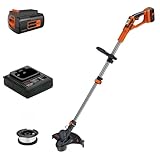

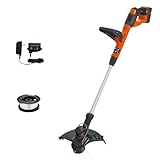
20V vs. 40V: the practical difference
Black+Decker sells cordless trimmers in both battery families, but models and included accessories vary by retailer and over time. The figures below describe the battery platforms and typical use—not a promise that every trimmer in a series has the same equipment or performance. Check the specific model’s manual for its cutting width, weight, feed system, and compatible battery.
| Comparison | Black+Decker 20V | Black+Decker 40V |
|---|---|---|
| Nominal battery voltage | 20 volts | 40 volts |
| Common battery capacities | About 1.5–4.0 Ah, depending on the battery | About 2.0–4.0 Ah, depending on the battery |
| Typical best fit | Small yards, tidy edges, light grass | Larger yards, longer sessions, heavier growth |
| Runtime expectation | Often roughly 15–30 minutes of intermittent trimming | Often roughly 25–45 minutes of intermittent trimming |
| Line feed | Model-dependent; automatic feed is common | Model-dependent; automatic feed is common |
| Edging | Suitable on models with a rotating head or edging guide | Suitable on models with a rotating head or edging guide |
Runtime ranges are planning estimates, not manufacturer guarantees. They assume ordinary intermittent trimming rather than holding the trigger continuously in dense, wet growth. A larger amp-hour battery generally stores more energy and can extend working time, but adds cost and may add weight. A 40V battery is not interchangeable with a 20V tool battery just because both are from Black+Decker.
Which voltage fits your yard?
| Your situation | Better starting point | Why |
|---|---|---|
| Small, regularly maintained lawn; short edging sessions | 20V | Usually enough for light grass and easier to justify if you do not need long run time. |
| Already own compatible 20V batteries and trim occasionally | 20V | Using batteries you already have can lower the cost of adding a tool. |
| Long lawn perimeter or several areas to trim in one session | 40V | A higher-capacity 40V setup may reduce interruptions for charging or battery changes. |
| Grass often gets tall, or the yard has persistent weeds | 40V, with realistic expectations | It is the more sensible platform to consider, but a cordless string trimmer is not a brush cutter. |
| Low budget, limited storage, mostly fine edging | 20V | It is typically the more economical, compact choice; compare the complete kit, not just the bare tool. |
Choose 20V for light, frequent upkeep
A 20V trimmer is a reasonable choice when the grass is kept short and the job consists of lawn borders, fence lines, and small patches the mower cannot reach. Its main limitation is not that it cannot cut grass at all; it is that thick or overgrown vegetation can drain the battery quickly and make progress slow. For a small yard, trimming a little every week is often more manageable than trying to clear several weeks of growth in one session.
Choose 40V when the job is longer or tougher
Consider a 40V model if you routinely trim a large perimeter, want fewer battery interruptions, or face denser grass. It can be a better fit for regular maintenance across a bigger space, but it does not make every heavy-duty job suitable. Woody stems, saplings, and brambles may call for a brush cutter or another tool designed for that work. Do not force a string trimmer through material it cannot cut cleanly.
Runtime: estimate your session before buying
A useful way to compare battery options is to calculate the time you actually need, then leave a reserve. For example, if your trimming route takes 20 minutes and you want roughly 25% spare capacity, plan for a setup that can deliver at least 25 minutes in your conditions:
Required runtime = planned trimming time ÷ 0.8
For a 20-minute job, 20 ÷ 0.8 = 25 minutes. That margin helps account for thick patches, repeated starts, and line advancing. If a listing or manual does not give a comparable runtime test, treat advertised run time as a best-case reference rather than a guarantee. Wet grass, a wide cutting path, worn line, and continuous trigger use can all shorten a charge.
Battery amp-hours are useful for comparing capacity within a compatible platform, but they do not tell you exactly how many square feet a trimmer will cover. Cutting conditions and technique vary too much. If the job regularly exceeds one battery’s practical runtime, a spare compatible battery may be more useful than expecting one charge to handle everything.
Line feed and edging: check the exact model
Black+Decker trimmers commonly use automatic line feed: the tool advances line as needed during operation, rather than requiring the user to tap the spool head on the ground. That is convenient, but it uses more line if the head contacts paving, fencing, or other hard surfaces. Some models or product generations may differ, so confirm the feed system in the model specifications and manual before ordering.
Edging is also a model feature, not a guaranteed benefit of choosing 20V or 40V. Look for a rotating head, an edging mode, or a guide wheel if you want to turn the trimmer for a neater lawn border. A trimmer without an edging feature can still cut along a border when held carefully, but it may be harder to maintain a consistent vertical line. Neither voltage class is restricted to “light grass only” by definition; cutting capacity depends on the individual tool, its line, and the material.
Ownership details that affect performance
- Use the specified line size: Line that is too thick can overload a spool or motor; line that is too thin may break more often. Follow the manual’s diameter and loading instructions.
- Keep line off hard surfaces where possible: Repeated contact with concrete and metal wears line quickly and can trigger frequent feeding.
- Clear grass from the head: After use, remove packed clippings around the spool and guard with the battery removed. Buildup can interfere with line movement and airflow.
- Store batteries sensibly: Keep them dry and away from extreme heat or cold, and follow the battery manual for charging and long-term storage.
- Expect consumable wear: Cutting line is a routine replacement item. Spool covers and other plastic parts can also wear or break, especially if the head is repeatedly struck against hard edges.
Common mistakes include buying a bare tool without checking battery compatibility, assuming a battery’s voltage determines its runtime, and letting the lawn become so overgrown that a light-duty trimmer has to work continuously. A larger battery may improve working time, but it can also make the tool heavier. If comfort matters, compare the complete tool-and-battery weight rather than the bare-tool figure.
Bottom line
Pick a Black+Decker 20V battery weed eater for a small, maintained lawn, occasional trimming, and light grass—especially if you already own compatible 20V batteries. Step up to 40V when your sessions are longer, the area is larger, or growth is consistently denser. Before buying either, verify the exact model’s runtime information, battery included, line-feed system, edging features, and tool weight. Those details determine whether it suits your job more reliably than the voltage label alone.