What's inside
As an Amazon Associate I earn from qualifying purchases. This post may contain affiliate links at no extra cost to you.
A mobile repair van needs a charger that is compact, predictable, and easy to use between jobs. The fastest charger on a workshop wall is not automatically the best choice in a vehicle. Space is limited, shore power may be unavailable, and a charger that overheats or vibrates loose can turn a productive day into a battery shortage.
The right setup usually combines one primary charger for your tool battery platform with a second, slower charger as backup. Choose chargers that match the batteries you already own unless you are prepared to replace your cordless tools as well.
As an Amazon Associate we earn from qualifying purchases at no extra cost to you.


What matters in a mobile van
Input power is the first limitation. Most cordless tool chargers are designed for a 120-volt AC outlet. A van without shore power needs a pure sine-wave inverter, a portable power station, or a generator. Small chargers commonly draw roughly 100 to 300 watts while charging, while rapid chargers can draw more. Check the charger label rather than guessing.
A 500-watt inverter may run one ordinary charger, but it leaves little margin for startup loads or another appliance. A 1,000-watt pure sine-wave inverter is a more comfortable minimum for a van carrying several chargers. Avoid plugging a charger into a cheap modified-sine inverter unless the manufacturer specifically allows it; some chargers run hot, buzz, or fail to charge properly.
Size and mounting matter. A compact single-port charger takes less room than a multi-bay unit and is easier to store in a drawer. Multi-bay chargers reduce cable clutter, but they are often wider and may charge batteries sequentially rather than simultaneously. A charger sliding around on a shelf can damage its cord, battery contacts, or plastic housing, so use a retaining strap, drawer, or dedicated charging box.
Heat is a real failure mode. Do not charge batteries inside a sealed metal toolbox or in direct sun. Lithium-ion batteries and chargers need airflow. In a closed van, interior temperatures can exceed 120°F on a sunny day, which may cause charging to pause or accelerate battery aging. Charge during cooler periods, leave ventilation around the charger, and never cover it with rags or clothing.
Charger types compared
| Charger type | Best use | Main advantage | Main drawback |
|---|---|---|---|
| Standard single-port | One or two batteries in a small van | Small, inexpensive, low power draw | Slowest option |
| Rapid single-port | High daily tool use | Shorter turnaround between jobs | More heat and higher inverter demand |
| Multi-port sequential | Crews carrying several batteries | Charges multiple packs from one outlet | May charge only one battery at a time |
| Dual-voltage or vehicle-input charger | Charging from a van electrical system | Can avoid a large inverter | Less common and platform-specific |
| Portable power station with AC outlet | Vans without permanent electrical work | Simple, quiet, and self-contained | Added cost, weight, and conversion losses |
The best basic setup
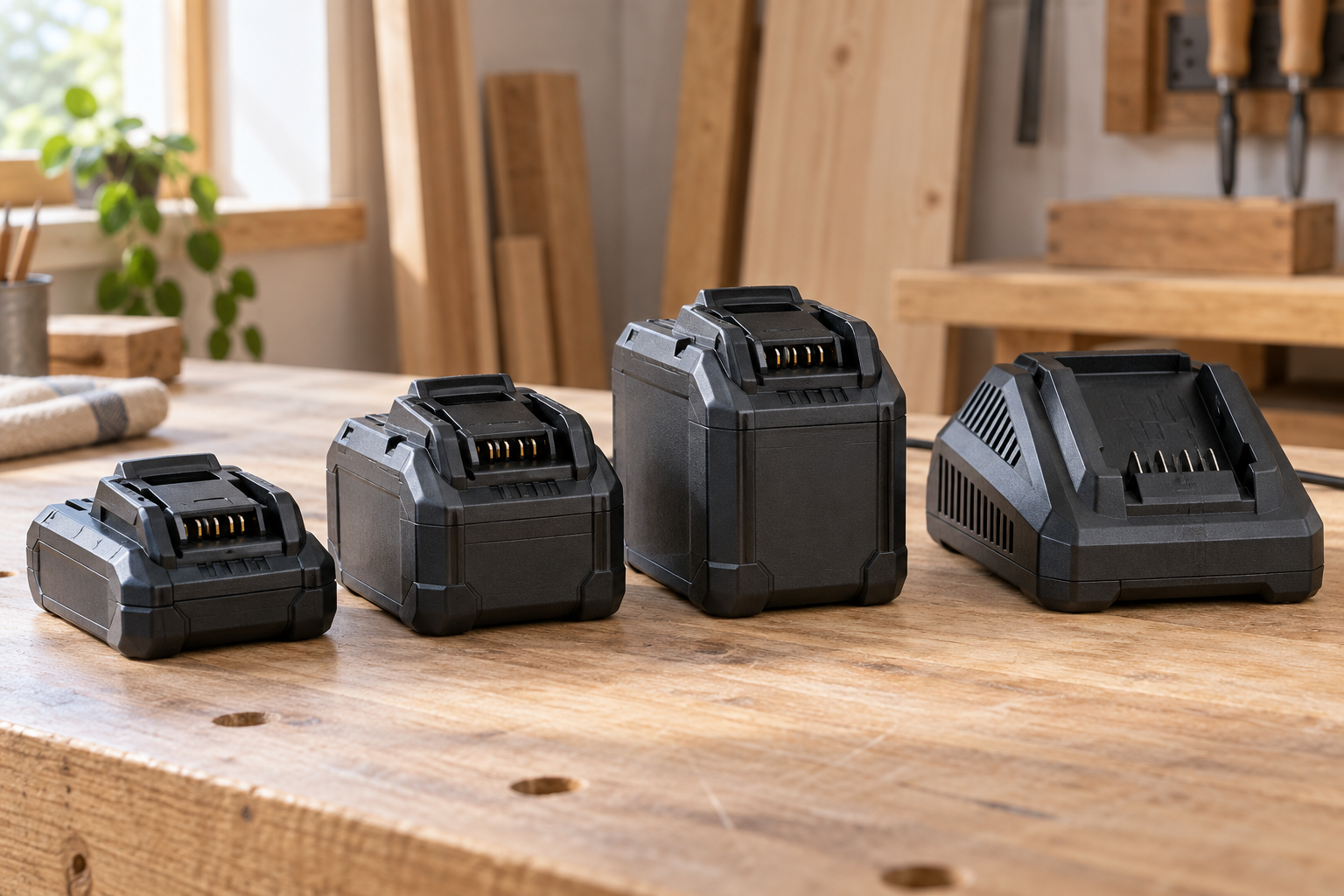
For most solo repair vans, a standard single-port charger is the sensible starting point. It is usually the smallest and cheapest way to keep a battery platform working. Search for standard single-port tool battery chargers in your existing battery system, then compare the physical footprint and charging times.
A standard charger may take several hours to refill a large high-capacity battery. That is acceptable if you carry three or four charged packs and rotate them. It is a poor choice if your work involves continuous drilling, grinding, or cutting and you own only one or two batteries.
In that case, a rapid charger can earn its space. Rapid charging may cut waiting time substantially, but it is not free: the charger can be larger, louder, and hotter, and the inverter must handle its input load. Rapid charging also creates more heat in the battery. Use it for turnaround during the workday, then use a standard charger when practical for overnight charging.
When multi-bay chargers pay off
A multi-port charger is useful when several batteries need attention at the end of a shift. Before buying, determine whether it charges packs simultaneously or sequentially. A four-port charger that works through the batteries one at a time may take most of a night to finish a full load.
Multi-bay units make more sense for a van with a permanent inverter and a regular charging station. They are less attractive for a small service vehicle where every inch of shelf space is valuable. If you carry batteries from two brands, buying one charger for each platform is often more practical than trying to consolidate incompatible systems.
Use multi-port cordless battery chargers when you routinely return with several depleted packs. Otherwise, two compact single-port chargers may offer better redundancy and take up less usable space.
Powering chargers from the van
A permanent inverter is cleanest, but installation needs proper fusing and cable sizing. High-current wiring connected directly to a starting battery can create a fire hazard if it is not fused close to the battery. An inverter connected to the vehicle’s 12-volt accessory socket may be limited to around 120 to 180 watts, depending on the vehicle fuse and outlet. That may run a small charger but not a high-demand charging station.
A portable power station is easier to deploy. Look for a unit with a pure sine-wave AC output, at least 500 watt-hours of capacity for light charging, and enough continuous wattage for the charger you intend to use. Remember that AC conversion is not perfectly efficient. A 500-Wh power station will not deliver 500 Wh to the battery packs.
For a simpler backup, consider portable pure sine-wave power stations. They cost more than an inverter alone, but they include battery storage, outlets, protection circuits, and a display. The trade-off is weight: a unit large enough for a full day of charging can weigh 10 to 20 pounds or more.
Battery management and safety
Keep batteries dry, protected from metal objects, and out of direct sunlight. A loose battery beside wrenches or fasteners can short its terminals. Inspect packs for cracked housings, swollen cases, damaged contacts, or unusual heat. Do not charge a battery that was dropped hard, soaked, or shows physical damage.
Label batteries with the purchase date or an identification number. In a busy van, this makes it easier to find a failing pack. If one battery repeatedly takes much longer to charge, runs hot, or loses power quickly, remove it from service rather than assuming the charger is at fault.
The cheapest standard charger is fine when you have enough batteries to rotate and can charge overnight. Spend more on rapid or multi-port equipment only when charging time is genuinely limiting your work. In a mobile repair van, reliable power, ventilation, and secure storage usually matter more than the highest advertised charging speed.
Related guides
- Longest Lasting Lawn Mower Battery: AGM vs Lithium vs Flooded Lifespan and Cost per Season
- Duralast Gold Lawn Mower Battery Review: U1 Fit, CCA and When to Pay for AGM
- Greenworks Pro 80V 21-Inch Mower Review: Runtime Math, Push vs Self-Propelled and Yard Fit
- Bosch High Pressure Washer Gun Replacement: Fittings, Adapters and What Fits Your Model