What's inside
As an Amazon Associate I earn from qualifying purchases. This post may contain affiliate links at no extra cost to you.
Clearing sawdust is a different job from blowing leaves. A leaf blower’s high air volume can scatter fine dust across the shop, while a weak compact blower may not move heavier chips from around a saw base or workbench. The best cordless setup produces controlled airflow, runs long enough for cleanup, and uses batteries you already own—or batteries that will also power your other tools.
As an Amazon Associate we earn from qualifying purchases at no extra cost to you.


What matters when blowing sawdust
Air speed helps break up piles and push dust out of corners. Air volume determines how much material the blower can move once it is loose. Manufacturers often advertise maximum air speed in miles per hour and air volume in cubic feet per minute (CFM), but those numbers are not always measured under the same conditions. Treat them as useful comparisons within a product range, not as laboratory-equivalent ratings.
For a small bench, miter saw, or portable table saw, a compact blower producing roughly 90 to 150 CFM is usually enough. For a larger shop floor, driveway, or work area with mixed chips and sawdust, look closer to 150 to 250 CFM. Higher output is useful, but it also stirs up more airborne dust and drains a battery faster.
Variable speed is more important than maximum power for indoor cleanup. A low setting can move dust away from a finished surface without blasting it back into the room. A lock-on trigger or cruise control is useful when sweeping a floor, though a simple trigger is easier to control around open tool cabinets and electrical cords.
Choose the blower type for the work
| Blower type | Best use | Main advantage | Main drawback |
|---|---|---|---|
| Compact handheld blower | Benches, tools, small work areas | Light and easy to aim | Shorter runtime and less force |
| Full-size handheld blower | Floors, driveways, large sawdust piles | More airflow and longer runtime | Louder, heavier, and more likely to spread dust |
| Inflator-style or detail blower | Tool surfaces, narrow gaps, vehicles | Precise airflow and compact storage | Not suitable for broad floor cleanup |
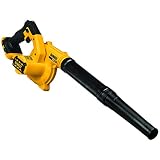
A compact handheld model is the practical choice for most woodworkers. It can clear dust from a saw table, workbench, sawhorses, and tool cases without the weight of a yard blower. If you regularly clean a two-car garage or outdoor cutting area, a full-size variable-speed cordless leaf blower is more efficient.
Detail blowers are convenient for clearing dust from router bases, drill vents, and narrow dadoes. They are not a replacement for a shop vacuum or a higher-volume blower. Some compact tools use small proprietary batteries, while others use the same slide packs as drills and saws. The latter are usually the better long-term buy if you already use that platform.
The battery platform usually matters more than the blower
A blower is often used for only a few minutes at a time, so buying into a new battery system just for this tool rarely makes sense. If you already own cordless drills, saws, or sanders, choose a bare tool from that platform. A 4.0Ah or 5.0Ah battery is a good general-purpose size: it provides useful runtime without making a compact blower unnecessarily heavy.
Small 1.5Ah to 2.0Ah batteries keep a detail blower balanced and are often enough for quick bench cleanup. Expect roughly 10 to 20 minutes of demanding use from a small pack, depending on the tool and speed setting. A full-size blower may drain a 5.0Ah battery in approximately 15 to 30 minutes at high output. Intermittent trigger use can stretch that considerably.
Battery voltage alone is not a reliable performance ranking. Motor design, fan efficiency, nozzle shape, and electronic controls all affect output. Compare tested airflow where available, then consider battery cost, charger availability, warranty support, and what other tools you expect to buy. A cheaper blower is a sensible choice when it uses batteries you already have and the cleanup area is small.
If you are starting from scratch, a kit with a battery and charger can cost less than buying them separately. Shop for a cordless blower kit with battery and charger, but check the battery capacity. A kit with a tiny pack may look inexpensive while providing poor runtime for floor cleanup.
A blower should not replace dust collection
Blowing sawdust is cleanup, not dust control. Fine particles can remain airborne long after the floor looks clear. Use the saw’s dust port and a shop vacuum while cutting, then wear eye protection and a suitable respirator when blowing settled dust. Open doors or use ventilation when practical, but avoid directing dust toward neighbors, vehicles, or open windows.
For indoor work, use the lowest effective speed and aim the nozzle close to the floor. Start at the back of the area and work toward a collection point. A straight nozzle gives reach and concentrated force; a wider nozzle spreads airflow over a larger area but can create a broad dust cloud. Some blowers accept accessory nozzles, but do not assume a nozzle improves performance—the wrong restriction can reduce airflow or overheat the motor.
Features worth paying for
A brushless motor is useful for frequent users because it generally improves efficiency, durability, and runtime, though it raises the purchase price. Electronic speed control, a battery fuel gauge, and an easy-to-clean intake screen are genuinely practical. A removable tube helps with storage, but a tool that requires several parts to be assembled before every cleanup becomes inconvenient.
Pay attention to balance. A blower that feels comfortable empty may become tiring with a large battery attached. The intake should remain clear when held at normal angles, and the trigger should not require a hard squeeze. Avoid using the blower around loose nails, screws, or gravel: high-velocity debris can become a projectile and can damage the fan.
For occasional workshop use, a basic compact cordless blower bare tool is usually the best value if it matches your existing batteries. Spend more on a full-size brushless unit only when you need to clear large areas, move damp or heavier chips, or use the blower frequently enough for runtime and durability to matter.
Related guides
- Longest Lasting Lawn Mower Battery: AGM vs Lithium vs Flooded Lifespan and Cost per Season
- Duralast Gold Lawn Mower Battery Review: U1 Fit, CCA and When to Pay for AGM
- Greenworks Pro 80V 21-Inch Mower Review: Runtime Math, Push vs Self-Propelled and Yard Fit
- Bosch High Pressure Washer Gun Replacement: Fittings, Adapters and What Fits Your Model