What's inside
As an Amazon Associate I earn from qualifying purchases. This post may contain affiliate links at no extra cost to you.
Start with the voltage
A cordless tool battery label usually gives you three useful clues: voltage, capacity, and chemistry. Read them together. A battery with more amp-hours is not automatically more powerful, and a pack that fits physically is not necessarily safe or compatible with a tool or charger.
Voltage describes the battery pack’s electrical potential. Common tool-platform labels include 12V, 18V, and 20V MAX. The difference between 18V and 20V MAX is often a labeling convention, not a different class of battery: a lithium-ion pack sold as 20V MAX may have a nominal voltage of about 18V and a higher voltage when fully charged. Compare the platform’s stated nominal voltage and compatibility, rather than assuming the bigger printed number means more work gets done.
Higher-voltage platforms can support tools designed for greater power, such as larger saws or grinders. But voltage alone does not tell you how much power a particular tool delivers. Motor design, electronics, battery current limits, and pack construction also matter. A high-capacity battery cannot turn a compact drill into a high-power tool.
Capacity is about stored energy and runtime
Capacity is usually printed in amp-hours (Ah). A 5Ah pack can, in idealized terms, deliver 5 amps for one hour, or 1 amp for five hours. Real runtime varies with the tool, load, temperature, battery age, and the pack’s power limits. A saw cutting thick material may drain a pack much faster than a drill driving small screws.
For a rough comparison across different voltages, multiply nominal voltage by amp-hours to estimate watt-hours (Wh): an 18V, 5Ah battery is about 90Wh; a 12V, 4Ah battery is about 48Wh. This is a useful measure of stored energy, but it still does not predict exact runtime or peak output.
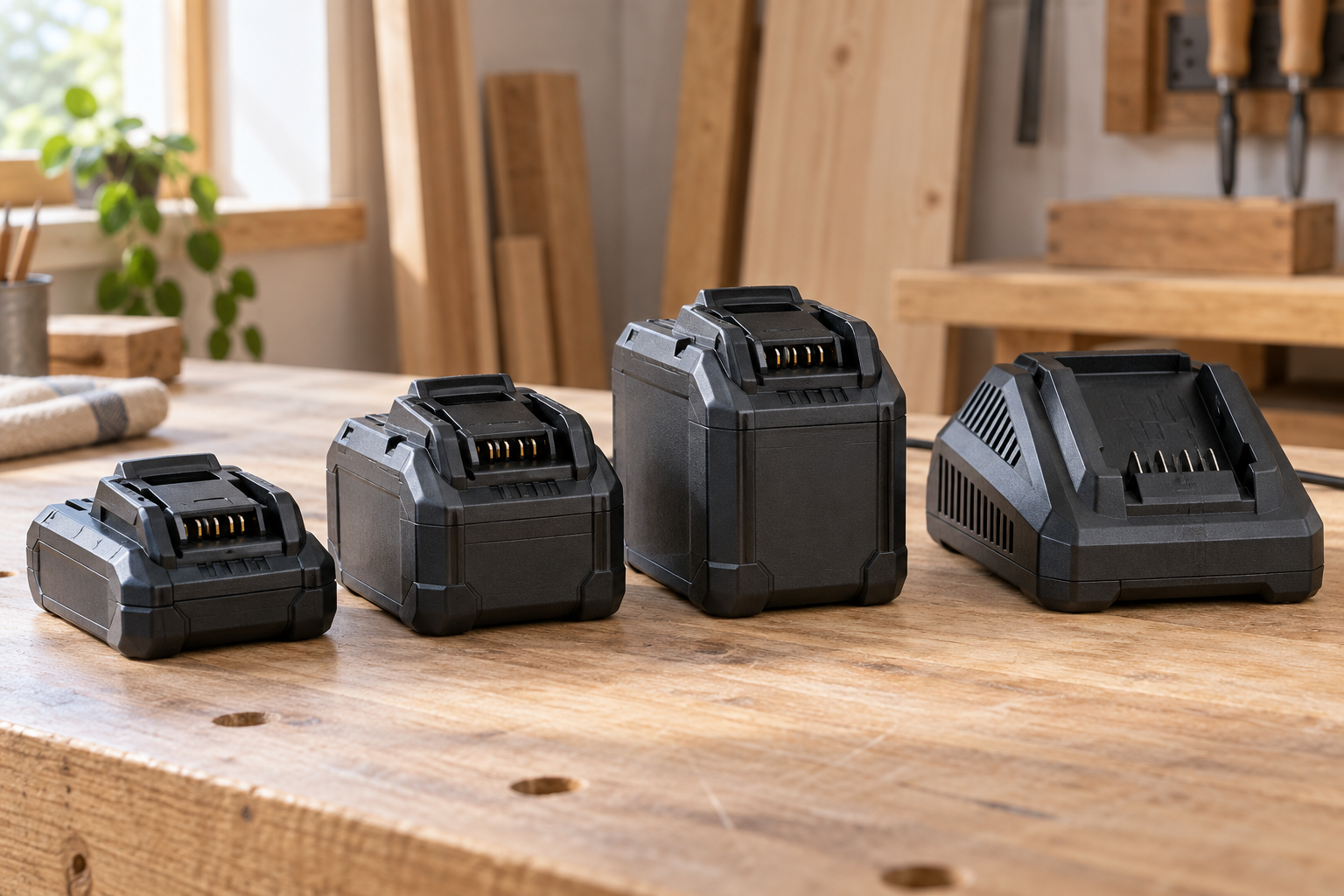
More capacity typically means longer runtime, but also more weight, bulk, and cost. For overhead drilling or repeated ladder work, a smaller pack may be easier to handle. For a shop vacuum, circular saw, or long stretch of fastening, a larger pack can mean fewer battery changes. If you need a spare, consider a replacement cordless tool battery pack that matches your platform and tool requirements.
What common label details tell you
| Label marking | What it tells you | What it does not tell you |
|---|---|---|
| 18V or 20V MAX | Platform voltage class; check whether the brand lists nominal or maximum voltage. | Exact power, runtime, or compatibility with every tool. |
| 2Ah, 4Ah, or 5Ah | Rated charge capacity; a larger number generally means more stored energy in the same voltage class. | Guaranteed hours of use or higher tool speed. |
| Wh | Watt-hours, a direct estimate of stored energy that helps compare packs with different voltages. | How efficiently a particular tool uses that energy. |
| Li-ion | Lithium-ion battery chemistry, the standard for most current cordless tool packs. | Cell quality, pack condition, or whether it fits your platform. |
| “High output” or similar | May indicate a pack designed for greater current delivery or demanding tools. | A universal performance rating; wording and specifications vary by brand. |
Chemistry: lithium-ion, NiCd, and NiMH
Most current cordless tool batteries use lithium-ion cells. They hold more energy for their weight than older nickel-cadmium (NiCd) packs, and they are common across modern tool platforms. Lithium-ion packs include control and protection electronics, so use a charger designed for the exact platform. Do not try to charge a tool battery with a generic charger just because its voltage appears similar.
NiCd and nickel-metal hydride (NiMH) labels may appear on older tools. Those packs are not automatically interchangeable with lithium-ion replacements, even if they share a brand or similar voltage marking. The pack shape, contacts, voltage behavior, and tool electronics all matter. If you are keeping an older tool, verify compatibility through the tool or battery manufacturer’s documentation before buying a replacement.
Battery age matters as much as the label. A used 5Ah pack with worn cells may run less time than a healthy 4Ah pack. Avoid packs with cracked cases, swollen sections, corrosion, burn marks, or damaged contacts. If a pack gets unusually hot, smells odd, or repeatedly shuts down under modest load, stop using it and follow the manufacturer’s disposal guidance. Don’t open or repair a sealed pack unless you are qualified to work on battery systems.
Check fit, platform, and charger compatibility
Before buying, match the battery to the exact tool platform, not just the brand name or voltage. Brands may sell several battery families that do not share the same rails, terminals, or electronics. Some newer high-output packs work across a platform but deliver their full advantage only in certain tools. A pack that clicks into place can still be an unsupported combination.
Check the manufacturer’s compatibility chart for both the tool and charger. A charger from the right platform should identify the battery family and manage charging correctly; a physically similar third-party charger may not. If you are expanding a platform, a compatible platform battery charger is usually a safer choice than a universal unit with unclear specifications.
Choose capacity for the work, not the biggest number
For light household work—hanging shelves, assembling furniture, or occasional drilling—a smaller battery is often the sensible buy. It costs less, weighs less, and may be enough if you already have a charged spare. A compact 12V 2Ah tool battery can suit light-duty tools, provided it is made for your exact platform.
For sustained cutting, sanding, or fastening, a larger pack can reduce interruptions, though it adds weight and can be uncomfortable on a drill held overhead. If you use several tools in one platform, two moderate-capacity packs may be more practical than one very large pack: one can charge while the other is in use. Compare watt-hours, weight, price, and the tool maker’s guidance. The best battery is the one that fits the tool, charger, and workload—not simply the one with the largest capacity printed on its label.
Related guides
- Longest Lasting Lawn Mower Battery: AGM vs Lithium vs Flooded Lifespan and Cost per Season
- Duralast Gold Lawn Mower Battery Review: U1 Fit, CCA and When to Pay for AGM
- Greenworks Pro 80V 21-Inch Mower Review: Runtime Math, Push vs Self-Propelled and Yard Fit
- Bosch High Pressure Washer Gun Replacement: Fittings, Adapters and What Fits Your Model