What's inside
As an Amazon Associate I earn from qualifying purchases. This post may contain affiliate links at no extra cost to you.
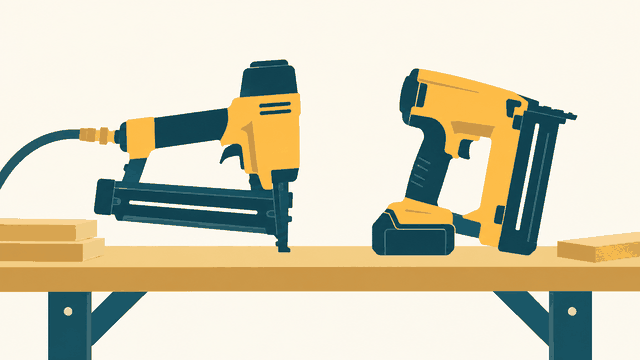
For trim work, both cordless and pneumatic brad nailers can produce clean results. The better choice depends less on nail-driving power than on how often you move, whether you already own a compressor, and how much setup and hose handling you’re willing to tolerate.
As an Amazon Associate we earn from qualifying purchases at no extra cost to you.


Quick comparison
| Factor | Cordless brad nailer | Pneumatic brad nailer |
|---|---|---|
| Setup | Load the battery and nails | Connect a compressor, hose, and nailer; set pressure |
| Movement | No hose or power cord to drag around | Hose can snag on corners, ladders, and finished floors |
| Weight and balance | Generally heavier at the tool | Usually lighter in the hand, with compressor weight elsewhere |
| Repeated firing | Can slow or pause as the tool cycles; battery needs charging | Usually keeps up with trim work if the compressor is sized and regulated properly |
| Noise | Tool makes a sharp firing and motor sound | Tool fires quietly, but the compressor may cycle loudly |
| Cost to start | High if you need a battery and charger; lower if you’re already on the platform | Low if you own a suitable compressor; higher if buying the whole setup |
Why cordless is convenient on a trim job
A cordless nailer is easier to carry from room to room and use on a ladder or in a tight hallway. There’s no hose to pull around a door casing or keep off a freshly finished floor. For a punch list, a few pieces of baseboard, or trim repairs spread across a house, skipping compressor setup can save more time than the faster firing cycle of a pneumatic tool.
The trade-off is weight. Cordless tools contain a motor and firing mechanism, and some also have a fuel cell; they’re typically bulkier than a pneumatic nailer. That matters when you’re holding the tool overhead to install crown molding. Try the tool in your hand if possible, and check its balance with the battery attached, not just the bare-tool weight.
Battery choice matters, too. A smaller pack keeps the tool lighter, while a larger pack can reduce interruptions on a long day. If you already own compatible batteries and a charger, a cordless 18-gauge brad nailer can be a sensible addition. Starting a new battery platform just for occasional trim work is harder to justify: include the cost of the battery and charger when comparing prices.
When pneumatic is the better buy
A pneumatic nailer is usually lighter in your hand and has a simple, direct firing cycle. If you already own a compressor that can supply the nailer’s required pressure and airflow, the tool itself is often the economical choice. It’s a good fit for repeated trim installation in a workshop or on a large project where you can leave the compressor in one spot and route the hose safely.
But the setup is real work. You have to connect the hose, adjust the regulator, manage the compressor’s noise, and avoid marking walls or floors with the hose. A compressor that runs often can interrupt a quiet interior job. A very small compressor may also struggle to keep up with rapid firing; check the nailer and compressor specifications rather than assuming any tank will do. If you need to buy everything, compare the full cost of a pneumatic brad nailer and compressor setup with a cordless kit.
Nail length, depth, and common problems
Brad nailers typically use 18-gauge nails. For trim, common lengths are about 1 to 2 inches, but the right length depends on the trim thickness and what you’re fastening into. The nail should pass through the trim and get a useful bite in the backing without striking plumbing, wiring, or another hard surface. For a thin piece of trim on drywall, a longer nail is not automatically better; it still needs solid backing to hold securely.
Test the depth setting on a scrap piece of the same trim and backing. A nail that sits proud can be set a little deeper; one buried too far leaves a divot that needs filling and may split narrow molding. Hard hardwood, knots, and angled shots can deflect nails, so avoid placing fasteners close to an edge. Keep your free hand behind the work, never in line with the nail path.
Misfires and proud nails aren’t always a power problem. Check that the magazine is loaded with the correct nail type and length, the nose is pressed firmly against the work, and the depth setting is appropriate. On a pneumatic tool, confirm the regulator pressure is within the manufacturer’s range and check for leaks or a kinked hose. On a cordless tool, a low battery, a jam, or a slow firing cycle can interrupt work; clear jams only as the manual directs and disconnect the battery first.
A practical buying decision
Choose cordless if you already own the battery platform, move between rooms often, or value quick setup more than tool weight. For occasional repairs, borrowing or renting may be better than buying either system. If you want a cordless tool mainly for trim, an 18-gauge cordless brad nailer sold as a bare tool can make sense when you already have the matching batteries and charger.
Choose pneumatic if you already have a suitable compressor, expect long sessions, and can keep the hose out of the way. If you’re buying from scratch, count the compressor, hose, regulator, and fittings—not just the nailer. Either type can do clean trim work; test on scrap, use the right fastener, and plan for a little filling and touch-up.
Related guides
- Longest Lasting Lawn Mower Battery: AGM vs Lithium vs Flooded Lifespan and Cost per Season
- Duralast Gold Lawn Mower Battery Review: U1 Fit, CCA and When to Pay for AGM
- Greenworks Pro 80V 21-Inch Mower Review: Runtime Math, Push vs Self-Propelled and Yard Fit
- Bosch High Pressure Washer Gun Replacement: Fittings, Adapters and What Fits Your Model