
Our Top Picks
 Jig Saw Corded: DEKOPRO Electric Jigsaw Tool Power9.25 x 3.54 x 11.2 inches4.9 PoundsCheck on Amazon

What's inside
- Contents
- Types of cordless jigsaws
- How to choose a cordless jigsaw
- Key features that matter
- Battery and platform considerations
- Use cases: what each job asks of the saw
- Setting up for a clean cut
- Safety essentials
- Care and maintenance
- Common mistakes
- Who should choose what
- Buying and setup checklist
- Frequently asked questions
- Conclusion
As an Amazon Associate I earn from qualifying purchases. This post may contain affiliate links at no extra cost to you.
The short answer: the best cordless jigsaw is the one whose handle style, cutting action and battery fit the work you actually do. For most home workshops, a top-handle model with adjustable orbital action, tool-free blade changes, a bevelling base and variable speed is the safest all-round choice. Choose a barrel-grip model if you spend long sessions on delicate curves or work in tight spots. Choose a heavier-duty, higher-voltage platform if you regularly cut thick hardwood or work all day on site. Whatever you pick, the blade matters as much as the saw.
Types of cordless jigsaws
A jigsaw is a simple idea: a narrow blade moves up and down while a flat base plate rides on the workpiece. The differences between models come from how you hold the tool, how the blade moves and how much power sits behind it. Understanding those three variables will narrow the field faster than any specification sheet.
Top-handle and barrel-grip jigsaws
A top-handle saw has an arched handle above the blade line, giving good downward control for straight cuts and general carpentry. A barrel-grip saw puts the motor housing in your palm, so your hand sits lower, you see the line better and tight curves take less wrist effort; downward pressure is a little harder to apply evenly.
Orbital versus straight-cutting action
On a straight-action saw, the blade moves purely up and down. This gives the smoothest, most accurate cut and the least tear-out on veneered boards, laminate and thin metal. On an orbital saw, the blade also swings slightly forward on the upstroke, so it bites more aggressively on the way up and clears on the way down. Most cordless models let you select between several orbital settings, including zero. A higher setting cuts faster in thick softwood but leaves a rougher edge.
Comparison of jigsaw types
| Type | Strengths | Limitations | Best suited to |
|---|---|---|---|
| Top-handle, orbital | Good downward control, fast in wood, widely available accessories | Rougher edge at high orbital settings | General carpentry, straight and gently curved cuts |
| Barrel-grip | Low centre of gravity, good line of sight, comfortable for curves | Less natural pressure on the base plate, unfamiliar feel | Fitting, template work, tight spots |
| Straight-action only | Cleanest finish, least tear-out | Slower in thick stock | Laminate, veneer, thin sheet material |
| Compact light-duty | Light, easy to store, small batteries | Limited thickness, shorter run time under load | Occasional hobby use, thin panels |
| Heavy-duty brushless | Sustained power, longer endurance | Heavier, higher cost | Frequent use, thick timber, worktops |
How to choose a cordless jigsaw
Start with the material and thickness you cut most often, not the most demanding job you can imagine. A saw that handles an occasional thick board slowly will still do the job; a saw that is too heavy for everyday work will end up sitting in its case. Write down your three most common cuts and decide which handle style and class they point toward.
Next, consider how precise the finished edge needs to be. If you are cutting hidden material, such as a rough hole in a subfloor, speed matters more than finish. If the edge will be visible, as in a shelf end, a worktop cut-out or a decorative profile, you want a saw with a straight-action setting, a rigid blade guide and good blade support. Finish quality depends heavily on the blade and technique, but the saw must be capable of holding the blade steady.
Think about the way you will hold the tool. Ask yourself whether you will cut overhead, at arm’s length or from above, and whether you will be on a bench or on a ladder. Weight with a battery attached is what you carry, so check that figure if it is listed. If you can handle a saw in a shop, pick it up with a battery fitted, mimic the cutting posture and see how your wrist feels after a minute.
Key features that matter
Orbital settings and variable speed
Look for a clearly marked selector with several steps, including a straight setting. Pair this with variable speed, either through a trigger or a dial. Slow speeds suit metal, plastics and starting a cut without skating; faster speeds suit soft timber. A dial that caps the maximum speed helps when you want repeatable results without feathering the trigger.
Blade clamp and blade changes
A tool-free blade clamp saves time and removes the need to hunt for a hex key. The best designs grip the blade firmly, release it with one lever motion and accept the common shank styles. Check which shank style the saw takes and buy blades to match. A clamp that loosens mid-cut is a safety problem, so test it by tugging on a freshly fitted blade.
Base plate, bevel and dust management
A rigid base plate keeps the cut square. Bevel adjustment, usually in either direction, lets you cut mitres in panels. Detents at common angles save time, though it is wise to confirm the angle against a square for precision work. Many saws include a built-in blower that clears sawdust from the line, and some accept a dust extraction adapter or a splinter guard insert. Both help visibility and reduce airborne dust.
Battery and platform considerations
Cordless tools are sold either as a kit with a battery and charger or as a bare tool. Battery capacity is usually described in amp-hours, and larger numbers generally mean longer run time at the cost of added weight. For a jigsaw, a mid-size battery usually gives a sensible compromise between endurance and balance. A very large pack can make the tool top-heavy, which works against control in precise curves.
Voltage classes vary by manufacturer and are not directly comparable across brands. As a rule, a higher voltage platform delivers more sustained power for thick material, while a lower voltage platform keeps the tool light. Rather than chasing a number, match the platform to the rest of your tools. A shared battery across a drill, a sander and a saw reduces the number of chargers you need and lets you swap a depleted pack for a charged one in seconds.
Use cases: what each job asks of the saw
Curves and scrolling
Tight curves call for a narrow blade, a straight or low orbital setting and a patient feed rate. A barrel-grip body is often more comfortable here. Make relief cuts in the waste side of the line so the blade is not forced around the curve and the waste falls away in pieces.
Worktops and sink cut-outs
Laminate and engineered worktops chip easily. Use a fine-tooth blade designed for clean cutting, switch orbital action off, mark the line with masking tape and cut from the finished face downward or upward according to the blade’s design. Support the offcut so it cannot drop and tear the edge as the cut finishes. Drill pilot holes in the corners of a cut-out first, so the blade has a starting point and the corners are rounded.
Setting up for a clean cut
- Remove the battery before touching the blade or adjusting the base plate.
- Select the blade for the material: more teeth per length for clean cuts and thin stock, fewer and larger teeth for fast rough cuts in timber, a specific metal-cutting blade for sheet metal.
- Fit the blade with the teeth facing forward and the back edge seated in the guide roller, then tug it to confirm it is locked.
- Set the orbital selector and speed. Start low if you are unsure.
- Clamp the work so the cut line overhangs the bench edge, with nothing beneath the blade’s travel, including your bench top, clamps and cords.
- Rest the base plate on the surface with the blade clear of the material, insert the battery, and start the saw before the blade touches the wood.
- Guide, do not force. Let the blade reach full speed, advance steadily and follow the line.
Safety essentials
A jigsaw feels less intimidating than a circular saw, but it still causes injuries, usually when the work moves or the blade snaps.
- Eye and ear protection. Wear safety glasses with side protection every time, and use hearing protection for longer sessions or loud materials.
- Dust protection. Wood dust, particle board and composite materials create fine dust. Wear a suitable dust mask or respirator, work with extraction where you can and keep the area ventilated. Dust from some treated or engineered boards can be hazardous, so check the guidance for the material.
- Battery removed for blade changes. Take the pack off before changing blades, adjusting the shoe or clearing a jam. A saw that starts unexpectedly is the quickest way to a serious cut.
- Workholding. Clamp the workpiece securely. Never hold small pieces by hand near the blade, and keep both hands on the saw unless you have a good reason otherwise.
- Clear travel. Check beneath the work before cutting. The blade extends below the material and can cut a bench, a cord or your knee.
- Let it stop. After releasing the trigger, keep the saw away from your body until the blade has stopped. Rest it down on its base only when it is still.
- Sensible clothing. Avoid loose sleeves, dangling jewellery and hair that could catch.
Care and maintenance
A jigsaw is a rugged tool, but it gets heavy dust exposure. After use, remove the battery and wipe the housing with a dry cloth. Use a soft brush or a gentle puff of air to clear dust from vents and the blade clamp area, wearing eye protection while doing so. Keep the guide roller clean and check that it spins freely; a sticky roller or a worn one lets the blade wander.
Inspect the base plate for scratches or burrs that could mark delicate surfaces. A small cover or a piece of tape on the plate can protect polished materials. Check the blade clamp for wear and for debris, and replace blades as soon as they dull, bend or lose teeth. A tired blade burns the wood, overloads the motor and drains the battery quickly.
Common mistakes
- Using the wrong blade. Many disappointing cuts come from a blade that does not suit the material. A fast wood blade tears laminate; a metal blade crawls through softwood.
- Forcing the cut. Pushing the saw harder makes the blade bow, leaving a cut that is not square to the surface and sometimes snapping the blade.
- Skipping the clamps. A workpiece that vibrates produces rough edges and unsafe moments.
- Cutting with orbital action on veneers. It causes chipping on the top face. Switch to straight action and use tape.
- Starting the cut with the blade touching. Always let the blade reach speed before contact to avoid kickback and chatter.
- Neglecting dust. A blocked line of sight makes you guess, and fine dust is a health issue.
Who should choose what
Comparison of jigsaw buyer profiles
| Buyer | Suggested type | Priorities | Watch out for |
|---|---|---|---|
| Occasional home DIYer | Compact or mid-range top-handle | Light weight, tool-free blades, shared battery | Paying for power you will not use |
| Hobbyist maker and crafter | Barrel-grip or straight-action capable top-handle | Fine control, variable speed, dust blower | Wrong blades causing tear-out |
| Kitchen and joinery fitter | Mid-range barrel-grip or top-handle with bevel | Line of sight, rigid guide, accurate bevel | Chipped laminate, drifting cuts |
| Renovator and builder | Heavy-duty brushless top-handle | Endurance, strong clamp, rugged base | Weight and extra batteries cost |
| Metalworker (light sheet) | Variable-speed model with straight action | Low speed control, secure clamping | Hot blades and sharp edges |
If you are still undecided, a mid-range top-handle saw with orbital adjustment is the most forgiving starting point. It handles most household tasks, accepts a wide range of blades and leaves room to grow. You can add a barrel-grip model later if finesse work becomes a regular pursuit. For a shopping starting point, browse the cordless jigsaws on Amazon and compare handle style, orbital settings and included batteries against the checklist below.
Buying and setup checklist
- List your three most common materials and thicknesses before comparing saws.
- Choose a handle style by holding it with a battery fitted, if possible.
- Confirm the saw has a straight setting plus several orbital steps.
- Check that the blade clamp is tool-free and holds a blade firmly.
- Match the blade shank style to blades you can easily buy.
- Look for variable speed with a trigger or dial.
- Check the bevel range and verify angles with a square.
- Compare weight with the battery on, not the bare tool.
- Decide whether you need to fit existing batteries or buy a kit.
- Prepare safety glasses, hearing protection and a dust mask.
- Remove the battery before every blade change.
- Clamp the workpiece and check clear space beneath the cut.
- Test the cut on scrap before cutting the real piece.
- Brush dust from the vents and clamp after each session.
Frequently asked questions
Are cordless jigsaws powerful enough to replace corded ones?
For most household and light site tasks, yes. Modern batteries and brushless motors handle typical cuts in timber and sheet material well. A corded saw can still make sense if you do long, continuous cuts in dense material and prefer not to manage batteries.
Should I buy a top-handle or a barrel-grip jigsaw?
If you only buy one, a top-handle is the more common and usually the more versatile choice. A barrel-grip is worth considering if you do a lot of curved or fitted work and want a lower, more controlled hold.
What orbital setting should I use?
Use zero or the lowest for laminate, veneer, plastics and metal. Use a middle setting for general woodwork, and the highest only for fast, rough cuts in thick softwood where the finish does not matter.
How do I stop chipping on the top surface?
Use a fine-tooth blade designed for clean cutting, turn orbital action off, apply masking tape along the line and support the work close to the cut. Cutting from the face that matters while using a downward-cutting blade design can also help; check the blade’s packaging for guidance.
Can I cut straight lines with a jigsaw?
You can, with a clamped straight edge and a stiff blade, but results depend on the blade staying true. For long, square cuts in thick stock, a circular saw or a guided track system is usually more accurate. Treat the jigsaw as the choice for curves and cut-outs.
Is it safe to leave the battery in the saw?
Not while changing blades, adjusting settings, clearing debris or storing the tool. Remove the pack each time to prevent accidental starts. Also remove it when transporting the saw.
How do I know when a blade needs replacing?
Replace it when cutting slows noticeably, the material burns, teeth go missing or the cut starts to wander.
Is it safe to leave the battery in the saw?
Not while changing blades, adjusting settings, clearing debris, storing or carrying the tool. Remove the pack each time to prevent accidental starts.
Conclusion
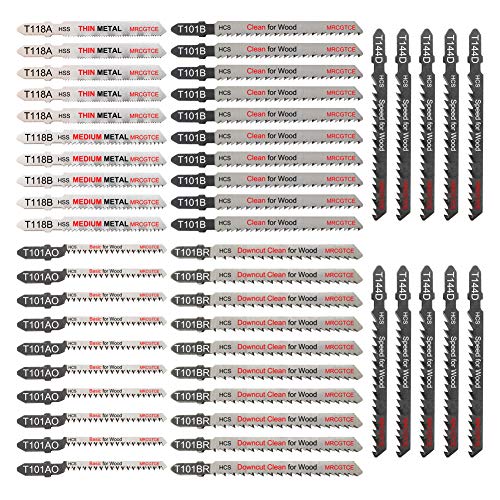
Choosing among cordless jigsaws is less about finding a single champion and more about matching a design to your work. Decide on handle style, understand when to use orbital action, insist on a secure blade clamp and a rigid guide, and treat the battery platform as a long-term decision. Then put the same effort into blades, clamping and safety, because those details determine cut quality more than the badge on the housing. A mid-range, top-handle saw with a sensible battery is a strong foundation for most people. If your work leans toward fine curves or heavy timber, move toward barrel-grip or heavy-duty classes accordingly. When you are ready to compare options, see the jigsaw blade assortments to cover wood, laminate and metal, and consider a pair of safety glasses if yours are worn.
As an Amazon Associate, we earn from qualifying purchases. Links marked as sponsored may earn a commission at no extra cost to you.
Related guides
More from Amazon
Programs that pair well with the guide above. Offers and eligibility are set by Amazon and may change.
A free business account with business pricing and bulk-buying tools for work, shop or home office.
Create a business accountFree shipping on eligible items, Prime Video and more. Eligible new members can start with a free trial.
Start a Prime free trialAudiobooks and podcasts to listen to on the go. Eligible new members can start with a free trial.
Try Audible freeAd-free music streaming. Eligible new subscribers can start with a free trial.
Try Music Unlimited freeAs an Amazon Associate we earn from qualifying purchases.

Write Your Review
No reviews yet. Be the first to share your experience!