What's inside
As an Amazon Associate I earn from qualifying purchases. This post may contain affiliate links at no extra cost to you.
Carrying tools between sites changes what matters in a cordless platform. A broad tool catalog is useful, but so are batteries that fit the tools you actually use, chargers that can keep up overnight, and a kit that does not turn every move into a heavy lift. The best choice is usually the platform that covers your regular work with the fewest spare batteries and least downtime—not the one with the most tools listed in its catalog.
As an Amazon Associate we earn from qualifying purchases at no extra cost to you.


Start with your workload
List your core tools and how often they run away from an outlet. A drill, impact driver, and work light have different battery demands from a circular saw, grinder, or rotary hammer. High-draw tools drain small batteries quickly, so a compact battery that is convenient in a drill may be a poor primary pack for cutting or grinding.
For a typical two-tool kit, plan on at least two batteries: one in use and one charging or ready to go. If the workday includes sustained cutting or grinding, three or more packs may be practical. Battery capacity is commonly stated in amp-hours (Ah), but Ah alone does not tell you how long a tool will run: voltage, tool load, battery condition, and temperature matter too. Compare packs within the same platform and use the tool maker’s compatibility guidance; packs that physically fit may not be recommended for every tool.
How the main platform types compare
| Platform approach | Best fit | Trade-off to check |
|---|---|---|
| Broad professional 18V/20V-class system | Mixed trades and crews needing drills, impact tools, saws, and specialty tools | Tool and battery prices vary; check the exact tool range in your market |
| Compact 12V system | Service work, installation, and frequent indoor moves | Less suited to long sessions on demanding cutting or grinding tools |
| High-output or higher-voltage system | Repeated heavy cutting, demolition, or outdoor work | Heavier, often costlier batteries; not necessary for every task |
| One-brand system with a few corded tools | Trades with predictable cordless needs and occasional stationary work | Mixing power sources can mean carrying extra equipment |
Voltage labels are not a simple performance ranking: marketing conventions differ, and output depends on the tool and battery design. Compare the specific tools you need, not just the number printed on the pack.
Battery and charger logistics
Battery weight adds up when you carry tools up stairs or between vehicles. A larger pack can extend runtime, but it may make a drill or impact driver awkward for overhead work. A practical setup often pairs a smaller pack for fastening and detail work with larger packs for high-draw tools, provided the manufacturer approves both for those tools.
Check charging time for the batteries you intend to buy, not just the charger’s advertised maximum. A single charger may struggle to replenish several depleted packs during a short lunch break. For a crew, one charger per worker—or a shared multi-port charger where the site has reliable power—can prevent morning delays. Cold batteries may charge slowly or be restricted by the charger; let them warm naturally rather than using direct heat. Keep spare packs protected from rain, dust, metal debris, and crushing in the van.
Buying the first kit
If you are starting from zero, choose around the tools you expect to use weekly. For general construction or maintenance, a mainstream professional platform with a wide local tool range is a sensible default. Look for a drill and impact driver kit, then add the saw or specialty tool your work actually requires. Before buying, check replacement battery prices and whether bare tools are easy to source locally. A low-cost starter kit can be good value if its batteries and charger meet your workload.
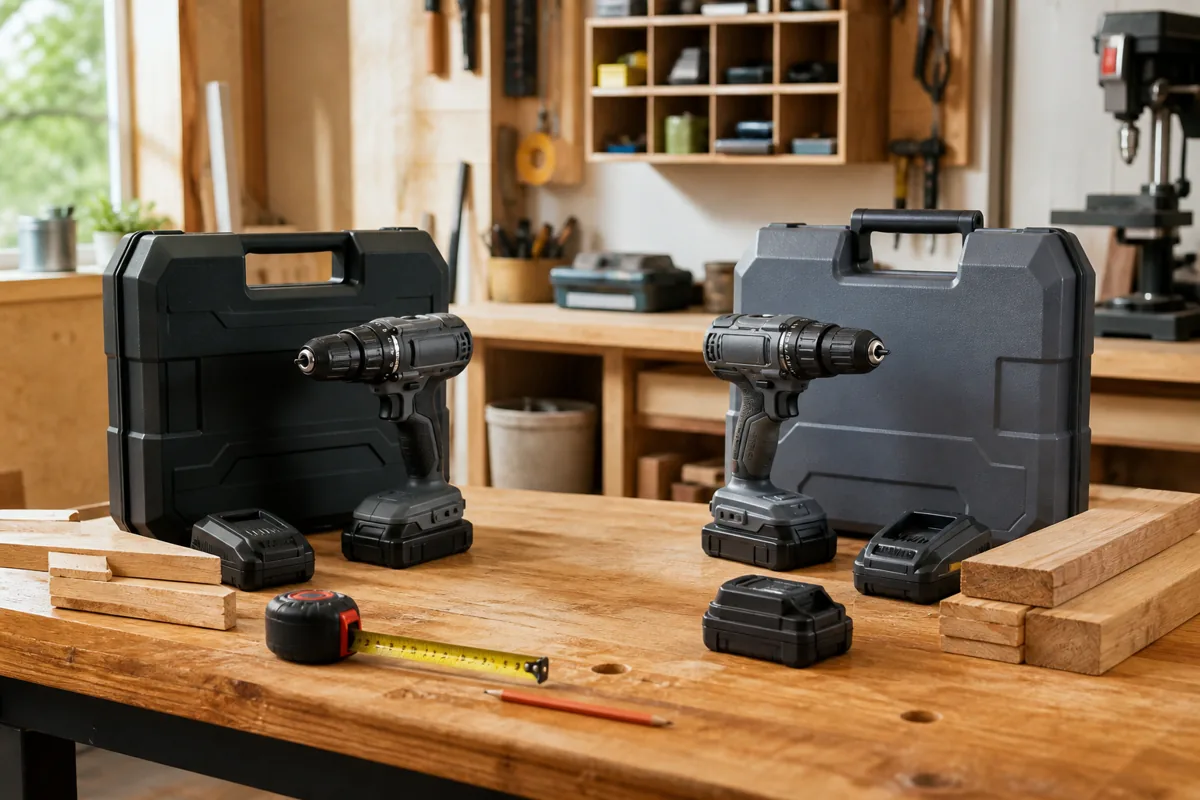
Compare cordless drill and impact driver kits by included battery capacity, charger, warranty, and tool compatibility—not by the number of accessories in the case. If overhead drilling, cabinet installation, or service calls dominate, a 12V drill and impact kit may be lighter and cheaper. It is a poor bargain if you later need to buy a second platform for routine high-load work.
When a second platform makes sense
Staying with one battery system reduces chargers and spare packs, but it is not a rule. A specialist tool may be better on another platform, or a compact system may save real weight for service work. Add a second ecosystem only when the tool fills a regular gap or clearly improves the job. Otherwise, you may end up carrying two chargers and multiple battery types for little benefit.
Adapters can look like a cheap way to share batteries, but they may bypass protections or create compatibility and warranty problems. Avoid them unless both tool and battery makers explicitly support the arrangement. For heavy daily use, buy batteries and chargers from the tool’s approved system and keep packs in good condition; a worn battery that cuts out under load can waste more time than the money saved on a bargain replacement.
Packing for moves between sites
Carry only the batteries needed for the day, but do not arrive with every pack nearly empty. A simple routine is to label packs by condition, charge them after the shift, and remove batteries from tools before transport. Keep tools and packs in cases or a secure van organizer so terminals cannot contact loose screws, keys, or metal offcuts. Inspect packs for cracks, swelling, damaged contacts, or unusual heat; retire damaged batteries rather than putting them back into rotation.
Finally, check what your work sites allow. Some locations restrict charging, battery storage, or transport of damaged lithium-ion packs. If power is uncertain, carry enough charged capacity for the planned tasks and arrange charging at the next stop. The right platform is the one that gets your regular work done without forcing you to haul unnecessary weight or wait for a charger.
Related guides
- Longest Lasting Lawn Mower Battery: AGM vs Lithium vs Flooded Lifespan and Cost per Season
- Duralast Gold Lawn Mower Battery Review: U1 Fit, CCA and When to Pay for AGM
- Greenworks Pro 80V 21-Inch Mower Review: Runtime Math, Push vs Self-Propelled and Yard Fit
- Bosch High Pressure Washer Gun Replacement: Fittings, Adapters and What Fits Your Model