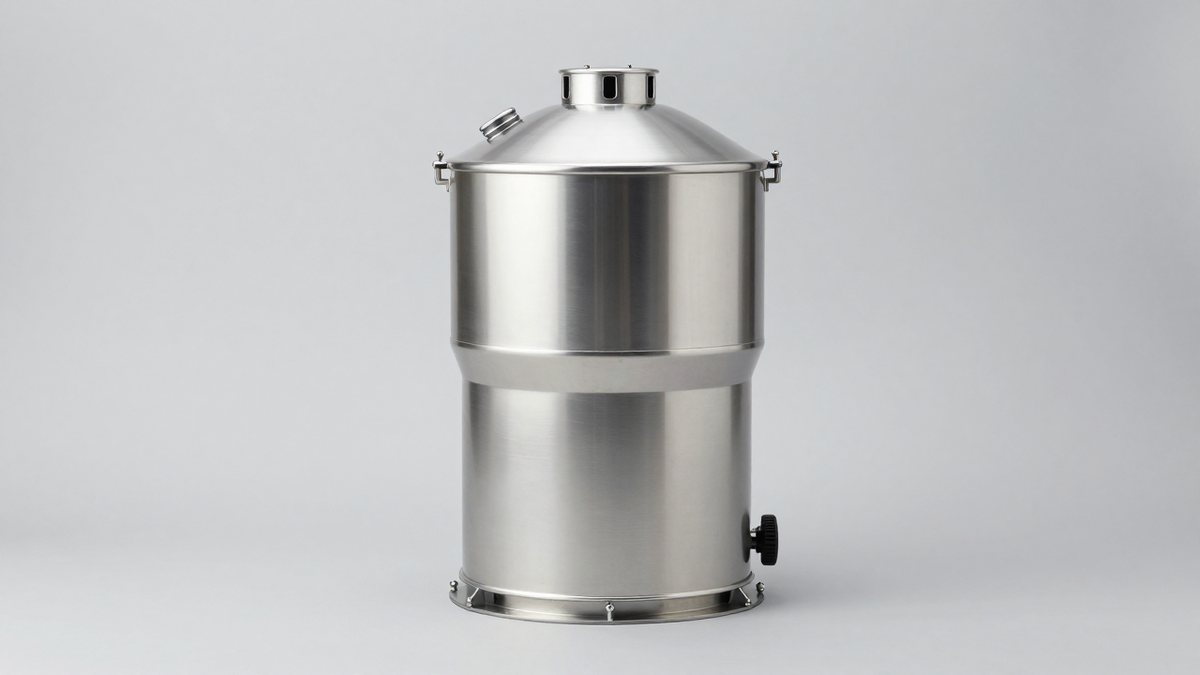
Key takeaways
- Best dust collectors for small workshops: six picks compared by airflow, filter micron rating, inlet size and footprint, with two support accessories.
What's inside
As an Amazon Associate I earn from qualifying purchases. This post may contain affiliate links at no extra cost to you.
The best dust collector for most small workshops is the POWERTEC 1 HP model rated at 800 CFM, because it combines a real 4-inch inlet, one-micron filter bags and a mobile base in a package that still fits a one-car garage. A dust collector is a motor and impeller that pull chips and dust from your machines through 4-inch hose into a filter bag and a collection bag, so its airflow and filter rating decide how clean your shop stays. If floor space is tight, the WEN DC3401 and the VEVOR wall-mount unit are lighter and more compact, while the larger WEN DC1300 suits a shop with a dedicated corner and a stronger electrical circuit.
Two of the six products here are not full dust collectors: the DEWALT is an overhead air cleaner and the Dustopper is a bucket separator for a shop vacuum, and we place them as supporting gear.
Quick List
- WEN DC1300 1,300 CFM Dust Collector – best for a larger small shop with two 4-inch inlets and a big bag
- WEN DC3401 660 CFM Dust Collector – best for tight spaces and benchtop machines
- VEVOR 1 HP Wall-Mount Dust Collector – best for getting the collector off the floor
- DEWALT DWXAF101 Air Filtration System – runner-up accessory for cleaning airborne dust between sessions
- Dustopper PRO Cyclone Separator Kit – runner-up accessory for protecting a shop vacuum with a bucket cyclone
- POWERTEC 1 HP 800 CFM Dust Collector – best overall balance of airflow, filtration and footprint
Which One Is Right for You?
| If you… | Choose |
|---|---|
| want a balanced single-hose collector with fine filter bags | POWERTEC 1 HP 800 CFM |
| run several machines and want two 4-inch inlets and a large bag | WEN DC1300 |
| need a collector that can hang on a wall and free up floor space | VEVOR Wall-Mount Dust Collector |
| have a small bench shop with a sander, bandsaw or lathe | WEN DC3401 |
| already use a shop vacuum and want a bucket cyclone ahead of it | Dustopper PRO Kit |
| want to clean the air that escapes the collector and tools | DEWALT DWXAF101 |
Start by listing the machines you will connect and the largest dust port among them. Then check the electrical circuit, because the bigger motors draw a lot of current. If your shop is under about 200 square feet, a modest collector paired with an air cleaner often does more good than one oversized unit.
All 6 Picks in Detail
1. WEN DC1300 1,300 CFM Dust Collector – Best for a bigger small shop
As an Amazon Associate we earn from qualifying purchases at no extra cost to you.
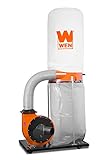
The WEN DC1300 is the heavy hitter on this list. It has a 14-amp motor driving a 10-inch impeller, dual 4-inch inlets so two tools can connect at once, a 5-micron filter bag on top and a 50-gallon collection bag underneath. WEN rates it at 1,300 CFM, which is a free-air number, so real airflow at the tool drops once you add hose and fittings.
It stands more than 6 feet tall with the bag attached and weighs in the mid-80-pound range, so it is a fit for a shop with a dedicated corner. The mobile base lets you roll it between machines, and the large collection bag means fewer trips to empty.
A collector this size makes the most sense when you run a planer or a thickness sander, because those machines fill a bag fast. Because it has two inlets, you can hook up a main machine and a floor sweep at the same time with a wye fitting, as long as you accept some loss of airflow at each port. Keep in mind that the bag needs headroom to hang freely, so measure your ceiling before you commit.
- Airflow rating: 1,300 CFM (maker figure), 14-amp motor
- Two 4-inch inlets
- 5-micron filter bag and 50-gallon collection bag
- Mobile base with locking casters
- Dry dust only; no automatic shut-off per retail details
Pros
- Strong airflow and two inlets for more flexibility
- Large bag cuts emptying frequency
Cons
- Tall and heavy for the smallest garages
- 5-micron bag passes fine dust unless you upgrade or add air filtration
Compared with the POWERTEC, it gives more airflow and capacity but asks for more height, current and floor space.
2. WEN DC3401 660 CFM Dust Collector – Best for tight spaces and light-duty tools
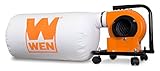
The DC3401 is WEN’s compact option: a 5.7-amp motor, a 12-gallon bag and a single 4-inch inlet in a slim, rolling body that can also be mounted on a wall. WEN rates it at 660 CFM, and the unit comes with a 5-micron zippered bag. It is a fit for a hobbyist with a bench sander, small bandsaw, lathe or router table rather than a shop full of large stationary machines.
Because it draws a modest amount of current, it is easier to run on a shared household circuit than the larger WEN. The trade-off is that it needs frequent emptying and gives less pull on long hose runs.
If you are building a first dust-collection setup in a spare room or a corner of a basement, this is the kind of collector that keeps costs and complexity low. Park it beside the tool you use most, run a short hose and swap the hose when you change machines.
- Airflow rating: 660 CFM (maker figure); 5.7-amp motor
- One 4-inch inlet
- 12-gallon, 5-micron collection bag
- Rolling base with lockable casters; optional wall mount
- Light enough to move by hand per retail details
Pros
- Compact and light for tiny shops
- Gentler on household circuits
Cons
- Small bag fills quickly with planer or saw chips
- Not enough for a long hose run or multiple tools at once
Beside the VEVOR wall unit, it stands on wheels by default, while the VEVOR focuses on a hang-it-on-the-wall layout and a larger bag.
3. VEVOR 1 HP Wall-Mount Dust Collector – Best for freeing up floor space
VEVOR describes this as a wall-mount dust collector with a 1-horsepower induction motor, 560 CFM of airflow and a 2.5-micron collector bag. Retail details list a bag of roughly 21 gallons with a bottom zipper so it can be emptied without detaching it, a weight of around 24 pounds and a noise level up to about 90 decibels. Mounting it on a wall keeps the floor clear, which is a real benefit when you have a car or a workbench to protect.
The listing name does not state the inlet diameter, so confirm it on the product page before ordering hose or reducers. Wall mounting also means you must anchor it into studs or a solid wall, so factor in the weight of a filled bag and leave enough clearance below to swing the bag zipper open.
This type of unit suits a woodworker who mostly connects one tool at a time, such as a miter saw station, a sanding table or a lathe, and who wants the collector parked in the same spot every day. A fixed hose drop from the wall unit to a bench also makes it easy to build a small, neat dust-collection corner.
- Motor and airflow: 1 HP, 560 CFM (maker figure)
- 2.5-micron collector bag; about 21-gallon capacity per retail details
- Wall-mount design; weight about 24 pounds
- Noise up to roughly 90 decibels per retail details
- Inlet size: confirm on the listing
Pros
- Keeps floor space free
- Finer bag rating than the 5-micron WEN bags
Cons
- Needs solid wall anchoring and a fixed location
- Loud at the rated maximum, so hearing protection helps
Compared with the POWERTEC, it is lighter and wall-hung, but it moves less air and is not designed to roll between machines.
4. DEWALT DWXAF101 Air Filtration System – Runner-up accessory for ambient air
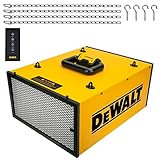
This product does not belong in the same category as the others, and it is important to say so plainly. The DEWALT DWXAF101 is a suspended air filtration system, not a dust collector. It hangs from the ceiling on chains, has an infrared remote with speed and timer controls, and cleans the air in the room instead of pulling dust from a tool. It does not connect to your machines and will not stop chips from landing on the floor.
Where it helps is the fine dust that gets past a tool hood and collector bag and hangs in the air. Use it after sanding sessions, and treat it as a companion to a real collector, not a replacement. Run it on a timer while you finish up, keep the room doors closed so it works on one volume of air and clean or replace its filters on the maker’s schedule so airflow stays steady. Hanging it takes solid ceiling framing, so find a joist before you drill.
- Ceiling-hung air cleaner with chains and hooks
- Three speeds and an auto mode, with an infrared remote and timer
- Airflow roughly 170, 210 and 250 CFM per the manual
- Two-stage filtering with a HEPA-class final stage per the maker
- Coverage about 452 square feet and 120-volt power per the maker
Pros
- Cleans lingering fine dust the collector misses
- Remote and timer make it easy to run after work
Cons
- Does not capture dust at the source
- Filters need regular replacement
Next to the Dustopper kit, both are support gear rather than main collectors, but this one cleans air while the Dustopper protects a shop vacuum.
5. Dustopper PRO Cyclone Separator Kit – Runner-up accessory for shop vacuum users

The Dustopper PRO is also not a stand-alone dust collector. It is a low-profile cyclone separator that sits on a standard 5-gallon bucket and connects to a wet/dry shop vacuum with 2.5-inch fittings. The kit includes two 90-degree sweep elbows and a 36-inch connection hose. The brand claims up to 99.9 percent capture, which is a manufacturer figure, and the clear chamber lets you watch the separation.
In a small shop, this is a way to get a collector-like result from a shop vacuum without buying a motorized unit, especially for sanding and bench work. You still need the vacuum, and its airflow is lower than a true collector.
Because the listing name uses the words dust collector, it is easy to assume this is a stand-alone machine, so it is worth stating again that it needs a motorized vacuum to work. For many hobbyists that is exactly the point: a vacuum they already own plus a bucket separator is a cheap way to keep bags and filters from clogging while they build up a larger system over time.
- Low-profile cyclone separator for a 5-gallon bucket (bucket not included, per the kit description)
- Includes two sweep elbows and a 36-inch hose
- Connects to 2.5-inch wet/dry shop vacuum fittings
- Maker claim of up to 99.9 percent separation
- Clear chamber with latches and gasket
Pros
- Protects the vacuum filter and cuts cleaning time
- Fits under a bench thanks to its low profile
Cons
- Not a motorized collector; airflow depends on your vacuum
- Does not suit large chip-makers like a planer
In comparison with the POWERTEC, it costs less setup and space but cannot move the airflow a real collector does.
6. POWERTEC 1 HP 800 CFM Dust Collector – Best overall for a small workshop
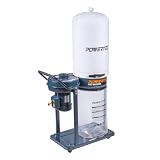
This POWERTEC collector uses a 1-horsepower motor rated at 800 CFM, a 4-inch inlet, a one-micron filter bag and a lower collection bag on a mobile base. Maker details list 120-volt or 240-volt operation and a weight around 55 pounds, which is light enough to roll between a planer, table saw and bandsaw. The one-micron bag is the finest rating on the list, so less fine dust escapes into the room than with the 5-micron WEN bags.
It is the sensible default for most small shops: enough airflow for a single machine at a time, a manageable footprint and a straightforward bag arrangement. Run it on a dedicated circuit if you can, and keep hose runs short.
Plan a place to park it near the center of the shop so no machine is more than a short hose length away, and consider adding a second blast gate or a wye later if you want two machines connected. Because it has a single 4-inch inlet, you will move the hose between tools, which is fine in a shop where only one machine runs at a time.
- 1 HP motor, rated 800 CFM (maker figure)
- One-micron filter bag with a lower collection bag
- 4-inch inlet
- Mobile base with casters and a handle
- Weight about 55 pounds per retail details
Pros
- Fine one-micron filtration
- Rolls easily between machines
Cons
- Only one inlet, so you switch hose between tools
- Bag emptying is still a messy job without a cyclone
Compared with the WEN DC1300, it moves less air but uses less space and finer filtration.
Specs Compared
| Model | Type | Airflow (maker) | Motor | Filter / bag | Inlet | Mounting |
|---|---|---|---|---|---|---|
| WEN DC1300 | Dust collector | 1,300 CFM | 14 amp | 5-micron bag, 50-gallon collection bag | Two 4-inch | Mobile base |
| WEN DC3401 | Dust collector | 660 CFM | 5.7 amp | 5-micron, 12-gallon bag | 4-inch | Rolling or optional wall mount |
| VEVOR Wall-Mount Collector | Dust collector | 560 CFM | 1 HP | 2.5-micron bag, about 21 gallons | Confirm on listing | Wall mount |
| DEWALT DWXAF101 | Ceiling air filter (not a collector) | About 170 to 250 CFM (manual) | Confirm on listing | Two-stage, HEPA-class final | None | Ceiling hung |
| Dustopper PRO Kit | Bucket cyclone separator (not a collector) | Depends on your vacuum | None | Cyclone with clear chamber | 2.5-inch hose fittings | 5-gallon bucket |
| POWERTEC 1 HP | Dust collector | 800 CFM | 1 HP | 1-micron bag with collection bag | 4-inch | Mobile base |
How We Chose These
We worked from the product set and published specifications rather than from shop use. For each item we read the manufacturer pages and retailer listing fields for airflow, motor size, filter rating, inlet size and mounting style, and we compared them against what a small workshop typically needs: a fit for a garage footprint, a reasonable electrical load and fine-dust filtration. Two listed items turned out to be an air cleaner and a bucket separator rather than collectors, so we kept them as clearly labeled accessories. Airflow numbers are maker ratings, not measured values, and they fall once hose and fittings are added.
What to Look For
Airflow, static pressure and hose length
CFM tells you how much air the impeller can move with nothing attached. Real performance depends on static pressure, which rises with every foot of hose, every bend and every clogged filter. A tool that needs about 350 to 400 CFM at its port will not get that from a collector rated at 560 CFM if you add a long hose run, so favor short, straight 4-inch hose and keep the collector close to the machines.
Filter micron rating
The micron rating of the filter bag shows the particle size it can capture. A 5-micron bag lets through finer dust that stays airborne, while a 1-micron or 2.5-micron bag holds back more. Fine dust under about 10 microns is the portion that can reach deep into the lungs, so a finer bag and a respirator are both worth having. Remember that the lower collection bag is not the filter: the upper bag is.
Electrical load and circuits
A 14-amp motor on a 120-volt household circuit uses nearly all of a standard 15-amp breaker, and the start-up surge is higher. Give a large collector its own circuit if you can, avoid long extension cords, and do not run it alongside another big tool on the same breaker. A 5.7-amp unit is far easier on a shared circuit, and a 240-volt option, where available, halves the current draw.
Footprint, mounting and noise
Measure the corner where the collector will live, including height with the bag attached. A tall unit can be awkward in a low-ceiling garage. Wall mounting frees the floor but needs solid anchoring, and a rolling base makes it easy to move the collector to the machine you are using. Collectors can be loud, so hearing protection is wise.
A simple rule of thumb
For a small shop, buy for your largest chip-maker. If that is a 13-inch planer with a 4-inch port, pick a collector rated at 600 CFM or more, run it with short hose, and add an air cleaner for the fine dust. If your biggest tool is a sander, a compact unit or a shop-vacuum cyclone may be all you need.
Questions
Do I need a dust collector or a shop vacuum?
A shop vacuum moves less air but at higher suction, which suits sanders and small tools. A dust collector moves more air at lower suction, which suits planers, jointers and saws with large dust ports. Many shops use both.
Why do my chips still escape the machine?
Poor capture usually comes from leaks, long hose or a hood that is too open, not from the collector itself. Seal the connections, shorten the hose and make sure the machine’s hood is intact.
Is a 5-micron bag good enough?
It captures chips and coarse dust but lets fine dust pass back into the room. If you sand or cut a lot of hardwood or MDF, upgrade to a finer bag, add an air cleaner and wear a respirator.
Can a ceiling air cleaner replace a collector?
No. An air cleaner only handles what is already floating in the room and cannot capture chips at the tool. It works best as a companion to a collector.
How far should I place the collector from my machines?
As close as practical. Each extra foot of hose and each bend cuts airflow, so keep runs short and straight. If you cannot move the collector, consider a rigid duct run with a short flexible tail.
What safety steps matter most?
Use a proper circuit, empty bags before they overfill, keep ignition sources away from fine dust and wear a respirator. Wood dust is a recognized health hazard, so controlling it at the source and in the air both matter.
Update History
- October 20, 2026 – Initial publication; product set drawn from current catalog listings.
- Check the product page for current specifications and availability before buying.
Sources
- Manufacturer product and specification pages for WEN, VEVOR, DEWALT, Dustopper and POWERTEC
- Retailer listing titles and specification fields for each product
- OSHA guidance on wood dust hazards