What's inside
- Quick comparison: which knee walker fits your situation?
- Head-to-head specifications that matter
- Best choice for indoor maneuverability: the compact steerable walker
- Best choice for outdoor surfaces: an all-terrain walker
- Knee-pad comfort and fit are safety decisions
- Braking performance: what to inspect
- Folding size and ownership costs
- Setup and maintenance checklist
- What wears first—and common mistakes
- Bottom line
As an Amazon Associate I earn from qualifying purchases. This post may contain affiliate links at no extra cost to you.
The best knee walkers for most users are four-wheel steerable models with a 300-pound capacity, adjustable handlebars and knee pad, a turning radius of about 20–30 inches, and dual locking brakes; choose an all-terrain version only when outdoor surfaces justify its extra weight and larger folded size.
A knee walker can be easier to control than crutches for some short-term mobility situations, but the right choice depends on where you will use it, how often you will fold it, and whether the padded support fits your leg comfortably. The comparison below focuses on the specifications that affect daily use rather than on marketing features.
As an Amazon Associate we earn from qualifying purchases at no extra cost to you.


Our Top Picks
 BlessReach All Terrain Knee Walker Scooter for Adults300 Pound32 x 17 x 39 inches24.3 poundsCheck on Amazon

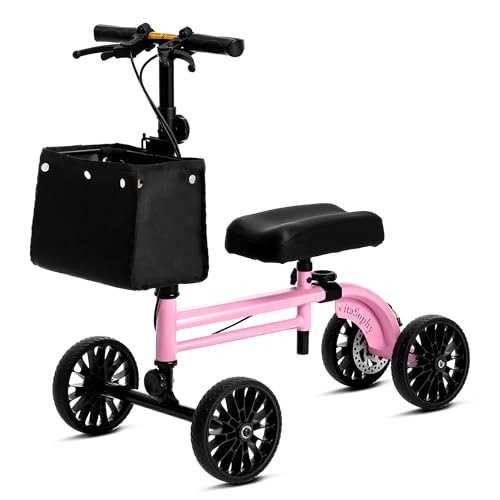

Quick comparison: which knee walker fits your situation?
| Situation | Best type | Why it fits | Trade-off |
|---|---|---|---|
| Mostly indoor use and a limited budget | Compact steerable knee walker | Usually 20–25 lb, 7–8 inch wheels, and a smaller folded footprint | Less stable on gravel, grass, and cracked pavement |
| Frequent outdoor use | All-terrain knee walker | 10–12 inch pneumatic or air-filled wheels roll over uneven ground more easily | Often 25–35 lb and harder to lift into a vehicle |
| Tall or short user | Broadly adjustable model | Look for roughly 30–40 inches of handlebar adjustment and 16–22 inches of knee-pad height | More adjustment hardware can add weight and potential looseness |
| Small apartment or frequent car travel | Folding model with a removable steering column | Common folded lengths are approximately 28–36 inches | Folding hinges and release pins need regular inspection |
| Longer daily use | Wide, contoured knee pad with replaceable cover | Spreads pressure and is easier to keep clean | Usually costs more than a basic narrow-pad design |
Head-to-head specifications that matter
| Feature | Compact indoor model | Heavy-duty model | All-terrain model |
|---|---|---|---|
| Typical user weight capacity | 250–300 lb | 350–400 lb | 300–350 lb |
| Approximate product weight | 20–25 lb | 25–32 lb | 25–35 lb |
| Wheel size | 7–8 inches | 8–10 inches | 10–12 inches |
| Turning radius | 20–26 inches | 24–32 inches | 28–36 inches |
| Knee-pad adjustment | About 16–20 inches | About 17–22 inches | About 16–21 inches |
| Handlebar height range | About 30–38 inches | About 31–40 inches | About 31–40 inches |
| Folded length | 28–34 inches | 31–38 inches | 34–42 inches |
| Typical market price | $100–$180 | $180–$300 | $180–$350 |
These are useful buying ranges, not universal specifications. Confirm the manufacturer’s current capacity, dimensions and wheel type before ordering, especially if you are near the stated weight limit. Capacity includes clothing, bags and anything carried on the walker.
Best choice for indoor maneuverability: the compact steerable walker
A compact four-wheel walker is usually the sensible pick for hallways, kitchens, offices and smooth sidewalks. Its shorter wheelbase reduces the turning radius, while a rigid frame keeps steering predictable. Eight-inch solid or semi-solid wheels are generally sufficient for tile, wood, low-pile carpet and well-maintained pavement.
Check the width as carefully as the length. A walker measuring 16–18 inches wide may pass through many interior doorways, while a wider heavy-duty frame can make bathroom and bedroom access awkward. Measure the narrowest doorway, then leave at least 1–2 inches of clearance for steering corrections.
Best choice for outdoor surfaces: an all-terrain walker
Larger wheels reduce the chance of catching on expansion joints, gravel and short grass. Air-filled tires can provide a less jarring ride, but they require pressure checks and can puncture. Solid rubber wheels eliminate punctures but may transmit more vibration through the frame and knee pad.
All-terrain models still are not designed for stairs, steep loose slopes or wet surfaces. Their larger turning radius is noticeable in tight rooms, and their weight can make lifting them into a trunk difficult. If outdoor use means only a smooth driveway, a compact model may be easier to own.
Knee-pad comfort and fit are safety decisions
The knee pad should support the lower leg without forcing the knee sharply sideways or leaving the kneecap near the edge. A wider contoured pad is often more forgiving than a narrow flat pad, particularly during longer periods of use. Look for dense foam over a firm base, a washable cover, and a surface that does not slide when clothing is smooth.
To set the height, stand beside the walker and place the affected leg on the pad. The thigh should be close to level, with the knee centered and the foot relaxed behind the knee. The handlebars should allow a slight bend in the elbows rather than forcing you to hunch or reach upward. If your injury, surgery or balance limitations make positioning uncertain, ask a clinician or rehabilitation professional to check the fit.
Braking performance: what to inspect
Hand brakes should slow both rear wheels evenly, and a parking lock should hold the walker while you mount, dismount or stand still. Cable-operated brakes are common and can need adjustment as the cable settles. Test the brakes on a level surface before relying on them near a curb or slope.
- Squeeze each brake lever separately and check that the corresponding wheel resists rotation.
- Apply both levers and push gently; the walker should not roll.
- Engage the parking lock, put light downward pressure on the handlebars, and confirm that the frame remains stable.
- Do not use a walker with a frayed cable, loose lever, damaged tire or brake that contacts only one wheel.
A tight turning radius is useful, but excessive steering sensitivity can make a novice user wobble. For a first-time user, predictable steering and strong parking locks are more valuable than maximum agility.
Folding size and ownership costs
A folding mechanism is valuable only if you can operate it without twisting the injured leg or balancing on one foot. Release pins should click fully into place, and the steering column should have little side-to-side play when locked. Before buying, compare the folded dimensions with your vehicle’s trunk opening rather than its total cargo volume.
For occasional use, a $120–$180 compact model may be economical. For example, if it is used 30 times over a recovery period, the equipment cost is roughly $4–$6 per use before resale. A $250 all-terrain model used 100 times works out to about $2.50 per use, but only if its extra capability is actually needed. This calculation excludes delivery, replacement parts and accessories.
Setup and maintenance checklist
- Inspect the frame. Confirm that every quick-release pin, hinge and height collar is fully engaged.
- Set the knee pad. Center the knee, keep the thigh close to level and check that the pad does not rock under load.
- Set the handlebars. Adjust them so your elbows remain slightly bent and your shoulders stay relaxed.
- Check wheel contact. Place the walker on a flat surface and verify that all four wheels touch evenly.
- Test the brakes unloaded. Roll slowly, apply both levers, and then test the parking lock.
- Practice turning. Use wide, slow turns first; avoid sharply twisting the supported leg.
- Clean after outdoor use. Wipe grit and moisture from wheels, axles and folding joints. Do not soak brake cables or bearings.
- Inspect weekly during frequent use. Look for worn tread, loose fasteners, flattened padding and cable slack. Check air-filled tires before each outing.
What wears first—and common mistakes
Wheel tread, brake cables, knee-pad covers and folding-joint hardware typically show wear before the main frame. Replacement availability matters more than a small difference in advertised capacity. A removable pad cover is particularly useful because sweat, dirt and skin oils accumulate where the leg rests.
Common mistakes include exceeding the capacity, carrying a heavy bag from the handlebars, using a compact walker on rough ground, and adjusting the pad so high that the user leans forward. Do not use the walker to climb stairs or as a substitute for a stair rail. Stop if the frame develops play, the brakes pull unevenly or the supported leg becomes painful or numb.
Bottom line
Choose a compact steerable knee walker for smooth indoor surfaces and limited storage, a heavy-duty model for a higher user weight or more robust frame, and an all-terrain model for regular gravel, grass or broken pavement. Prioritize correct knee-pad and handlebar adjustment, reliable parking brakes, replacement parts and a folded size you can manage. A healthcare professional can help determine whether a knee walker is appropriate for your particular injury, surgery or balance needs.