What's inside
As an Amazon Associate I earn from qualifying purchases. This post may contain affiliate links at no extra cost to you.
The best electric fireplace inserts are the ones whose heat output, firebox dimensions, and control system match your room—not necessarily the model with the most convincing flames. For most living rooms, choose a 1,500-watt insert rated for roughly 400–1,000 square feet, then verify that its visible opening and installation depth fit the existing fireplace.
As an Amazon Associate we earn from qualifying purchases at no extra cost to you.


Our Top Picks
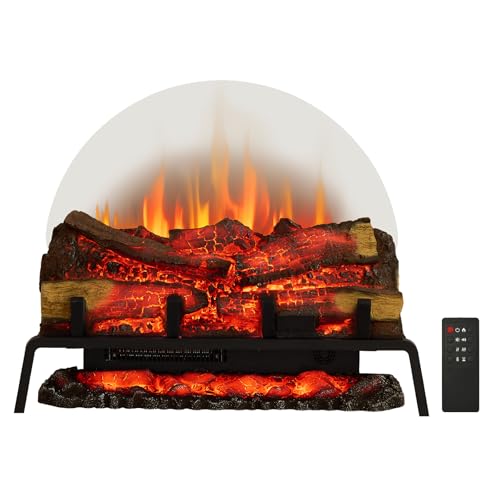 PuraFlame 27" Free Standing Electric Fireplace Log Set27"9.8 x 27 x 19.9 inches18.3 poundsCheck on Amazon
 PuraFlame Western Electric Fireplace Insert with Fire Crackling33"8.78 x 35.04 x 26.99 Inches46.74 poundsCheck on Amazon

Quick picks by situation
| Situation | Best insert type | Useful target specifications | Why it fits |
|---|---|---|---|
| Small bedroom or office | Compact built-in or freestanding insert | 400–750 watts, 20–28 in. wide, 20–30 lb | Lower heat demand and easier installation in a shallow opening |
| Average living room | Standard 1,500-watt insert | 28–36 in. wide, 5,100 BTU maximum, 400–1,000 sq. ft. claimed coverage | Balances useful supplemental heat with a convincing flame display |
| Large room or open-plan area | Wide 1,500-watt insert or built-in electric fireplace | 36–50 in. wide, 5,100 BTU maximum, thermostat and timer | Provides a wider visual focus, although one heater may not warm the entire open space |
| Rental or occasional use | Plug-in log-set or shallow insert | 1,000–1,500 watts, 18–28 in. wide, no permanent wiring | Can usually be removed without modifying the fireplace surround |
| Most realistic appearance | Premium projection or reflective-panel insert | Multi-layer flame effect, ember bed, adjustable brightness, 30–40 in. wide | Depth, moving light, and layered logs look more natural than a flat LED screen |
How much heat does an electric fireplace insert need?
Electric heaters convert essentially all of their electrical input into heat at the point of use. The practical limit is therefore electrical capacity: a 1,500-watt heater produces about 5,100 BTU per hour, while a 750-watt setting produces about 2,550 BTU per hour.
As a starting point, allow approximately 10 watts per square foot in a reasonably insulated room with standard ceiling height. A 300-square-foot room would therefore need about 3,000 watts under that rough rule, but most inserts are limited to 1,500 watts. In practice, a 1,500-watt insert is supplemental heat rather than a whole-home heating system.
Use the higher end of the estimate for drafty rooms, high ceilings, poorly insulated exterior walls, or cold climates. Reduce expectations in an open-plan room: heat quickly disperses into adjacent spaces, so the insert may warm the seating area without raising the temperature everywhere.
A useful electricity calculation
Suppose the heater runs at 1,500 watts for four hours each evening. That is 1.5 kilowatts × 4 hours, or 6 kilowatt-hours per day. At an electricity rate of $0.18 per kWh, the cost is about $1.08 per evening, or approximately $32.40 over 30 days. Flame-only mode uses much less power because it runs the lights and controls without the heating element, often making it a better choice when ambience—not warmth—is the goal.
Check your local electricity rate and the appliance label before estimating operating cost. A thermostat that cycles the heater off can reduce actual consumption compared with running it continuously.
Head-to-head: the features that matter most
Flame realism versus viewing convenience
Basic inserts use LEDs behind a rotating or moving reflector. They are inexpensive and can look attractive from directly in front, but the flame may appear flat from an angle. Better models use a deep ember bed, several layers of logs or crystals, reflective panels, and independently adjustable flame and ember brightness.
Projection-based systems can create more convincing movement and depth, but the effect is sensitive to room lighting and viewing angle. A television-style screen offers vivid color and sometimes multiple scenes, yet it can look less like a real fire when viewed from the side. If realism is your priority, inspect the log layout and ember-bed depth rather than judging the flame color alone.
Heat control and energy use
Look for separate controls for flame and heat, at least two heat settings, an adjustable thermostat, and an automatic shutoff timer. A heater with a thermostat is more comfortable and generally more economical than one with only a manual on/off switch.
Never assume a lower temperature setting halves energy use. On many inserts, the heating element still draws close to its rated wattage while operating; the thermostat saves energy mainly by shortening the time it runs.
Installation depth and electrical connection
Measure the opening at its narrowest points: width, height, depth, and the distance from the opening to the nearest outlet. Also measure the rear taper if the firebox narrows toward the back. A product that matches the front opening may still fail to fit because of its cabinet depth or power cord position.
Plug-in models are the simplest choice, but the receptacle should be properly grounded and suitable for the appliance load. A 1,500-watt heater on a 120-volt circuit draws approximately 12.5 amps, leaving little capacity on a shared 15-amp circuit. Do not use an extension cord, power strip, or adapter unless the manufacturer explicitly permits it. For a hardwired installation, use a qualified electrician and follow local electrical requirements.
Decision matrix for choosing the right insert
| Your priority | Choose | Accept the trade-off |
|---|---|---|
| Lowest purchase cost | Basic LED log-set or shallow insert | Less depth, fewer flame adjustments, simpler controls |
| Frequent winter heating | 1,500-watt model with thermostat, timer, and remote | Higher purchase price and greater electrical demand |
| Most realistic fire effect | Layered log bed, reflective interior, adjustable ember brightness | More cleaning around the display and usually greater depth |
| First-time DIY installation | Freestanding or plug-in insert with supplied trim | May leave visible gaps in an irregular masonry opening |
| Minimal visible controls | Remote-controlled unit with concealed buttons | Remote batteries can fail and may be easy to misplace |
| Use in a tight existing fireplace | Shallow model with a clearly stated minimum opening | Less convincing three-dimensional flame depth |
Installation steps that prevent common mistakes
- Measure before selecting the style. Record the opening width at the top and bottom, opening height, usable depth, and outlet location. Compare these measurements with the manufacturer’s minimum clearance and required cavity dimensions.
- Inspect the existing fireplace. Remove loose ash, debris, and flammable material. A working wood-burning chimney is not normally required for an electric insert, but do not block ventilation openings or use the unit in a damp location.
- Confirm circuit capacity. Add the insert’s amperage to other appliances on the same circuit. Repeated breaker trips are a wiring problem, not a reason to keep resetting the breaker.
- Position the insert securely. Keep it level, leave the specified air gaps, and use trim or a surround to cover a gap rather than pushing the cabinet tightly against combustible materials.
- Test each function separately. Check flame-only mode, low and high heat, thermostat cycling, timer, remote, and automatic shutoff before final placement.
Ownership details: what wears first
The moving reflector or flame motor is often the first mechanical part to become noisy. Dust can also dim the flame effect and restrict the heater’s intake, causing overheating protection to activate. Unplug the insert, then clean the intake and exhaust grilles with a soft brush or vacuum attachment several times each heating season. Wipe the glass or front panel with a dry or slightly damp microfiber cloth; avoid spraying cleaner into vents or controls.
Remote-control batteries, LED light modules, and small fan bearings are common service concerns. LEDs generally last much longer than incandescent bulbs, but some units use proprietary flame assemblies that are difficult to replace economically. Before buying, check whether replacement remotes, flame motors, and display components are available.
Do not place logs, blankets, decorations, or furniture over the heater outlet. Avoid using the top surface as a shelf if it blocks airflow. A faint odor during the first few uses can come from manufacturing residue, but stop using the insert if you notice burning plastic, abnormal noise, damaged wiring, or repeated shutdowns.
Final buying checklist
- Does the heat output suit the room, or are you expecting one 1,500-watt appliance to heat an open floor plan?
- Does the cabinet fit the smallest measured opening, including depth and rear taper?
- Can the flame operate without heat?
- Are thermostat, timer, remote, and manual controls included?
- Is the power cord long enough to reach a suitable grounded outlet without an extension cord?
- Can you obtain replacement batteries, remote controls, and service parts?
- Are the intake and exhaust vents accessible for cleaning?
For most buyers, the best electric fireplace inserts are a standard 1,500-watt, thermostat-controlled model with independent flame operation, a minimum of two heat settings, and dimensions that leave the required clearance around the opening. Spend more on layered flame construction and better controls only when you will use the visual effect or heater frequently; otherwise, a simpler shallow insert can deliver the same basic warmth at lower cost.