What's inside
- Milwaukee M12 vs M18 caulk gun: the short answer
- Milwaukee caulk gun comparison
- Pushing force: where the M18 earns its size
- Variable-speed control: faster is not always better
- Anti-drip performance and pressure release
- Cartridge versus sausage-tube compatibility
- Which Milwaukee caulk gun fits your situation?
- Ownership costs and battery considerations
- Loading and maintenance tips
- Final verdict
- Milwaukee M12 vs M18 caulk gun: the short answer
- Milwaukee caulk gun comparison
- Pushing force: where the M18 earns its size
- Variable-speed control: faster is not always better
- Anti-drip performance and pressure release
- Cartridge versus sausage-tube compatibility
- Which Milwaukee caulk gun fits your situation?
- Ownership costs and battery considerations
- Loading and maintenance tips
- Final verdict
As an Amazon Associate I earn from qualifying purchases. This post may contain affiliate links at no extra cost to you.
The Milwaukee M12 caulk gun is the better choice for lighter sealants, tighter spaces, and occasional work, while the Milwaukee M18 caulk gun is the stronger option for thick construction adhesive, cold material, large sausage packs, and frequent use.
As an Amazon Associate we earn from qualifying purchases at no extra cost to you.


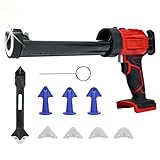
Milwaukee M12 vs M18 caulk gun: the short answer
Milwaukee’s two cordless caulk guns are built around different jobs rather than being simple size variations. The M12 model, commonly sold as the 2441-20, delivers up to 400 lb of pushing force and a faster maximum feed rate. The M18 model, commonly sold as the 2641-20, produces up to 950 lb of force and is better suited to high-viscosity adhesives and long application runs.
Choose the M12 caulk gun for windows, trim, kitchens, bathrooms, and general sealing. Choose the M18 caulk gun when you regularly dispense construction adhesive, polyurethane sealant, roofing products, or other materials that are difficult to push by hand.
Milwaukee caulk gun comparison
| Specification | Milwaukee M12 2441-20 | Milwaukee M18 2641-20 |
|---|---|---|
| Maximum pushing force | 400 lb | 950 lb |
| Variable-speed feed rate | 0–29 inches per minute | 0–21 inches per minute |
| Typical tool weight without battery | About 3.6 lb | About 4.9 lb |
| Primary battery platform | Milwaukee M12 | Milwaukee M18 |
| Common cartridge capacity | 10 oz | 10 oz |
| Pack formats | 10 oz cartridges and compatible sausage configurations | 10 oz cartridges, 20 oz sausage packs, and compatible bulk configurations |
| Anti-drip operation | Automatic pressure release when the trigger is released | Automatic pressure release when the trigger is released |
Weights and capacities can vary slightly with the installed carriage, battery, and kit contents. A bare-tool listing may not include the cartridge holder, sausage-tube holder, battery, or charger needed for your preferred format.
Pushing force: where the M18 earns its size
The biggest difference is force. With up to 400 lb of thrust, the M12 has enough capacity for most acrylic, latex, silicone, and standard sealants. It also handles many general-purpose adhesives, provided the material is not unusually thick or cold.
The M18’s 950 lb rating gives it more than twice the stated pushing force of the M12. That reserve matters when a nozzle is small, the product has high viscosity, or the cartridge has been stored in a cold truck or garage. It reduces the chance of the motor stalling and makes it easier to maintain a consistent bead through long joints.
More force does not automatically produce a better bead. For ordinary caulk, an M18 can be unnecessarily heavy and powerful. If you use its trigger aggressively, it can dispense material faster than you can tool the joint. The M12’s lower output is often easier to control for detail work.
Variable-speed control: faster is not always better
Both tools use a variable-speed trigger, so the operator controls the feed rate rather than relying on a simple on/off switch. The M12 reaches approximately 29 inches per minute, compared with approximately 21 inches per minute for the M18.
The M12’s higher maximum speed is useful when sealing long baseboard runs or applying a low-viscosity product. Its lighter body also makes it less tiring to reposition around corners and overhead joints.
The M18 trades some maximum speed for power. That is a sensible arrangement for thick adhesive: a slower, stronger feed is easier to manage than a fast motor that struggles against resistance. For clean work, begin with the trigger barely engaged, keep the nozzle moving, and increase pressure only until the bead fills the joint.
Anti-drip performance and pressure release
Both Milwaukee models use an automatic anti-drip system that releases pressure from the plunger when the trigger is released. This helps prevent the cartridge from continuing to push material after you stop, reducing blobs at the end of a bead.
Anti-drip is helpful, but it cannot compensate for excessive trigger pressure, a cut nozzle that is too large, or a damaged cartridge seal. A small amount of residual material can still appear, especially with elastic silicone or adhesive. For the cleanest finish, stop the trigger slightly before the end of the joint, pull the nozzle away smoothly, and wipe the nozzle between runs.
If the tool continues pushing noticeably after the trigger is released, inspect the plunger rod and carriage for hardened material. Dried sealant can prevent the mechanism from retracting cleanly.
Cartridge versus sausage-tube compatibility
10-ounce cartridges
Both tools are commonly configured for standard 10-ounce cartridges. This is the most convenient format for household repairs and trim work because it is widely available and easy to load. The cartridge’s rigid paper, plastic, or aluminum body also makes it simple to change products without transferring material into another container.
Before buying a bare Milwaukee caulk gun, check whether the 10-ounce carriage is included. Some configurations are sold with a specific holder, while others rely on interchangeable accessory carriages.
20-ounce sausage packs
The M18 is the more practical choice for 20-ounce sausage packs. Its higher force and larger-format accessory options make it suitable for contractors applying substantial quantities of adhesive or sealant. Sausage packs can reduce packaging waste and often provide more usable material than an equivalent number of small cartridges.
The M12 can work with certain smaller sausage configurations when the correct holder is fitted, but it is not the best platform for routine heavy-volume sausage-pack use. Confirm the holder size and maximum pack length before purchasing, since a 10-ounce carriage and a 20-ounce sausage-tube carriage are not interchangeable by assumption.
Bulk material
Bulk loading is a separate setup from using a cartridge or sausage tube. It requires a compatible bulk barrel and a material container that is clean and free of cured debris. This arrangement can be economical for repetitive commercial work, but it adds cleanup and storage responsibilities. For occasional repairs, standard cartridges are usually less troublesome.
Which Milwaukee caulk gun fits your situation?
| Your situation | Better choice | Reason |
|---|---|---|
| Occasional homeowner repairs | M12 | Lower tool weight and adequate force for common sealants |
| Windows, trim, cabinets, and finish work | M12 | Faster feed and easier control in confined areas |
| Frequent construction adhesive use | M18 | 950 lb of force handles thick products with less strain |
| 20-ounce sausage packs | M18 | Better suited to large-capacity holders and longer runs |
| Already own several M12 batteries | M12 | Lower total ownership cost if the battery platform is established |
| Already own several M18 batteries | M18 | Convenient platform compatibility and greater application range |
| Overhead or ladder work | M12 | Lower bare-tool weight reduces wrist and arm fatigue |
Ownership costs and battery considerations
The cheapest purchase is not always the cheapest setup. Bare-tool prices for these models commonly fall in the general cordless-tool range, while kits cost more because they include a battery and charger. If you already own compatible batteries, a bare tool can make sense. If not, compare the complete system cost, including the correct carriage for your material format.
A simple example shows why usage matters. Suppose a 10-ounce cartridge produces an average 25-foot bead. Using four cartridges per job means roughly 100 feet of coverage. If your work normally uses only one cartridge every few months, the M12’s lighter body and lower entry cost are more valuable than the M18’s extra force. If you use several 20-ounce packs every day, the M18’s productivity and reduced strain can justify its higher system cost.
Battery runtime depends heavily on material viscosity, bead size, temperature, and trigger use. Keep a charged spare battery available for production work rather than choosing solely by advertised capacity. High-resistance adhesive consumes more energy per foot than thin acrylic caulk.
Loading and maintenance tips
- Retract the plunger fully before inserting a cartridge or sausage tube. This prevents the rear seal from catching on the plunger.
- Cut the nozzle at a 30- to 45-degree angle. Start with a smaller opening; enlarging it is easier than correcting an oversized bead.
- Pierce the cartridge’s inner seal completely. A partially opened seal creates unnecessary resistance and can make the motor work harder.
- Set the tool to a low trigger speed for the first test bead. Increase speed only after confirming the material flows consistently.
- Release the trigger before lifting the nozzle. Allow the anti-drip mechanism to relieve pressure, then wipe the tip.
- Remove unused cartridges when storing the tool. Wipe fresh residue from the carriage and plunger before it cures.
The parts most likely to create problems are not usually the motor or gearbox. Hardened sealant around the plunger, damaged cartridge seals, worn nozzle tips, and incorrectly matched holders cause more day-to-day trouble. Never force a blocked cartridge by repeatedly squeezing the trigger; remove it, inspect the seal, and clear the obstruction safely.
Final verdict
The Milwaukee M12 caulk gun is the better all-round choice for lighter sealing work, detail applications, limited storage, and users who value low weight and fast control. The Milwaukee M18 caulk gun is the stronger professional choice for high-viscosity products, frequent adhesive work, and 20-ounce sausage packs.
If your normal material fits a 10-ounce cartridge and you are unsure which to buy, choose the M12 unless you already own the M18 battery platform or regularly use difficult-to-dispense adhesive. If your work routinely makes a manual caulk gun uncomfortable, the M18’s 950 lb of pushing force is the more meaningful upgrade.