What's inside
As an Amazon Associate I earn from qualifying purchases. This post may contain affiliate links at no extra cost to you.
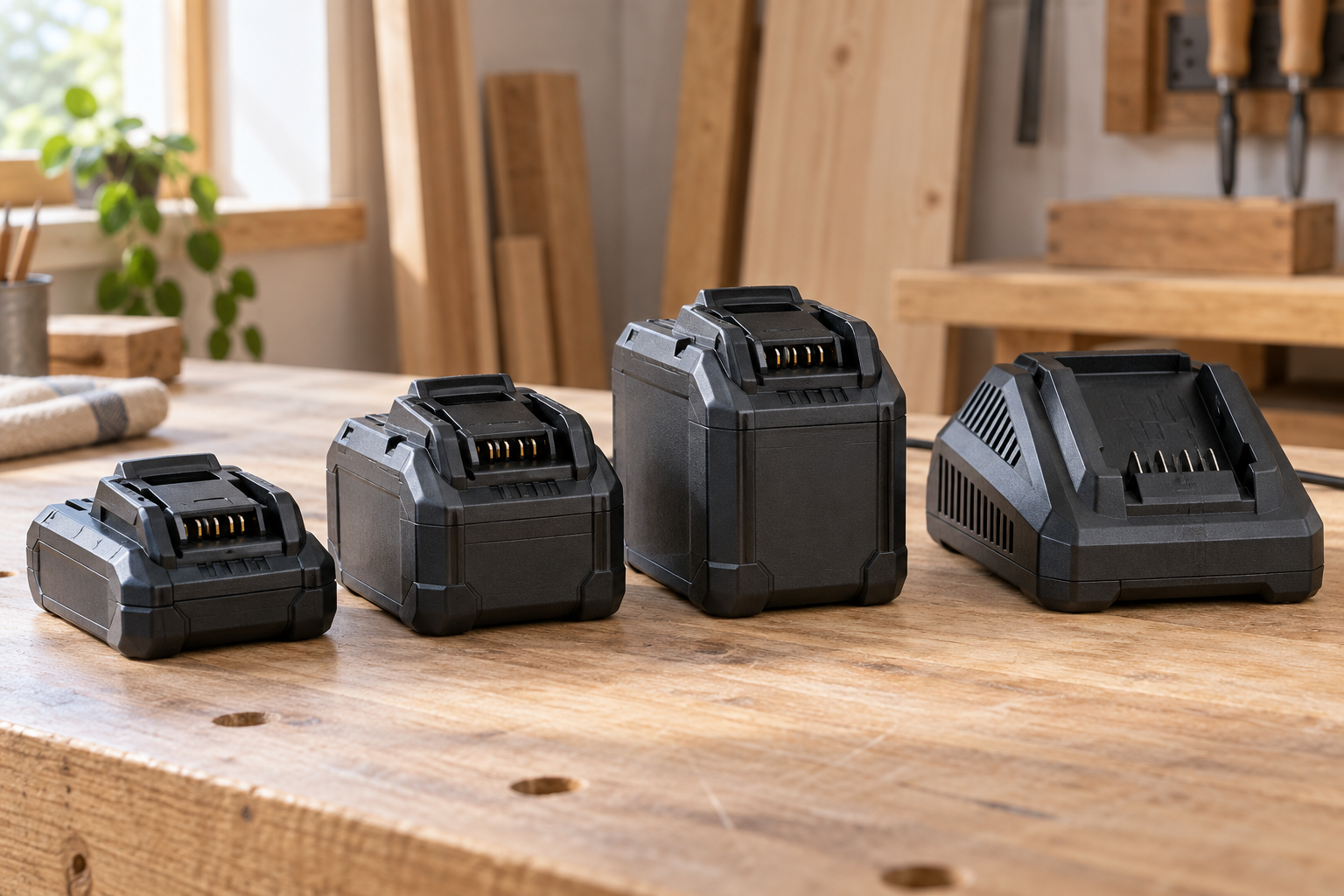
High-capacity batteries can keep a cordless table saw or miter saw working through longer cuts, but a bigger pack is not automatically the better choice. It adds weight, costs more, and may not deliver much extra runtime if the saw’s motor or battery electronics limit output. Match the pack to the saw, the material, and how often you can recharge.
As an Amazon Associate we earn from qualifying purchases at no extra cost to you.


What battery capacity means for a saw
Battery capacity is usually listed in amp-hours (Ah). A 5Ah pack holds less energy than a 10Ah pack at the same voltage, but Ah alone does not tell you how much power the battery can supply at once. Saw performance also depends on the platform voltage, cell design, pack electronics, and the tool’s motor.
For a rough energy comparison, multiply nominal voltage by Ah: a 18V 8Ah pack is about 144 watt-hours; a 36V 4Ah pack is also about 144 watt-hours. These figures help compare stored energy, not predict an exact number of cuts. Wood species, blade condition, cut depth, feed rate, and temperature all affect runtime.
Compare pack sizes and trade-offs
| Battery size | Best fit | Main advantage | Main trade-off |
|---|---|---|---|
| 4–5Ah | Occasional cuts, trim work, lighter cordless saws | Lower cost and weight | More frequent swaps under sustained cutting |
| 6–8Ah | Regular jobsite use and mixed cutting | Useful balance of runtime and handling | Heavier and costlier than compact packs |
| 9–12Ah or equivalent high-output packs | Long cutting sessions, demanding materials, larger saws | More stored energy and often better sustained output | High cost, added weight, and potentially longer charging |
These ranges are general, not interchangeable specifications. A platform may offer high-output packs in different sizes, and a saw may require a particular battery type to reach its rated performance. Check the saw manual for compatible packs before buying.
Choose for the saw and the work
A cordless table saw draws power repeatedly during a run of rip cuts. For that use, a high-output pack in the 8Ah-and-up class can be worthwhile, especially when cutting thick stock or working far from a charger. If you make a few short cuts at a time, a mid-size pack may be easier to handle and much cheaper.
A miter saw often makes short cuts with pauses between them. In that setting, a 5Ah or 6Ah pack can last through plenty of trim work, and a larger battery may add more weight than practical value. For framing, decking, or repeated cuts in dense lumber, step up to a pack the manufacturer recommends for high-demand tools.
When choosing a high-capacity battery for your tool platform, confirm three things: voltage, physical compatibility, and whether the saw supports the pack’s performance features. Similar-looking batteries from the same brand can differ in output or compatibility, and batteries from different brands are not interchangeable without an adapter. Adapters can also affect protection and warranty coverage.
Set realistic runtime expectations
There is no reliable universal “cuts per charge” number. A shallow crosscut in dry softwood uses less energy than a deep rip through wet, knotty lumber. A dull or dirty blade increases load, as does forcing the cut so the motor slows down. If the saw bogs, ease the feed rate; repeated stalls can trigger battery protection and interrupt work.
Heat is another limit. High current and hot weather can make a pack reduce output or shut down temporarily. Let the battery cool before charging it, and keep vents clear. Cold batteries may also deliver less power until they warm up. A larger battery can reduce how often you swap packs, but it will not eliminate thermal limits or compensate for a poor blade.
Plan around charging and weight
Check the charger’s rated charging time for the exact battery size. A charger that handles a 5Ah pack quickly may take substantially longer with a 10Ah pack. For all-day cutting, two compatible batteries and a charger often make a better workflow than one very large pack: one runs the saw while the other charges. That only works if charging speed keeps pace with consumption.
For a rapid charger for your battery platform, check that it supports the pack’s voltage and capacity. Fast charging is convenient, but frequent high-rate charging can add heat. Follow the manufacturer’s guidance, and avoid charging a pack that is still hot from sustained saw use.
When a smaller battery is the better buy
Choose a smaller pack if your work consists of occasional cuts, if the saw is already heavy, or if you own several batteries and can swap them. The lighter setup is easier to carry, and the money saved may be better spent on a sharp blade or a second pack. A mid-size replacement battery is often a sensible choice for a homeowner’s miter saw.
Buy a high-capacity pack when you regularly run out mid-task, cut demanding material, or need to work away from power for long stretches. Compare the price of one large pack with two mid-size packs, and include charger time and carrying weight in the decision. The best battery is the compatible one that keeps the saw productive without making the setup harder to use.
Related guides
- Longest Lasting Lawn Mower Battery: AGM vs Lithium vs Flooded Lifespan and Cost per Season
- Duralast Gold Lawn Mower Battery Review: U1 Fit, CCA and When to Pay for AGM
- Greenworks Pro 80V 21-Inch Mower Review: Runtime Math, Push vs Self-Propelled and Yard Fit
- Bosch High Pressure Washer Gun Replacement: Fittings, Adapters and What Fits Your Model