What's inside
- Top 3 Picks
- Quick Comparison
- How We Chose
- 1. Aivituvin Tortoise Habitat Turtle Enclosure (Tan) – Best for Furniture-Grade Indoor Housing
- 2. PawHut Wooden Tortoise House (Yellow) – Best for a First Enclosure on a Budget
- 3. GEGURI Tortoise Habitat Indoor & Outdoor – Best Overall for Year-Round Use
- 4. Boao 2-Piece Leaf Reptile Food & Water Bowl – Best for Feeding and Watering
- 5. PawHut Tortoise Habitat with Adjustable Lamp Holder – Best for Plug-and-Play Heating
- 6. PawHut Tortoise Habitat Outdoor with Run – Best for Supervised Outdoor Grazing
- 7. Aivituvin Wooden Tortoise Habitat with Detachable Legs & Adjustable Lamp Holder – Best for Indoor Height Flexibility
- 8. TimberCabin 43″ Large Tortoise Habitat with Stand – Best for Adult Small-to-Medium Species Indoors
- 9. Magazoopet 39″ L Large Tortoise Enclosure – Best Budget Large Enclosure
- 10. XilishppEcxEco Large Tortoise Hidden Habitat – Best for a Built-In Hide with Outdoor Looks
- 11. LIYAHUIA Wooden Tortoise House with Tray – Best Budget Enclosure for Easy Cleaning
- 12. ZENTAVO 3-Room Large Tortoise Habitat with Pull-Out Tray – Best Premium Multi-Zone Enclosure
- How to Choose
As an Amazon Associate I earn from qualifying purchases. This post may contain affiliate links at no extra cost to you.
If you want the short answer: the GEGURI Tortoise Habitat Indoor & Outdoor is the best overall tortoise enclosure for most keepers in 2026, because its detachable legs let a single mid-range wooden box work as a tabletop terrarium in winter and a ground-level outdoor pen in summer. The PawHut Wooden Tortoise House is the best budget starting point for a hatchling or juvenile of a small species, and the ZENTAVO 3-Room Large Tortoise Habitat is the best premium pick if you want multiple zones, a ramp and a pull-out tray for a bigger animal. Almost every enclosure below is built from wood or a wood-and-plastic composite, so the real decisions are footprint, ventilation, how easily a heat lamp mounts to the lid, and how quickly you can get substrate out of it.
Our Top Picks
 Aivituvin Tortoise Habitat Turtle Enclosure39.4"L x 22.5"W x 31.5"H39.4 x 22.5 x 31.5 Inches29.5 poundsCheck on Amazon
 PawHut Wooden Tortoise House Indoor Turtle Habitat Enclosure35.75" x 23.75" x 12.5"23.75 x 35.75 x 12.5 inches16.5 poundsCheck on Amazon
 GEGURI Tortoise Habitat Indoor & Outdoor40.2"L x 22.0"W x 40.9"H40.16 x 22.01 x 40.94 inches33.1 poundsCheck on Amazon
 Boao 2 Pieces Leaf Reptile Food Water Bowl2 Piece Assortment8.27 x 5.91 x 0.79 inchesCheck on Amazon
 PawHut Tortoise Habitat with Adjustable Lamp Holder40.2"L x 22.0"W x 40.9"H40.2 x 22 x 40.9 inches34 PoundsCheck on Amazon
 PawHut Tortoise Habitat Outdoor with Run Wooden Openable44.5 x 41.9 x 17.5 Inches30 poundsCheck on Amazon
Top 3 Picks
Best overall: GEGURI Tortoise Habitat Indoor & Outdoor. A mid-range wooden house with detachable legs, which means you buy one enclosure instead of an indoor box plus a separate outdoor run. The legs come off for tabletop use next to a window and go back on for a raised floor-standing setup, and the open base makes substrate changes far less awkward than a fixed-leg design.
Best budget: PawHut Wooden Tortoise House Indoor Turtle Habitat Enclosure. A simple single-room wooden box that covers the basics — solid walls, a screened top section and a footprint that suits juveniles of smaller species. It is the cheapest sensible way to get a tortoise out of a glass aquarium and into something with real airflow.
Best premium: ZENTAVO 3-Room Large Tortoise Habitat with Pull-Out Tray. Three connected rooms, a ramp and a pull-out tray turn cleaning from a rebuild into a five-minute job, and the larger footprint gives you room for a proper temperature gradient rather than one hot corner and a cold one.
Quick Comparison
| Product | Best for | Type & material | Footprint class | Ventilation | Heating fit | Cleaning | Price tier |
|---|---|---|---|---|---|---|---|
| Aivituvin Tortoise Habitat Turtle Enclosure (Tan) | Keepers who want a furniture-grade indoor box | Wooden house, open/closed lid, tan finish | Medium–large (roughly 3 ft class) | Wire-mesh top panel | Lamp rests on mesh; no built-in holder | Lift lid, shovel out substrate | Premium |
| PawHut Wooden Tortoise House (Yellow) | First enclosure for a hatchling or juvenile | Wooden single-room box, hinged top | Small–medium (roughly 2 ft class) | Partially screened roof | External clamp lamp needed | Hinged lid, no tray | Budget |
| GEGURI Tortoise Habitat Indoor & Outdoor | Buying one enclosure for both seasons | Wooden house, detachable legs | Medium (roughly 3 ft class) | Screened panels plus open floor option | Lamp holder compatible top | Legs off, base lifts clear | Mid-range |
| Boao 2-Piece Leaf Reptile Food & Water Bowl | Feeding and watering without tipping | Molded resin, leaf-shaped, 2 pieces | Accessory — fits any enclosure | Not applicable | Not applicable | Rinse and wipe, dishwasher-friendly class | Budget |
| PawHut Tortoise Habitat with Adjustable Lamp Holder | Keepers who want the lamp solved out of the box | Wooden, 2 layers, storage shelf beneath | Medium (two-storey, roughly 3 ft class) | Screened upper panels | Adjustable lamp holder included | Removable lower tray class | Mid-range |
| PawHut Tortoise Habitat Outdoor with Run | Supervised outdoor grazing on warm days | Wooden, openable top, dark gray | Large (run footprint) | Open top plus mesh run | Outdoor ambient heat; shade essential | Open top, hose-out base | Premium |
| Aivituvin Wooden Tortoise Habitat with Detachable Legs & Lamp Holder | Indoor keepers who want height adjustability | Wooden terrarium, detachable legs | Medium (roughly 3 ft class) | Screened top | Adjustable lamp holder included | Lift-out base panel class | Mid-range |
| TimberCabin 43″ Large Tortoise Habitat with Stand | Adult small-to-medium species in a living room | Wooden enclosure on matching stand | Large — 43 in long class | Screened roof section | Stand height keeps lamp clear of floor | Floor-level access, no tray | Premium |
| Magazoopet 39″ L Large Tortoise Enclosure | Budget buyers who still need length | Wood & plastic composite with storage shelf | Large — 39 in long class | Screened panels | Shelf does not obstruct lamp mounting | Wipe-down composite interior | Budget |
| XilishppEcxEco Large Tortoise Hidden Habitat | Outdoor-look housing with a built-in hide | Wooden, asphalt roof, ventilating wire panels | Medium–large (roughly 3 ft class) | Wire vent panels | Roof shade reduces heat build-up | Roof lifts, interior accessible | Mid-range |
| LIYAHUIA Wooden Tortoise House with Tray | Cheapest route to a tray-based clean | Wooden box, removable tray | Small–medium (roughly 2–3 ft class) | Screened top opening | External lamp required | Slide-out tray, fastest clean here | Budget |
| ZENTAVO 3-Room Large Tortoise Habitat | Multi-zone layout for a growing tortoise | Wooden, 3 rooms, ramp, grass element | Large (multi-room footprint) | Vented panels across rooms | Multiple zones support a real gradient | Pull-out tray under main room | Premium |
How We Chose
This roundup is built from product specifications, category norms and published husbandry guidance — not from handling the enclosures. Every pick was filtered through four criteria. First, footprint honesty: the listed dimensions had to be large enough to matter for the species the enclosure is marketed toward, and where a listing does not state an exact measurement, we describe it by size class rather than inventing a figure. Second, category fit: wood houses, composite boxes, open-topped outdoor runs and multi-room units do different jobs, so each product is judged against its own category rather than against a premium indoor cabinet. Third, use case: we asked whether the enclosure supports the four things a tortoise actually needs — a basking zone, a cooler retreat, a hide and a shallow water dish. Fourth, upgrade path: an enclosure that can only ever house a hatchling is a poor buy, so we favoured designs whose footprint, lamp mounting or cleaning access can grow with the animal.
1. Aivituvin Tortoise Habitat Turtle Enclosure (Tan) – Best for Furniture-Grade Indoor Housing
As an Amazon Associate we earn from qualifying purchases at no extra cost to you.
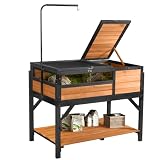
This is the pick for a keeper who wants the enclosure to look deliberate in a living room rather than like a pet crate. The tan finish, house-style roofline and wooden construction put it in the same visual category as a small cabinet, and the size class suits a juvenile to young adult of a smaller Mediterranean-type species. It suits someone who is willing to spend premium money once and then live with the result for years, and who does not need the enclosure to double as an outdoor pen.
Key specs
- Type: wooden tortoise house with a hinged or removable top panel
- Footprint class: medium to large — roughly the 3 ft long class, deeper than a typical glass tank of similar length
- Material: painted wood with a wire-mesh ventilation panel in the roof
- Access: full-width lid opening for substrate changes and animal handling
- Heating fit: mesh panel accepts a dome fixture resting on top, or a clamp lamp on the rim
- Substrate depth supported: deep enough for a burrowing species to dig down several inches
- Best indoor placement: against a wall away from radiators and draughts
What it does well
The strength here is the ratio of usable floor area to visual bulk. Because the walls are solid timber rather than glass, the interior holds warmth and humidity noticeably better than an open aquarium, which matters if you are running a Mediterranean species that needs a warm basking end without the whole room being heated. Solid walls also reduce the “glass surfing” behaviour that some tortoises show in clear-sided tanks, where they can see out and keep trying to walk through the barrier.
The lid design is the second advantage. A large opening means you are not reaching through a small hatch with a scoop while the animal sits in the way. That single detail changes how often you actually do a full substrate change, and the honest answer for most keepers is that cleaning frequency drops when cleaning is easy.
Ventilation is handled by the mesh roof section rather than by drilling holes in the sides, which keeps the airflow high where heat and humidity collect. The trade-off is that a mesh roof is also where heat escapes, so a wooden house in a cool room usually needs a slightly stronger basking lamp than a comparable glass setup.
Pros
- Solid wood walls hold heat and humidity better than glass or thin plastic
- Full-width top opening makes substrate changes straightforward
- Furniture-style appearance suits indoor placement in living areas
- Supports several inches of digging substrate
- Mesh roof provides high-level ventilation where it is needed
Cons
- Premium tier — the most expensive way to solve a problem that a budget box also solves
- No built-in lamp holder, so the heat fixture is an extra purchase and an extra thing to align
- Wood needs periodic attention if the enclosure is used outdoors or in a humid room
- Footprint will be outgrown by a fast-growing species within a couple of years
How it compares
The nearest alternative is the Aivituvin wooden habitat with detachable legs and an adjustable lamp holder. That model costs less, includes the lamp holder and can be raised or lowered, so it wins on value and flexibility. This tan enclosure wins on appearance and on the size of the single uninterrupted floor area — if you want one clean rectangular space rather than a leg frame to work around, it is the better choice.
2. PawHut Wooden Tortoise House (Yellow) – Best for a First Enclosure on a Budget

This is the entry point: a compact wooden box with a hinged top, marketed for tortoises and small reptiles including lizards and geckos. It suits a beginner setting up a hatchling or juvenile of a small species, or a keeper who needs a safe indoor box for the colder months and plans to build or buy something larger later. It is not the enclosure you keep an adult in for the next fifteen years.
Key specs
- Type: single-room wooden house with hinged lid
- Footprint class: small to medium — roughly the 2 ft long class
- Material: wood with a partially screened roof for airflow
- Access: hinged top opening
- Heating fit: needs an external clamp lamp or a dome fixture positioned above the mesh
- Cleaning: no removable tray, so substrate is scooped out through the lid
- Suits: hatchlings, juveniles, quarantine or hospital setups, small reptile species
What it does well
The value proposition is simple: for a budget price you get an enclosed wooden box with a screened section, which is a genuine step up from a bare plastic tub and a real improvement on a glass aquarium for humidity retention. Beginners often start with a glass tank because it is what the shop had, then discover that a tank with a mesh lid loses humidity as fast as you can add it. A wooden box with solid sides and a partial screen fixes most of that.
The small footprint is a feature at this stage, not a flaw. A hatchling in a very large enclosure can struggle to find its basking spot and its food, and temperature gradients become hard to control when the volume is large relative to the heat source. A compact box is easier to heat correctly, easier to monitor, and easier to move to a different room while you work out where the enclosure actually belongs.
The hinged lid keeps the whole footprint accessible, and because the unit is light for its size, one person can relocate it without help. For an indoor-only setup in a heated home, that is most of what you need.
Pros
- Lowest-cost route to a proper enclosed wooden habitat
- Solid walls retain humidity far better than an open glass tank
- Small size makes heating and temperature control genuinely manageable
- Light enough for one person to move between rooms or into a shed
- Works as a quarantine or recovery box even after you upgrade
Cons
- Will be outgrown — a growing tortoise needs more floor area within roughly one to three years
- No removable tray, so full substrate changes are slower than on tray-based designs
- No lamp holder included; the heat fixture must be bought and positioned separately
- Limited room for a deep substrate bed, which restricts burrowing species
- Not designed for unsupervised outdoor use
How it compares
The closest alternative in this list is the LIYAHUIA wooden tortoise house with a tray. Both sit at budget tier and both suit the same stage of ownership. The LIYAHUIA wins clearly on cleaning because the tray slides out, which turns a twenty-minute job into a five-minute one. This PawHut box wins on simplicity and on being the more forgiving size for a very small hatchling. If you expect to keep the enclosure for years, take the tray; if you need the smallest possible heated box right now, take this one.
3. GEGURI Tortoise Habitat Indoor & Outdoor – Best Overall for Year-Round Use

This is the best overall pick because it solves the problem most keepers hit in their second year: they own an indoor box and an outdoor pen, and they spend the warm months carrying the animal between the two. The detachable legs let the same wooden house sit on a table or shelf indoors, then drop to ground level or stand raised outdoors when the weather allows. It suits a keeper with a juvenile or small adult of a hardy species who wants one purchase instead of two.
Key specs
- Type: wooden tortoise house with detachable legs
- Footprint class: medium — roughly the 3 ft long class
- Material: wood with screened ventilation panels
- Configuration: tabletop (legs off) or floor-standing/raised (legs on)
- Heating fit: top surface accepts a lamp holder or dome fixture
- Cleaning: legs detach so the base can be lifted and emptied rather than scooped in place
- Suits: Mediterranean and other hardy small-to-medium species, seasonal indoor/outdoor rotation
What it does well
The detachable legs are the whole argument. An enclosure that lives permanently at floor level is hard to clean and harder to light, because you are crouching to reach into it. An enclosure that lives permanently on a table is easy to light but awkward to move outside. Being able to change the height changes how you use the product across the year, and that is worth more than any single extra feature on this list.
Second, the open base design makes substrate management realistic. Deep substrate is one of the most commonly skipped parts of tortoise husbandry, because shovelling damp coir out of a fixed box through a lid is unpleasant. When you can lift the shell off its base and tip the contents straight into a bin bag, you do it more often, and the animal lives in cleaner conditions as a result.
Third, the mid-range tier means the money goes into structure rather than finish. There is no premium cabinetry here, but there is enough solid wood to hold warmth and humidity, enough mesh to keep the air moving, and a footprint that will carry a small species through to adulthood in most cases.
Pros
- One enclosure covers both indoor and outdoor use across the seasons
- Detachable legs make cleaning and substrate replacement genuinely quick
- Height adjustment solves the common lamp-positioning problem
- Mid-range price sits well below premium cabinetry with similar usable floor area
- Screened panels give high-level ventilation without a fully open top
Cons
- Leg joints are the part most likely to loosen with repeated assembly — check them each season
- Not weatherproof for permanent outdoor exposure in wet or freezing climates
- Footprint is adequate rather than generous for a large adult
- Lamp holder is not included, so the heating setup is still a separate purchase
How it compares
The nearest alternative is the Aivituvin wooden habitat with detachable legs and adjustable lamp holder, which sits in the same mid-range tier and offers the same height flexibility. The Aivituvin includes the lamp holder, so it wins on out-of-the-box completeness. The GEGURI wins on the openness of the base and on the indoor/outdoor framing — if you intend to move the enclosure outside regularly rather than just once, this is the more practical of the two.
4. Boao 2-Piece Leaf Reptile Food & Water Bowl – Best for Feeding and Watering
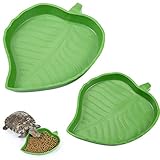
This is the accessory every enclosure on this list needs and almost none of them include. Two leaf-shaped molded dishes in one pack give you a dedicated food plate and a separate water dish, which matters because tortoises walk through their food and foul their water constantly when the two are combined. It suits any keeper, at any budget, in any of the enclosures above.
Key specs
- Type: molded resin feeding and watering dishes, pack of two
- Shape: leaf design with a shallow, wide profile
- Size class: small — intended for hatchlings through medium adults
- Depth: shallow, so a tortoise can reach the rim without climbing
- Cleaning: rinse under a tap, wipe, or wash in a dishwasher
- Placement: sink slightly into the substrate to prevent tipping and to keep the rim at floor level
What it does well
The shallow profile is the point. Deep bowls are a genuine hazard for small tortoises, which can flip onto their backs trying to reach over a high rim, and a flipped tortoise in a hot enclosure is an emergency. A wide, shallow dish lets the animal drink and eat with its feet on the ground and its head at a natural angle.
The leaf shape is not just decorative. A curved dish with a low rim is easier for a tortoise to approach from multiple directions, and the wider footprint resists being dragged around the enclosure. Sinking the base into the substrate stops the tipping problem entirely, which is the single most common complaint about lightweight plastic dishes.
Having two identical pieces means you can keep one in the enclosure and one clean and drying, so the animal is never without a water source while the other dish is being washed. For the price tier, that is a sensible piece of redundancy.
Pros
- Shallow design reduces the risk of tipping and of small tortoises flipping
- Two dishes in one pack — one for food, one for water, kept separate
- Molded resin resists staining better than plain plastic
- Fits inside every enclosure in this roundup, including the compact budget boxes
- Trivial to clean compared with scrubbing a heavy ceramic bowl
Cons
- Too small for a large adult tortoise to drink from comfortably
- Light weight means it must be sunk into the substrate or it will be pushed around
- Shallow depth means water evaporates quickly in a warm enclosure — check twice daily in summer
- Not a substitute for a proper soak tray for larger species
How it compares
There is no direct competitor in this list, because the other eleven products are enclosures. The nearest comparison is between this pack and whatever dish happens to come with an enclosure — most wooden houses ship with no dish at all, and the ones that do usually supply a single bowl that gets used for both food and water. Two dedicated dishes are a small upgrade that removes a daily hygiene problem, and at budget tier there is little reason to skip it.
5. PawHut Tortoise Habitat with Adjustable Lamp Holder – Best for Plug-and-Play Heating

This is the pick for a keeper who does not want to solve the lighting problem themselves. The adjustable lamp holder is built into the design, and a storage shelf underneath turns the enclosure into a piece of furniture with a practical job. It suits an indoor keeper with a juvenile or small adult, and it particularly suits anyone who has already tried balancing a clamp lamp on a wooden rim and would rather not do it again.
Key specs
- Type: two-layer wooden tortoise enclosure with storage shelf
- Footprint class: medium — roughly the 3 ft long class
- Material: wood with screened ventilation panels
- Heating fit: adjustable lamp holder included, height set by the keeper
- Cleaning: removable lower tray class, plus lift-off upper access
- Storage: shelf beneath the enclosure for substrate, bulbs and tools
- Suits: indoor-only setups in a heated room
What it does well
The adjustable lamp holder does more work than it first appears. Basking temperature is set by distance as much as by wattage, so being able to raise or lower the fixture lets you dial in the hot spot without buying a different bulb. That also means you can adjust seasonally, lowering the lamp slightly in a cold room and raising it in summer, rather than chasing the correct temperature with a dimmer or a thermostat alone.
The two-layer design and storage shelf solve a problem that is invisible until you own an enclosure: where the substrate, spare bulbs, calcium powder and cleaning cloths actually live. Having them directly under the animal means maintenance gets done when you notice it needs doing, rather than being deferred until you find the scoop.
Ventilation through screened upper panels keeps humid air from stagnating above the basking zone, which is where respiratory problems start in wooden enclosures that are sealed too tightly. The removable tray class of cleaning access puts it ahead of the budget boxes in this list, though behind the slide-out designs.
Pros
- Adjustable lamp holder included — no separate fixture to buy or align
- Built-in storage keeps consumables with the enclosure
- Two-layer construction gives vertical separation and extra usable volume
- Removable tray makes routine cleaning faster than a fixed-base box
- Mid-range price for a feature set that usually costs more
Cons
- Two-storey designs are heavier and harder to move alone than a simple box
- The shelf adds floor footprint in the room even though it adds no animal space
- The included lamp holder limits you to compatible fixture types
- Not intended for outdoor use
How it compares
The direct rival is the Aivituvin wooden habitat with detachable legs and an adjustable lamp holder. Both include a lamp holder at mid-range tier, so the decision comes down to form. The Aivituvin gives you height flexibility and a more open base; this PawHut gives you storage and a two-level structure. If space under the enclosure is useful to you, this wins. If you want to move the enclosure between a table and the floor, the Aivituvin wins.
6. PawHut Tortoise Habitat Outdoor with Run – Best for Supervised Outdoor Grazing

This is an outdoor unit rather than an indoor one. The openable top and attached run let a tortoise graze, walk and get natural sunlight over a much larger area than any tabletop box can offer, in a wooden frame with a dark gray finish. It suits keepers in mild climates with a secure garden, who want the animal outside for part of the day during the warm months under supervision.
Key specs
- Type: wooden outdoor habitat with integrated run
- Footprint class: large — the run adds substantially to the total ground area
- Material: wood, dark gray finish, with mesh run panels
- Access: openable top for feeding, handling and cleaning
- Heating fit: relies on ambient sunlight; shade and a hide are essential for thermoregulation
- Cleaning: open top and ground-level base allow hosing and raking
- Suits: hardy species, warm-weather daytime use, supervised only
What it does well
Floor area is the single most valuable thing you can give a tortoise, and no tabletop enclosure competes with a run. Walking distance supports muscle development, digestion and normal behaviour, and natural sunlight provides UVB in a way that artificial fixtures only approximate. For a species that would otherwise spend its life in a box, this is a meaningful quality-of-life upgrade.
The openable top makes the run practical rather than ornamental. You can drop food in, lift the animal out, and rake the surface without dismantling anything. The mesh panels keep the airflow high and prevent the build-up of stale humid air, which is a real risk in any closed outdoor box on a warm day.
Construction is solid enough to survive a season outdoors, which is more than can be said for most indoor wooden enclosures used outside. The dark gray finish is also a practical choice: it does not show soil, and it does not look out of place against a fence or a lawn edge.
Pros
- Far more usable ground area than any tabletop enclosure in this list
- Natural sunlight and grazing access for part of the year
- Openable top makes daily feeding and cleaning quick
- Mesh run panels keep airflow high on hot days
- Weather-resistant finish suits garden placement
Cons
- Not a complete solution — it cannot be the animal’s only housing in a cold climate
- Requires supervision; a mesh run is not a defence against determined predators
- No heating provision, so it is a warm-weather product only
- Premium tier, and it is an addition to an indoor enclosure rather than a replacement
How it compares
The nearest alternative is the GEGURI indoor/outdoor habitat with detachable legs, which can be moved outside but is fundamentally an indoor box. The GEGURI is cheaper, easier to move and can be heated; this run gives dramatically more ground area and natural light but cannot be used in cold weather. Keepers who can afford both usually run the indoor box as the primary enclosure and this as the summer daytime option.
7. Aivituvin Wooden Tortoise Habitat with Detachable Legs & Adjustable Lamp Holder – Best for Indoor Height Flexibility

This is the mid-range indoor option for a keeper who wants the lamp problem solved and the enclosure height to be adjustable. The detachable legs and the built-in adjustable lamp holder are the two features that matter, and together they cover the most common frustrations of indoor tortoise keeping: lighting placement and cleaning access. It suits a keeper with a small-to-medium species in a heated home.
Key specs
- Type: wooden terrarium-style habitat for small animals and reptiles
- Footprint class: medium — roughly the 3 ft long class
- Material: wood with screened top ventilation
- Configuration: tabletop or floor-standing, legs detachable
- Heating fit: adjustable lamp holder included
- Cleaning: base accessible with legs removed
- Suits: indoor-only, juvenile through small adult
What it does well
Combining detachable legs with an included lamp holder is the sensible pairing, because both features address the same underlying problem — getting the right distance between the heat source and the animal’s back. A lamp holder that adjusts vertically plus a base that can be raised or lowered gives you two ways to set basking temperature without changing bulbs. That is more control than either feature provides alone.
The wooden shell holds warmth better than a glass terrarium, which means a lower-wattage bulb can achieve the same basking spot temperature. Over a year of running a basking lamp for twelve hours a day, that difference shows up on the electricity bill, and it also reduces the risk of cooking a small enclosure with an oversized bulb.
Because the legs detach, the enclosure can be set up on a desk or a low table while the animal is small, then dropped to the floor as it grows and needs more room to move. The enclosure effectively adapts to two different stages of ownership without a second purchase.
Pros
- Adjustable lamp holder included at mid-range pricing
- Detachable legs give two usable configurations from one product
- Wooden walls retain heat, allowing a lower-wattage basking bulb
- Legs-off base access makes substrate changes straightforward
- Screened top ventilation keeps humidity from stagnating
Cons
- Footprint is adequate for a small species, tight for a large adult
- Leg fixings need periodic checking if the enclosure is moved often
- Indoor use only — the wood is not finished for permanent outdoor exposure
- No storage shelf, unlike the two-layer PawHut design
How it compares
The closest alternative is the GEGURI indoor/outdoor habitat, which shares the detachable-leg design and the same mid-range tier. The GEGURI is framed for seasonal outdoor use and has a more open base; this Aivituvin includes the lamp holder and is aimed squarely at indoor setups. If the enclosure will never leave the house, this is the more complete purchase; if it will spend summers outside, take the GEGURI.
8. TimberCabin 43″ Large Tortoise Habitat with Stand – Best for Adult Small-to-Medium Species Indoors

At 43 inches long, this is the longest single-room enclosure in the roundup, and the matching stand lifts it to a working height rather than leaving it on the floor. It suits a keeper with an adult of a smaller species — the kind of animal that has outgrown a two-foot starter box and needs genuine walking length without a full custom build.
Key specs
- Type: wooden tortoise habitat on an integrated stand
- Length: 43 in class — the longest single-chamber option here
- Material: wood with a screened roof section
- Access: top opening across the length of the enclosure
- Heating fit: stand height keeps a dome fixture clear of the floor and at a workable distance
- Cleaning: no slide-out tray; substrate is removed through the top
- Suits: adult small-to-medium species, indoor permanent placement
What it does well
Length is what a tortoise actually uses. A 43-inch enclosure gives an adult room to walk a real circuit between the basking end and the cool end, and it makes it possible to establish a proper temperature gradient instead of a single warm corner. For a species that would otherwise be circling a two-foot box, this is the difference between adequate and appropriate housing.
The stand is more useful than it sounds. An enclosure at floor level is hard to light correctly, because the lamp has to travel a long way down and the keeper has to crouch to reach in. Raising the whole unit puts the basking zone at a sensible distance from a dome fixture and makes daily feeding and spot-cleaning comfortable rather than a chore. It also keeps the animal above draughts and away from cold floors.
The screened roof section provides the high-level ventilation that wooden enclosures need, releasing the warm humid air that collects above the basking spot while keeping the lower part of the enclosure stable. Solid walls plus a screened top is the standard recipe for a reason.
Pros
- Longest single-chamber footprint in this roundup at 43 inches
- Integrated stand improves lamp positioning and daily access
- Enough length for a genuine warm-to-cool temperature gradient
- Wooden construction holds heat and humidity better than glass
- Suitable as a permanent enclosure for an adult of a smaller species
Cons
- Premium tier, and the stand makes it bulky to move once assembled
- No pull-out tray, so full substrate changes are slower than tray-based designs
- Long footprint needs a wall of clear space in the room
- Not weatherproof for outdoor use
How it compares
The nearest alternative is the Magazoopet 39-inch enclosure, which is only slightly shorter but sits two tiers lower on price and includes a storage shelf. The Magazoopet is the value choice; this TimberCabin is the one to pick when you want the extra four inches of walking length, a proper stand and a furniture-grade appearance. If the animal is already an adult, the extra length is worth the premium.
9. Magazoopet 39″ L Large Tortoise Enclosure – Best Budget Large Enclosure

This is the budget answer to the problem of outgrowing a small box. At 39 inches long it belongs in the large size class, and the wood-and-plastic composite construction with a storage shelf keeps the price down without collapsing the footprint. It suits a keeper who needs length on a limited budget and is willing to trade premium finish and tray convenience for floor area.
Key specs
- Type: wooden and plastic composite tortoise enclosure with storage shelf
- Length: 39 in class — large tier at a budget price
- Material: wood frame with composite panels, screened ventilation
- Access: top opening
- Heating fit: open top surface accepts a dome fixture or clamp lamp
- Cleaning: composite interior wipes down; no slide-out tray
- Suits: budget-conscious keepers, juveniles growing into adults
What it does well
The composite construction is the interesting part. Where an all-wood enclosure needs periodic sealing and can stain from damp substrate, composite panels wipe clean and resist moisture uptake. That matters most in exactly the place where wooden enclosures fail — the corners and the floor, where damp substrate sits for weeks at a time.
The storage shelf underneath performs the same trick as the shelf on the two-layer PawHut: it keeps substrate, bulbs and tools with the enclosure, so maintenance happens when you notice it rather than when you finally go looking for the scoop. On a budget enclosure, that is a genuinely useful inclusion rather than padding.
At 39 inches, the enclosure supports a warm end and a cool end with a usable middle, which is the minimum for a proper gradient. It is not a luxury footprint, but it is a working one, and at budget tier that combination is uncommon.
Pros
- Large-tier length at a budget-tier price
- Composite panels resist moisture and wipe clean easily
- Storage shelf keeps consumables with the enclosure
- Screened ventilation panels keep air moving above the basking zone
- Long enough to establish a real temperature gradient
Cons
- No pull-out tray, so full substrate changes are slower
- Composite panels are lighter than solid timber, so heat retention is lower
- Budget fittings and hinges are the parts most likely to need attention first
- Indoor use only
How it compares
The nearest alternative is the TimberCabin 43-inch habitat with stand. The TimberCabin is longer, comes with a stand and looks better in a living room, but it costs substantially more. This Magazoopet wins on cost per inch of usable floor area, which is the metric that matters most when you are trying to house a growing animal on a fixed budget. If you can live without the stand, this is the smarter purchase.
10. XilishppEcxEco Large Tortoise Hidden Habitat – Best for a Built-In Hide with Outdoor Looks

The distinguishing feature here is the hidden-habitat layout: the enclosure is built around a sheltered retreat rather than being an open box with a hide dropped in as an afterthought. The asphalt roof and ventilating wire panels give it a garden-shed appearance that suits a patio or a sheltered outdoor spot as well as an indoor corner. It suits a keeper who wants the hide to be structurally part of the enclosure.
Key specs
- Type: wooden hidden-habitat enclosure with roof
- Footprint class: medium to large — roughly the 3 ft class
- Material: wood with an asphalt roof and ventilating wire panels
- Access: roof lifts for feeding and cleaning
- Heating fit: roof shade reduces heat build-up; lamp mounting is external
- Cleaning: lift the roof, rake or scoop the base
- Suits: indoor or sheltered outdoor placement in mild conditions
What it does well
A built-in hide is better than a loose one for one simple reason: it does not get pushed around, buried or tipped over. Tortoises use hides constantly to thermoregulate and to feel secure, and a structurally fixed retreat means the animal always has somewhere to go. It also gives you a defined cool zone, which makes the temperature gradient easier to reason about when you are positioning the basking lamp.
The asphalt roof does two jobs. It sheds rain if the enclosure sits outdoors in a sheltered spot, and it provides shade that keeps the interior from overheating in direct sun. On a warm day, a wooden box with a solid roof and open sides stays noticeably cooler than a glass tank in the same position, which is a genuine welfare advantage during a heatwave.
The ventilating wire panels run the length of the enclosure rather than being confined to a small patch, so air exchange is consistent across the whole interior. That reduces the risk of the stagnant, humid pockets that cause respiratory problems in poorly vented wooden boxes.
Pros
- Integrated hide is structural, so it cannot be displaced by the animal
- Asphalt roof sheds water and provides built-in shade
- Wire vent panels run along the enclosure for even airflow
- Roof lifts for full access to the interior
- Garden-shed appearance suits outdoor and semi-outdoor placement
Cons
- Roof shading reduces the heat a lamp can deliver, so basking temperatures need checking
- Not designed for permanent exposure to hard frost
- Internal layout is fixed — less flexible than an open box you furnish yourself
- Mid-range price for a footprint that is not the largest here
How it compares
The nearest alternative is the GEGURI indoor/outdoor habitat, which is also framed for both settings and sits in the same price tier. The GEGURI gives you height adjustment and an open floor plan; this XilishppEcxEco gives you a fixed hide, a weather-shedding roof and better shading. If your tortoise is a species that spends most of the day hidden, the built-in retreat is the more useful design.
11. LIYAHUIA Wooden Tortoise House with Tray – Best Budget Enclosure for Easy Cleaning

This is the budget pick for anyone whose main complaint about their current setup is how long it takes to clean. The removable tray is the feature that matters: it slides out, gets emptied, gets wiped and goes back, which turns a full substrate change from a chore into a few minutes of work. It suits a keeper with a small-to-medium species who wants hygiene to be easy rather than aspirational.
Key specs
- Type: wooden tortoise house with removable tray
- Footprint class: small to medium — roughly the 2 to 3 ft class
- Material: wood with a removable base tray
- Access: top opening plus tray removal
- Heating fit: external clamp lamp or dome fixture above the mesh
- Cleaning: slide-out tray — fastest routine clean in this roundup
- Suits: budget setups, quarantine boxes, keepers who clean frequently
What it does well
Cleaning frequency is the most reliable predictor of how healthy an enclosure is, and tray designs raise that frequency more effectively than any other single feature. When the substrate sits in a lift-out tray, you can do a full change in the time it takes to make a coffee, which means you actually do it on schedule instead of stretching the interval. Over a year, that difference compounds.
The wooden shell provides the humidity and heat retention that an open glass tank cannot, while the tray solves the moisture problem that normally shortens a wooden enclosure’s life. Damp substrate sits in the tray rather than against the timber, so the wood stays drier and lasts longer. That is a design decision that pays for itself.
Because the footprint is modest, the enclosure heats efficiently. A single basking lamp can hold a proper gradient across a small box, and a small box is easier to monitor for temperature problems than a large one. For a juvenile, that simplicity is worth more than extra floor area.
Pros
- Slide-out tray makes full substrate changes fast and easy
- Wooden walls hold heat and humidity better than glass
- Tray protects the timber from damp substrate, extending enclosure life
- Budget tier, and cheaper than any other tray-equipped option here
- Small footprint heats efficiently with a single basking lamp
Cons
- Footprint will be outgrown by a medium or large species
- No lamp holder included
- Wood construction needs occasional attention in humid conditions
- Tray edges can be chewed or pushed by a determined animal if the fit is loose
How it compares
The nearest alternative is the PawHut wooden tortoise house at the same budget tier. Both are small wooden boxes aimed at beginners, but they solve different problems. The PawHut is the simpler, slightly more forgiving size for a tiny hatchling; this LIYAHUIA is the better long-term budget buy because the tray keeps the enclosure clean and the wood dry. If you clean less often than you should, take the tray.
12. ZENTAVO 3-Room Large Tortoise Habitat with Pull-Out Tray – Best Premium Multi-Zone Enclosure

Three connected rooms, a ramp, a grass element and a pull-out tray make this the most feature-dense enclosure in the roundup. It suits a keeper with a growing or adult tortoise who wants distinct zones — a basking room, a cooler walking room and a sheltered retreat — plus cleaning access that does not require dismantling the setup.
Key specs
- Type: multi-room wooden tortoise habitat with ramp and grass element
- Footprint class: large — multi-room layout, the biggest internal volume here
- Material: wood with ventilated panels across the rooms
- Zones: three connected compartments joined by a ramp
- Heating fit: multiple zones let you place a basking lamp in one room and leave another genuinely cool
- Cleaning: pull-out tray under the main room
- Suits: adults of small-to-medium species, keepers who want environmental variety
What it does well
Multi-zone layouts solve the hardest problem in tortoise housing: giving the animal a real choice of microclimates. In a single open box, the gradient is a smooth slope from hot to cold, and the animal has nowhere to be genuinely warm and hidden at the same time. With three rooms, you can run a hot basking room, a moderate walking room and a cool retreat, and the animal moves between them on its own schedule. That is closer to how a tortoise uses space in the wild.
The ramp adds vertical movement and usable surface area, which encourages activity in an animal that otherwise spends most of the day stationary. It also makes the enclosure visually interesting, which matters if it lives in a living area rather than a spare room.
The pull-out tray under the main room means the dirtiest part of the enclosure — the basking zone, where waste accumulates fastest — can be emptied without touching the rest of the layout. Combined with the larger footprint, that puts this enclosure ahead of every single-room option here on maintenance convenience.
Pros
- Three distinct zones allow a genuine choice of temperature and humidity
- Pull-out tray makes cleaning the main room quick
- Largest internal volume in this roundup
- Ramp adds usable surface area and encourages activity
- Ventilated panels across multiple rooms keep airflow even
Cons
- Premium tier — the most expensive enclosure here
- Multi-room layouts are harder to heat evenly; expect to monitor temperatures in each zone
- Large footprint and assembled weight make it hard to move
- More internal surfaces and joints to clean than a simple box
How it compares
The nearest alternative is the TimberCabin 43-inch habitat with stand. Both are premium, both are large, and both aim at adult animals. The TimberCabin gives one long, clean, easy-to-heat space with a stand; the ZENTAVO gives multiple zones, a ramp and a pull-out tray but demands more careful temperature management. If your priority is behavioural enrichment, take the ZENTAVO. If your priority is a simple gradient that is easy to control, take the TimberCabin.
How to Choose
The enclosure decision has an order of operations. Get the footprint right first, then the material, then ventilation, then heating, then cleaning. Choosing in any other order leads to a setup that looks good and works badly.
Start with footprint, not features
Floor area is the constraint that everything else has to fit around, and it is the one thing you cannot upgrade later without buying