What's inside
- Top 3 Picks
- Quick Comparison
- How We Chose
- 1. K&F CONCEPT Fluid Head – Best for Hybrid Stills and Video
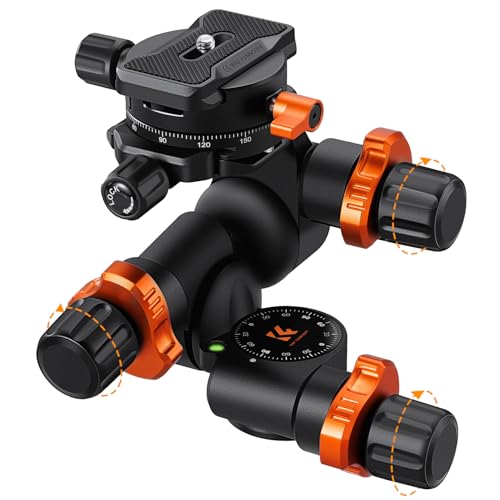
- 2. K&F Concept 3-Way Geared Tripod Head – Best for Precise Composition and Macro
- 3. NEEWER GM36 Low Profile Ball Head – Best for Budget Stills and Panoramas
- 4. CAVIX H-46 Ball Head – Best for Heavy Stills Kits
- 5. K&F CONCEPT 36mm Ball Head with Detachable Handle and Tilt Limiter – Best for One-Hand Control
- 6. NEEWER GM27 Fluid Head with ±10° Leveling Base – Best for Leveling on Uneven Ground
- 7. INNOREL C19 Mini Ball Head – Best for Travel and Tabletop Rigs
As an Amazon Associate I earn from qualifying purchases. This post may contain affiliate links at no extra cost to you.
The best tripod head for most people shooting both stills and video is the K&F CONCEPT Fluid Head with its Arca-Swiss-compatible clamp: it pans and tilts smoothly enough for video, holds a mirrorless or DSLR kit steady for stills, and sits in the mid-range tier rather than the premium one. If your work is stills-first and your kit is heavy — a 70–200mm f/2.8 or a gripped body — the CAVIX H-46 is the better buy, because a 46mm ball rated to 20 kg (44 lb) holds a heavy rig with far more margin than any 36mm head can. If you are spending as little as possible, the NEEWER GM36 is the budget pick; if you shoot dedicated video with long, slow pans, the premium NEEWER ⌀55mm fluid head is the one that feels engineered for exactly that. Geared heads, mini heads and lever-lock 46mm heads cover the rest: precision composition, travel rigs, and fast event work where locking speed matters. This guide compares ball, fluid and geared heads by load capacity, weight, locking strength and panning smoothness — and explains where a gimbal head, which none of the picks below is, would be the right answer instead.
Our Top Picks



Top 3 Picks
Best Overall: K&F CONCEPT Fluid Head
The most versatile head in this list for hybrid shooters. Fluid pan and tilt give you usable video motion, while the Arca-Swiss-compatible clamp means the same plate you use on a ball head works here. It is the head to buy when you cannot justify two separate setups.
Best Budget: NEEWER GM36 Low Profile Ball Head
A 36mm metal ball with a panorama base at the budget tier. It is the sensible first upgrade from a plastic pan-and-tilt head and handles a mirrorless body with a compact zoom without drama. It will not hold a long telephoto, and it is not trying to.
Best Premium: NEEWER Video Fluid Head with 55mm Panorama Base
The largest panning base in this roundup, a telescopic handle for leverage, and a quick release plate. This is a head for people who shoot video as the primary job rather than as an occasional mode, and it is priced accordingly.
Quick Comparison
| Product | Best for | Key specs | Load class | Price tier |
|---|---|---|---|---|
| K&F CONCEPT Fluid Head | Hybrid stills + video | Two-axis fluid pan/tilt; Arca-Swiss-compatible clamp; 1/4″-20 camera screw, 3/8″-16 base | Mirrorless or DSLR with standard zoom | Mid-range |
| K&F Concept 3-Way Geared Tripod Head | Precision composition | Three geared axes; independent locks; micro-adjustable pan, tilt and shift | Moderate to heavy tripod kits | Premium |
| NEEWER GM36 Low Profile Ball Head | Budget stills and panoramas | 36mm metal ball; low profile; panorama base; 360° pan | Light to moderate | Budget |
| CAVIX H-46 Ball Head | Heavy stills kits | 46mm metal ball; rated 20 kg / 44 lb; Arca-Swiss quick release | Heavy | Mid-range |
| K&F CONCEPT 36mm Ball Head with Handle | One-hand control | 36mm ball; detachable pan handle; tilt limiter | Light to moderate | Budget |
| NEEWER GM27 Fluid Head | Leveling on uneven ground | Fluid pan/tilt; ±10° leveling base; 37mm base diameter | Moderate | Mid-range |
| INNOREL C19 Mini Ball Head | Travel and tabletop rigs | CNC metal low-profile ball head; 360° pan; 90° tilt | Very light | Budget |
| Avella V1 38mm Ball Head | First serious ball head | 38mm ball; 360° swivel; U-shaped groove for portrait drop | Light to moderate | Budget |
| NEEWER Video Fluid Head (55mm base) | Dedicated video panning | Fluid head; ⌀55mm panorama-scaled base; telescopic handle; quick release plate | Moderate to heavy video rigs | Premium |
| WEYLLAN EH46L Lever Ball Head | Fast lever locking | 46mm low-profile ball; lever lock; stainless steel lock pin | Heavy | Premium |
| EVUMO EX46L Lever Ball Head | Arca-Swiss lever workflow | 46mm low-profile ball; lever lock; stainless steel lock pin; Arca-Swiss mount | Heavy | Premium |
| SmallRig CT-10 Tripod & Monopod | Complete starter kit | Aluminum tripod plus monopod; 71 in / 180 cm max height; ball head included | Light to moderate | Mid-range |
How We Chose
These picks were assembled from published manufacturer specifications, category standards that apply across the industry, and a clear-eyed look at how each head type is actually used. Four criteria did the sorting. First, specification fit: ball diameter, stated load rating, base thread, plate standard and pan base diameter, all of which determine what a head can physically hold. Second, category fit: whether a head is genuinely a fluid head with drag, a ball head with a friction control, or a geared head with independent axes — the labels matter less than the mechanism. Third, use case: a head that is excellent for a 600mm lens is the wrong answer for a travel rig, and a mini ball head that is perfect on a tabletop is useless under a full-frame body with a fast zoom. Fourth, upgrade path: whether the head leaves you room to grow, shares a plate standard with the rest of your kit, or becomes a dead end the moment your lens gets heavier. We did not test these heads, did not benchmark them, and did not handle them in person. Everything here is based on what the products are specified to do and how that specification maps onto real shooting situations.
1. K&F CONCEPT Fluid Head – Best for Hybrid Stills and Video
As an Amazon Associate we earn from qualifying purchases at no extra cost to you.

This is the head to buy if you shoot both stills and video and want one piece of gear instead of two. The K&F CONCEPT Fluid Head is built around fluid pan and tilt, which means the motion has resistance built in rather than the free, snappy swing of a ball head. That resistance is the whole point: it lets you start a pan, hold it, and stop it without a jerk at either end. It suits a mirrorless or DSLR body with a standard zoom, and it suits anyone who shoots travel, events, or run-and-gun video where setting up a second head is not realistic.
- Type: two-axis fluid head with pan and tilt drag
- Quick release: Arca-Swiss-compatible clamp, so it shares plates with most ball heads
- Mounting: industry-standard 1/4″-20 camera screw and 3/8″-16 base thread
- Control: a single panning handle for controlled starts and stops
- Load class: mirrorless or DSLR with a standard zoom; not a long-telephoto head
- Price tier: mid-range
The Arca-Swiss-compatible clamp is the detail that makes this head easy to live with. If you already own Arca-Swiss-style plates on your camera bodies and lenses, you do not need to buy anything else — the plate that lives on your camera for a ball head slots straight into this head. That single compatibility point removes the most common reason people avoid owning a fluid head alongside a ball head: the fear of carrying two plate systems and swapping them in the field.
On panning smoothness, fluid drag is categorically different from a ball head’s friction control. A ball head’s friction is there to stop the camera from flopping; a fluid head’s drag is there to shape motion. For a slow, even pan across a landscape or a steady tilt down a building, the fluid head will look better on playback with no practice, because the resistance smooths out the small involuntary movements your hands make. For stills, the trade-off is that the head does not snap into a locked position the way a ball head does — you compose, then lock, and if you nudge it you re-level. That is a workflow difference, not a defect.
Pros
- Fluid pan and tilt that produces usable video motion without a learning curve
- Arca-Swiss-compatible clamp means one plate standard across your whole kit
- Mid-range tier rather than premium, so it is reachable for a one-head setup
- Handles stills competently, which makes it a genuine hybrid rather than a video-only tool
Cons
- Not a substitute for a gimbal head if you shoot long telephoto lenses
- A single panning handle limits two-handed control on long, slow moves
- Fluid heads drift slightly when you are trying to frame stills with precision
- Load ceiling is well below the 46mm ball heads further down this list
How it compares: the nearest alternative is the NEEWER GM27, which is also a fluid head in the mid-range tier but adds a ±10° leveling base on a 37mm base. If you shoot on uneven ground and do not own a bowl tripod, the GM27 solves a problem this head does not. If you want the widest compatibility with existing plates and the option to shoot stills on the same head, the K&F CONCEPT is the more flexible choice. Against the premium NEEWER ⌀55mm fluid head, this one gives up pan base diameter and handle length, which is exactly what you are paying for at the top of the range.
2. K&F Concept 3-Way Geared Tripod Head – Best for Precise Composition and Macro

Geared heads are the answer to a specific frustration: you frame a shot, tighten the lock, and the camera shifts a fraction of a degree as the lock bites. A geared head removes that problem entirely, because you adjust each axis with a knob through a gear train rather than by hand. The K&F Concept 3-Way Geared Tripod Head gives you independent geared control of pan, tilt and shift, which makes it the right tool for architectural work, macro, product photography, and any landscape where you are aligning a horizon to a grid and cannot afford to lose the alignment.
- Type: three-axis geared head with independent geared adjustment
- Axes: pan, tilt and shift, each with its own control
- Adjustment: micro-adjustment through the gear train, with independent locking
- Best rigs: tripod-based stills work with moderate to heavy camera bodies
- Price tier: premium
The practical advantage of gearing shows up most clearly in macro and architecture, where the smallest camera movement changes the composition meaningfully. At 1:1 magnification, a two-degree nudge moves your subject several millimetres across the frame. With a geared head you can make a one-degree correction deliberately and repeatably. That repeatability matters if you are shooting a focus stack or a series of frames you intend to stitch — you can step the camera in predictable increments rather than eyeballing each move.
Geared heads also hold heavy loads in a way ball heads struggle with. Because the load is carried by a gear train rather than a friction surface, there is no slipping, no creep, and no need to over-tighten a knob to keep a heavy camera in place. That means less wear on the mechanism over years of use, and it means you can mount a heavier body and lens than you would want to trust to a ball head’s friction control. The cost of that precision is speed. If your subject moves, a geared head is the wrong tool, and you will feel it within the first minute.
Weight and bulk are the other honest trade-offs. A three-axis geared head is a substantial piece of metal, and it will make a light travel tripod top-heavy and less pleasant to carry. It also demands a tripod with real torsional rigidity — put it on flimsy legs and you have bought precision you cannot use, because the legs will move more than the head does.
Pros
- Micro-adjustment that makes framing repeatable instead of approximate
- No lock-bite shift, which is the single biggest reason to move away from ball heads
- Gear train holds heavy loads without friction creep
- Independent axis locks let you move one axis without disturbing the others
Cons
- Slow for anything that moves, including people and weather
- Heavier and bulkier than any ball head in this list
- Premium tier, so it is a considered purchase rather than an impulse upgrade
- Needs a genuinely rigid tripod to deliver its advantage
How it compares: the nearest alternative here is the K&F CONCEPT Fluid Head, which is cheaper, lighter and far faster to operate but has none of the geared head’s precision. If your work is video, people, or anything handheld-ish, the fluid head wins outright. If your work is macro, architecture, or studio stills on a tripod, the geared head is the only one of the two that will let you nail a composition on the first attempt and repeat it exactly on the second.
3. NEEWER GM36 Low Profile Ball Head – Best for Budget Stills and Panoramas
The NEEWER GM36 is what a first proper ball head should be: a 36mm metal ball, a low-profile body, and a panorama base that rotates independently of the ball. It suits a mirrorless or entry DSLR body with a compact or standard zoom, and it suits anyone who has been fighting a plastic pan-and-tilt head and wants to stop. The low-profile design keeps the camera closer to the tripod’s apex, which lowers the centre of gravity and reduces the lever arm that vibration works through.
- Ball diameter: 36mm metal ball
- Design: low profile, which reduces height and improves stability
- Panning: independent panorama base with 360° rotation
- Release: Arca-Swiss-style quick release plate
- Load class: light to moderate camera and lens combinations
- Price tier: budget
Ball diameter is the number that matters most on a ball head, and 36mm is the classic budget-to-mid entry point. A bigger ball has more surface area in contact with the socket, which means more friction available at any given knob pressure and less tendency to slip under load. A 36mm ball will hold a mirrorless body with a standard zoom comfortably, and it will hold a small telephoto if you are careful and keep the friction knob reasonably firm. It will not hold a 70–200mm f/2.8 pointed down at a low angle without creeping, and no amount of knob tightening changes the physics.
The low-profile geometry is a genuine advantage for stability but a mild disadvantage for range. Because the ball sits closer to the base, the camera can contact the head sooner when you tilt far, so the extremes of the tilt range are less usable than on a taller head with the same ball size. For landscape and general stills, that trade is worth taking. For anyone who needs to shoot straight up or drop into a deep portrait orientation at the same time as a long lens, a taller head gives more clearance.
The panorama base is the feature that makes this head better than its price tier suggests. Being able to pan the whole assembly without touching the ball’s lock is what makes stitched panoramas practical, because the camera rotates around a fixed vertical axis between frames instead of drifting. It also makes video pans at least tolerable, even though a fluid head will always be smoother.
Pros
- Independent panorama base for stitched panoramas and simple pans
- Low-profile body keeps the centre of gravity low and the rig compact
- Metal ball construction at a budget price tier
- Straightforward single-knob friction control with no learning curve
Cons
- 36mm ball runs out of holding power with heavy telephoto lenses
- Low profile limits usable tilt at the extremes
- No separate friction and lock knobs, so fine drag adjustment is limited
- Not a video head — panning motion will not be as smooth as fluid drag
How it compares: the nearest alternative is the K&F CONCEPT 36mm Ball Head with detachable handle, which shares the same ball size class but adds a panning handle and a tilt limiter. If you want the smoother, more controlled panning that a handle gives you, that head is the better buy at the same tier. If you want the simplest, lightest, most compact option and you mostly shoot stills, the GM36 is the cleaner choice. Against the CAVIX H-46, this head gives up ten millimetres of ball diameter and the corresponding load capacity, which is the entire difference between a budget head and a heavy-duty one.
4. CAVIX H-46 Ball Head – Best for Heavy Stills Kits

The CAVIX H-46 is the value proposition of this roundup for anyone with a heavy stills kit. It pairs a 46mm metal ball with a rated load of 20 kg (44 lb) and an Arca-Swiss quick release, at a mid-range price tier rather than a premium one. That combination is unusual, and it is the reason this head appears here: if you shoot a 70–200mm f/2.8, a gripped full-frame body, or a medium-format system, this is the cheapest sensible way to get a big ball under it.
- Ball diameter: 46mm metal ball
- Rated load: 20 kg / 44 lb
- Release: Arca-Swiss quick release plate
- Body: metal construction with an independent panning base
- Price tier: mid-range
Understanding why a 46mm ball changes things is worth two minutes. The friction a ball head generates depends on the contact area between the ball and the socket, and on how much pressure the locking mechanism applies. Going from 36mm to 46mm increases the ball’s surface area substantially, which means the head can generate far more holding force at the same knob pressure. In practice, this is the difference between a camera that stays exactly where you point it and a camera that sags slowly the moment you let go. For long lenses especially, that sag is the difference between a usable head and a frustrating one.
The 20 kg rating should be read as a ceiling rather than a target. Nobody needs a head rated to 20 kg to hold a 2 kg camera, but the rating tells you the head has engineering margin: the friction mechanism, the clamp jaws and the panning base are all built to survive loads far beyond what you will put on them. That margin is what translates into long-term durability, because you are never operating the mechanism at its limit. A head used at 20% of its rated capacity will outlast a head used at 90% of its rated capacity by a wide margin.
The trade-off is weight and bulk. A 46mm ball head is a substantial object, and on a light travel tripod it will feel like the tail wagging the dog. It also costs more than the budget heads here, though far less than the premium lever-lock 46mm heads. If you do not own a lens heavy enough to need it, the extra capacity is dead weight in your bag.
Pros
- 20 kg / 44 lb rated load at a mid-range tier, which is exceptional headroom for the money
- 46mm ball gives far more holding power than any 36mm or 38mm head here
- Arca-Swiss quick release keeps you in the most widely supported plate standard
- Metal construction and generous engineering margin support long-term durability
Cons
- Heavier and bulkier than the budget ball heads, which matters for travel
- Overkill for a mirrorless body with a small lens
- Knob locking is slower to operate than the lever locks on the premium heads
- Large ball diameter takes more knob travel to fully release
How it compares: the nearest alternatives are the WEYLLAN EH46L and EVUMO EX46L, both 46mm low-profile lever-lock heads in the premium tier. Those two give you faster locking and a stainless steel lock pin, and the low-profile design puts the camera lower. The CAVIX gives you the same ball diameter and a higher stated load rating at a lower tier, with knob locking instead of lever locking. If you shoot events where you unlock and relock constantly, the lever heads earn their premium. If you compose carefully and lock once, the CAVIX is the smarter spend.
5. K&F CONCEPT 36mm Ball Head with Detachable Handle and Tilt Limiter – Best for One-Hand Control

This head solves a problem most ball heads ignore: a ball head with no handle forces you to grip the camera itself to pan, which is exactly the wrong place to apply force. The K&F CONCEPT 36mm Ball Head adds a detachable panning handle and a tilt limiter, which together make the head behave more like a video head for motion while keeping the ball-and-socket mechanism for stills. It suits photographers who shoot a mix of stills and casual video and want one head that handles both without the cost of a dedicated fluid head.
- Ball diameter: 36mm
- Handle: detachable panning handle for controlled pan and tilt
- Tilt limiter: restricts how far the head will tilt, preventing an accidental forward flop
- Release: Arca-Swiss-style quick release
- Load class: light to moderate camera and lens combinations
- Price tier: budget
The tilt limiter is the more interesting feature of the two, and it is often misunderstood. It is not counterbalance and it does not make a heavy lens weightless. What it does is mechanically stop the head from tilting past a set point, which prevents the classic accident where you loosen the ball with a front-heavy lens attached and the whole rig dives forward before you can catch it. On a 36mm head with a compact telephoto, that is a genuinely useful safety net, and it is the kind of feature that matters most to people who have already dropped a camera once.
The detachable handle is what changes the feel of panning. Applying force at a handle several centimetres from the ball gives you finer control than gripping the camera body, because your hand movements are translated into smaller angular changes. That is the same principle that makes a fluid head’s handle useful. The handle detaches, which means you can remove it for travel and reattach it when you need it — a small thing that makes the head far more packable than a fixed-handle design.
What this head is not is a fluid head. There is no fluid drag cartridge, so panning has the free, low-resistance feel of a ball head rather than the damped feel of a video head. With practice you can produce decent pans, and the handle helps considerably, but a purpose-built fluid head at a similar or slightly higher tier will always be smoother. If video is more than a third of what you shoot, buy the fluid head instead.
Pros
- Detachable handle gives much better panning control than a bare ball head
- Tilt limiter prevents the classic front-heavy lens dive
- Handle removes for travel, so the head packs small
- Budget tier with a full-size 36mm ball
Cons
- No fluid drag, so panning is not as smooth as a true fluid head
- 36mm ball limits how heavy a lens you can use confidently
- Detachable handle is one more thing to lose or leave at home
- Tilt limiter constrains creative angles if you forget it is engaged
How it compares: the nearest alternative is the NEEWER GM36, which uses the same 36mm ball class but has no handle and no tilt limiter. If you shoot stills almost exclusively and want the smallest, simplest head, the GM36 is the better pick. If you want smoother panning and a safety net against lens dives, this head is the better one — and it is the closest thing to a hybrid in the budget tier. Against the K&F CONCEPT Fluid Head, it gives up fluid drag entirely but costs less and packs smaller.
6. NEEWER GM27 Fluid Head with ±10° Leveling Base – Best for Leveling on Uneven Ground

The NEEWER GM27 is a fluid head with a feature that most heads in its class do not have: a built-in leveling base with ±10° of adjustment. That single addition solves a problem that otherwise requires either a bowl tripod or a lot of fiddling with leg lengths. It suits video shooters working on slopes, stairs, uneven terrain or a tripod whose legs are set at different angles, and it suits anyone who wants a level horizon without carrying a separate leveling bowl.
- Type: fluid head with pan and tilt drag
- Leveling: integrated ±10° leveling base
- Base diameter: 37mm
- Release: quick release plate
- Load class: moderate camera and lens combinations
- Price tier: mid-range
Leveling is one of those things that seems like a minor convenience until you have shot without it. A fluid head’s panning motion is only level if the panning axis is vertical. If your tripod is set up on a slope, the pan axis tilts with it, and a horizontal pan becomes a slow arc that drifts up on one side and down on the other. You can fix this by adjusting leg lengths, but that is slow, imprecise, and annoying every time you move the tripod. A ±10° leveling base lets you set the legs roughly, then level the head precisely in a couple of seconds with a single control.
Ten degrees is a meaningful amount of correction. On a tripod with a footprint of roughly a metre, ±10° covers a substantial slope — more than most people encounter on a path, a beach or a staircase. It will not cover the extremes, like shooting from a steep hillside where you need 25 or 30 degrees of correction; for that you need a proper bowl and a 75mm or 100mm fluid head, which is a different category of equipment entirely. But for the overwhelming majority of outdoor video work, ±10° is enough.
The 37mm base diameter is on the smaller side for a fluid head, which is consistent with its mid-range positioning. A larger pan base gives you more bearing surface and therefore smoother, more consistent pans, especially at very slow speeds. This head is not competing with the premium ⌀55mm fluid head further down this list on panning smoothness, and it is not priced to.
Pros
- Integrated ±10° leveling base removes the need for a separate bowl
- Fluid drag gives usable, damped pan and tilt motion
- Mid-range tier, which is unusually affordable for a leveling fluid head
- Fast setup on uneven ground compared with adjusting leg lengths
Cons
- ±10° will not cover extreme slopes, where a bowl system is still required
- 37mm base diameter is modest for very slow, very long pans
- Leveling base adds a control to manage and a little more weight
- No Arca-Swiss-compatible clamp stated, so plate compatibility needs checking
How it compares: the nearest alternative is the K&F CONCEPT Fluid Head, which offers an Arca-Swiss-compatible clamp but no leveling base. Choose the GM27 if you shoot outdoors on uneven ground and leveling is your recurring headache; choose the K&F if your plate system is Arca-Swiss and you want one plate across all your heads. Against the premium NEEWER ⌀55mm fluid head, this one gives up base diameter and handle length in exchange for the leveling base and a much lower tier.
7. INNOREL C19 Mini Ball Head – Best for Travel and Tabletop Rigs

The INNOREL C19 is a mini ball head: a small, CNC-machined metal low-profile head with 360° pan and 90° tilt. It suits situations where a full-size head is simply the wrong tool — tabletop product shots, a second camera on a light stand, a compact travel tripod, a small slider, or a phone or action-camera rig. It is not a head for a full-frame body with a fast zoom, and treating it as one is the most common mistake people make with mini heads.
- Type: mini low-profile ball head
- Construction: CNC-machined metal
- Motion: 360° pan, 90° tilt
- Footprint: very small, designed for compact rigs and accessories
- Load class: very light — compact cameras, phones, small accessories
- Price tier: budget
The value of a mini head is entirely in its size. On a tabletop tripod, a full-size ball head makes the whole assembly top-heavy and awkward, and it often cannot get low enough to shoot a small object from a useful angle. A mini head lets the camera sit centimetres off the surface, which is exactly what product, food and flat-lay photography needs. The 90° tilt also means you can shoot straight down at a subject on a table, which is a common requirement for overhead shots.
The limitation is load. A mini ball head has a small ball, and small balls generate limited friction. A compact camera or a phone is fine. A mirrorless body with a modest lens can work if you keep the rig balanced and accept that you will need to tighten the friction firmly. A full-frame body with a 24–70mm f/2.8 will creep, and there is no version of this head where it will not. Buy it for what it is: an accessory head, not a primary one.
CNC-machined metal construction matters more here than on a large head, because small parts are easier to make badly. A machined body holds its tolerances, which means the ball does not develop play in the socket after a season of use. That is the difference between a mini head that lasts years and one that becomes a wobbly nuisance within months.
Pros
- Very small and light, which is the entire point
- 90° tilt allows overhead and straight-down compositions
- CNC-machined metal body holds tolerances better than cast alternatives
- Budget tier, so it is easy to add as a second head
Cons
- Very limited load capacity; unsuitable for full-frame bodies with fast lenses
- Small ball means limited friction range and more creep under load
- Not a substitute for a primary head on a full-size tripod
- Pan and tilt controls are necessarily small and less precise to operate
How it compares: the nearest alternative in this list is the Avella V1, which uses a 38mm ball and is a full-size head rather