
Key takeaways
- Compare the best welding gloves for MIG, TIG and stick welding, from 14 inch leather gauntlets to 16 inch heat rated pairs sewn with Kevlar thread.
As an Amazon Associate I earn from qualifying purchases. This post may contain affiliate links at no extra cost to you.
Welding gloves are process-specific hand protection, not general work gloves with a thicker hide. Stick and flux-core work throws heavy spatter and radiant heat, MIG sits in the middle, and TIG asks for thin, supple leather so the welder can feed filler rod by feel. Leather type, lining, stitching thread and cuff length decide how a pair behaves at the arc, and those published details matter more than brand familiarity.
This roundup compares five leather welding gloves built for those three processes: a traditional lined gauntlet, an unlined goatskin TIG design, two 16 inch heat rated pairs with published temperature figures, and a certified 14 inch pair. The picks are grouped into budget, mid-range and premium tiers using published specifications only, so you can match a glove to your process before anything else.
As an Amazon Associate, we earn from qualifying purchases.
Quick answer
For most MIG and stick work, the Lincoln Electric Traditional K2979-ALL is the safe pick: 14 inches of split leather, cotton lining and Kevlar stitching. TIG welders who need finger feel should choose the unlined goatskin Caiman 1868. Heavy spatter work calls for the 16 inch coverage of the RAPICCA or WZQH pairs, and the QeeLink is the budget tier 14 inch pair with CE certification.
The picks
Lincoln Electric Traditional MIG/Stick Welding Gloves (K2979-ALL)
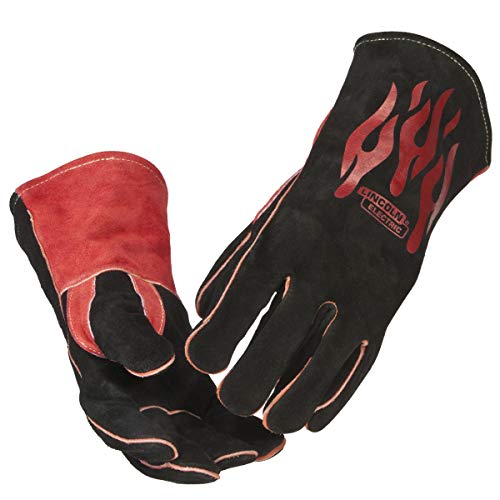
Lincoln Electric builds this gauntlet for the two processes that punish gloves hardest. The shell is heat and flame resistant split leather with a soft cotton liner inside, and the seams are sewn with Kevlar thread, which holds up far longer than plain cotton thread when spatter lands on a seam line. The 14 inch gauntlet cuff covers the wrist and lower forearm, the zone a jacket sleeve often leaves exposed when reaching across a workpiece.
The one size format keeps the fit simple, and the black and red colorway is easy to spot in a cluttered shop. There is no published numeric temperature rating for this model, so its case rests on construction: lined split leather, welted stress points and heat resistant thread. For general fabrication, repair work and training benches, it is the mid-range reference point of this roundup.
Specs
– Model: K2979-ALL
– Material: Split cowhide leather
– Lining: Soft cotton
– Stitching: Kevlar thread
– Length: 14 in
– Cuff: Gauntlet
– Color: Black and red
– Size: One size
– Intended use: MIG, stick and flux-core welding, cutting
Caiman 1868 Premium Goat Grain TIG/MIG Welding Gloves

The Caiman 1868 is the dexterity pick. Its palm is top grain goatskin, a hide valued for abrasion resistance in a thin, flexible form, while the back is split cowhide with a flame resistant treatment. The glove is unlined, which keeps filler rod feedback direct, and the Kontour pattern uses pre-curved, three-dimensional fingers so the hand rests in a natural curl instead of fighting flat leather.
Palm padding and a reinforced thumb saddle add wear life where a TIG torch hand and a ground clamp hand take the most friction. Every seam is sewn with Kevlar thread, and the maker includes glove loops with a carabiner so the pair stays together between jobs. Sized from small to extra large, it suits welders who find one size gauntlets sloppy. This is the premium tier entry here, aimed at TIG first and lighter MIG work second.
Specs
– Model: 1868 (Medium is 1868-4)
– Palm: Top grain goatskin
– Back: Split cowhide, flame resistant
– Lining: Unlined
– Stitching: Kevlar thread
– Design: Kontour pre-curved fingers, padded palm
– Color: White and gold
– Sizes: S to XL
– Intended use: TIG and MIG welding, plasma cutting
RAPICCA Welding Gloves 16IN (Blue)
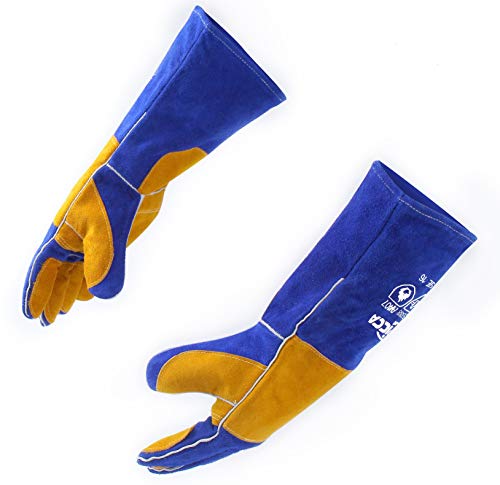
RAPICCA publishes the kind of numbers spec shoppers look for. This 16 inch glove carries a stated temperature rating of 932 °F (500 °C) and an ANSI/ISEA heat level of 4, built from three layers: a fire resistant cowhide leather exterior, an insulating aluminum foil middle layer that reflects radiant heat, and a heat resistant cotton liner against the skin. The leather is 1.5 mm thick, and the extended sleeve guards the forearm well past the wrist.
The trade-off for that coverage is bulk. A 16 inch lined gauntlet is the wrong tool for fine TIG beads, but for stick welding, flux-core work, forging and moving hot stock, the extra length and published rating make it a strong mid-range choice. It is sold as one size in an extra large fit, so smaller hands should expect room inside.
Specs
– Length: 16 in
– Material: Cowhide leather exterior, aluminum foil middle layer, cotton liner (70, 10 and 20 percent by layer)
– Temperature rating: 932 °F (500 °C)
– Heat level: ANSI/ISEA level 4
– Thickness: 1.5 mm
– Size: X-Large, one size
– Color: Blue
– Intended use: Stick, MIG and flux-core welding, forge work
WZQH 16 Inches Leather Welding Gloves
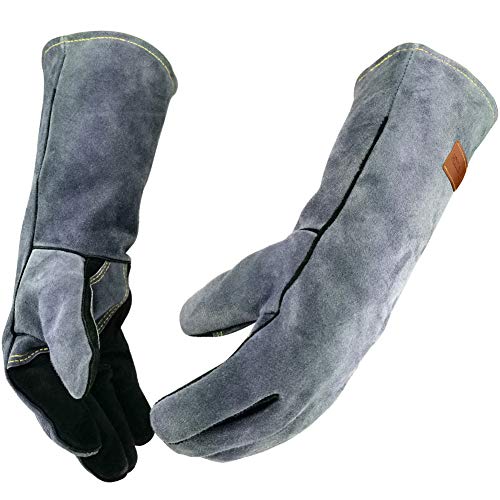
The WZQH pair matches the RAPICCA on headline figures at the budget tier: 16 inches long, a published 932 °F (500 °C) rating and ANSI/ISEA heat level 4. The shell is 1.2 mm split cowhide taken from the shoulder cut, sewn with Kevlar thread, with an insulated cotton lining inside. Published dimensions of 16 x 7 x 0.7 inches make it easy to judge the fit against your hand and jacket cuff before ordering.
Thinner leather than the RAPICCA means a little more flexibility and a little less armor, a sensible balance for home fabrication, farm repair and occasional forge work. The maker also lists cold resistance among its traits, which suits unheated shops in winter. For buyers who want long cuff coverage and published ratings without moving up a tier, this is the value entry in the roundup.
Specs
– Length: 16 in
– Leather: 1.2 mm split cowhide
– Stitching: Kevlar thread
– Lining: Insulated cotton
– Temperature rating: 932 °F (500 °C)
– Heat level: ANSI/ISEA level 4
– Size: Large
– Color: Black-gray
– Dimensions: 16 x 7 x 0.7 in
QeeLink Welding Gloves (14 Inch)
QeeLink takes a different route to credibility: published certification. The maker lists CE EN388 and EN407 certificates for this glove, covering mechanical risks and thermal risks respectively, which is uncommon documentation at the budget tier. The shell is split cowhide leather sewn with fireproof Kevlar stitching, and the interior is lined for comfort during longer sessions.
At 14 inches, it gives up forearm coverage compared with the two 16 inch pairs, but gains hand mobility in return, making it a reasonable fit for MIG work, bench fabrication and mixed shop tasks around hot metal. The brown colorway hides grime well. No numeric temperature rating is published for this model, so buyers who need a stated figure should look at the RAPICCA or WZQH instead; buyers who value third-party certification will find this pair easy to justify.
Specs
– Length: 14 in
– Material: Split cowhide leather
– Stitching: Kevlar fireproof thread
– Lining: Lined interior
– Certifications: CE EN388 and EN407
– Color: Brown
– Intended use: MIG and stick welding, forge and fireplace work
How to choose
Match the glove to the process first. TIG work rewards thin goatskin and an unlined or lightly built palm, because filler rod control is a fingertip task. MIG gloves sit in the middle, with moderate leather weight and a gauntlet cuff. Stick and flux-core work throws the most spatter, so heavier split cowhide, full lining and longer cuffs earn their bulk there.
Read the construction details next. Kevlar stitching outlasts cotton thread at hot seams, so treat it as a durability feature rather than a marketing line. Linings add insulation and sweat management; unlined gloves give feel and dry faster. Published temperature ratings and ANSI/ISEA heat levels, where a maker provides them, describe brief contact protection, not permission to hold hot metal indefinitely. Finally, check sizing honestly: sized gloves fit better for detail work, while one size pairs suit shared shop benches.
Who should skip
Skip the heavy 16 inch gauntlets if your work is mostly fine TIG welding; the bulk works against the control you need, and the Caiman style of unlined goatskin exists for that reason. Skip every glove here if you need cut resistant hand protection rated for sheet metal handling, mechanic style gloves with knuckle armor, or electrically insulating gloves for live electrical work; those are separate product categories with their own standards. Welders with small hands should also skip one size extra large formats and choose a sized model instead.
FAQ
What is the difference between MIG, TIG and stick welding gloves?
TIG gloves are the thinnest, usually goatskin, and often unlined so the welder can feel the filler rod. MIG gloves use medium weight leather with a gauntlet cuff for spatter protection while keeping trigger control. Stick gloves are the heaviest, with thick split cowhide and full lining, because stick and flux-core arcs throw the most spatter and radiant heat.
How long should welding gloves be?
A 14 inch glove covers the hand and wrist, which suits most MIG and TIG work. A 16 inch glove adds forearm coverage that helps with stick welding, flux-core work, forging and handling hot stock, especially when jacket sleeves ride up. Longer is not automatically better; extra length adds bulk and heat buildup during fine work.
Why does Kevlar stitching matter on a welding glove?
Seams are the usual failure point on a welding glove, because thread sits exposed to sparks and spatter. Kevlar thread keeps its strength at temperatures that weaken ordinary cotton or polyester thread, so seams stay closed longer. Every glove in this roundup uses Kevlar stitching, which is a useful baseline when comparing other models.
When should a pair of welding gloves be replaced?
Replace a pair when the leather cracks or stiffens enough to limit finger movement, when a seam opens, when the lining wears through, or when a hole appears anywhere on the palm or fingers. Leather that has hardened after heavy heat exposure no longer flexes with the hand, and that loss of control is itself a safety problem at the torch.
Final verdict
For a single pair that covers most shop welding, the Lincoln Electric Traditional K2979-ALL pairs lined split leather with Kevlar stitching in a proven gauntlet format. TIG specialists should take the Caiman 1868 for its unlined goatskin feel and sized fit. When coverage and published heat ratings lead the decision, the 16 inch RAPICCA and WZQH pairs deliver them at mid-range and budget tiers respectively, and the certified QeeLink remains the documentation-first budget option at 14 inches.

Related guides
More from Amazon
Programs that pair well with the guide above. Offers and eligibility are set by Amazon and may change.
A free business account with business pricing and bulk-buying tools for work, shop or home office.
Create a business accountFree shipping on eligible items, Prime Video and more. Eligible new members can start with a free trial.
Start a Prime free trialAudiobooks and podcasts to listen to on the go. Eligible new members can start with a free trial.
Try Audible freeAd-free music streaming. Eligible new subscribers can start with a free trial.
Try Music Unlimited freeAs an Amazon Associate we earn from qualifying purchases.


Write Your Review
No reviews yet. Be the first to share your experience!