What's inside
- Ryobi 1800 PSI Pressure Washer: Key Specifications
- Price: How Much Does the Ryobi 1800 PSI Pressure Washer Cost?
- Cleaning Performance: What Can the Ryobi 1800 PSI Handle?
- Nozzles and Accessories: What Comes in the Box?
- Ease of Use, Portability, and Storage
- Advantages and Disadvantages
- Ryobi 1800 PSI vs. Ryobi 2100 PSI: Should You Upgrade?
- Safety and Maintenance Tips
- Frequently Asked Questions
- Final Verdict: Should You Buy the Ryobi 1800 PSI Pressure Washer?
As an Amazon Associate I earn from qualifying purchases. This post may contain affiliate links at no extra cost to you.
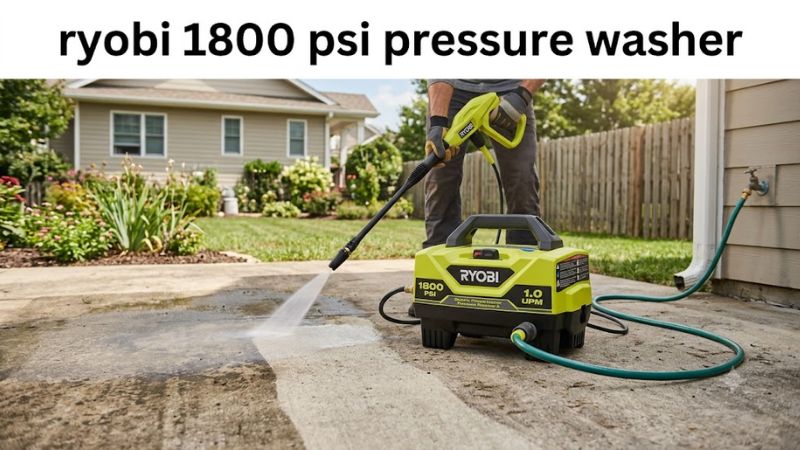
The Ryobi 1800 PSI pressure washer is a compact, corded electric cleaner designed for light-duty household jobs, including washing cars, cleaning patio furniture, rinsing outdoor equipment, and removing everyday dirt from suitable exterior surfaces. With a maximum advertised pressure of 1,800 PSI and water flow of up to 1.2 gallons per minute (GPM), it prioritizes portability and convenience over heavy-duty cleaning power.
Verdict: The Ryobi 1800 PSI is worth considering if you want an affordable pressure washer for routine residential cleaning and have access to a suitable outdoor electrical outlet and water supply. It is less suitable for stubborn, deeply embedded grime, extensive concrete cleaning, or jobs that demand higher sustained cleaning productivity.
One important detail is the model number. Ryobi has sold multiple 1800 PSI electric pressure washers, including the RY141802, RY141803, and older RY141820. Their specifications and included accessories can differ, so this review focuses primarily on the RY141803, a newer corded model, while identifying differences when discussing other versions.
Ryobi 1800 PSI Pressure Washer: Key Specifications
The RY141803 is a lightweight, corded electric pressure washer intended for residential cleaning. Its published specifications place it in the light-duty category rather than the class of machines intended for demanding commercial or large-scale cleaning.
| Specification | Ryobi RY141803 |
| Tool type | Corded electric pressure washer |
| Maximum advertised pressure | 1,800 PSI |
| Maximum advertised water flow | 1.2 GPM |
| Power supply | 120 V AC, 13 A |
| Power cord | 35 ft |
| High-pressure hose | 20 ft |
| Listed weight | Approximately 14.4–15 lb, depending on source |
| Spray accessories | 15-degree nozzle and turbo nozzle; soap applicator included |
| Nozzle connection | 1/4-inch quick-connect |
| Intended use | Light-duty residential cleaning |
| Warranty | 3-year limited warranty, subject to applicable terms |
Sources: Ryobi product information, Pro Tool Reviews, and Consumer Reports. Weight and accessory descriptions should be confirmed against the exact package being purchased.
What do 1,800 PSI and 1.2 GPM mean?
PSI measures water pressure, while GPM measures the volume of water delivered per minute. Both influence cleaning performance, but neither number alone tells you how quickly a pressure washer will remove dirt.
- 1,800 PSI maximum pressure: Provides useful cleaning force for routine outdoor maintenance, but the advertised maximum should not be interpreted as the pressure delivered continuously at every nozzle or operating condition.
- 1.2 GPM maximum flow: Indicates relatively modest water throughput compared with many larger machines. This can mean slower rinsing and lower productivity on broad surfaces.
- Corded electric power: Avoids fuel mixing, exhaust, and battery-runtime concerns, but requires an appropriate electrical outlet and careful management of the power cord.
The combination makes the machine more appropriate for small cleaning jobs than for stripping stubborn buildup from large driveways.
Price: How Much Does the Ryobi 1800 PSI Pressure Washer Cost?
The price depends on the exact model, retailer, and included accessories. The manufacturer’s US product listings showed the following prices when researched on October 20, 2026. These are observed listing prices, not guaranteed checkout prices.
| Model | Observed US price | What to know |
| RY141803 | $89 promotional listing | Newer 1,800 PSI model; verify the current offer and package contents |
| RY141802 | $99 | 1,800 PSI, 1.2 GPM model with two main cleaning nozzles and a soap applicator |
Prices can change with promotions, local availability, and retailer inventory. Before purchasing, check whether the listing includes the complete washer, spray wand, hose, nozzles, and soap applicator rather than a separate accessory or bundled package.
Is it good value? At around 90–110, the RY141803 is a reasonable option for homeowners who need occasional, light-duty cleaning. If a stronger model costs only slightly more during a sale, compare its actual specifications and accessories before choosing the lower-pressure unit.
Cleaning Performance: What Can the Ryobi 1800 PSI Handle?
Ryobi positions this pressure washer for light-duty residential cleaning. Its suitability depends on the surface, the type of dirt, the nozzle, and how long the grime has been accumulating.
Washing cars and recreational vehicles
The machine can be useful for rinsing road dirt and routine exterior grime. Start with a suitable wide spray, keep the nozzle at a safe distance, and follow the vehicle manufacturer’s cleaning recommendations. Avoid directing concentrated spray at seals, sensors, electrical components, or damaged paint.
Patio furniture, grills, and outdoor equipment
These are sensible applications when the material can tolerate pressure washing. Use a suitable nozzle and test a small inconspicuous area first. For grills, work only when they are cool and follow the manufacturer’s cleaning instructions.
Walkways and small outdoor surfaces
The RY141803 can handle some light surface dirt, but its 1.2 GPM flow rate limits how quickly it can rinse larger areas. Heavy staining, algae, and old embedded grime may require appropriate detergent, more time, or a higher-capacity machine.
Use caution. Soft wood, aged paint, vinyl siding, and other vulnerable surfaces can be damaged by concentrated pressure or incorrect spray technique. Follow the surface manufacturer’s guidance rather than assuming 1,800 PSI is safe for every material.
What independent testing tells us
BestReviews reported testing the older RY141802VNM version on several surfaces, including a wooden fence, a window, brick, and metal furniture. Its review found that the washer handled light dirt more effectively than stubborn buildup, and it criticized the soap applicator’s detergent mixing performance. It also reported limitations with the turbo nozzle in its tests.
These findings are useful context, but they are not a controlled performance test of the newer RY141803. Different model revisions and accessories can affect results, so it would be misleading to transfer those measurements directly to the newer machine.
There is no verified, directly comparable test here establishing the RY141803’s exact cleaning time, sustained operating pressure, or performance advantage over competing models. Its published specifications and intended applications support a light-duty recommendation, not a claim that it outperforms more powerful washers.
Nozzles and Accessories: What Comes in the Box?
The RY141803 is described as including a 15-degree nozzle, a turbo nozzle, and a soap applicator. It also has a 1/4-inch quick-connect nozzle coupler and onboard storage for the hose, cord, and accessories.
| Accessory | Main purpose | Important consideration |
| 15-degree nozzle | More concentrated cleaning for suitable, durable surfaces | Can damage paint, wood, seals, and softer materials if used too close |
| Turbo nozzle | Rotating concentrated spray for compatible hard surfaces | Use only where the manual and surface allow it; avoid delicate finishes |
| Soap applicator | Applying compatible cleaning detergent | Use an approved detergent and follow its dilution and application instructions |
| Spray wand and hose | Directing water toward the work area | Inspect connections and hose condition before use |
A nozzle’s spray angle changes how concentrated the water stream is. A narrower spray can increase localized cleaning force, but it also raises the risk of surface damage. Do not assume that every pressure-washer accessory will fit simply because it uses a quick-connect fitting; confirm the fitting, pressure rating, and compatibility requirements.
The exact contents can differ between standalone units and bundled kits. Check the package documentation before buying any additional foam cannon, hose, or nozzle.
Ease of Use, Portability, and Storage
Portability is one of the strongest reasons to consider the Ryobi 1800 PSI pressure washer. The RY141803 weighs approximately 14.4 lb according to Pro Tool Reviews, while the older RY141802 is listed at 16 lb by Ryobi. Its carrying handle, compact design, and onboard storage make it convenient for users who do not want to store a large pressure washer.
The 35-foot power cord and 20-foot high-pressure hose provide useful reach for small residential jobs. However, the hose length may still require moving the machine when cleaning around a vehicle or across a larger patio.
Because this is a corded electric tool, you must manage the power cable while moving around wet work areas. Its portability does not mean it can operate without an electrical outlet or that its hose and cord are long enough for every property.
Electrical requirements
The US version of the RY141803 is a 120 V corded model. It is not a cordless pressure washer and does not run on Ryobi ONE+ 18V or 40V batteries. Those battery platforms are separate from this product’s electrical power supply.
If purchasing outside the United States, verify the exact regional model, voltage, frequency, plug, and manual. Do not assume that a US 120 V unit can be safely connected to a different regional supply.
For outdoor use, follow the supplied manual’s requirements for electrical protection, grounding, connections, and extension cords. Use an appropriately protected outlet, keep electrical connections dry, and never handle a plug or connection with wet hands. Do not use an extension cord unless the manual permits it and specifies suitable ratings.
Advantages and Disadvantages
Pros
- Affordable entry price: Promotional pricing around $90 makes it accessible for occasional household cleaning.
- Lightweight construction: Easier to carry and store than many larger pressure washers.
- Useful hose and cord reach: The 20-foot hose and 35-foot power cord support many small outdoor jobs.
- Two main cleaning nozzles: The 15-degree and turbo nozzles provide different spray patterns for compatible surfaces.
- No fuel or battery charging: Corded operation avoids gas-engine maintenance and battery-runtime limitations.
- Three-year limited warranty: Ryobi lists a three-year limited warranty for the relevant product line, subject to the applicable terms.
Cons
- Limited water flow: At up to 1.2 GPM, it is less suited to fast cleaning of large areas.
- Not a heavy-duty machine: Stubborn stains and deeply embedded dirt may require a more capable washer or additional cleaning methods.
- Requires an electrical outlet: The cord limits where you can work.
- Pressure can damage delicate surfaces: Incorrect nozzle selection or working distance can damage paint, wood, siding, and seals.
- Model numbers can be confusing: Older and newer 1800 PSI models may differ in weight, accessory configuration, and design.
- Detergent performance may vary: Independent testing of an older model raised concerns about its soap applicator; the same result should not be assumed for the RY141803.
Ryobi 1800 PSI vs. Ryobi 2100 PSI: Should You Upgrade?
If you expect to clean more demanding surfaces regularly, comparing the 1800 PSI RY141803 with the 2100 PSI RY142012 is worthwhile.
| Feature | RY141803 | RY142012 |
| Maximum advertised pressure | 1,800 PSI | 2,100 PSI |
| Maximum advertised flow | 1.2 GPM | 1.2 GPM |
| Power source | Corded electric | Corded electric |
| High-pressure hose | 20 ft | 25 ft |
| Power cord | 35 ft | 35 ft |
| Intended workload | Light-duty cleaning | Light- to medium-duty cleaning |
| Observed US price in research | $89 promotional listing | $199 listing |
The RY142012 has a higher advertised pressure rating and a longer hose, but both models have the same published maximum flow rate. The higher PSI figure alone does not establish how much faster it will clean a particular surface.
The price difference also matters. At the observed prices, the RY142012 costs substantially more. If your main jobs are rinsing vehicles, patio furniture, and lightly soiled equipment, the cheaper model is likely the more economical choice. For more frequent work on sidewalks, fencing, and siding, the upgrade may be worth investigating.
Neither model should be treated as a substitute for a high-flow machine when large driveways or extensive heavy staining are regular jobs.
Safety and Maintenance Tips
Pressure washers can cause serious injuries and property damage when misused. Follow the exact operator’s manual for the model you own.
- Inspect the equipment before use. Check the hose, spray gun, fittings, cord, plug, and housing for damage. Do not operate the washer with damaged electrical components or leaking high-pressure connections.
- Connect the water supply correctly. Follow the manual’s water-supply requirements and make sure the unit has an adequate supply before starting it.
- Use the correct nozzle. Start with a less concentrated spray and test an inconspicuous area. Never direct the stream at people, animals, skin, or electrical equipment.
- Manage electrical hazards. Keep electrical connections protected from water, use the specified outdoor electrical protection, and avoid standing in water while handling electrical connections.
- Shut down before changing accessories. Follow the manual’s procedure for switching off the machine and releasing residual pressure before disconnecting the hose or nozzle.
- Clean and store it properly. Disconnect the power and water supply according to the manual, drain and store the equipment as instructed, and protect it from freezing temperatures where applicable.
Never try to stop a leak with your hand. High-pressure water can penetrate skin and cause serious injury. Suspected injection injuries require immediate emergency medical assessment, even if the wound looks small.
Frequently Asked Questions
1. Is the Ryobi 1800 PSI pressure washer powerful enough to wash a car?
Yes, it can be suitable for routine car washing when used with an appropriate nozzle, safe working distance, and vehicle-compatible cleaning products. Its 1,800 PSI maximum rating does not mean you should direct concentrated spray at paint, trim, seals, tires, or sensors from close range.
2. How much does the Ryobi 1800 PSI pressure washer cost?
The observed US manufacturer’s listings were $89 for the RY141803 promotional offer and $99 for the RY141802. These prices were checked on October 20, 2026, and may change. Confirm the exact model and included accessories before purchasing.
3. Can the Ryobi 1800 PSI pressure washer clean a driveway?
It can handle some light dirt on small sections of suitable hard surfaces, but it is not the best choice for extensive concrete cleaning or stubborn, embedded stains. Its maximum advertised flow of 1.2 GPM limits rinsing productivity, and a higher-capacity machine may be more practical for large areas.
4. Is the Ryobi 1800 PSI pressure washer cordless?
No. The RY141803 is a corded electric pressure washer designed for a 120 V US electrical supply. It does not use Ryobi ONE+ 18V or 40V batteries. Buyers seeking a cordless model should compare the specifications and runtime limitations of Ryobi’s separate battery-powered pressure washers.
Final Verdict: Should You Buy the Ryobi 1800 PSI Pressure Washer?
The Ryobi 1800 PSI pressure washer is a sensible budget option for homeowners who need a compact machine for occasional outdoor cleaning. Its lightweight design, useful cord and hose lengths, and included nozzles make it practical for vehicles, patio furniture, and lightly soiled outdoor equipment.
Its main limitation is cleaning productivity. The 1.2 GPM flow rate and light-duty positioning make it less suitable for extensive concrete cleaning or stubborn grime. Buyers who regularly tackle larger surfaces should compare higher-capacity alternatives before committing.
Buy it if you want an affordable, easy-to-store pressure washer for routine residential jobs and can work comfortably with a corded machine.
Skip it if you need frequent heavy-duty cleaning, faster coverage of large areas, or cordless operation.
Before ordering, confirm the model number, current price, included accessories, electrical compatibility, and warranty terms. Those details will help you determine whether the RY141803 is the right value for your cleaning needs.
Related guides
- DEWALT 3300 PSI Pressure Washer Review: Specs, Price, and Is It Worth Buying?
- Sun Joe Electric Pressure Washer: How to Choose, Use, and Troubleshoot One
- Greenworks 1800 PSI Pressure Washer Review: Price, Specs, and Is It Worth Buying?
- DEWALT 4400 PSI Pressure Washer Review: Price, Specs, and Is It Worth Buying?