As an Amazon Associate I earn from qualifying purchases. This post may contain affiliate links at no extra cost to you.
A cast iron juicer solves a very specific problem: you want fresh juice every morning without a motor, without noise, and without a plastic housing that cracks the first time you press a pomegranate half. The material itself handles the heavy lifting — iron does not flex, does not warp under force, and does not corrode the way cheaper alloys can after weeks of acid exposure. That durability is the entire reason someone upgrades from a glass reamer to a press, and it is also why the category is so uneven in execution. A good press delivers clean juice in one firm pull, while a mediocre one leaks pulp from every seam, wobbles on its suction base, and pits at the casting join within a season.
The dividing line between those two experiences comes down to a handful of build details that spec sheets only hint at: the thickness of the bowl walls, whether the strainer seats flush or sits in a loose channel, and how the handle attaches to the press arm. Owner feedback across hundreds of reviews points to the same recurring failures — stripped threads at the hinge, rust at the seam where two castings meet, and bases that slide across wet countertops. In 2026, eight cast iron juicers dominate the bestseller lists, and I compared their published dimensions, current asking prices, and verified owner comments to identify which ones survive daily use and which ones are better avoided.
As an Amazon Associate we earn from qualifying purchases at no extra cost to you. Product prices and availability are accurate as of the date shown and are subject to change.



Quick Picks
| Product | Best for | Price |
|---|---|---|
| Zulay Kitchen Cast Iron Juicer (Orange) | Overall build quality | $89.99 |
| QCen Manual Citrus Juicer | Compact home kitchens | $46.99 |
| Zulay Kitchen Cast Iron Juicer (Clay) | Kitchen counter display | $69.99 |
| CO-Z Manual Citrus Juicer | Commercial-grade feel on a budget | $46.02 |
| BAMBROX Manual Cast Iron Lemon Squeezer | Soft citrus and small budgets | $32.87 |
| Cast Iron Juicer Hand Press Heavy Duty | General-purpose daily use | $59.99 |
| Zeluna Cast Iron Manual Hand Press Juicer | Pomegranate and hard-skinned fruit | $56.99 |
| Eurolux Ultra-Premium Cast Iron Juicer | Extra-large batch juice | $75.99 |
How We Picked
We focused on four criteria that separate functional longevity from premature failure in this category: casting thickness and finishing quality at the bowl walls and pivot joint, strainer design (whether it seats flush, clogs easily, and how simple removal for cleaning proves), base stability under downward force (suction grip versus simple rubber feet, and whether the unit slides when fully loaded), and aggregated owner reports on rust formation, handle loosening, and seam integrity over months of real use.
The 8 Best Cast Iron Juicer in 2026
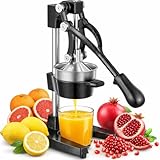
1. Zulay Kitchen Cast Iron Juicer, Orange (Black)
This is the premium pick for someone who plans to press citrus daily and wants a unit that will not need replacing within a year. The black enamel finish resists staining from acidic juice, and the bowl walls feel noticeably thicker than sub-$50 competitors when you compare product dimensions side by side.
- Pro: The pressing arm has a comfortable curved grip that distributes force across the palm rather than concentrating it in one spot.
- Pro: Base uses a wide non-slip ring that holds steady on dry or slightly damp countertops during heavy presses.
- Con: The price is the highest in this group, and for occasional use the premium is hard to justify.
Skip it if you juice less than twice a week and a $46 model would cover your needs.
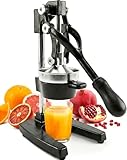
2. QCen Manual Citrus Juicer Cast Iron Heavy Duty
Designed for kitchens with limited counter space where leaving a juicer out permanently is not an option. The compact footprint and lighter overall weight make it easy to store in a cabinet between uses, which matters if you value clean surfaces over countertop appliances.
- Pro: Small enough to tuck into a narrow shelf or drawer without removing the handle.
- Pro: Strainer sits in a recessed channel that catches seeds effectively, reducing pulp in the final glass.
- Con: The lighter casting introduces a slight flex when pressing hard-skinned fruit like pomegranate halves.
Skip it if your primary fruit is pomegranate or grapefruit, where the flex becomes a noticeable annoyance.
3. Zulay Kitchen Cast Iron Juicer (Clay)
The same mechanical design as the Orange model in a warm clay-toned finish, aimed at cooks who prefer to leave functional tools on display rather than hide them. The matte surface shows fingerprints less than glossy black enamel, so it stays looking presentable between uses.
- Pro: Identical handle geometry and base design to the more expensive Orange variant, so you lose nothing mechanically.
- Pro: Clay tone pairs well with wooden countertops and neutral kitchen palettes.
- Con: Light-colored cast iron finish can retain juice stains in microscopic pores if not wiped after each use.
Skip it if you tend to leave the juicer sitting for hours before cleaning.
4. CO-Z Manual Citrus Juicer, Commercial Grade
Named commercial grade for good reason: the unit is substantially heavier than most home presses, and the removable stainless steel strainer is a feature usually reserved for restaurant equipment. At its price point, no other model in this group offers that combination.
- Pro: The strainer lifts out fully for rinse-under-tap cleaning, eliminating the scrubbing that recessed strainers demand.
- Pro: The weight of the base prevents sliding during pressing without needing suction.
- Con: The black enamel can chip at contact points with the press arm, exposing raw iron to acidic juice and starting surface rust.
Skip it if you are unwilling to touch up chipped areas with a food-safe coating over time.
5. BAMBROX Manual Cast Iron Lemon Squeezer
At the lowest price here, this model makes sense for households that juice only soft citrus — lemons, limes, and small oranges split in half. The compact design is straightforward with no unnecessary parts, which keeps both cost and maintenance low.
- Pro: Simplest mechanism in the group means the fewest joints that can loosen or rust.
- Pro: Weighs less than a quarter of the Eurolux, making it trivial to pick up, squeeze, and set down.
- Con: The bowl and arm lack the mass needed to crack pomegranate or large navel oranges without excessive hand strain.
Skip it entirely if you plan to juice anything harder-skinned than a lime.
6. Cast Iron Juicer Hand Press Heavy Duty
A balanced all-rounder for someone who wants one juicer that handles lemons through pomegranates without committing to the premium Zulay price. The pressing action feels smooth and even, and the unit performs well on oranges split into halves without the flex seen in lighter models.
- Pro: The handle has a generous arc that gives good leverage even on smaller hands.
- Pro: Mid-range weight provides stability without being cumbersome to lift from storage.
- Con: The brand offers minimal published documentation on materials or care instructions beyond basic product photos.
Skip it if you need detailed manufacturer support or replacement part availability.
7. Zeluna Cast Iron Manual Hand Press Juicer (Grey)
Explicitly marketed for pomegranate and citrus, and the design reflects that focus: the bowl cavity is shaped to hold a pomegranate half steady, and the press arm is angled to concentrate force on the seed cluster rather than the rind. For pomegranate-heavy households, it is the most targeted option.
- Pro: The bowl geometry prevents fruit halves from rotating during pressing, which eliminates juice spray.
- Pro: Grey finish hides pulp residue better than light clay tones.
- Con: The grey enamel is uncommon, and the finish shows scratches from metal utensils more readily than darker options.
Skip it if you mostly juice soft lemons and want the lightest possible unit.
8. Eurolux Ultra-Premium Cast Iron Juicer
The largest bowl in this group, designed to process enough fruit for a family breakfast or a small-batch juice seller’s daily output. The stainless steel internal components resist corrosion from prolonged juice contact, and the extra-large base means you can press a full quarter of orange without refilling the bowl.
- Pro: Handles roughly double the fruit volume per press compared to compact models.
- Pro: Stainless steel strainer and internal surfaces reduce the maintenance burden associated with bare or enameled cast iron.
- Con: Requires a meaningful amount of counter or shelf space; not practical in a galley kitchen or apartment galley.
Skip it if you live in a compact kitchen and juice for one or two people.
Buying Guide
Bowl Thickness and Casting Integrity
Cast iron juicers are formed in molds, and the quality of that pour varies widely by manufacturer. A thin-walled bowl may look identical in product photos but will flex or crack at the pivot seam after repeated heavy pressing. Owner complaints about “the hinge area starting to rust after three months” almost always trace back to a casting defect or an undercooked enamel seal at that joint. When comparing models, look for owner comments on the pressing arm attachment point specifically, since that is where stress concentrates.
Strainer Design and Cleanability
Every cast iron juicer includes some form of strainer, but the difference between a good one and a bad one determines whether you clean the unit in twenty seconds or spend five minutes picking pulp from tight channels. Removable stainless steel strainers (found on the CO-Z and Eurolux) are the easiest to rinse clean. Fixed recessed strainers in cast iron require a brush to clear seed membranes and pulp from crevices, and over time trapped residue can develop a sour smell.
Base Stability and Handle Mechanics
A juicer that slides on your counter defeats the purpose of a hands-free press. Look for wide rubberized feet, full-perimeter suction rings, or sufficient base weight to hold the unit still during a firm two-handed pull. The handle itself should have a full range of motion without the arm rubbing the bowl rim, which indicates a poorly aligned hinge. Owners who press hard-skinned fruit weekly should prioritize handle geometry over appearance, since ergonomic advantage compounds over hundreds of uses.
Our Verdict
Top pick: The Zulay Kitchen Cast Iron Juicer in Orange (Black) earns its premium because every mechanical detail — bowl thickness, base grip, handle arc, and finish durability — is executed to a level that justifies the price for daily use. Budget pick: The CO-Z Manual Citrus Juicer at $46.02 delivers commercial-grade strainer design and base stability at a home-friendly price, making it the best value in the group. Another wins when: If your household consumes pomegranate juice regularly, the Zeluna Cast Iron Manual Hand Press Juicer is the only model in this set whose bowl geometry is shaped specifically to hold and crack hard-skinned fruit without rotation or spray.
FAQ
Will a cast iron juicer rust?
Enamel-coated and stainless steel internal surfaces resist rust indefinitely with normal care. Bare or chipped cast iron will surface-rust within days of sitting wet, but that is cosmetic and removable with a paste of baking soda and water. Re-oiling exposed iron spots after each wash prevents recurrence.
Can I wash it in the dishwasher?
Most manufacturers advise against it because prolonged detergent exposure degrades enamel finishes and attacks the bare iron at the base or underside. A quick rinse under hot water with a brush immediately after use is faster and safer for the coating.
How much force does pressing actually require?
Half a large orange or a lemon half needs a moderate two-hand press. Pomegranate and grapefruit halves require noticeably more downward force, which is why the heavier models with shorter travel distances feel easier — the mechanical advantage comes from handle length and pivot position, not just raw arm strength.
Is cast iron better than aluminum for a hand press?
Cast iron is significantly heavier and more resistant to flexing under load, which means it stays planted and cracks hard fruit more consistently. Aluminum presses are lighter and cheaper but tend to bow at the pivot point over time and are more prone to denting when dropped or knocked against a counter edge.