What's inside
As an Amazon Associate I earn from qualifying purchases. This post may contain affiliate links at no extra cost to you.
For finish work, a cordless random-orbit sander is usually the better all-around purchase. It removes material faster, leaves no directional scratch pattern, and handles both rough preparation and final smoothing. A cordless sheet sander—also called a finishing or palm sander—still makes sense for flat panels, delicate veneer, and users who already have compatible batteries and want a smaller, cheaper tool.
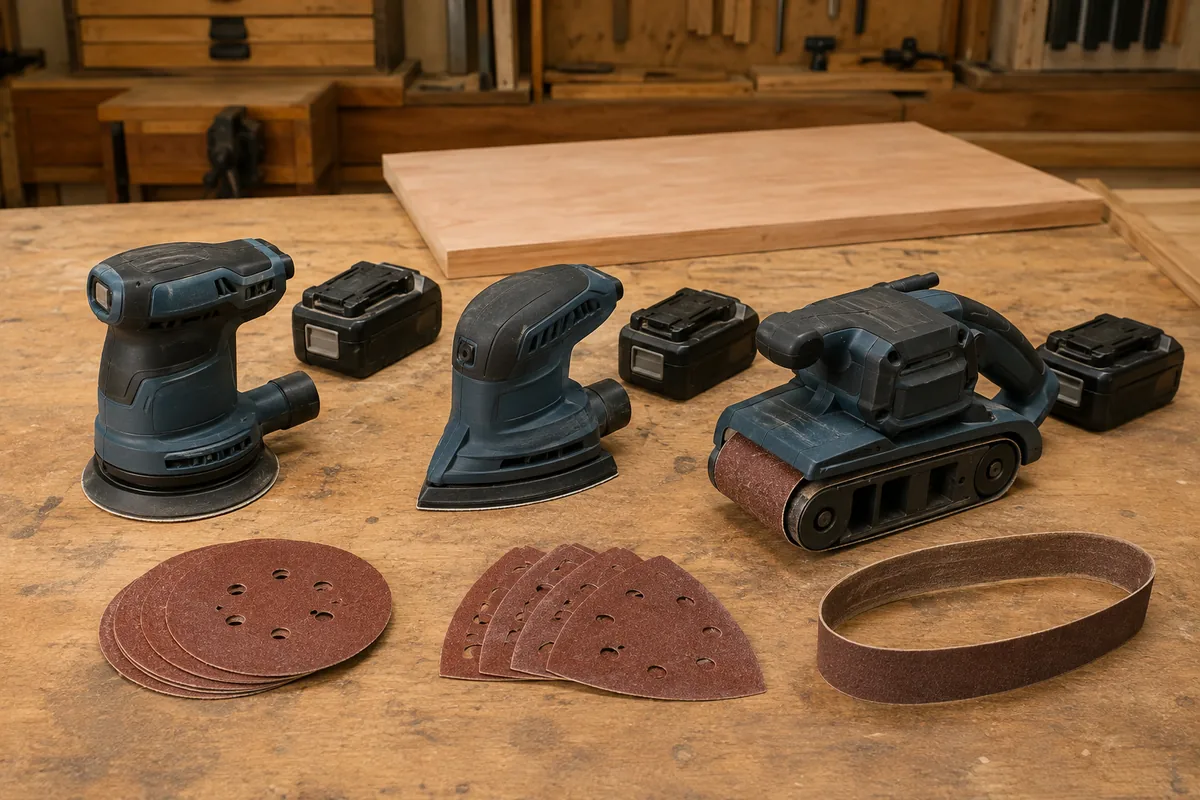
The important distinction is the sanding motion. A random-orbit sander spins a round pad while the pad also moves in small eccentric circles. A sheet sander moves a rectangular pad back and forth in a short stroke. That difference affects speed, scratch visibility, paper cost, dust collection, and how easily you can damage an edge.
As an Amazon Associate we earn from qualifying purchases at no extra cost to you.


How the two sanders work
A random-orbit sander normally uses 5-inch hook-and-loop discs. The pad rotates unpredictably while orbiting, so the scratches cross in different directions. You can sand with the grain or across it without leaving the obvious straight grooves associated with a vibrating finishing sander. That makes it forgiving when preparing tabletops, cabinet parts, doors, and painted surfaces.
A sheet sander uses quarter-sheets or half-sheets of standard abrasive paper, held by clamps or sometimes hook-and-loop. Its rectangular pad fits closer to inside corners and works neatly along edges. The linear motion is gentle and controlled, but it can leave visible swirl-like or straight scratch patterns if you dwell in one spot or skip grits.
Neither tool eliminates the need for hand sanding. A random-orbit sander generally cannot reach a sharp inside corner, while a sheet sander may still need hand sanding on profiles and edges.
Cordless random-orbit versus cordless sheet sander
| Factor | Cordless random-orbit sander | Cordless sheet sander |
|---|---|---|
| Best use | General preparation, stock removal, broad finish work | Light finish sanding on flat panels and near edges |
| Typical abrasive | 5-inch hook-and-loop discs | Quarter-sheets or half-sheets |
| Scratch pattern | Less directional and easier to hide | Can show linear scratches if technique is poor |
| Material removal | Fast; suitable for leveling and paint removal | Slow; best for light smoothing |
| Edge control | Easy to round over edges accidentally | Better control near straight edges and corners |
| Typical runtime | Roughly 20–45 minutes with a 2.0Ah battery, depending on pressure and speed | Often roughly 30–60 minutes with the same battery |
Which one should you buy?
Choose a cordless random-orbit sander if you want one tool for furniture, trim, plywood, construction lumber, and painted surfaces. It is the safer choice when you do not yet know how often you will sand. The higher productivity usually matters more than the modest extra cost of discs.
Choose a cordless sheet sander when your work is mostly flat cabinet panels, doors, drawer parts, or final sanding between finish coats. It is also a good fit for someone who values low vibration and precise edge work over speed. If you already own the batteries and charger, the tool-only price can be attractive.
The cheaper sheet sander is fine for a small number of projects. For example, if you are smoothing a dozen cabinet doors that are already flat and free of glue blobs, its slower removal rate is not a serious problem. It becomes frustrating when you must level uneven boards, remove old finish, or sand large tabletops.
Battery platform and tool weight
Buy into the battery platform you already use unless the sander will be your only cordless tool. A bare tool may look inexpensive, but adding a battery and charger can change the comparison by $50 to $150. Check whether your existing batteries fit physically and electrically; batteries from different brands are not interchangeable, even when their voltage labels look similar.
For finish work, a compact 2.0Ah or 2.5Ah battery often balances well. Larger 4.0Ah and 5.0Ah packs extend runtime, but they add weight above your wrist. That matters on vertical doors or when sanding for 20 minutes continuously. A random-orbit sander already creates more hand movement, so an overly large battery can make fatigue noticeable.
Look for a variable-speed trigger or selectable speed range, a comfortable grip, and a battery position that does not block your view of the work. A charger that supports fast charging is useful if you own only one battery, but a second small battery is often more convenient than waiting beside the charger.
How to get a clean finish
Start with the coarsest grit that actually solves the problem. Use 80 grit for substantial leveling or finish removal, 120 grit for general smoothing, and 180 or 220 grit for final bare-wood preparation. Jumping directly from 80 to 220 leaves deep scratches that take longer to remove than using 120 in between.
Keep the sander moving at a steady pace—about 1 to 2 inches per second on a broad surface—and use only enough pressure to keep the pad flat. Heavy pressure slows the motor, reduces dust collection, clogs the abrasive, and can create uneven patches. On a random-orbit sander, do not tilt the tool onto the pad edge. That quickly rounds over corners and can cut a shallow dish into softwood.
With a sheet sander, sand with the grain for the final pass and overlap each path by about half the pad width. Do not leave the tool running while stationary. Stop the motor before lifting it from the work, particularly with a coarse abrasive.
Dust collection and common failure modes
Dust collection is not optional for finish sanding. Fine wood dust clogs abrasives and can ruin a finish. A cloth dust bag is better than nothing, but a shop vacuum with the correct adapter is substantially more effective. Make sure the abrasive’s holes line up with the pad; solid-backed paper on a perforated pad will reduce airflow.
Expect cordless runtime to fall when sanding hardwood, paint, or filler aggressively. If the tool pulses, slows under light pressure, or leaves shiny unsanded spots, the battery may be nearly empty—or the abrasive may be clogged. Replace the disc or sheet before pressing harder. Pressing harder usually produces heat and a worse surface, not faster work.
Before applying stain or clear finish, inspect the surface under strong side lighting and wipe it clean. A random-orbit sander hides scratches better than a sheet sander, but it does not remove them automatically. For most owners, the cordless random-orbit sander kit is the more capable starting point. A sheet sander remains the sensible specialist choice when flat, delicate, low-volume finish work is your priority.
FAQ
Which one should you buy?
Related guides
- Longest Lasting Lawn Mower Battery: AGM vs Lithium vs Flooded Lifespan and Cost per Season
- Duralast Gold Lawn Mower Battery Review: U1 Fit, CCA and When to Pay for AGM
- Greenworks Pro 80V 21-Inch Mower Review: Runtime Math, Push vs Self-Propelled and Yard Fit
- Bosch High Pressure Washer Gun Replacement: Fittings, Adapters and What Fits Your Model