
What's inside
- DEWALT 16 Gauge Finish Nailer: Quick Verdict
- DEWALT DCN660 vs. DCN662: Specifications Compared
- DEWALT DCN660 16 Gauge Angled Finish Nailer Review
- DEWALT DCN662 16 Gauge Straight Finish Nailer Review
- DEWALT 16 Gauge Finish Nailer Price: How Much Should You Pay?
- Battery Compatibility and Operating Costs
- What Type of Nails Does a DEWALT 16 Gauge Finish Nailer Use?
- DEWALT 16 Gauge vs. 18 Gauge Finish Nailer: Which Is Better?
- DEWALT 16 Gauge Finish Nailer vs. Pneumatic Finish Nailer
- Safety and Maintenance Considerations
- Warranty and Long-Term Value
- Who Should Buy the DEWALT 16 Gauge Finish Nailer?
- Frequently Asked Questions
- Final Verdict: Is the DEWALT 16 Gauge Finish Nailer Worth It?
As an Amazon Associate I earn from qualifying purchases. This post may contain affiliate links at no extra cost to you.
The DEWALT 16 gauge finish nailer is a strong option for professional carpenters, remodelers, and serious DIY users who need reliable fastening for trim, baseboards, door casings, and cabinetry. Its cordless design removes the need for an air compressor, pneumatic hose, or gas cartridges, making finish work more convenient across different job sites.
However, DEWALT offers two important 16-gauge cordless models: the DCN660 angled finish nailer and the DCN662 straight finish nailer. They share the same general battery platform and many operating features, but their magazine designs serve slightly different applications.
This review examines both models, their specifications, practical advantages, limitations, battery compatibility, and price considerations. The goal is to help buyers choose the right configuration rather than assume every DEWALT 16-gauge nailer is identical.
Product information and US-market pricing checked November 9, 2026.
DEWALT 16 Gauge Finish Nailer: Quick Verdict
The DEWALT DCN660 is the better starting point for buyers who regularly install crown molding, door casing, baseboards, and other architectural trim. Its angled magazine can make access easier in corners and restricted working positions.
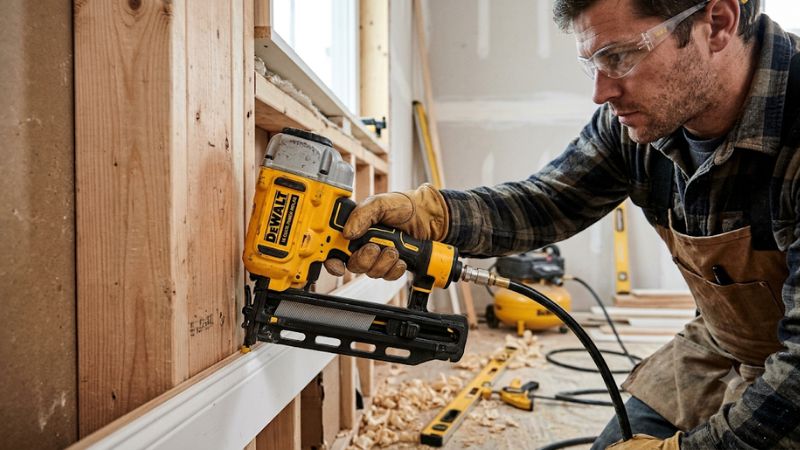
The DCN662 is a practical alternative for users who prefer a straight magazine and primarily perform general finish carpentry.
Both models use DEWALT’s 20V MAX battery platform, feature brushless motors, and support selectable sequential and contact actuation. Neither requires an external compressor.
Overall recommendation: Choose the DCN660 if angled-nailer access is important for your projects. Choose the DCN662 if your preferred fasteners and working conditions suit a straight finish nailer.
DEWALT DCN660 vs. DCN662: Specifications Compared
The most important distinction is the magazine configuration. The DCN660 accepts 20-degree angled 16-gauge finish nails, while the DCN662 uses straight 16-gauge finish nails.
| Specification | DCN660 | DCN662 |
| Product type | Angled finish nailer | Straight finish nailer |
| Battery platform | 20V MAX | 20V MAX |
| Motor | Brushless | Brushless |
| Nail gauge | 16 GA | 16 GA |
| Nail length | 1-1/4–2-1/2 in. | 1-1/4–2-1/2 in. |
| Nail collation angle | 20 degrees | Straight |
| Magazine capacity | Up to 110 | 110 |
| Operating modes | Sequential and bump | Sequential and bump |
| Magazine design | Angled | Straight |
| Weight | Approximately 6 lb with battery | 5.6 lb without battery |
| Battery included | Depends on package | Depends on package |
The weight figures are not directly comparable because the DCN660 figure includes a battery, while the DCN662 figure is specified without one.
What Does 16 Gauge Mean for Finish Carpentry?
A 16-gauge finish nail is thicker than an 18-gauge brad nail. This makes it useful for fastening trim components that need more holding strength than small decorative brads typically provide.
Common applications include:
- Installing baseboards and door casings.
- Attaching window trim and decorative molding.
- Securing crown molding.
- Installing cabinet face frames and selected woodworking components.
- Fastening suitable hardwood and softwood trim assemblies.
However, a 16-gauge nail leaves a more noticeable entry hole than an 18-gauge brad. For delicate molding, thin decorative pieces, or applications where minimizing visible holes is the priority, an 18-gauge brad nailer may be more appropriate.
The correct fastener length also depends on the thickness of the trim, the substrate, and the required penetration. Longer nails are not automatically better because they can penetrate hidden services or emerge from the opposite side of a workpiece.
DEWALT DCN660 16 Gauge Angled Finish Nailer Review
Best for angled trim applications
The DEWALT DCN660 is a cordless XR finish nailer designed for users who want pneumatic-style finish fastening without an air compressor.
Its 20-degree angled magazine is particularly useful when working around corners, door frames, cabinetry, and other locations where a straight magazine can make positioning more difficult.
Brushless Motor and Cordless Operation
One of the DCN660’s biggest advantages is its brushless motor.
Brushless motors reduce the mechanical friction associated with traditional brushed motor designs. DEWALT positions this motor technology as a way to improve runtime and durability.
The nailer uses a battery-powered mechanical driving system rather than relying on a gas cartridge. This removes two recurring consumable requirements associated with some cordless nailers: fuel cells and compressed air equipment.
For contractors already carrying DEWALT 20V MAX batteries, the DCN660 can fit into an existing cordless setup without introducing another battery ecosystem.
However, cordless convenience comes with a trade-off. The battery contributes to the overall weight, and users must plan charging and battery rotation for extended production work.
Nail Capacity and Driving Performance
The DCN660 accepts 16-gauge angled finish nails from 1-1/4 to 2-1/2 inches long, with a 20-degree nail stick angle.
Its magazine holds up to 110 nails.
DEWALT states that the DCN660 can drive up to 800 nails per charge using a 20V MAX 2.0Ah DCB203 battery. This is a manufacturer-stated maximum, not a guaranteed result for every application.
Actual output can vary with wood density, nail length, firing mode, battery condition, and operating technique.
For occasional trim installation, a 2.0Ah battery may be sufficient. For larger jobs involving repeated fastening, keeping an additional compatible battery available is a practical decision.
Adjustable Depth and Firing Modes
The DCN660 includes a tool-free depth adjustment wheel. This lets users change how deeply nails are driven without reaching for a separate adjustment tool.
Correct depth matters when installing visible trim. Nails that sit too high may interfere with filling and finishing, while excessive countersinking can damage the surface and create additional repair work.
The selectable firing modes provide two operating approaches:
- Sequential mode: The user activates the contact trip against the workpiece before pulling the trigger. This is useful when accurate individual nail placement matters.
- Bump mode: The trigger is held while the contact trip is repeatedly pressed against the workpiece. This supports faster repetitive fastening but requires greater attention to tool control.
For decorative trim, sequential mode is generally the more sensible starting point.
Jam Release, LED Lights, and Handling
The DCN660 includes several features intended to reduce interruptions during work.
Its tool-free jam release provides access to the magazine area when a fastener becomes stuck. A separate stall release lever helps reset the driver mechanism if it stalls.
Multifunctional LED lights illuminate the work area and provide tool-status information. The reversible belt hook also accommodates different carrying preferences.
The included no-mar pad helps reduce the risk of marking finished surfaces when the contact area touches the material. It does not eliminate the possibility of surface damage, so testing on scrap material remains worthwhile.
DCN660 Advantages and Disadvantages
Advantages
- Brushless motor and cordless operation.
- Angled magazine improves access in selected restricted spaces.
- Compatible with DEWALT 20V MAX batteries.
- Tool-free depth adjustment and jam release.
- Sequential and bump firing modes.
- No compressor, air hose, or gas cartridge required.
Disadvantages
- Higher purchase cost than many pneumatic alternatives.
- Battery adds weight during overhead work.
- Requires compatible 20-degree angled finish nails.
- Battery runtime varies with workload and material.
- Not the best choice for applications requiring very small nail entry holes.
DEWALT DCN662 16 Gauge Straight Finish Nailer Review
Best for straight-magazine fastening
The DEWALT DCN662 offers much of the same cordless technology as the DCN660 but uses a straight magazine.
This makes it a suitable alternative for carpenters who prefer straight finish nails and want a cordless tool for everyday trim installation.
Straight Magazine and Micro Nose Design
The DCN662’s straight magazine accepts 16-gauge straight finish nails between 1-1/4 and 2-1/2 inches long.
Its micro nose is designed to improve visibility and nail-placement accuracy compared with the older DEWALT DC616 model.
This is particularly useful when fastening narrow trim pieces or working close to edges where positioning accuracy matters.
The straight magazine also makes fastener selection straightforward for users whose existing nail inventory already uses compatible straight 16-gauge nails.
Importantly, straight and angled nail sticks are not interchangeable simply because they share the same gauge and length range. Buyers should check the collation angle and manufacturer’s compatibility requirements before purchasing fasteners.
Motor, Battery, and Nail Capacity
Like the DCN660, the DCN662 uses a brushless motor and the DEWALT 20V MAX battery platform.
Its magazine holds 110 nails, and DEWALT states a maximum of approximately 770 nails per charge when using a 20V MAX 2.0Ah battery.
That figure is a manufacturer claim under specified conditions, not an independent guarantee of real-world output.
The tool weighs approximately 5.6 pounds without a battery. The installed battery increases the total working weight.
Its selectable sequential and bump actuation modes provide flexibility for both controlled fastening and repetitive work.
Depth Adjustment and Jam Clearing
The DCN662 includes a tool-free depth adjustment wheel, tool-free jam release, and stall release lever.
These features are valuable because finish carpentry often involves changing materials and trim thicknesses throughout a project.
Instead of using one depth setting for every surface, the operator can adjust nail penetration and test the result on scrap material.
The tool’s LED lighting also provides illumination and diagnostic information, while the reversible belt hook offers convenient carrying options.
DCN662 Advantages and Disadvantages
Advantages
- Brushless cordless design.
- Straight 16-gauge nail compatibility.
- Micro nose improves visibility and placement.
- 110-nail magazine capacity.
- Tool-free depth adjustment and jam clearing.
- Works with DEWALT 20V MAX batteries.
Disadvantages
- Straight magazine may be less convenient in certain confined corners.
- Battery weight affects extended overhead use.
- Requires the correct straight-collated 16-gauge nails.
- Bare-tool pricing can be substantial for first-time DEWALT buyers.
DEWALT 16 Gauge Finish Nailer Price: How Much Should You Pay?
Price is an important consideration because the DCN660 and DCN662 are cordless professional tools rather than entry-level pneumatic nailers.
US retail listings observed around the November 2026 research period provide the following reference points:
| Model and package | Observed price | Package contents |
| DCN660B | Around $399 | Bare tool |
| DCN660D1 | Around 399–449 | Tool, 2.0Ah battery, charger, and case or kit packaging |
| DCN662B | Around 329–399 | Bare tool |
| DCN662D1 | Varies by retailer | Kit configuration; verify included components |
These are retailer listing observations, not guaranteed manufacturer prices or universal selling prices. Promotions, inventory, and regional availability can change the final cost.
Bare Tool vs. Complete Kit
The bare-tool versions are generally more attractive for existing DEWALT users.
If you already own compatible 20V MAX batteries and a suitable charger, purchasing the DCN660B or DCN662B can avoid paying for equipment you do not need.
However, a first-time buyer should calculate the total cost of the tool, battery, and charger before comparing prices.
The DCN660D1 kit is particularly relevant because its listed configuration includes:
- One DCN660 angled finish nailer.
- One DCB203 2.0Ah battery.
- One DCB112 charger.
- One kit box.
Always confirm the actual package contents before ordering because retailers may sell different configurations under similar product descriptions.
Is the DEWALT 16 Gauge Finish Nailer Worth the Price?
For professional carpenters who regularly install trim, the cordless convenience can justify the higher initial cost.
Eliminating compressor setup, hose management, and gas cartridges can make smaller jobs and room-to-room work more convenient.
For occasional DIY projects, however, the purchase price may be harder to justify. A pneumatic finish nailer can cost less if the buyer already owns a compatible compressor and hose.
The decision should therefore consider total ownership cost rather than tool price alone.
Battery Compatibility and Operating Costs
Both the DCN660 and DCN662 belong to DEWALT’s 20V MAX cordless tool platform.
They are designed to work with compatible DEWALT 20V MAX lithium-ion battery packs. However, buyers should always check the exact battery and charger documentation rather than assuming every DEWALT battery from another voltage family is suitable.
Which Battery Capacity Should You Choose?
| Battery capacity | Best application | Main consideration |
| 2.0Ah | Occasional trim installation | Lightweight and suitable for smaller projects |
| 4.0Ah | Regular carpentry | More stored energy for extended work |
| 5.0Ah | Larger installation projects | Greater runtime potential but additional weight |
A higher Ah rating represents greater battery energy capacity within the same nominal voltage platform. It does not automatically mean the nailer drives individual nails with greater force.
DEWALT’s stated figures of up to 800 nails for the DCN660 and 770 nails for the DCN662 use a 2.0Ah battery reference. These numbers should not be treated as guaranteed production rates.
For buyers who already own multiple 20V MAX batteries, battery compatibility is a major advantage because the nailer can share the existing charging infrastructure.
What Type of Nails Does a DEWALT 16 Gauge Finish Nailer Use?
Choosing the correct nails is essential for reliable operation.
The DCN660 requires compatible 20-degree angled 16-gauge finish nails, while the DCN662 uses straight-collated 16-gauge finish nails.
Both models support nail lengths from approximately 1-1/4 to 2-1/2 inches.
Before buying fasteners, check:
- Nail gauge: 16 GA.
- Nail length: Within the tool’s specified range.
- Collation: Correct for the angled or straight magazine.
- Nail strip dimensions and compatibility with the specific nailer.
- Fastener material and finish appropriate for the application.
Do not purchase nails based on gauge alone. Two 16-gauge fasteners may have different collation arrangements and may not work in the same magazine.
For exterior trim, also consider corrosion resistance. The appropriate fastener coating or material depends on the wood species, exposure conditions, and surrounding materials.
DEWALT 16 Gauge vs. 18 Gauge Finish Nailer: Which Is Better?
A common buying question is whether to purchase a 16-gauge finish nailer or an 18-gauge brad nailer.
These tools serve overlapping but different applications.
| Feature | 16 Gauge Finish Nailer | 18 Gauge Brad Nailer |
| Nail thickness | Thicker | Thinner |
| Holding applications | More substantial trim fastening | Lightweight trim and decorative work |
| Entry hole | More noticeable | Smaller |
| Typical projects | Baseboards, casing, crown molding | Small molding, delicate trim, cabinet details |
| Filling requirements | Usually more noticeable | Usually less noticeable |
A 16-gauge nailer is generally the better choice when fastening substantial trim to a suitable wooden substrate.
An 18-gauge brad nailer is more appropriate when working with thinner decorative components where minimizing visible holes matters.
Neither tool replaces the other in every situation. Professional trim installers may benefit from owning both because different materials require different fastener sizes.
DEWALT 16 Gauge Finish Nailer vs. Pneumatic Finish Nailer
The choice between cordless and pneumatic equipment depends on the working environment.
A pneumatic 16-gauge finish nailer can be an economical option for a permanent workshop or a contractor who already owns a compressor.
The DEWALT DCN660 and DCN662 offer greater portability because they do not require an external air supply.
| Consideration | DEWALT Cordless | Pneumatic |
| Power source | 20V MAX battery | Air compressor |
| Air hose | Not required | Required |
| Compressor | Not required | Required |
| Mobility | High | Depends on hose and compressor |
| Initial cost | Generally higher | Often lower |
| Ongoing costs | Battery replacement over time | Compressor maintenance and air-system accessories |
| Best environment | Mobile work and remodeling | Workshop and repetitive production |
For contractors moving between rooms or working in finished homes, cordless operation can save setup time and reduce the inconvenience of dragging hoses across completed floors.
For a stationary workshop with existing pneumatic equipment, a traditional air-powered nailer may remain the better-value purchase.
Safety and Maintenance Considerations
Although cordless finish nailers are convenient, they remain potentially dangerous fastening tools. A nail can penetrate wood unexpectedly, ricochet, or cause serious injury.
Follow the manufacturer’s instruction manual whenever loading, operating, adjusting, or clearing the nailer.
Important safety practices include:
- Wear appropriate eye protection. Use safety glasses with side shields that meet the applicable requirements specified in the manual. Hearing protection is also recommended.
- Remove the battery before maintenance. Disconnect the battery before adjusting the tool, inspecting the magazine, or clearing a jam.
- Keep the tool pointed away from people. Never point the nailer toward yourself or another person, even when the magazine appears empty.
- Use the contact trip correctly. Place the nailer firmly against the workpiece before firing. Avoid firing into unsupported material.
- Check the workpiece. Be aware of hidden electrical wiring, plumbing, and other obstructions before driving nails.
- Inspect safety mechanisms. Check the trigger lock-off and contact trip for proper movement. Never modify or disable these components.
- Use the correct firing mode. Sequential mode is a sensible choice when precision and controlled placement are priorities.
- Keep the tool clean. Remove external dust and debris using the cleaning methods permitted by DEWALT. Do not spray lubricants or cleaning solvents inside the nailer.
If a nail becomes jammed, follow the model-specific clearing procedure. Never attempt to remove a jam while the battery remains connected.
For long-term storage, remove the battery and keep the tool in a cool, dry location. Store batteries according to DEWALT’s battery instructions, away from excessive heat and conductive metal objects.
If the driver mechanism repeatedly stalls or the tool develops an electrical or mechanical fault, discontinue use and contact an authorized service provider.
Warranty and Long-Term Value
DEWALT lists a three-year limited warranty, one year of free service, and a 90-day satisfaction guarantee for the US DCN660B product listing.
Warranty coverage is subject to the applicable terms, purchase requirements, and exclusions.
The same general warranty information is listed for the DCN662B US product configuration. Buyers should verify the warranty applicable to their exact regional SKU and purchase location.
This is particularly important for international customers. A US-market 20V MAX model should not automatically be assumed to have identical warranty coverage or service availability in another country.
Long-term value also depends on the battery ecosystem. Existing DEWALT users may find the nailers more economical because they can use compatible batteries and chargers already in their workshop.
Who Should Buy the DEWALT 16 Gauge Finish Nailer?
The DCN660 and DCN662 are designed for users who regularly need professional-style finish fastening.
Buy the DCN660 if:
- You frequently install crown molding and architectural trim.
- You work around corners and restricted spaces.
- You already own compatible DEWALT 20V MAX batteries.
- You want a cordless angled finish nailer for remodeling and carpentry.
Buy the DCN662 if:
- You prefer a straight magazine.
- Your projects primarily involve baseboards, door casings, and general finish carpentry.
- You use compatible straight 16-gauge finish nails.
- You want the same general cordless convenience in a straight configuration.
Consider a pneumatic alternative if:
- You already own a suitable air compressor.
- You mainly work in a permanent workshop.
- Your projects do not require frequent tool transportation.
- Your priority is minimizing initial equipment costs.
Consider an 18-gauge brad nailer instead if:
- You install delicate decorative molding.
- You need smaller nail entry holes.
- Your materials are too thin or fragile for typical 16-gauge fastening.
Frequently Asked Questions
1. Is the DEWALT DCN660 a 16 gauge finish nailer?
Yes. The DEWALT DCN660 is a cordless 16-gauge angled finish nailer that accepts compatible 20-degree angled nails between 1-1/4 and 2-1/2 inches long.
2. What is the difference between DEWALT DCN660 and DCN662?
The DCN660 uses a 20-degree angled magazine, while the DCN662 uses a straight magazine. Both feature brushless motors, 20V MAX battery compatibility, selectable firing modes, and tool-free depth adjustment.
3. How many nails can a DEWALT DCN660 drive per battery charge?
DEWALT states that the DCN660 can drive up to 800 nails using a 2.0Ah DCB203 battery. Actual output varies depending on material, fastener length, firing mode, and operating conditions.
4. Is the DEWALT 16 gauge finish nailer worth buying?
Yes, for professional carpenters and frequent DIY users who need portable finish fastening and already own compatible DEWALT batteries. Occasional users with an existing compressor may find a pneumatic nailer more economical.
Final Verdict: Is the DEWALT 16 Gauge Finish Nailer Worth It?
The DEWALT 16 gauge finish nailer is a worthwhile investment for users who regularly install baseboards, crown molding, door casings, and other substantial trim components.
The DCN660 stands out for its angled magazine, making it a practical choice for carpenters who frequently work in confined spaces. The DCN662 offers a straight-magazine alternative with a micro nose designed to improve nail-placement visibility.
Both models combine brushless motor technology, cordless operation, selectable firing modes, and useful tool-free adjustments.
Their biggest disadvantages are the relatively high purchase price, battery-related weight, and requirement for correctly matched fasteners.
For existing DEWALT 20V MAX users, the DCN660 is the stronger overall recommendation when angled access is useful. However, the DCN662 may provide better practical value for buyers who specifically prefer straight finish nails.
Before purchasing, compare the bare-tool and kit prices, verify the included accessories, and make sure the selected nailer matches your existing battery system and fastening requirements.
Related guides
More from Amazon
Programs that pair well with the guide above. Offers and eligibility are set by Amazon and may change.
A free business account with business pricing and bulk-buying tools for work, shop or home office.
Create a business accountFree shipping on eligible items, Prime Video and more. Eligible new members can start with a free trial.
Start a Prime free trialAudiobooks and podcasts to listen to on the go. Eligible new members can start with a free trial.
Try Audible freeAd-free music streaming. Eligible new subscribers can start with a free trial.
Try Music Unlimited freeAs an Amazon Associate we earn from qualifying purchases.





Write Your Review
No reviews yet. Be the first to share your experience!