What's inside
As an Amazon Associate I earn from qualifying purchases. This post may contain affiliate links at no extra cost to you.
What M18 compatibility means
Milwaukee M18 batteries are designed for Milwaukee M18 cordless tools and chargers. The basic check is straightforward: look for “M18” on the tool, battery, and charger. An M18 pack is not interchangeable with Milwaukee’s M12 system or with another brand’s battery platform, even if a pack looks similar or has a similar voltage.
Compatibility does not mean every M18 battery is the best choice for every tool. Packs differ in capacity, size, weight, and how much power they can supply under load. A battery that fits may still run a demanding saw or grinder less effectively than a higher-output pack. Check the tool’s manual and the battery’s markings before buying, especially if the tool is older, used, or part of a kit with missing components.
Check the tool and battery labels
Read the tool’s model label or manual and confirm that it identifies the M18 platform. Then check the battery label for M18. Do not rely on color alone: third-party packs may copy Milwaukee’s red styling, and worn labels can be hard to read. If you are shopping for a replacement, search by the exact tool model and confirm the listing identifies a compatible M18 battery rather than assuming that any battery with “18V” in the title will fit.
Milwaukee’s M18 packs are nominally 18 volts. That number identifies the platform; it does not tell you the battery’s capacity or prove compatibility with a different brand’s 18-volt tool. The battery must match the tool’s physical rails and electrical interface, and the tool’s electronics must support it.
For a straightforward replacement or a second battery, compare Milwaukee M18 battery options by capacity, pack size, and stated compatibility. Stick to a genuine, correctly labeled pack when reliability and warranty support matter. A reputable compatible pack may cost less, but its real capacity, protection circuitry, and service support can be harder to verify.
Capacity and output trade-offs
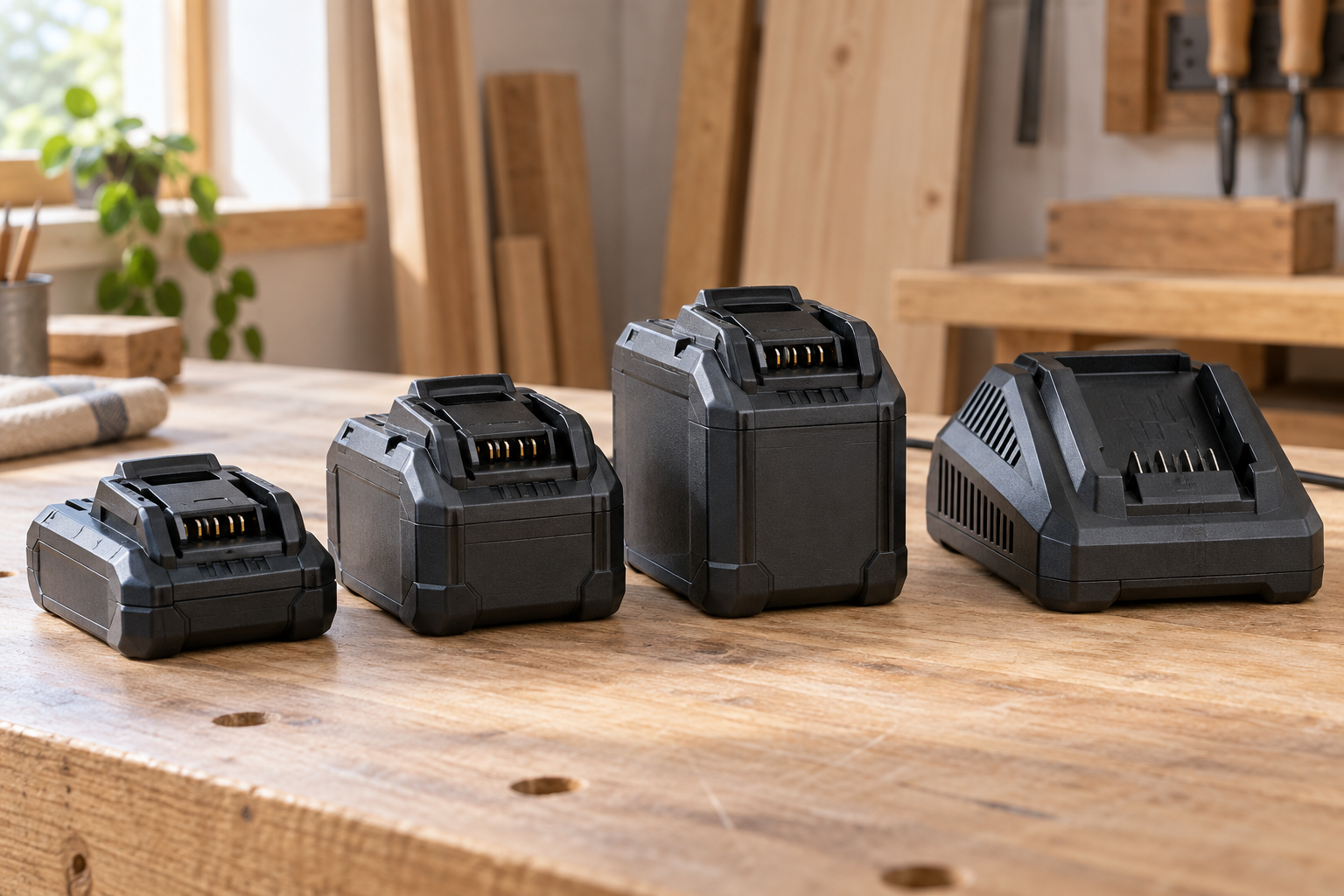
Capacity is measured in amp-hours (Ah). A 5.0Ah pack stores more energy than a 2.0Ah pack, but it is also generally larger and heavier. In simple terms, a 5.0Ah battery has 2.5 times the rated capacity of a 2.0Ah one; that does not guarantee 2.5 times the runtime in every tool, because workload, temperature, battery age, and the pack’s ability to deliver current all matter.
For a drill or impact driver used for occasional fastening, a compact pack can be a sensible choice: less weight at the wrist and usually a lower purchase cost. For repeated cutting, grinding, or other sustained high-load work, a higher-capacity, higher-output M18 pack is less likely to bog down or require frequent swaps. The trade-off is weight and bulk, which can make overhead or one-handed work tiring.
Battery marketing can add confusion. “High output” describes a pack designed to deliver more power in demanding applications; it is not a separate voltage platform. A high-output pack is still an M18 battery, but the extra capability may be wasted in a light-duty drill. Buy for the work you actually do rather than choosing the largest pack by default.
Check charger compatibility separately
Do not assume a charger is compatible just because it is red or was included with a Milwaukee tool. Read its label and manual for the battery platform it charges. An M18 charger is for M18 batteries; an M12 charger is for M12 batteries. Some Milwaukee chargers are designed to charge both platforms, but that capability must be stated on the charger—not inferred from its appearance.
Charging speed and charging time vary by charger, battery capacity, pack temperature, and battery condition. A larger battery usually takes longer to charge than a smaller one. If you need batteries ready for a full workday, compare the charger included in a kit with your current charger and consider whether a second charger is actually useful. A Milwaukee M18 charger is worth considering when your existing charger is damaged, too slow for your routine, or limited to a platform you do not own.
If a battery does not charge, first check that both the charger and battery are intended for M18. Then inspect the contacts for dirt or damage and follow the manual’s guidance on temperature and fault lights. Do not force a pack onto the charger, bridge the contacts, or try to charge a swollen, cracked, or unusually hot battery.
Quick compatibility check
| Item | What to verify | Common mistake |
|---|---|---|
| Tool | Manual or label identifies the M18 platform | Assuming every Milwaukee cordless tool uses M18 |
| Battery | Label says M18; pack is undamaged and seats correctly | Buying by voltage or color alone |
| Charger | Label lists M18, or explicitly lists both M18 and M12 | Assuming one-platform chargers handle both |
| Battery capacity | Ah and pack size suit the tool and work duration | Choosing the heaviest pack for every job |
| Third-party pack | Fit, protection features, warranty, and seller are credible | Treating a compatible claim as proof of equal performance |
Older tools and aftermarket batteries
Most compatibility decisions are settled by the M18 label and the manufacturer’s documentation, but used tools deserve extra care. Ask for the exact model number, check the manual or Milwaukee’s product information, and inspect the battery bay for broken rails, corrosion, or signs of modification. A pack that will not slide on easily should not be forced; damaged contacts or an altered tool can create an electrical or safety problem.
Aftermarket batteries can be cheaper and may be adequate for light, occasional use, particularly when the savings matter more than maximum runtime or support. The risk is uncertainty: capacity claims may be optimistic, and quality control and warranty terms vary. Avoid packs with damaged housings, loose-fitting rails, unclear manufacturer information, or no credible return policy. Do not use a pack that becomes unusually hot, has a damaged case, or repeatedly triggers tool or charger faults.
When buying a tool kit, compare the complete bundle rather than just the tool price: number and capacity of batteries, charger type, case, and warranty. A kit with a small battery may be the cheaper choice for occasional drilling. For frequent high-load work, paying more for a larger, appropriate pack can reduce interruptions—but only if the added weight and cost make sense for your jobs.
Related guides
- Longest Lasting Lawn Mower Battery: AGM vs Lithium vs Flooded Lifespan and Cost per Season
- Duralast Gold Lawn Mower Battery Review: U1 Fit, CCA and When to Pay for AGM
- Greenworks Pro 80V 21-Inch Mower Review: Runtime Math, Push vs Self-Propelled and Yard Fit
- Bosch High Pressure Washer Gun Replacement: Fittings, Adapters and What Fits Your Model