What's inside
As an Amazon Associate I earn from qualifying purchases. This post may contain affiliate links at no extra cost to you.
Cabinet screws are a useful test for an impact driver. The fastener is usually long enough to need sustained power, but the workpiece is often expensive and easy to damage. A good driver should start smoothly, fit into tight cabinet hardware, and accept a compact battery without becoming top-heavy.
For most cabinet installation and furniture work, a compact 18V or 20V impact driver with a brushless motor is the best balance. A 12V model can be easier to handle all day, while a full-size high-torque driver is usually unnecessary and more likely to overdrive screws or damage hinges.
As an Amazon Associate we earn from qualifying purchases at no extra cost to you.


What to look for in a cabinet impact driver
Look first at the tool’s length and battery position, not its maximum torque number. A head length around 5 inches or less is useful inside face-frame cabinets and near drawer boxes. A compact battery in the 1.5Ah to 2.0Ah range keeps the tool from twisting your wrist when driving screws at shoulder height.
Brushless motors are worth paying for if you install cabinets regularly. They generally run cooler, use battery power more efficiently, and tolerate repeated fastening better than inexpensive brushed tools. For occasional repairs, a brushed impact driver can still be perfectly serviceable, especially if it is already part of a battery kit you own.
Three forward speed settings are more useful than an extreme torque rating. A low setting helps start screws and install hinge screws. Medium is appropriate for most cabinet screws. High is useful for long structural screws, but it demands more care. A bright work light, a belt hook, and a short overall length are practical features; Bluetooth controls and elaborate electronic modes are not essential for this job.
Compact batteries and cordless platforms
A compact battery does not necessarily mean a weak tool. Battery capacity, measured in amp-hours, mainly affects runtime. The tool’s voltage platform and motor determine much of its available output, although the battery’s discharge capability also matters.
| Battery type | Typical advantage | Best use | Main compromise |
|---|---|---|---|
| 12V, 1.5–2.0Ah | Smallest and lightest package | Hinge screws, face frames, light cabinet assembly | Less reserve for long structural screws |
| 18V/20V, 1.5–2.0Ah | Good balance of size and power | General cabinet installation and shop work | Not as light as a 12V tool |
| 18V/20V, 4.0–5.0Ah | Long runtime and high sustained output | Deck screws, framing, production work | Bulky and tiring for overhead cabinet work |
If you already own cordless tools, staying within that battery ecosystem is usually the cheapest and most sensible choice. The bare tool may cost little, and one charger can serve drills, saws, lights, and sanders. Do not buy a second platform solely for a slightly shorter impact driver unless you use the tool frequently enough to justify another charger and battery collection.
For a new platform, compare charger speed, battery prices, compact battery availability, and the quality of the other tools you may eventually need. A bargain kit with two batteries can be cheaper initially, but a platform with expensive replacement batteries becomes less attractive after several years.
The best categories for this work
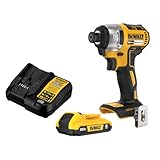
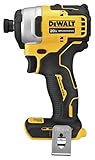
Compact brushless 18V/20V impact driver: This is the best general recommendation. It has enough power for cabinet screws, ledger screws, and most shop construction, while a small battery keeps the package manageable. Look for a kit or bare tool in the compact brushless 20V impact driver category.
12V brushless impact driver: Choose this when weight, balance, and access matter more than maximum output. It is especially comfortable for installing hardware, assembling cabinets, and driving screws into predrilled hardwood. A 12V tool can drive many 2-1/2-inch cabinet screws, but it will slow down sooner in dense material or when the bit is dull. Consider a 12V brushless impact driver kit if you do mostly finish and installation work.
Inexpensive brushed impact driver: This is fine for a homeowner who drives a few dozen screws per month and already owns the batteries. It may be louder, less refined at low speed, and less efficient, but those drawbacks do not matter much for short jobs. The cheaper option stops making sense when you work overhead for hours, need consistent depth control, or rely on the tool professionally.
How to avoid stripped screws and damaged cabinets
An impact driver is not a substitute for a clutch. It continues applying force after the screw head is flush, so you must control trigger pressure and stop early. Start on the lowest speed, use short trigger pulls, and finish the last few turns by hand if the screw is visible or near a hinge.
Use a high-quality, correctly sized bit. A worn Phillips bit can cam out even when the driver has plenty of power. For cabinet screws with square or star recesses, use the exact matching bit and keep firm pressure along the screw axis. Magnetic bit holders are convenient, but a locking holder reduces the chance of losing a bit inside a cabinet.
Predrill near board ends and in hardwood. A pilot hole roughly the screw’s minor diameter prevents splitting and reduces the torque needed from the driver. For a typical #8 cabinet screw, a pilot hole around 1/8 inch in softwood is a useful starting point; dense hardwood may need a slightly larger hole. Test on scrap because screw design and wood species vary.
A practical buying checklist
Buy the smallest tool that covers your longest and thickest fastener. Check the bare-tool weight, head length, low-speed control, battery cost, and warranty. If the kit includes only a large 4Ah battery, budget for a compact replacement. A small battery often makes more difference to comfort than a few extra torque figures on the box.
For cabinet installation, prioritize a compact brushless driver, a 1.5Ah or 2.0Ah battery, two quality bits, and a charger that fits your existing platform. Spend more for smoother control and better ergonomics when the tool will be used weekly. For occasional assembly, an inexpensive compatible driver is enough—provided you slow down, predrill where needed, and do not rely on full trigger speed to set every screw.
Related guides
- Longest Lasting Lawn Mower Battery: AGM vs Lithium vs Flooded Lifespan and Cost per Season
- Duralast Gold Lawn Mower Battery Review: U1 Fit, CCA and When to Pay for AGM
- Greenworks Pro 80V 21-Inch Mower Review: Runtime Math, Push vs Self-Propelled and Yard Fit
- Bosch High Pressure Washer Gun Replacement: Fittings, Adapters and What Fits Your Model