
Key takeaways
- Learn how to choose a moisture meter: pin vs pinless sensing, depth, material range and calibration, with five verified picks for wood and drywall.
What's inside
As an Amazon Associate I earn from qualifying purchases. This post may contain affiliate links at no extra cost to you.
- Top Pick: Klein Tools ET140 Pinless Moisture Meter
- Runner-up: General Tools MMD4E Digital Moisture Meter
- Also consider: General Tools MMH800 4-in-1 Pin/Pad Moisture Meter
Every moisture meter answers the same question — how much water is inside this material — but pin and pinless models get there differently. A pin meter drives two metal probes into the surface and measures electrical resistance between them, giving a percentage at that exact spot. A pinless meter rests a flat sensor pad on the surface and reads an average across a wider area and a fixed depth, leaving no holes behind. The wrong choice leads to readings you cannot trust: pin holes in a finished floor, or a scan that misses the wet core of a thick beam.
This guide explains how to choose between the two designs and where five well-documented meters fit: a budget pin meter for spot checks, a pinless scanner for finished surfaces, a dual-mode meter that also reads temperature and humidity, a rugged pin meter for firewood and lumber, and a premium pinless instrument for wood professionals.
As an Amazon Associate, we earn from qualifying purchases.
Quick answer
Choose a pinless meter if you need to scan walls, floors or lumber without leaving holes, and a pin meter if you need a material-specific percentage at a known spot. Many buyers do best with a dual-mode meter. Match sensing depth to your material thickness, and confirm the meter covers the range your material needs.
Klein Tools ET140 Pinless Moisture Meter

The ET140 is the pinless reference point in this guide: a single-purpose scanner for finished surfaces that cannot be punctured. Its electromagnetic sensor reads up to 3/4 inch below the surface, and separate modes for drywall, masonry, hardwood and softwood keep the display meaningful instead of one generic scale for every material. On drywall and masonry the readout is a relative 0 to 100 scale, which is the honest way to map a leak: scan a grid and find where the numbers climb to locate the wettest area without opening the wall.
The trade-offs are the usual pinless ones: the reading is an average over the sensing area and depth, metal behind the surface can distort it, and it cannot pinpoint moisture at one precise depth the way driven pins can.
Specs
- Sensor type: Pinless electromagnetic sensor pad
- Sensing depth: Up to 3/4 inch (19 mm) below the surface
- Material modes: Drywall, masonry, hardwood, softwood
- Display: LCD with a relative 0 to 100 scale on drywall and masonry modes
- Power: 9V battery
- Tier: Mid-range
General Tools MMD4E Digital Moisture Meter
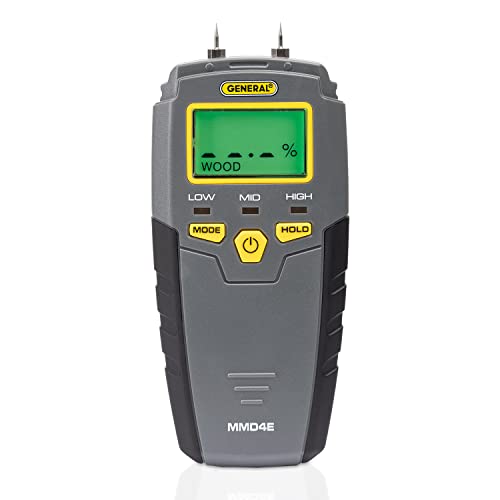
The MMD4E is the classic budget pin meter, and it shows what the pin design does best: a direct percentage from two stainless steel probes pressed into the material. A mode button switches between its wood and building material scales, and a backlit LCD with large digits, a reading-hold button and audible plus visual high, medium and low alerts make it easy to work in crawlspaces and dim basements.
Because the pins only sample the small volume between their tips, it is a spot-check instrument rather than a scanner, and it leaves two small holes at every reading point. The 8 mm pins are replaceable — a spare pair is included — and the protective cap doubles as a calibration checker. For leak tracing or confirming that a board has dried, it delivers the essential pin function without paying for scanning hardware.
Specs
- Sensor type: Pin, two replaceable stainless steel pins (8 mm)
- Wood range: 5 to 50 percent
- Building material range: 1.5 to 33 percent
- Display: Backlit LCD with 0.3 inch digits and reading hold
- Alerts: Audible and visual high, medium and low moisture alerts
- Power: 9V battery, included, with extra pins and protective cap
- Tier: Budget
General Tools MMH800 4-in-1 Pin/Pad Moisture Meter

The MMH800 answers the pin-versus-pinless question by refusing to pick a side. A pair of pins on top handles direct contact readings, a split metal pad on the back handles non-invasive surface scans, and built-in sensors add ambient temperature and relative humidity — four measurements in one housing, aimed at restoration work. Knowing the room humidity alongside the wall reading helps you judge whether a damp patch is still drying or actively fed by a leak.
The kit is unusually complete, with a hard case and two extra pin pairs, 10 mm and 15 mm, for deeper readings in soft material. The honest limitation is precision: published pin-mode accuracy is plus or minus 3 percent of reading plus 5 digits, so treat it as a mapping and screening tool rather than a laboratory instrument.
Specs
- Sensor type: Pin pair plus pinless pad, with temperature and humidity sensors
- Moisture range: 5 to 50 percent for wood and paper; 1.5 to 33 percent for building materials
- Temperature range: 32 to 140 degrees Fahrenheit
- Humidity range: 25 to 95 percent relative humidity
- Published pin accuracy: Plus or minus 3 percent of reading plus 5 digits
- Included: Hard carrying case, 9V battery, extra pin pairs (10 mm and 15 mm)
- Dimensions: 7.13 x 2.17 x 1.57 inches
- Tier: Mid-range
Calculated Industries 7440 AccuMASTER XT Moisture Meter

The AccuMASTER XT is a pin meter tuned for people who handle a lot of wood: firewood sellers, sawyers, and lumber buyers. Its pins are replaceable, the body is built to be gripped hard enough to drive them into dense hardwood, and the backlit display pairs the percentage with low, medium and high icons plus an audible alert, so a stack of split logs can be sorted quickly without memorising threshold numbers.
It also reads brick, concrete, drywall and plaster. Calibration check pins are built into the protective cap, so you can confirm the meter reads correctly before trusting it on kiln-dried stock. Like every pin meter it marks the surface, and it cannot scan a wall for a hidden leak pattern. Within the pin category, it is the sturdier, wood-focused option.
Specs
- Sensor type: Pin, stainless steel, replaceable
- Wood range: 5 to 50 percent, with low, medium and high icon bands
- Materials: Wood, brick, concrete, drywall, plaster
- Display: Backlit LCD with moisture level icons and audible alert
- Calibration: Built-in calibration check pins in the protective cap
- Power: 9V battery, included
- Warranty: 1 year limited
- Tier: Budget
Wagner Meters Orion 950 Pinless Wood Moisture Meter

The Orion 950 is the premium pinless option, built for flooring contractors, cabinet shops and inspectors who need documented wood readings rather than quick screens. It reads at two selectable depths, 1/4 inch or 3/4 inch, which separates surface moisture from the core of a board — the distinction that decides whether flooring can be installed yet. Wagner’s IntelliSense technology is designed to reduce the influence of surface moisture on the deep reading.
What separates it from basic scanners is everything around the sensor. It stores readings, connects by Bluetooth to Wagner’s FloorSmart and WoodSmart apps, and carries an ambient sensor that calculates equilibrium moisture content automatically, along with dew point and grains per pound or kilogram figures. An on-demand calibrator is included and the warranty runs seven years. It is wood-focused — drywall is handled in a relative mode — and priced accordingly.
Specs
- Sensor type: Pinless electromagnetic, IntelliSense technology
- Sensing depth: Dual depth, 1/4 inch or 3/4 inch selectable
- Sensing area: 2 x 2.5 inches
- Data: Onboard reading storage, Bluetooth app connection
- Ambient sensing: Temperature and relative humidity with automatic EMC calculation, dew point and grains per pound or kilogram
- Calibration: On-Demand Calibrator included
- Warranty: 7 years
- Tier: Premium
How to choose
Decide the sensor type first. Pin meters measure the material itself between two probes, so they give the most defensible percentage at a specific depth and work on rough or narrow pieces — but they leave holes and sample a tiny area. Pinless meters average a larger volume to a fixed depth, scan fast and leave no marks, but they need a flat surface in full contact with the pad and can be fooled by metal or foil backing.
Match depth to material next. Most pinless meters read to 3/4 inch; dual-depth models add a 1/4 inch shallow mode for the surface layer of flooring or veneer. With pin meters, depth is set by pin length, so longer pins matter for thick beams. Then check the scale: wood is a true percentage, while drywall and masonry are usually relative scales on pinless meters, so compare against a known dry area.
Finally, weigh calibration. Better pinless meters can be recalibrated in the field; better pin meters ship with a calibration check in the cap. Buy the simplest meter whose depth, range and calibration match your decisions.
Who should skip
Skip this category if your only concern is indoor air; a hygrometer or leak alarm answers that for less. Skip pin meters if your surfaces are finished or antique, because every reading leaves two holes. Skip pinless meters if you mostly measure firewood rounds, narrow parts or rough-sawn stock, since the pad cannot sit flat. And skip the premium tier if a single yes-or-no check before painting or flooring is all you need; a budget pin meter settles that.
FAQ
Which is more accurate, a pin or a pinless moisture meter?
Neither wins outright. A pin meter is more precise at the exact depth its pins reach, because it measures the material directly. A pinless meter is more representative across an area, but its fixed depth can blend dry and wet layers. Either way, accuracy only holds when the meter is calibrated and set for the material.
How deep can a pinless moisture meter read?
Most handheld pinless meters read to about 3/4 inch. Dual-depth models such as the Orion 950 add a 1/4 inch mode. Thicker material is only sampled partway through, so for thick beams, take pin readings at depth or read from both faces.
What moisture level is right for firewood and indoor lumber?
Firewood burns cleanly at or below about 20 percent, which is why pin meters with level bands mark 16 to 50 percent as high. Indoor furniture and flooring lumber should sit near the equilibrium moisture content of the room, often around 6 to 8 percent in heated interiors.
Can one moisture meter measure both wood and drywall?
Yes. Most meters here carry separate wood and building material modes, and dual-mode designs such as the MMH800 add a pinless pad. Drywall readings on pinless meters are relative comparisons, not true percentages, so map them against a known dry section of the same wall.
Final verdict
For most households, the practical answer is a pin meter like the MMD4E for spot checks, or the MMH800 if one tool must also scan finished surfaces and track room humidity. Choose the Klein ET140 for mapping walls and floors without damage, the AccuMASTER XT when firewood and lumber dominate, and the Orion 950 when stored, calibrated, dual-depth wood data is part of the job. Pin versus pinless is not a quality ranking — it is a match between how a meter senses and what your material allows.
Related guides
More from Amazon
Programs that pair well with the guide above. Offers and eligibility are set by Amazon and may change.
A free business account with business pricing and bulk-buying tools for work, shop or home office.
Create a business accountFree shipping on eligible items, Prime Video and more. Eligible new members can start with a free trial.
Start a Prime free trialAudiobooks and podcasts to listen to on the go. Eligible new members can start with a free trial.
Try Audible freeAd-free music streaming. Eligible new subscribers can start with a free trial.
Try Music Unlimited freeAs an Amazon Associate we earn from qualifying purchases.


Write Your Review
No reviews yet. Be the first to share your experience!