What's inside
As an Amazon Associate I earn from qualifying purchases. This post may contain affiliate links at no extra cost to you.
The real difference is charging time
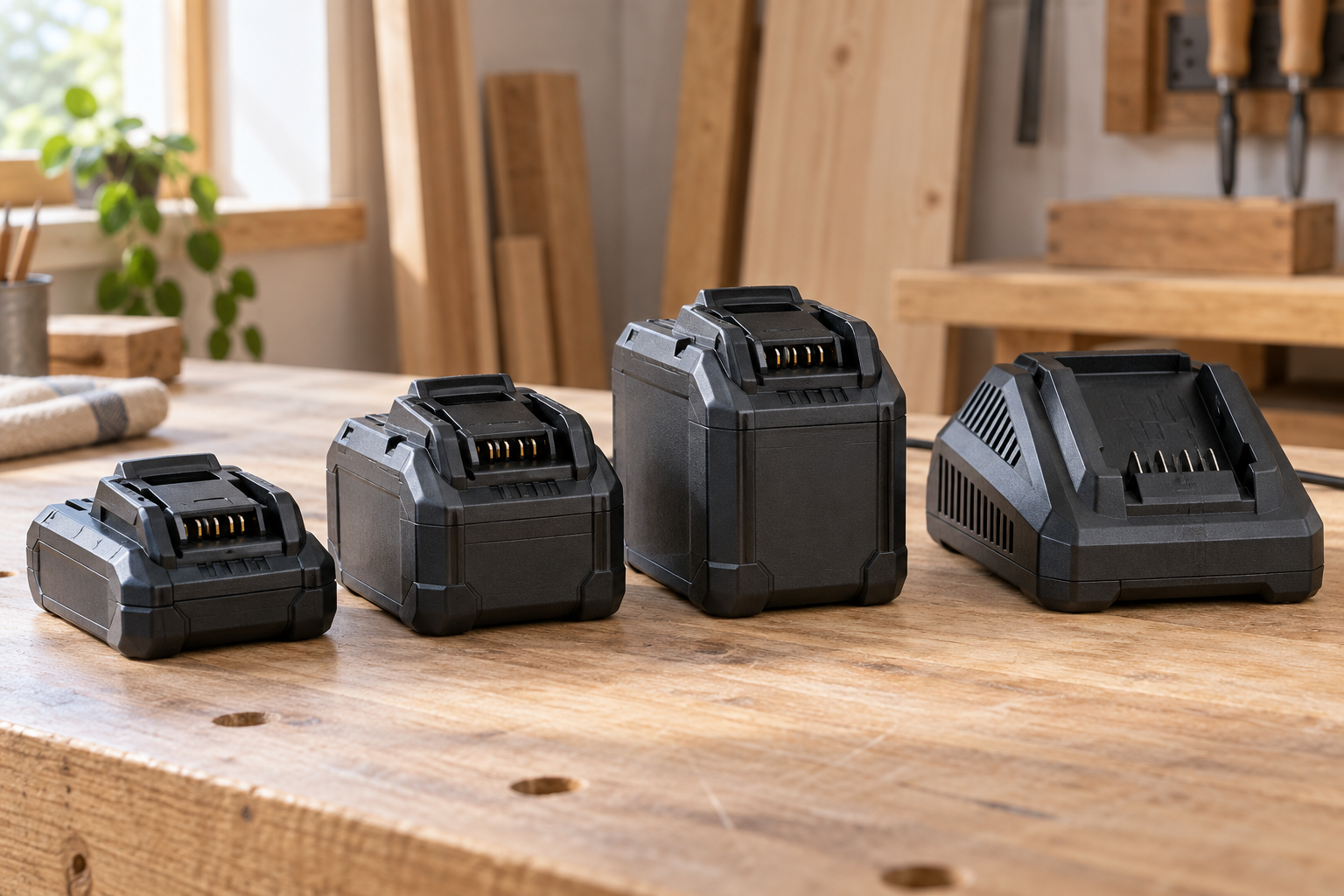
A standard cordless tool charger is usually the lower-cost, lower-current option included with a kit or sold as a basic replacement. A rapid charger pushes more power into a compatible battery, cutting the wait between jobs. The trade-off is straightforward: rapid charging can cost more, take up more space, and generate more heat, while a standard charger is often perfectly adequate for occasional use.
Charging time depends on battery capacity, charger output, battery temperature, and the charging profile near the end of the cycle. A 2.0Ah battery may be ready in under an hour on a suitable charger; a 5.0Ah pack can take several hours on a basic one. Rapid chargers may shorten those times substantially, but “rapid” is not a fixed standard across brands. Check the charger’s stated time for the exact battery size you own rather than comparing labels alone.
Match the charger to the battery platform
Start with the battery brand, platform voltage, and connector. A charger intended for one battery ecosystem generally will not charge another brand’s pack, even when the batteries have the same nominal voltage. Some brands also have distinct charger families for different voltage platforms. Confirm compatibility in the manufacturer’s documentation before buying.
Then look up the charger’s compatibility with your specific battery. A charger may accept several pack sizes but charge them at different rates. The smallest battery that works with a rapid charger may not benefit from its highest output, and some chargers limit charging current for particular packs. If you are buying a replacement, search by the exact platform and battery family, such as a charger for your cordless tool battery platform, then verify the fit against the manufacturer’s compatibility list.
Standard vs. rapid at a glance
| Factor | Standard charger | Rapid charger |
|---|---|---|
| Typical use | Home projects, occasional charging, overnight charging | Frequent work, short breaks, fewer spare batteries |
| Charge speed | Slower; varies widely by pack size and charger | Often faster with supported batteries; check published times |
| Purchase price | Usually lower | Usually higher |
| Heat and noise | Often modest, though the battery can still warm up | May use a fan and can produce more airflow and noise |
| Best reason to choose it | You can wait, or have enough batteries to rotate | Downtime costs more than the charger’s price |
These are broad patterns, not guarantees. Some standard chargers are reasonably quick, and some rapid chargers make only a modest difference with a small battery. Compare the manufacturer’s charge-time figures for the pack you actually use.
Work out whether speed pays
Consider how much battery capacity your work consumes between charging opportunities. If you use one 2.0Ah pack for a few holes and then put the tool away, a rapid charger is unlikely to change the job. The standard charger that came with a kit may be all you need. Likewise, a homeowner with two batteries can often keep one on the tool and one charging, especially for intermittent drilling or fastening.
For repeated cutting, sanding, or drilling through a long workday, charging speed matters more. If a 5.0Ah battery runs flat before your break ends, a faster compatible charger may get you back to work sooner. An alternative is buying a second battery: that costs more upfront, but avoids waiting and may be more useful when you work away from an outlet. Compare a spare battery for your tool platform with the price of the rapid charger before deciding.
Do not assume that a higher amp-hour battery charges in the same time as a smaller one. A 5.0Ah pack stores more energy than a 2.0Ah pack, so it generally takes longer to refill. A charger’s advertised minimum may refer to a smaller battery, not the largest pack you own.
Avoid heat-related charging problems
Lithium-ion batteries can get warm during use and charging. Many modern chargers monitor temperature and pause or reduce charging when a pack is too hot or too cold; an apparent delay is not necessarily a fault. After heavy use, let a hot battery cool before charging. In cold conditions, bring the pack to a suitable indoor temperature and follow the manufacturer’s instructions. Do not try to bypass temperature protection.
Use the charger on a dry, stable surface with its vents clear. A rapid charger with a fan needs room to move air; dust, sawdust, and debris can obstruct cooling. Avoid charging near flammable material or leaving packs in direct sun. Stop using a battery that is cracked, swollen, leaking, unusually hot, or damaged after a drop. A faster charger does not make a damaged pack safe.
Frequent rapid charging is not automatically harmful when the battery and charger are designed to work together. But heat is a stress on lithium-ion cells, and charging conditions vary. Keep the battery and charger clean, follow the platform’s guidance, and avoid treating charge speed as a substitute for sensible storage and handling.
A practical buying checklist
Before ordering, confirm the battery platform and charger compatibility; compare charge times for your pack size; check whether the charger’s voltage and plug suit your region; and consider where it will sit. If it will live in a workshop, fan noise and footprint may matter. If you travel between sites, a compact charger or a compact rapid charger for your battery platform may be useful, provided it supports your batteries.
Choose standard when you have time to wait, charge overnight, or rotate spare packs. Choose rapid when battery turnaround regularly interrupts paid work or a long project and the published charge time makes a meaningful difference. If you are unsure, use the included charger for a few jobs and note how often you actually wait for a battery. That simple test is more useful than paying extra for speed you may never need.
Related guides
- Longest Lasting Lawn Mower Battery: AGM vs Lithium vs Flooded Lifespan and Cost per Season
- Duralast Gold Lawn Mower Battery Review: U1 Fit, CCA and When to Pay for AGM
- Greenworks Pro 80V 21-Inch Mower Review: Runtime Math, Push vs Self-Propelled and Yard Fit
- Bosch High Pressure Washer Gun Replacement: Fittings, Adapters and What Fits Your Model