What's inside
As an Amazon Associate I earn from qualifying purchases. This post may contain affiliate links at no extra cost to you.
High-draw jobs—such as running a circular saw through thick lumber, drilling large holes, or using an impact wrench repeatedly—can make a cordless tool feel underpowered even when its battery gauge shows charge. The right battery depends on current demand, run time, heat, and compatibility, not just the largest amp-hour number on the label.
Start with the tool and the job
Check the tool manual for its approved battery voltage and any performance recommendations. A battery from the same brand is not necessarily compatible across every voltage platform, and adapters can create fit, protection, or warranty problems. Stay within the tool maker’s stated system.
Then consider how the tool will be used. A saw making occasional cuts in 2-by lumber has different needs from one ripping sheet goods all afternoon. An impact wrench used for a few lug nuts may be fine on a compact pack; repeated high-torque fastening can heat that pack and trigger a cutoff. Choose for the hardest sustained part of the job, not the easiest one.
Voltage, capacity, and output are different things
Voltage is the battery platform’s nominal electrical level. Amp-hours (Ah) describe capacity: in broad terms, a 5Ah pack stores more energy than a 2Ah pack on the same voltage platform. Watt-hours (Wh) are a useful way to compare energy across different voltages: nominal volts multiplied by amp-hours gives an approximate Wh rating.
Neither Ah nor Wh tells you by itself how much current a pack can deliver at once. High-draw performance also depends on cell design, pack electronics, temperature, and the tool. A larger pack often runs longer and may handle sustained loads better, but it is heavier and may not improve a tool that is limited by its motor or electronics. For overhead drilling or trimming, the extra weight can be a real cost.
Compare the practical trade-offs
| Pack type | Best fit | Main trade-off |
|---|---|---|
| Compact, lower-Ah pack | Light drilling, fastening, overhead work, short cuts | Less run time; may heat or cut out sooner under sustained heavy load |
| Mid-capacity pack | Mixed site work and occasional high-draw tasks | Good balance, but not always the best choice for long continuous cuts |
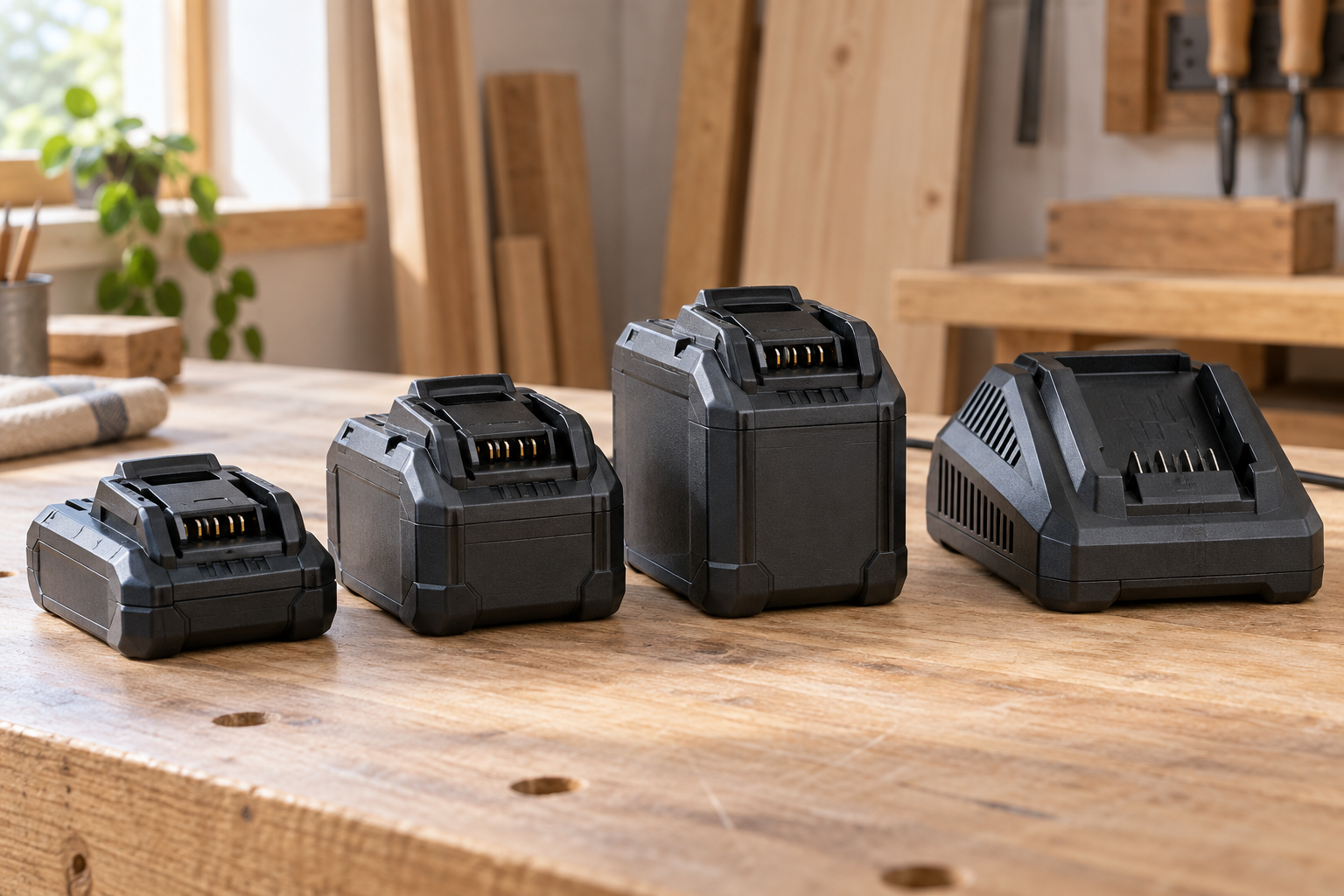
| High-capacity or high-output pack | Repeated cutting, large-hole drilling, heavy fastening | More weight, cost, and charging time; may be unnecessary for intermittent work |
For a circular saw used regularly, a high-output battery in your tool’s platform is worth considering. For a drill used mostly for pilot holes and cabinet hardware, a smaller pack is often easier to handle and cheaper to own.
Read battery claims carefully
Look for the pack’s voltage, Ah, and compatibility information. Some manufacturers advertise “high output,” “advanced,” or similar battery lines; those terms are brand-specific and do not create a universal performance rating. Compare packs within the same platform and check the manufacturer’s compatibility chart. A battery with more Ah is not automatically the one with the highest power delivery.
Also check whether the tool has a high-demand mode or recommends a particular pack size. Such recommendations are useful clues, but they do not mean smaller approved batteries are unsafe. They may simply deliver shorter run time or hit thermal limits sooner.
Understand heat, cutoffs, and declining performance
Heavy current draw heats cells, contacts, and the tool. Battery protection electronics may reduce output or shut the pack down to prevent damage. A cutoff during a long cut does not necessarily mean the battery is defective. Let it cool naturally, inspect the tool for binding, and avoid immediately repeating the same overload.
Common causes of poor performance include a dull saw blade, a bit that is too large for the drill, forcing the tool, pinched material, dirty contacts, and using a cold battery. Fixing the load can help more than buying a larger pack. Do not bypass protection, open a battery, or charge a hot or damaged pack. Follow the manual, and replace packs with cracked cases, swollen cells, or signs of overheating.
Plan around charging and workflow
A higher-capacity pack takes longer to recharge if the charger supplies the same charging current. If one battery is working while another charges, check the charger’s stated charge times for the exact pack sizes you use. A compatible rapid charger can reduce downtime, but it adds cost and may not be necessary for occasional home projects. Do not assume a charger labeled “fast” charges every pack equally quickly.
For a day of repeated cutting, two appropriately sized batteries can be more useful than one oversized pack: swap when one runs low, then let it cool and recharge. For intermittent repairs, one mid-size battery and the charger you already own may be enough.
Buy within the platform you already use
Battery ecosystems matter because packs and chargers are usually tied to a brand and voltage family. If you own several compatible tools, compare the cost of a bare tool plus battery against a kit; paying for another charger may be wasteful. When starting from scratch, consider the cost and availability of batteries, chargers, and the cordless tools you expect to add—not just the price of one tool.
A battery-and-charger starter kit can make sense when entering a platform, especially if the bundled pack suits the tools you plan to buy. For an existing system, an additional battery is often the simpler purchase. Choose the smallest pack that reliably handles your real workload, then step up only if heat, cutoffs, or frequent battery swaps are limiting the job.
Related guides
- Longest Lasting Lawn Mower Battery: AGM vs Lithium vs Flooded Lifespan and Cost per Season
- Duralast Gold Lawn Mower Battery Review: U1 Fit, CCA and When to Pay for AGM
- Greenworks Pro 80V 21-Inch Mower Review: Runtime Math, Push vs Self-Propelled and Yard Fit
- Bosch High Pressure Washer Gun Replacement: Fittings, Adapters and What Fits Your Model